
Papua’s natural wealth is increasingly attracting attention not only for its cultural and ecological importance, but also for the opportunities it may offer in science, technology and local economic development. At the University of Cenderawasih (Uncen), two newly inaugurated professors are demonstrating how research rooted in regional resources could help translate that potential into practical solutions.
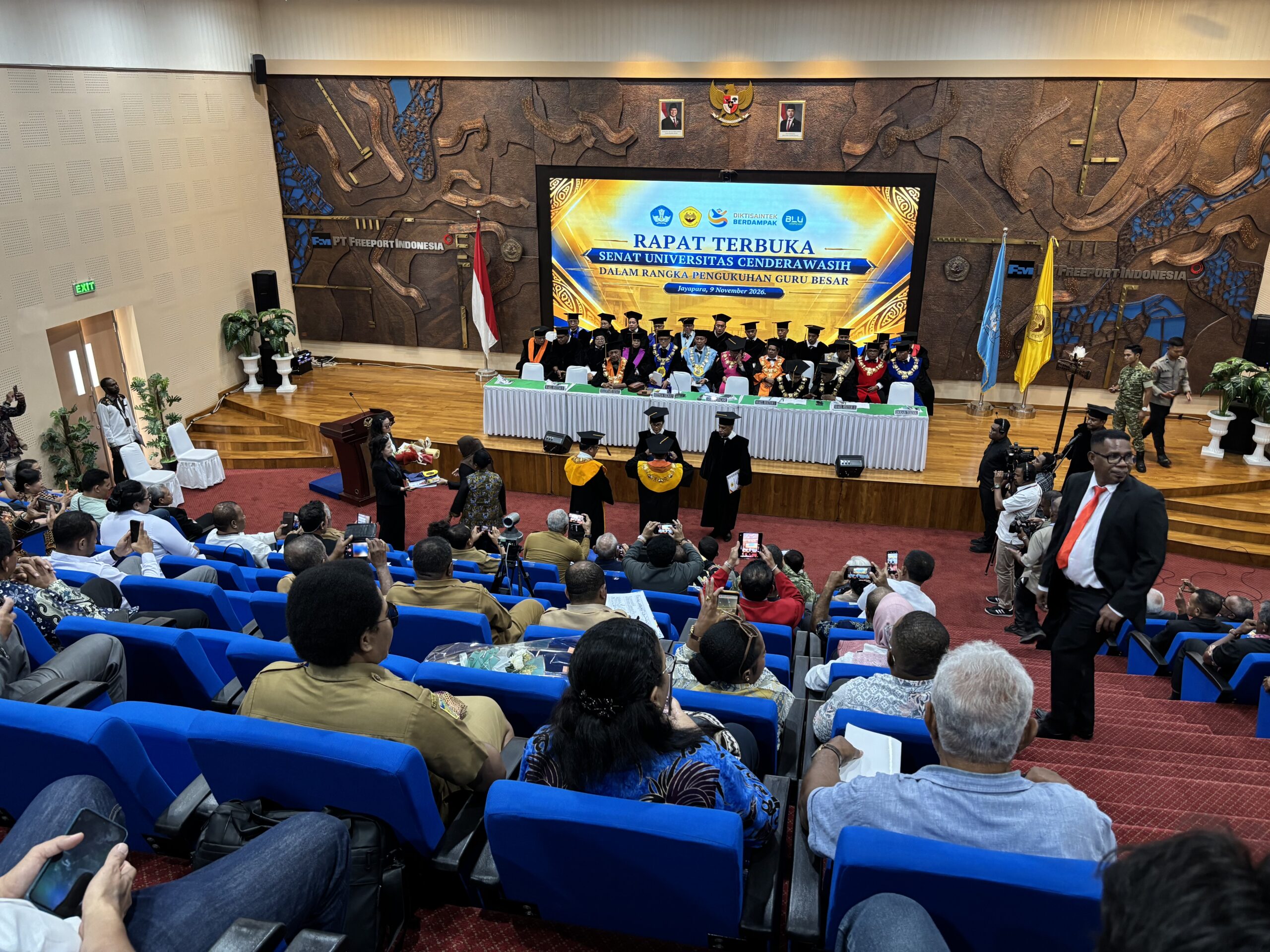
The university inaugurated Prof. Dr. Johni Jonatan Numberi and Prof. Dr. Lisye Iriana Zebua on November 9, during a formal open Senate session held as part of Uncen’s 64th anniversary celebrations in Jayapura. Their research focuses on two distinctly Papuan resources: sago processing waste, which may be converted into bioethanol, and the botanical diversity of red fruit pandan, scientifically known as Pandanus conoideus.
The appointment of the two academics marks more than an institutional milestone. It also highlights the role that universities can play in identifying local resources, developing scientific knowledge and creating pathways for communities and businesses to benefit from innovation.
For Papua, where sago remains an important food resource and native plants carry both ecological and economic significance, the research offers a practical question: how can resources already found in the region be studied, protected and used more productively?
Uncen Welcomes Two New Professors
The inauguration took place at the Science and Partnership Centre building, also known as the Freeport Indonesia Building, in Abepura, Jayapura, on November 9.
The open Senate session was led by Uncen Senate Chair Prof. Dr. Agustinus Fatem. It formed part of the university’s 64th anniversary programme and formally recognised the academic achievements of two lecturers whose expertise addresses important areas of science and technology.
Johni Jonatan Numberi was inaugurated as a professor in renewable energy engineering at the Faculty of Engineering. His academic work centres on energy conversion, particularly the development of bioethanol from sago processing residue and the engineering of combustion systems.
Lisye Iriana Zebua was inaugurated as a professor in plant systematics at the Faculty of Mathematics and Natural Sciences. Her research examines the identity, classification and relationships of local pandan plants, with particular attention to the diversity of red fruit pandan in Papua.
The two appointments brought Uncen’s total number of professors to 50 since the university first began producing professors. Around 40 were still active, according to acting rector Ferdinand Risamasu.
For the university, the appointments are significant because both areas of expertise remain relatively uncommon in Papua.
Risamasu said the arrival of the two professors would strengthen the university’s academic environment and expand its contribution to scientific development and public service.
Their expertise, he added, could help Uncen deepen its role in research while encouraging more lecturers to pursue advanced academic qualifications.
Turning Sago Waste into Renewable Energy
An 18-year research journey
Sago has long been recognised as an important food resource in Papua. Its starch is used in local diets and food products, while the processing of the plant also generates substantial amounts of residue.
For Johni Numberi, that residue represents an opportunity that deserves closer scientific attention.
His research into converting sago waste into bioethanol has developed over approximately 18 years. The work explores how material left behind after starch extraction can be processed into a liquid biofuel with potential applications as an alternative or supplementary energy source.
In his scientific address, Numberi presented the research under the theme of engineering bioethanol energy conversion from sago waste, integrating the physicochemical properties of fuel with combustion processes using the Honai Burner technology.
The central idea is straightforward: the starch used for food should remain available for its primary purpose, while the residue that would otherwise be discarded can be examined for energy production.
Numberi emphasised this distinction in his remarks.
“Sago for food security must continue to be used for food security. The waste and residue that would otherwise be discarded can be used as bioethanol fuel,” he said, according to RRI.
The principle is important for communities that depend on sago as a food source. Developing energy applications should not come at the expense of food availability or the sustainability of sago ecosystems.
According to Numberi, research literature estimates that Papua has approximately five million hectares of potential sago land. The figure illustrates the scale of the resource, although the existence of extensive sago areas does not automatically mean that all of them are suitable for commercial exploitation.
The research instead points towards a more targeted approach: making better use of the residue generated by existing processing activities.
From processing residue to bioethanol
The conversion of sago waste into bioethanol involves several stages, including examining the characteristics of the raw material, processing it through fermentation, testing the resulting fuel and evaluating its combustion properties.
The purpose is to establish whether material that has traditionally been treated as waste can become a useful industrial input.
If further developed and adopted, the approach could create additional economic value for sago processors and communities involved in production. Rather than allowing processing residue to accumulate or be discarded, it could potentially become part of a new production chain.
Such a development may also help address environmental concerns associated with unmanaged organic waste.
Numberi has argued that bioethanol derived from sago residue could be used as a substitute component in petrol blends. The research considers the possibility of gradually increasing the proportion of bioethanol in fuel, subject to technological development and further testing.
He has also identified other local crops, including sweet potatoes, taro and plants that produce sap, as potential subjects for future bioethanol research.
These possibilities suggest that Papua’s agricultural resources could support research beyond conventional food production. However, commercial implementation would require further assessment of production costs, raw material availability, fuel quality, distribution and regulatory requirements.
Honai Burner Offers Another Application
One of the practical technologies associated with Numberi’s research is the Honai Burner, a combustion device designed to use fuel such as bioethanol.
The technology is intended to explore possible applications beyond vehicle fuel, including household cooking and industrial heating.
According to the research findings presented by Numberi, the device uses 14 nozzles positioned at an angle of 45 degrees. Experimental testing produced temperatures of approximately 400 to 500 degrees Celsius.
In one experiment, the burner was able to bring around one litre of water to boiling point in approximately 15 minutes.
The results indicate that the technology has potential for further development as an alternative cooking or heating system. They should, however, be understood as experimental findings rather than proof of widespread commercial readiness.
Before broader adoption, the device would need further evaluation covering efficiency, safety, durability, fuel supply and operating costs.
Nevertheless, the research demonstrates how engineering innovation can begin with materials and needs found within the region itself.
For Papua, the possibility of combining agricultural processing with energy research offers an additional route to developing local industries and reducing waste.
Research Reveals the Botanical Identity of Red Fruit Pandan
Fifteen years of studying local plant diversity
While Numberi’s research focuses on energy engineering, Lisye Iriana Zebua’s work addresses another important aspect of Papua’s natural resources: understanding the diversity of native plants.
Her research on red fruit pandan developed over approximately 15 years. It began with observations of the different local names, colours and physical characteristics used to describe the plant in communities across Papua.
Samples and observations came from several areas, including Serui, Manokwari, Jayapura, Paniai and the mountainous regions, including the Baliem Valley.
In different locations, people recognised variations in the plant’s appearance. The fruit could display different colours, including red, yellow and orange, while the plants also showed differences in form and structure.
These observations raised a scientific question: were the variations evidence of several distinct plant species, or did they represent different forms of the same species?
To investigate the issue, Zebua combined morphological observation with statistical analysis and molecular DNA examination.
The statistical methods included Principal Component Analysis (PCA), which helps researchers identify patterns and group characteristics within a dataset.
DNA analysis then provided another level of evidence for examining the genetic relationships between the samples.
The findings indicated that, despite their differences in colour and physical appearance, the red fruit pandan samples examined in the research belonged to one species: Pandanus conoideus.
Zebua explained that the results helped clarify the identity of a plant that is recognised in different ways across Papuan communities.
“The red fruit pandan, despite its varied colours and shapes, is only one species. It converges into Pandanus conoideus,” she said, as reported by RRI.
Why plant identification matters
For Zebua, identifying plant species is an essential first step in understanding and managing biodiversity.
Without reliable information about the identity and characteristics of plants, it becomes more difficult to assess their ecological relationships, conservation needs and potential uses.
Plant systematics provides the scientific foundation for documenting biodiversity and understanding how different species are related.
In Papua, where numerous plant varieties are found across different landscapes, systematic research can help build a more reliable record of local biological resources.
Zebua said the findings could serve as an initial reference for further studies into the potential uses of pandan and other local plants, including possible applications in health-related research and other sectors.
She also stressed the importance of collaboration so that scientific findings can be developed beyond academic publications.
The research does not, by itself, establish a new commercial product or demonstrate an increase in community income. Its immediate contribution is to improve scientific understanding of the plant and provide a foundation for further investigation.
That foundation may eventually support conservation programmes, cultivation initiatives and responsible economic use.
Connecting University Research with Local Economic Development
The two professors’ research addresses different scientific questions, but both share an underlying objective: making better use of knowledge about Papua’s natural resources.
Numberi’s work explores how sago processing residue can be converted into a potentially useful energy product. Zebua’s research establishes a clearer scientific understanding of red fruit pandan, creating a basis for conservation and further studies into its potential applications.
Together, the projects illustrate how research can connect environmental management with economic opportunity.
For example, if bioethanol production becomes technically and commercially viable, sago processors could potentially gain an additional source of value from material that is currently treated as waste.
Likewise, more detailed botanical information could support the responsible development of native plant resources, provided that future research establishes their properties, sustainable cultivation requirements and appropriate uses.
The economic benefits, however, will depend on whether research can move into practical implementation.
This requires more than scientific discovery. It involves cooperation between universities, local governments, businesses, research institutions and communities that manage or cultivate the resources.
Uncen seeks stronger research partnerships
Acting Rector Ferdinand Risamasu said Uncen wanted research outcomes to contribute more directly to regional development.
He encouraged cooperation with local governments, regional-owned enterprises, state-owned enterprises and national and international partners to broaden the application of academic research.
Such partnerships could help connect university laboratories with industrial facilities, production networks and potential investors.
For example, the development of bioethanol from sago residue would require a reliable supply of raw material, appropriate processing facilities and a clear pathway for testing and distributing the resulting fuel.
Research into pandan biodiversity would similarly benefit from cooperation with conservation organisations, local communities and institutions capable of conducting further botanical and applied research.
Risamasu said the university wanted research to become more useful to society, rather than remaining confined to academic discussion.
The objective is to ensure that scientific knowledge can contribute to the development of Papua and improve public welfare.
Building Uncen’s Academic Capacity
The inauguration also reflects the university’s broader effort to strengthen its academic workforce.
Uncen has more than 800 lecturers, while around 40 of its 50 professors remain active, according to Risamasu.
The university considers the number of professors an area that still needs improvement and has set a gradual target for increasing their ranks over the next two to three years.
One of the measures is to encourage lecturers to conduct more research and publish their findings in reputable national and international scientific journals.
The university has also provided incentives for lecturers who publish academic work in recognised journals. Risamasu said the allocation for publication incentives had already been absorbed by July 2026, reflecting increased interest in academic publishing.
The university plans to strengthen this support in the future.
This strategy is important because the development of higher education depends not only on the number of lecturers but also on the quality of research, academic collaboration and the ability to produce knowledge that addresses real-world challenges.
For a university serving a region with extensive natural resources and distinctive development needs, building research capacity can help create stronger links between education and regional priorities.
Conclusion
The inauguration of Johni Jonatan Numberi and Lisye Iriana Zebua highlights the growing contribution of academic research to Papua’s development agenda.
Their work begins with resources that are already part of the region’s landscape and everyday life. Sago residue is being examined as a possible source of bioethanol, while red fruit pandan is being studied to establish its botanical identity and provide a foundation for conservation and further research.
Neither project should be mistaken for an already established commercial industry. Both, however, offer research pathways that could create practical benefits if supported by continued testing, investment and cooperation.
The challenge ahead is to turn scientific findings into solutions that communities can use. For the sago industry, that means developing efficient and economically viable waste-processing technology without compromising food security. For native plants, it means combining scientific knowledge with conservation and sustainable use.
Uncen’s role will therefore extend beyond producing academic titles. Its ability to connect researchers, public institutions, businesses and local communities will help determine how much value these discoveries can deliver.
The two new professors have added to Papua’s academic resources. Their next contribution may be measured not only in publications and laboratory results, but also in the practical opportunities that their research helps create for the people of Papua.
Read Also
Nabire Trains Papuan Women to Make Red Fruit Meatballs
Buah Merah Cultivation in Tolikara: A Red Fruit Fuels Green Growth in Papua

