
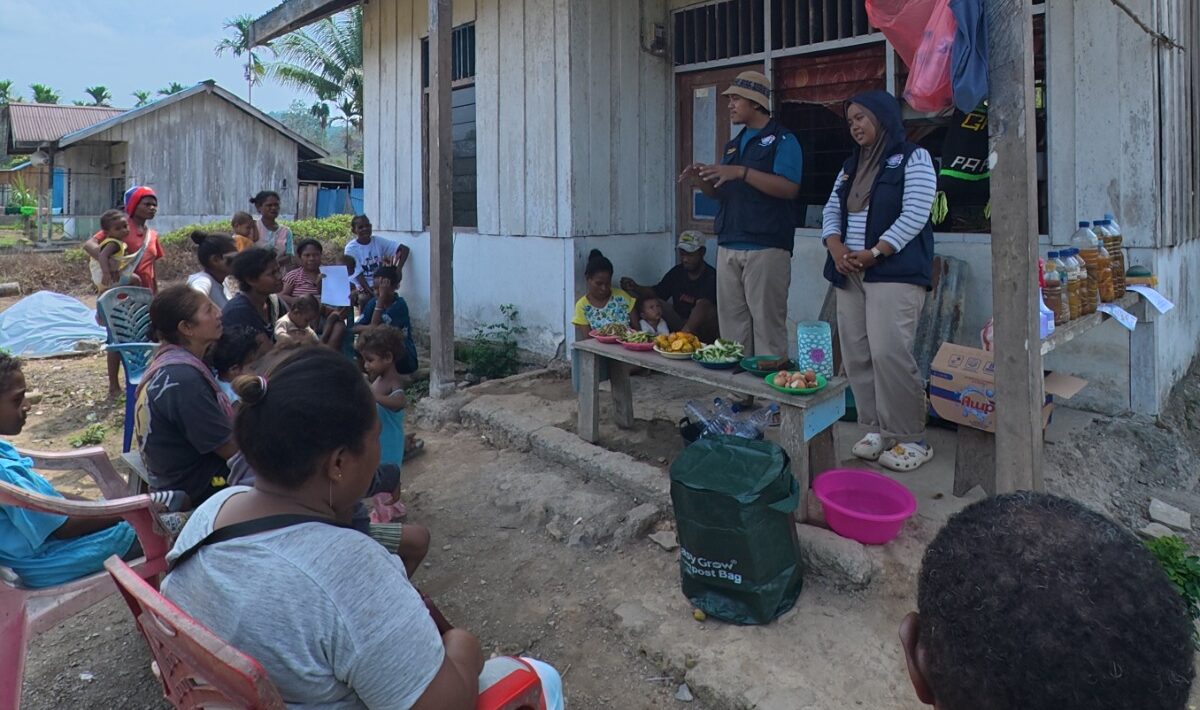
In a remote settlement in Indonesia’s easternmost region, a group of women is discovering that the leftovers from their kitchens can become a useful resource for growing food. Through a community training programme in Werianggi, Teluk Wondama Regency, Papua Barat (West Papua), household organic waste is being transformed into compost and fermented organic solutions to support vegetable cultivation.
The initiative, led by the University of Indonesia’s Patriot Expedition Team (Tim Ekspedisi Patriot, or TEP UI), has introduced 20 local women to practical methods of recycling fruit peels, vegetable scraps and dry leaves into materials that can be used in home gardens.
For families living in Tamoge, a settlement approximately four hours from Wasior, the nearest town, the training offers a way to address two everyday challenges: poor soil fertility and the high cost of agricultural supplies.
The programme also illustrates how small-scale community initiatives can contribute to Indonesia’s wider food security agenda under President Prabowo Subianto. Rather than relying exclusively on external agricultural inputs, participating households are learning to make use of resources already available around their homes.
At the centre of the initiative are the women locally known as mama-mama, whose involvement in household agriculture is helping turn a basic waste management activity into an opportunity for greater food independence.
From Kitchen Waste to a New Opportunity
The programme began with a problem familiar to many households in Tamoge: residents were eager to grow vegetables, but their efforts were constrained by the soil’s condition and the cost of agricultural materials.
Rathalia, a member of the University of Indonesia’s Patriot Expedition Team, explained that the initiative emerged after the team observed the community’s strong interest in gardening.
“Residents are very enthusiastic about growing vegetables when they receive support, but the soil is not very fertile. That is why we took the initiative to process household waste into something useful for improving soil fertility,” Rathalia said in a statement issued on November 6, 2026.
Her remarks, published by Indonesia’s Ministry of Transmigration on November 7, help explain why the team chose an approach based on organic materials rather than introducing a more expensive agricultural system.
The participants came from Settlement Units 1 and 2, known locally as Satuan Permukiman (SP) 1 and SP 2, in Tamoge, part of the Werianggi Transmigration Area.
According to the ministry, the area is located approximately four hours from Wasior. Residents had not previously received waste management education or assistance from the local Environmental Agency.
That gap created an opportunity for the expedition team to introduce a practical form of environmental education linked directly to the community’s agricultural needs.
Instead of treating organic waste simply as rubbish to be discarded, the programme encouraged residents to recognise its potential value.
Fruit peels and vegetable scraps could become ingredients for a fermented organic solution, while dry leaves and other suitable organic materials could be processed into compost.
The methods were designed around resources that households could obtain locally, making the training relevant to everyday life in the settlement.
Twenty Women Learn Practical Organic Waste Processing
The training brought together 20 women from the two Tamoge settlement units.
During the sessions, participants learned how to separate suitable household organic materials and process them into two different products: eco-enzyme, a fermented liquid made from organic waste, and compost produced from biodegradable materials such as dry leaves.
The approach connected waste management with home gardening, encouraging participants to use organic materials that might otherwise be thrown away or burnt.
One participant, Mama Olhal Netennya, described how the training had changed the way her household handled waste.
“Now we no longer throw away household waste. Since the young team members came, we have learned to process it to help our garden plants grow and reduce rubbish,” she said, according to the Ministry of Transmigration.
She explained that residents had previously relied on burning grass and placing the resulting ash around plants.
The new approach gave her household another way to make use of organic materials.
Mama Olhal also expressed hope that the knowledge gained through the training could be shared with other residents, allowing more families to take part in vegetable cultivation.
Her response points to one of the programme’s most important features: the possibility of transferring knowledge beyond the original group of participants.
Although only 20 women attended the reported training, the methods they learned involve common household materials and could be demonstrated to neighbours and relatives.
Whether the practice spreads more widely will depend on continued community interest, the availability of suitable materials and the participants’ ability to apply what they have learned.
How the Women Turn Waste into Organic Products
Making Eco-Enzyme from Fruit and Vegetable Scraps
One of the techniques introduced during the programme was the preparation of eco-enzyme using organic kitchen waste.
According to the Ministry of Transmigration, participants used fruit peels and chopped vegetable scraps as the principal organic ingredients.
The preparation involved dissolving 100 grams of palm sugar in one litre of water before adding 300 grams of finely chopped organic waste.
The mixture was then placed in a tightly closed container and stored in a shaded location for approximately three months to allow fermentation.
During the process, the container was opened occasionally to release accumulated gas.
The ministry said the resulting liquid could be used for purposes such as household cleaning, reducing unpleasant rubbish-bin odours and supporting gardening activities.
The three-month fermentation period is an important detail. It means the product isn’t ready right away, and participants must properly maintain the mixture before using it.
The programme’s reported benefits should also be understood in context. While the ministry described eco-enzyme as useful for plants, the reports did not present laboratory tests or comparative crop-yield measurements that demonstrated its effectiveness as a fertiliser.
For the participating households, however, the training introduced a new way of processing materials that had previously been discarded.
Turning Dry Leaves into Compost
The second technique focused on composting organic materials that were not suitable for the eco-enzyme preparation.
Participants learned to combine these materials with dry leaves to produce compost that could be applied to their home gardens.
Unlike the fermented liquid, composting is intended to transform biodegradable organic matter into material that can contribute to soil improvement as it decomposes.
The training therefore introduced two complementary approaches to handling household waste.
The first involved fermentation of selected kitchen scraps. The second involved the decomposition of other organic materials into compost.
Both methods were presented as alternatives to simply discarding organic waste.
For households facing high agricultural input costs, learning to produce compost from locally available materials may help reduce dependence on purchased soil amendments.
The practical significance lies in the ability of residents to repeat the process using materials they already have.
Home Gardens Begin Growing Vegetables Again
Following the training, participating women began cultivating vegetables in their home gardens.
The Ministry of Transmigration reported that residents were growing chillies, tomatoes, eggplants and mustard greens.
These crops are familiar ingredients in Indonesian households and can contribute to the variety of food available for daily consumption.
For the women of Tamoge, the activity represents more than the management of kitchen scraps. It connects household environmental practices with the ability to grow food close to home.
The ministry described the initiative as an effort to reduce reliance on relatively expensive chemical fertilisers and pesticides.
However, the available reports did not provide figures for vegetable yields, household savings, the amount of compost produced or the number of gardens successfully maintained over time.
The current achievement is therefore best understood as the introduction and early adoption of practical gardening and organic waste management techniques.
Longer-term results will depend on whether households continue producing compost, maintain their vegetable gardens and obtain reliable harvests.
Even at this early stage, the programme demonstrates the value of linking community education with activities that residents already want to pursue.
The expedition team built on an existing interest in farming. It responded to an existing enthusiasm for vegetable cultivation and helped participants address some of the obstacles they had encountered.
Supporting President Prabowo’s Food Self-Sufficiency Agenda
The Werianggi initiative is also consistent with the Indonesian government’s broader emphasis on food self-sufficiency and reducing dependence on external agricultural inputs.
President Prabowo Subianto has repeatedly identified food security as an important national priority.
During a simultaneous maize harvest event and the groundbreaking of 10 food security warehouses for the Indonesian National Police on 16 May 2026, Prabowo emphasised the strategic importance of reducing dependence on imported fertiliser.
“Once we free ourselves from dependence on fertilisers from abroad, we will become a very, very strong nation,” he said, according to the Ministry of Transmigration.
Although the President’s remarks concerned national fertiliser independence, the principle is relevant to the household-level initiative in Werianggi.
By teaching residents to process organic materials into compost, the expedition team is encouraging the use of locally available resources to support small-scale food production.
The approach is modest in scale, but it reflects a broader development principle: communities can become more resilient when they have the knowledge and practical means to meet part of their needs.
Household vegetable gardens cannot replace the agricultural production systems needed to supply an entire country. They can, however, complement wider food security policies by improving access to locally grown produce.
For remote settlements, the ability to cultivate vegetables at home may be particularly valuable where agricultural supplies are expensive or difficult to obtain.
The Werianggi programme therefore offers an example of how a national development priority can be translated into a practical activity at community level.
Government Leaders Call for Practical Solutions
The Patriot Expedition Team’s work in Papua Barat also reflects expectations expressed by senior Indonesian government officials that field programmes should produce benefits beyond research findings and written reports.
Coordinating Minister for Infrastructure and Regional Development Agus Harimurti Yudhoyono, widely known as AHY, addressed this issue during a dialogue with Patriot Expedition Team members in Jayapura, Papua, on September 17, 2026.
He stressed that teams working directly with communities should not stop after identifying problems.
“We must deliver the best solutions, ones that are relevant, feasible and make sense,” AHY said, according to the Ministry of Transmigration.
His remarks highlighted the importance of practical responses to local challenges.
In Werianggi, the expedition team’s response was to introduce an accessible waste management technique that could support an activity residents were already interested in pursuing.
Minister of Transmigration M. Iftitah Sulaiman Suryanagara had expressed a similar expectation on July 21, 2026.
“Do not leave behind only reports.” Leave behind work, solutions, and, most importantly, benefits that communities can continue to experience,” he said.
These statements provide a policy context for the expedition team’s activities.
They also establish an important standard for evaluating the programme: whether the skills introduced during the training continue to benefit households after the team has completed its fieldwork.
Women at the Centre of Community Food Resilience
The participation of 20 women is one of the defining features of the Werianggi programme.
Their involvement places household decision-making and everyday agricultural practices at the centre of the initiative.
In many communities, food preparation, household waste management and home gardening are closely connected. Teaching participants to transform kitchen scraps into materials for vegetable cultivation brings these activities together.
The women are not merely receiving information. They are learning a process they can apply in their homes and potentially share with other residents.
Mama Olhal’s hope that the experience could be passed on illustrates the importance of community ownership.
A training programme is more likely to produce lasting results when participants understand its relevance and are motivated to continue the activity independently.
The methods introduced by TEP UI are relatively simple, but their long-term value will depend on consistent application.
Participants must continue separating organic materials, preparing compost, managing fermentation and maintaining their gardens.
Further mentoring, where available, could help households address difficulties and assess whether the methods are producing the expected benefits.
The initiative also shows how environmental awareness and food security can reinforce one another.
Organic waste that might otherwise be burnt or discarded can be processed for gardening, while the resulting activities encourage residents to think differently about household resources.
A Community-Based Approach to Sustainable Development
The Werianggi programme offers a useful example of development assistance built around local needs.
Rather than introducing a large infrastructure project or a complicated agricultural technology, the expedition team focused on a specific problem identified through interaction with residents.
The community wanted to grow vegetables, but poor soil conditions and expensive agricultural supplies made the activity difficult.
The team suggested processing organic waste as a possible cheap way to help people garden at home.
This approach also demonstrates the contribution that universities can make to regional development.
Through field activities, academic institutions can connect technical knowledge with the practical experience of communities, helping identify solutions suited to local circumstances.
For Papua, such cooperation is particularly relevant because development challenges vary considerably between settlements.
An approach that works in an urban centre may not be suitable for a remote community several hours from the nearest town.
The Werianggi experience suggests that locally adapted programmes can provide a useful complement to larger government investments in agriculture, infrastructure and public services.
At the same time, the available information does not establish that the programme has already achieved measurable food self-sufficiency or significantly increased household income.
Its importance lies in the practical skills transferred, the initial gardening activities reported and the opportunity for residents to continue developing those practices.
Conclusion
The organic waste training programme in Werianggi, Teluk Wondama, demonstrates how community participation, university expertise and government development priorities can come together to address everyday challenges in Papua.
By teaching 20 local women to turn kitchen scraps and dry leaves into eco-enzyme and compost, the University of Indonesia’s Patriot Expedition Team has introduced practical methods that may help households improve their gardens, manage organic waste and reduce reliance on purchased agricultural inputs.
The initiative also reflects President Prabowo Subianto’s wider commitment to food self-sufficiency, showing how national objectives can find practical expression in local communities.
Its long-term success will depend on continued adoption, reliable vegetable production and the willingness of participants to share their knowledge with others.
For the women of Tamoge, the most meaningful outcome may be a simple but lasting change: recognising that materials once considered waste can become useful resources for growing food, strengthening household resilience and building a more self-reliant future in Papua Barat.
Read Also
Papua Targets 3,800 Hectares of New Rice Fields
Papua Targets Food Self-Sufficiency With 6,500 Hectares

