
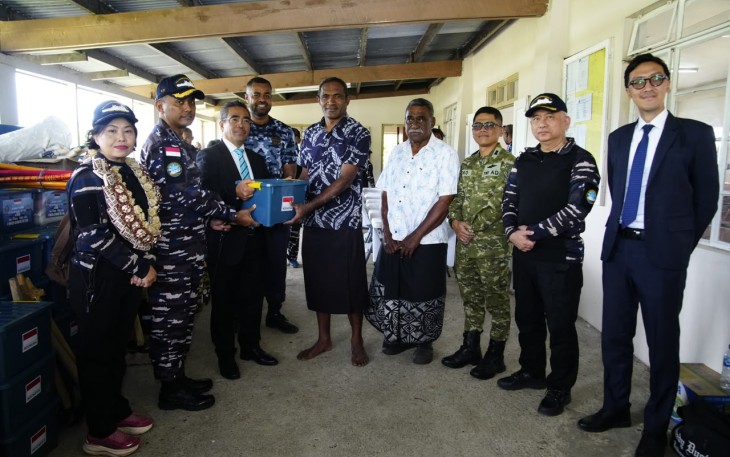
Indonesia’s KRI Wahidin Sudirohusodo-991 (KRI WSH-991) visit to Suva, Fiji has delivered a practical demonstration of humanitarian diplomacy, with the Indonesian Navy’s hospital ship providing medical services to 504 Fijian residents during its port visit to Suva from October 9 to 13, 2026. The mission brought together healthcare, community assistance, and diplomatic engagement, underscoring Jakarta’s efforts to build lasting relationships with Pacific nations through cooperation that directly benefits local communities.
The visit was part of Indonesia’s Integrated Joint Task Force Port. Visit 2026, a regional mission involving personnel from several branches of the Indonesian armed forces and other participating institutions. Operating under the theme of bridging friendship and serving Pacific communities, the deployment uses a hospital ship to deliver medical assistance while creating opportunities for closer ties in health, maritime affairs, social development, and diplomacy.
For Fiji, the arrival of KRI WHS-991 offered access to a range of medical services aboard a floating medical facility. For Indonesia, the program provided a visible way to translate diplomatic goodwill into practical assistance, with the potential to build trust beyond formal meetings between government officials.
From Vanuatu to Fiji: A Mission Across the Pacific
The Fiji visit formed the second stage of a wider Pacific deployment. Before reaching Suva, the task force had completed activities in Vanuatu, where the Indonesian contingent conducted humanitarian and community engagement programs. The ship departed Vanuatu on October 6 and continued its voyage to Fiji as part of Indonesia’s broader regional outreach.
The deployment began in September, when the task force was dispatched from Jakarta for a planned voyage through Vanuatu, Fiji, the Solomon Islands, and Papua New Guinea. According to Radio Republik Indonesia’s English-language reporting, the approximately 60-day mission was designed to combine healthcare and humanitarian assistance with cooperation in maritime affairs, education, economic activity, social relations, and culture. It involved 318 personnel drawn from the Indonesian Navy, Army, Air Force, National Police, government institutions, academia, students, volunteers, and journalists.
This broad composition reflects the mission’s emphasis on engagement beyond conventional military-to-military contact. The ship provides the central platform, but the intended outcome is wider: stronger institutional links, greater familiarity between communities and a more substantial foundation for cooperation between Indonesia and its Pacific partners.
October 9–10: Arrival and a Shared National Celebration
KRI WHS-991 arrived in Fiji during a period of national celebration. On October 10, members of the Indonesian task force attended Fiji’s 56th Independence Day commemoration at Albert Park in Suva, accompanied by Indonesian Ambassador to Fiji Dupito D. Simamora and Indonesian Defence Attaché Colonel Eko Pur Indriyanto. Fiji’s national ceremony included a military parade, formal proceedings, and cultural performances.
The timing gave the port visit a diplomatic significance beyond the ship’s medical mission. Participation in a national celebration allowed Indonesian representatives to join a decisive moment in Fiji’s public life and meet officials and other international guests in a setting centered on the host country’s identity and traditions.
Ambassador Dupito described the visit as an opportunity to connect friendship between countries with service to Pacific communities. He welcomed the presence of the Indonesian hospital ship during Fiji’s anniversary celebrations, highlighting the link between humanitarian work and stronger bilateral relations.
The program also included community assistance on October 10 at Nakula Methodist Church. Task force commander Colonel (Navy) Benedictus Hery Murwanto attended alongside the ambassador and the Indonesian defense attaché. The activities included reinforcing and concreting a road, maintaining the church building, and distributing supplies to local representatives.
Assistance was extended to different communities rather than limited to one institution or religious group. The Fiji Navy received cement, water storage tanks, and food supplies. Church representatives received basic necessities, Bibles, renovation tools, and cleaning equipment. The task force also provided copies of the Quran and its translation, mosque carpets, and food supplies to the Muslim community through Mohammad Karim, imam of Toorak Jame Mosque in Suva.
The range of activities gave the port visit a distinctly community-oriented character. Road improvements and building maintenance addressed practical local needs, while assistance to Christian and Muslim communities demonstrated an effort to engage across religious lines. These initiatives complemented the medical program by demonstrating the deployment’s intention to build relationships through various forms of service.
October 11–12: The Hospital Ship Opens Its Medical Services
The central humanitarian activity began on October 11, the third day of the ship’s presence in Fiji, and continued through October 12. The medical services were delivered aboard KRI WHS-991, which was berthed at Walu Bay Port in Suva. Task force commander Benedictus Hery Murwanto said healthcare was one of the main activities planned for the Fiji leg of the mission.
Residents came aboard to access free consultations and treatment. Services reported by Metro TV included general medical consultations, dental care, and examinations by specialist doctors. The ship’s medical facilities also attracted attention from Fiji’s health authorities, giving the visit a professional and institutional dimension alongside its immediate patient-care role.
The medical team ultimately treated 504 patients, according to Metro TV’s report published on October 13. Indonesian Ambassador Dupito Simamora said the number exceeded the expectations held before the activity began. He described the mission as a success and said it had received attention and a warm response from Fiji’s government and public.
The total is an important measure of the mission’s immediate reach. Each consultation gave a patient an opportunity to seek medical attention without paying for the service provided during the program. At the same time, the figure should be understood as the number of patients served during a short deployment, rather than as evidence that the visit resolved broader healthcare needs across Fiji.
That distinction matters. A two-day medical program cannot replace the continuous work of a national health system, which requires sustained staffing, equipment, funding, and follow-up care. Its value lies in providing direct assistance, demonstrating medical capacity, and creating opportunities for professional exchange that may inform future cooperation.
Fiji’s Health Minister Welcomes the Ship’s Medical Capacity
The visit also drew the attention of Fiji’s Minister for Health and Medical Services, Ratu Atonio Rabici Lalabalavu, who toured the facilities aboard KRI WHS-991 alongside Indonesian representatives.
In comments reported by Metro TV on October 12, Lalabalavu thanked the Indonesian government and the Indonesian Embassy in Fiji for enabling the visit. He praised the medical capacity available aboard the ship and said Fiji’s health authorities hoped to make use of the capabilities demonstrated during the tour. He also highlighted the importance of raising public awareness of the available services.
His remarks pointed to an opportunity that extends beyond the number of patients treated. The ship’s visit created a setting in which health officials could see the facilities, discuss possible cooperation, and consider how maritime medical services might contribute to healthcare delivery in an island nation.
For Fiji, a country whose communities are spread across numerous islands, access to medical care can involve geographical and logistical challenges. A hospital ship is not a substitute for local clinics or permanent medical infrastructure, but it can provide a temporary platform for treatment and demonstrate one model of reaching communities by sea. The interest expressed by Fiji’s health minister suggests that the visit opened a conversation about medical capabilities, although any future cooperation would require further discussion and planning.
Humanitarian Assistance as a Form of Maritime Diplomacy
The Fiji program illustrates how naval diplomacy can operate through a combination of practical service and official engagement. In conventional diplomatic settings, governments often work through meetings, agreements, and formal exchanges. A port visit adds another dimension by allowing communities to encounter a visiting country through visible activities such as medical consultations, repairs, and the distribution of essential supplies.
Indonesia’s Ambassador Dupito Simamora said the deployment represented humanitarian, defense, and health diplomacy while helping strengthen relations between the two countries. Following the conclusion of the Fiji program, he said the mission had enhanced Indonesia’s image and demonstrated its readiness to be a reliable partner in the Pacific.
Such statements reflect Indonesia’s diplomatic objectives, but the practical value of the mission can also be assessed through its activities: 504 patients received medical services, community organizations received assistance, and Fiji’s health minister had the opportunity to inspect the ship’s facilities. These are tangible outputs that give the broader diplomatic message a concrete foundation.
The program also demonstrated an approach that brings together military capability and civilian-facing service. Although KRI WHS-991 is operated by the Indonesian Navy, its hospital function allowed the deployment to focus on healthcare rather than military display. That distinction can be significant in building public familiarity and confidence, especially when activities are conducted in coordination with host-country institutions.
The mission is part of Indonesia’s broader effort to strengthen relations with countries across the South Pacific. Geography gives Indonesia a direct interest in regional stability, maritime cooperation, and people-to-people links. Its eastern provinces, including Papua and Southwest Papua, are connected to the wider Pacific through geography, communities, trade routes, and shared regional concerns.
For Indonesia, therefore, engagement with Fiji and other Pacific nations is not merely an exercise in distant diplomacy. It also creates opportunities to strengthen connections between Indonesia’s eastern regions and neighboring countries, while supporting cooperation in areas such as health, education, culture, maritime affairs, and disaster response.
October 13: Mission Completed, Voyage Continues
After the two-day medical program concluded, the task force prepared to leave Fiji for the next stage of its regional deployment. Metro TV reported on October 13 that KRI WHS-991 would continue its voyage to the Solomon Islands. The departure was led by Ambassador Dupito Simamora, marking the completion of the Fiji phase of the mission.
The transition from Fiji to the Solomon Islands underlined the regional design of Port Visit 2026. Rather than treating each stop as an isolated event, the deployment links several countries through a sequence of humanitarian activities, official engagements, and opportunities for cooperation.
The Fiji visit’s results will ultimately depend not only on the number of patients treated but also on whether the relationships established during the program lead to further collaboration. Potential areas include professional exchanges between health institutions, continued dialogue between the two navies, and wider cooperation involving communities and government agencies. These are possibilities rather than confirmed outcomes, but the visit has created a platform from which such discussions can proceed.
What the Fiji Visit Means for Indonesia and the Pacific
The KRI WHS-991 visit to Suva offers a useful example of how Indonesia can combine maritime reach with humanitarian engagement. Its medical team provided services to 504 people, while the wider program included community assistance and participation in Fiji’s Independence Day celebrations. The involvement of Fiji’s health minister and the Indonesian ambassador also helped connect the operational work aboard the ship with the two countries’ diplomatic relationship.
For Indonesia, the mission supports an image of regional engagement built around practical cooperation. For Fiji, it brought short-term medical assistance and an opportunity to examine the capabilities of a hospital ship. For the wider Pacific, it demonstrated one way countries can work together through humanitarian and maritime initiatives.
The longer-term test will be whether the port visit can sustain the goodwill it generated. Continued dialogue, professional exchanges, and cooperation with local institutions would help ensure that the mission’s impact extends beyond a few days in Suva.
The conclusion is straightforward: diplomacy becomes more meaningful when it reaches people in ways they can experience directly. By treating hundreds of Fijian patients, supporting community organizations, and engaging with national institutions, KRI WHS-991 gave Indonesia’s Pacific diplomacy a practical expression. The ship has now moved on, but the relationships strengthened during its visit provide a foundation for future cooperation between Indonesia, Fiji, and other Pacific partners.
Conclusion
The visit of KRI WHS-991 to Suva demonstrated how humanitarian assistance can strengthen diplomatic relations through practical action. By providing medical services to 504 Fijian residents, supporting local communities and participating in Fiji’s 56th Independence Day celebrations, Indonesia translated its commitment to Pacific engagement into tangible benefits for the people it served. The mission also created opportunities for dialogue with Fiji’s government and health authorities, reinforcing the importance of cooperation in healthcare, maritime affairs and community development.
As Indonesia continues to deepen its engagement with Pacific nations, the lasting value of Port Visit 2026 will depend on maintaining the relationships established during the deployment. Continued institutional exchanges, community partnerships and cooperation in public health could help extend the benefits beyond the ship’s five-day stay in Suva. The visit served as a clear reminder for Indonesia and Fiji that diplomacy thrives on mutual respect and meaningful service. The mission of KRI Wahidin Sudirohusodo therefore represents not simply a medical outreach programme but a constructive step towards stronger bilateral ties and a more connected, cooperative Pacific region.
Read Also
KRI Wahidin Brings Humanitarian Diplomacy to Vanuatu
Indonesian Navy Rescues 11 PNG Fishermen in Pacific

