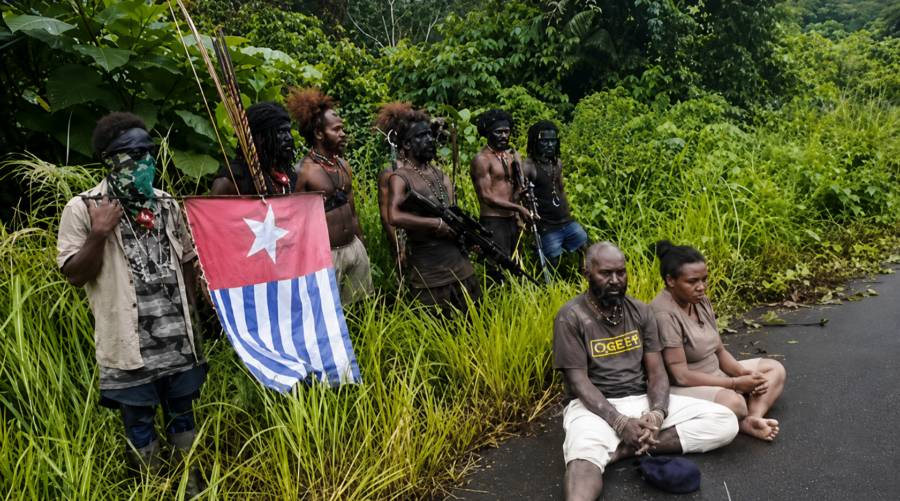
The pattern of the West Papua National Liberation Army from the Free Papua Movement (TPNPB OPM) attacks on civilians in Papua has drawn renewed attention after the group’s spokesperson acknowledged that people regarded as civilian by law may still be deliberately targeted when the group suspects them of working as Indonesian military intelligence agents. The statement offers a rare insight into the logic used by the armed group to justify attacks, while Indonesia’s Human Rights Minister Natalius Pigai has stressed that civilians must be protected regardless of whether they are Indigenous Papuan (OAP) or non-Papuan.
The issue has become increasingly important as violence in Papua continues to affect people who are not directly participating in armed operations. Drivers, teachers, government employees, traders and other residents can find themselves caught in an environment where armed groups make their own judgements about who is a civilian and who is supposedly connected to the Indonesian security apparatus.
That distinction is at the heart of the current debate.
For the Indonesian government, civilian protection is a human rights and humanitarian obligation. For TPNPB OPM spokesperson Sebby Sambom, however, the distinction between civilians and alleged intelligence agents is rejected when the group suspects an individual of supporting Indonesian security forces.
The result is a dangerous expansion of the category of people who can become targets.
The Statement That Exposed the Group’s Rationale
The latest discussion followed Pigai’s public appeal for all sides in Papua’s armed conflict to avoid involving civilians.
Speaking on September 23, 2026, Sebby Sambom responded to Pigai’s position and openly described the rationale used by TPNPB OPM for targeting certain individuals.
According to Republika, Sambom said the group’s armed operations deliberately target individuals whom TPNPB OPM considers Indonesian military intelligence agents. He said the group does not distinguish between a person who is legally a civilian and someone it suspects of being an intelligence operative.
That position is consequential because suspicion itself can become the basis for lethal action.
An armed group may treat a person as an alleged intelligence asset, even if they work as a driver, trader, teacher, or government employee.
In practical terms, the definition of a civilian becomes dependent not on objective status under humanitarian law, but on the armed group’s own suspicion.
This is precisely the kind of situation that creates heightened risks for communities living in conflict-affected areas.
Civilian Status Cannot Be Decided by Suspicion Alone
Pigai’s intervention takes the opposite approach.
The Human Rights Minister has called on Indonesian security personnel not to involve civilians in operational areas and has simultaneously urged TPNPB OPM not to kill civilians (noncombatants). He said protection must apply to everyone, including both Papuans and non-Papuans.
Pigai’s concern is practical as well as legal.
In a conflict environment, identifying who is a civilian and who is directly participating in hostilities can become difficult. He gave the example of civilian drivers operating in areas affected by security operations. He also noted that security personnel may sometimes operate without visible uniforms.
For that reason, he argued that clearer boundaries are necessary to prevent civilians from becoming casualties.
“Protection of civilians as a whole, both Papuans and non-Papuans, is important,” Pigai said, according to reporting on his statement.
The principle is significant because it rejects identity as a basis for determining who deserves protection.
Why TPNPB OPM Says Civilians Become Targets
Sambom’s explanation goes beyond allegations of intelligence activity.
He told Republika that TPNPB OPM considers Indonesian migrants living in Papua to be part of what he described as a government programme intended to displace Indigenous Papuans.
He characterised non-Papuan residents as participants in what the group calls Indonesian “colonialism” and “illegal occupation.” On that basis, he said civilians who identify themselves as traders, teachers or government employees could still be regarded as targets for expulsion.
The TPNPB OPM spokesperson made these claims. The supplied source does not independently verify the allegation that civilian migrants are part of a government program to eliminate Indigenous Papuans.
That distinction matters.
The statement nevertheless reveals how the group frames the conflict. The category of enemy is expanded from armed security personnel to a broader population perceived as representing Indonesian state presence.
Once that logic is adopted, ordinary civilian activity can be interpreted through a security lens.
A teacher can be suspected of being connected to the state. A driver can be accused of transporting security personnel. A government employee can be labelled an intelligence operative.
The individual may have no role in armed activity, but the group’s perception can nevertheless place that person at risk.
The Humanitarian Problem Behind the Labels
International humanitarian principles require parties to an armed conflict to distinguish civilians from people directly participating in hostilities.
Pigai’s statement specifically referred to the difficulty of distinguishing civilians from operational actors and stressed the importance of clear boundaries.
This principle has a direct implication for Papua.
Being ethnically Papuan or non-Papuan does not by itself determine whether a person is a legitimate military target. Neither does working for a government institution automatically remove civilian protection.
Likewise, a person’s alleged connection to a security organisation cannot simply be assumed from occupation, ethnicity or location.
The factual question is whether the individual is actually participating in hostilities in circumstances where international humanitarian law permits direct targeting.
A broad assumption that an entire category of civilians represents an enemy is therefore particularly dangerous.
It can turn ordinary social and economic life into a potential battlefield.
From Suspicion to Violence
The logic described by Sambom creates a chain that can be understood in several stages.
First comes suspicion.
An individual is believed to be connected to Indonesian security forces.
Second comes classification.
The person is no longer treated primarily as a civilian but as part of a wider security threat.
Third comes justification.
The alleged connection is used to rationalise an attack on the individual.
The final consequence can be lethal violence.
The chain’s first step may rely on unverified information.
Once suspicion is treated as proof, there is little protection left for ordinary people who happen to work near security operations or government institutions.
That is why Pigai’s emphasis on prevention is important.
He argued that simply condemning killings after they happen is insufficient. Authorities must establish measures to reduce the possibility that civilians become victims in the first place.
A Conflict Increasingly Affecting Ordinary People
The statements come against a broader pattern in which violence in Papua has increasingly raised concerns about civilian safety.
Pigai has previously warned that the conflict risks moving beyond a conventional confrontation between armed groups and security forces toward violence affecting people based on ethnicity and identity.
The latest statements add another dimension.
Categorising civilians based on perceived political or security affiliation makes it increasingly difficult to maintain the dividing line between combatants and noncombatants.
That can affect economic activity as well.
Drivers need to move people and goods. Teachers need to reach schools. Health workers need to travel to patients. Agricultural officers need to work with communities. Traders need to move merchandise.
When these ordinary activities are interpreted as evidence of political or military affiliation, communities can become reluctant to travel or provide public services.
The consequences therefore extend beyond individual victims.
They can affect the functioning of local economies and public administration.
The Question of Public Support
The user’s requested framing describes the violence as evidence that TPNPB OPM is becoming increasingly paranoid because it is losing public support.
The supplied sources, however, do not provide polling, community surveys or other quantitative evidence establishing a decline in public support for the group’s separatist agenda.
It would therefore be misleading to state that loss of public support has been proven as the direct cause of recent attacks.
However, Sambom’s statement allows for a narrower analytical point.
When an armed movement increasingly treats ordinary residents as potential enemies because of their occupation, ethnicity, migration background or alleged connection to the state, its definition of opposition becomes broader.
That can create a climate of suspicion within the very communities in which the group operates.
In that sense, the rhetoric can be interpreted as reflecting a heightened perception of threat.
The two supplied sources do not establish whether declining community support actually causes the heightened threat perception.
This distinction is important for credible international reporting.
The Risk of Ethnicising the Conflict
Perhaps the most serious aspect of Sambom’s statement is its treatment of non-Papuan residents as a broad category associated with Indonesian state policy.
Papua’s population includes Indigenous Papuans and residents from many parts of Indonesia who work, trade, teach, provide services or have established families in the region.
Treating an entire population category as responsible for government policy risks turning a political conflict into an ethnic confrontation.
That development could produce consequences far beyond the original security dispute.
Once identity becomes a determining factor in who is considered an enemy, ordinary social relationships can become politicised.
Neighbourhoods, workplaces, markets and schools can all be affected.
Pigai’s insistence that civilian protection must cover both Papuans and non-Papuans directly addresses this danger.
Indonesia’s Human Rights Position
Pigai’s statement also shows that the Indonesian government is addressing civilian protection.
The Human Rights Ministry has not limited its message to protecting one group.
Pigai explicitly said protection should cover everyone, including Papuan and non-Papuan civilians.
At the same time, he said his ministry could instruct government security institutions within the state apparatus not to involve civilians in operations. Regarding TPNPB OPM, he said he could appeal to the group not to attack civilians.
This distinction reflects the different forms of authority available to the government and an armed non-state group.
The state can establish rules for its institutions.
Against an armed group outside the government’s chain of command, the immediate tool available to a human rights minister is an appeal combined with broader law enforcement and accountability mechanisms.
Why Prevention Matters
Pigai’s strongest message was that civilian protection cannot depend on statements of condemnation after every attack.
He argued that authorities need preventive measures and clear operational boundaries.
His concern is particularly relevant in Papua because civilians may live and work close to areas affected by armed conflict.
A driver may have to transport passengers through a conflict-affected district.
A government worker may have to deliver agricultural assistance.
A teacher may have to travel to an isolated school.
A trader may need to cross an area where armed activity has occurred.
These people cannot simply be assumed to be combatants because of their occupation or proximity to security activity.
The same principle applies regardless of ethnicity.
A Wider Test for Papua’s Future
The issue therefore extends beyond the latest exchange between Pigai and Sambom.
The fundamental question is whether Papua can move toward a security environment in which civilians are separated as clearly as possible from armed confrontation.
That requires restraint from armed groups and discipline from state security institutions.
It also requires better information, community engagement and protection mechanisms.
For Indonesia, strengthening civilian protection can reinforce the credibility of its law enforcement approach in Papua.
For local communities, it can help preserve the ordinary activities that keep villages and towns functioning.
For the international community, it provides an important measure by which developments in Papua can be assessed: not simply by counting security operations, but by examining whether civilians are being protected.
Conclusion
The latest statements surrounding civilian killings in Papua reveal a disturbing logic.
According to TPNPB OPM spokesperson Sebby Sambom, the group deliberately targets people it suspects of being Indonesian military intelligence agents, even when those people are regarded as civilians. He also described Indonesian migrants and non-Papuan residents in Papua as part of what the group considers an Indonesian state project.
Those statements are the group’s own justification. They do not establish that the people targeted were actually intelligence personnel, nor do they establish that civilian migrants are part of a government program to eliminate Indigenous Papuans.
What they do demonstrate is the danger created when suspicion replaces evidence and identity becomes a basis for targeting.
The Human Rights Ministry has taken a different position.
Natalius Pigai has called on Indonesian security personnel not to involve civilians in operations and has simultaneously urged TPNPB OPM not to kill civilians. His message applies to everyone, regardless of whether they are Papuan or non-Papuan.
That principle should remain central to any discussion of Papua’s future.
Civilians should not be treated as bargaining chips, intelligence proxies or representatives of a political enemy.
They are people who need to work, travel, study, trade and raise their families without becoming targets of armed violence.
The available sources fail to establish a direct link between declining public support for separatism and TPNPB OPM’s attacks. But they do show an increasingly expansive definition of who the group considers a legitimate target.
That expansion is dangerous.
The more broadly an armed group defines civilians as enemies, the greater the risk that ordinary Papuans and non-Papuans alike become victims.
For Papua, the long-term challenge is therefore not simply defeating individual armed threats. It is protecting the civilian space in which communities can live, public services can operate and development can continue.
The clearest humanitarian principle is also the simplest: civilians must remain civilians, and political disagreement must never become a justification for killing them.
Read Also
Aris Sanda: A Migrant Driver Killed by TPNPB OPM in Papua
Three Jayawijaya Civil Servants Killed by TPNPB OPM in Muliama
The TPNPB OPM Attack on Civilian Aviation Raises Security Concerns in Papua