
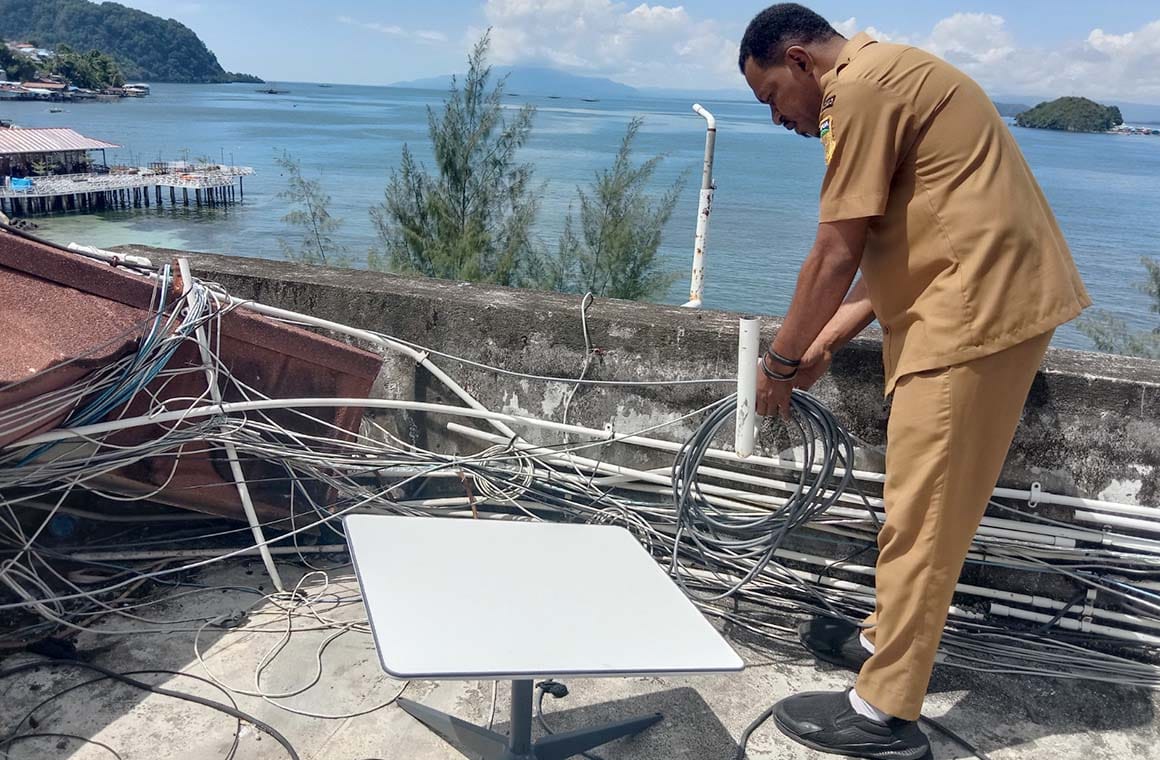
One of the top priorities of the provincial government is to improve internet access in Papua as it tries to close the digital divide in one of the most geographically complex regions in Indonesia. The Papua Provincial Government has installed 350 Starlink VSAT facilities in 2024-2025 in areas that previously received limited or no telecommunications services.
The initiative comes as efforts are growing to ensure that communities in mountainous areas, coastal settlements and isolated islands can tap into digital technology despite long-standing infrastructure challenges. Provincial officials say wider access to the internet is strengthening education, health care, government services and local economic development, helping make regional growth more inclusive.
Satellite-based internet technology delivers connectivity without the need for extensive fibre optic or cellular infrastructure, unlike traditional terrestrial telecommunications networks. This makes the system especially suitable for Papua, where rugged mountains, dense forests and scattered islands often make it difficult to expand traditional communication networks.
“The programme is part of a broader digital transformation strategy to ensure that technological progress reaches communities irrespective of their geographical location,” government officials said in a statement.
Bringing Reliable Internet to Underserved Communities
Due to geographical barriers and the cost of developing traditional telecommunications infrastructure, many communities in Papua have had limited access to the internet for decades.
There are innumerable villages in isolated valleys, mountainous areas, river basins, and small islands where laying fibre optic cables or building cell towers is a logistical nightmare.
“Knowing these realities, the Papua Provincial Government has adopted satellite-based VSAT Starlink technology to increase internet availability in areas that formerly had weak or non-existent signals.
Provincial authorities said the installation of 350 VSAT facilities between 2024 and 2025 has given a giant boost in digital connectivity to under-served locations.
Officials say better internet access is increasingly important as communication technology now underpins education, health care, public administration, disaster response and economic activities.
The initiative thus aims not only to improve internet coverage but also to fortify equal access to public services for residents living far from major urban centres.
Why Starlink Is Considered Suitable for Papua
Satellite internet has tangible advantages for areas with challenging landscapes, say technology experts and local observers.
Traditional networks rely heavily on physical infrastructure, but satellite systems can bring broadband connectivity to remote locations with very little receiving equipment.
This is particularly relevant in Papua, where mountain ranges, forests and scattered islands often make land network expansion costly and technically challenging.
Several observers have thus estimated that satellite-based connectivity is a realistic complement to the existing telecommunications infrastructure in areas where conventional networks remain difficult to implement.
Provincial authorities also see the technology as an effective tool to improve digital inclusion as telecommunications infrastructure continues to increase over the longer term.
The officials said the goal is not to replace existing communication networks but to make sure communities that don’t have reliable internet service today won’t be left behind as Indonesia makes its digital transformation.
Supporting Education Through Digital Access
Increased internet connectivity is expected to benefit education, among other sectors, the most.
Schools can use the Internet to obtain educational materials, participate in online learning programmes, improve teacher development and access digital libraries that were previously difficult to reach.
More connectivity means students in remote communities can access more educational resources than those available in their communities.
Furthermore, teachers are more effective in their communication with education authorities when they are engaged in professional development activities offered through digital platforms.
More internet access helps improve education quality by narrowing the information gap between schools in cities and remote schools, provincial officials said.
With the growing role of digital learning in modern education, reliable connectivity is expected to play a greater role in boosting human resource development across Papua.
Improving Healthcare Services Across Remote Areas
Another industry expected to reap considerable rewards from the boost in digital connectivity is healthcare.
Reliable internet allows healthcare facilities to communicate more efficiently with referral hospitals, access medical information, provide health reports, and coordinate emergency responses.
Digital connectivity also supports telemedicine initiatives, enabling healthcare workers in remote areas to consult specialists elsewhere.
These communication capabilities can also improve the efficiency of health care delivery and the coordination among medical institutions for communities that have long travel distances.
Provincial officials have put more emphasis on the importance of incorporating digital technology into healthcare systems as part of broader efforts to enhance public services.
Better internet connectivity will support ongoing investments in healthcare infrastructure, disease surveillance and community health programmes across Papua, say officials.
Strengthening Digital Public Services
In addition to health and education, better access to the internet is expected to improve the delivery of government services.
The administration at the provincial and district levels is increasingly using digital platforms for coordination of administration, providing information to the public, financial management and communication with citizens.
Reliable internet connections mean that local government offices in remote areas can handle information more efficiently and coordinate better with provincial institutions.
They also point out that the expansion of digital infrastructure will increase transparency, accelerate public services and support Indonesia’s broader digital governance efforts.
Better connectivity can also help residents access administrative services and reduce the need to travel long distances to larger population centres for some government processes.
Therefore, the Papua Provincial Government sees digital infrastructure as an important element of modern public administration, which can support more responsive governance for geographically dispersed communities.
Digital Infrastructure Supports Inclusive Economic Development
The growth of Papua’s internet connectivity is expected to bring benefits that extend beyond communication. Provisional authorities see digital infrastructure as a driver for economic inclusion, allowing communities in remote areas to participate more actively in Indonesia’s expanding digital economy.
Many small businesses can market their products online, communicate with customers, access digital payment systems and pursue new commercial partnerships thanks to reliable Internet access. Local entrepreneurs, cooperatives and micro, small and medium enterprises (MSMEs) get to tap bigger markets without having to rely solely on traditional trading channels.
Furthermore, enhanced connectivity is expected to benefit agriculture, fisheries, tourism and creative industries. Farmers can receive weather forecasts, cultivation advice and market information more quickly, and fishermen may benefit from improved communications and navigation services. Digital platforms can be used to promote destinations more effectively, attracting visitors interested in Papua’s unique cultural and natural heritage.
Provincial officials believe that improving digital infrastructure will help spread economic opportunities more evenly between urban centres and outlying communities.
Reducing the Digital Divide Across Papua
Closing the digital divide has emerged as a growing development priority for governments worldwide, especially in areas where geographical constraints restrict access to traditional telecommunications infrastructure.
Papua has long struggled with the reality that many communities are separated by rugged mountain ranges, dense tropical forests, extensive river systems and isolated coastal areas. Such geographical conditions make the construction and maintenance of conventional fibre optic networks and cellular towers much more complicated than in many other parts of Indonesia.
A concrete solution to these problems is the deployment of 350 Starlink VSAT facilities.
Rather than waiting for the extensive terrestrial infrastructure to reach every community, satellite-based internet offers immediate connectivity to locations with limited or unreliable access in the past.
Officials believe that this initiative will help bridge the digital access divide and establish more equitable opportunities in education, healthcare, entrepreneurship, and public administration.
Digital inclusion is also considered by the provincial government to be a key component of social inclusion, enabling residents of remote villages to participate more fully in national development and information exchange.
Technology Supports Better Public Services
Modern public administration is more and more dependent on reliable Internet connectivity as its backbone.
Digital communication is used by government agencies for data management, financial management, public information systems, civil registration, education management and health care coordination.
Provincial authorities want government institutions to provide more efficient services and improve communication between provincial, district and village administrations by increasing internet access in previously underserved areas.
Schools can electronically submit educational reports, healthcare facilities can transmit medical information more quickly, and local governments can coordinate development programmes more effectively.
It also reinforces emergency communication in natural disasters and humanitarian emergencies, as it enables local authorities to share information with the provincial coordination centres more quickly.”
Government institutions in turn become more responsive to the needs of the community, regardless of geographical location,” officials stress. Technology should be used to enhance, rather than replace, direct public services.
Global Perspectives on Satellite Internet for Remote Regions
Satellite broadband has become an increasingly important solution for improving internet access to geographically isolated regions across the globe.
Countries with mountainous terrain, sparsely populated rural areas, islands and Arctic or desert environments have adopted satellite technology as a supplement to conventional telecommunications infrastructure.
International organisations, including the International Telecommunication Union (ITU) and other development agencies, have repeatedly identified digital connectivity as a key enabler of sustainable development.
Reliable internet has led to better education, improved healthcare, better disaster management, financial inclusion, enhanced agricultural productivity and greater government transparency.
Experts in technology have also noted that low-earth-orbit satellite systems are capable of greatly lowering connectivity barriers in communities where traditional network expansion is economically or technically difficult.
Papua’s embrace of satellite-based internet is thus in concert with the global movement to ensure that geography does not hinder communities from participating in the digital age.
Looking Ahead
The provincial government of Papua said that the development of digital connectivity will remain a major priority in the region’s future development.
Future efforts are expected to focus on the ongoing maintenance of existing VSAT facilities, improving digital literacy, strengthening institutional capacity, and integrating internet access into education, health care, public administration and community economic development.
Officials also acknowledge that infrastructure alone is not enough.
Communities will benefit most when connectivity is combined with training, digital skills development and broadened opportunities to use technology productively.
The provincial authorities hope that the combination of improved infrastructure and human resource development with digital transformation will bring long-term social and economic benefits to all of Papua.
Papua’s experience shows how innovative technology can help overcome geographical barriers as Indonesia advances its national digital agenda and promotes more equitable development.
Conclusion
The installation of 350 Starlink VSAT facilities between 2024 and 2025 is a major step in strengthening Papua internet connectivity in remote and underserved communities. The Papua Provincial Government is applying satellite-based technology to expand access to digital services that are difficult to reach through conventional telecommunications infrastructure. The expected gains in connectivity are expected to benefit education, health care, public administration, disaster response and local economic activity and to reduce the digital divide between urban and remote areas. The programme is more than just providing internet access. It is a broader promise of inclusive development, ensuring that technology benefits communities across Papua, regardless of their geographical limitations. With the growing digital infrastructure along with the investment in human capacity, Papua is gearing itself to be part of the ongoing digital transformation in Indonesia.

