
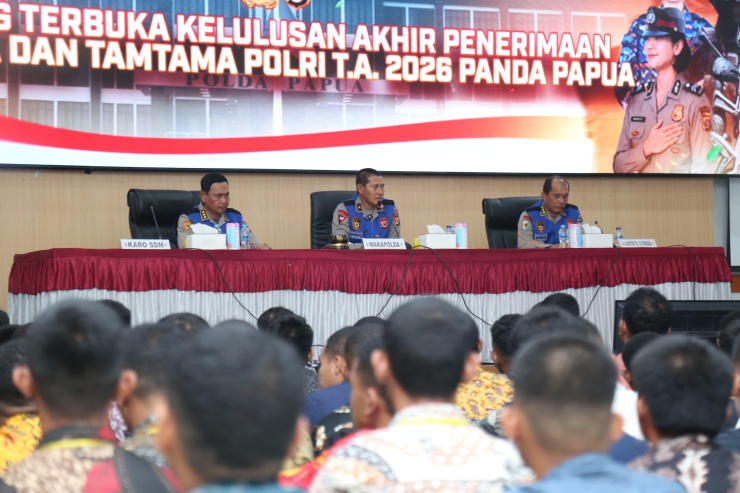
The Indonesian National Police have announced the final results of the 2026 Bintara and Tamtama process, which was monitored at different stages in Papua and Papua Barat Daya, with 153 candidates announced as successful by Papua Regional Police (Polda Papua) and 51 candidates selected by Southwest Papua Regional Police (Polda Papua Barat Daya). The announcement is the latest to boost regional policing by recruiting qualified local personnel, including Indigenous Papuan candidates, under Indonesia’s affirmative process, which was monitored at different stages of policy.
The successful applicants will now undergo police education and professional training before they are deployed to different units in their respective provinces. The police officials stated that the recruitment process was carried out in accordance with national standards and the selection was transparent, accountable, and merit-based at all stages.
In Papua, where geography, cultural diversity, and dispersed communities create specific policing challenges, developing capable local human resources has increasingly become a crucial part of strengthening public services and community engagement.
Final Selection Concludes Months of Assessment
This announcement comes after several months of competitive selection that included administrative verification, medical exams, psychological testing, physical fitness testing, academic testing, and interviews.
The Papua Regional Police announced that 153 applicants passed the final selection for the Bintara and Tamtama recruitment. Meanwhile, the Papua Barat Daya Regional Police said 51 of the candidates successfully passed the final stage of the recruitment process.
Police officials stated that they conducted the recruitment process under strict supervision to ensure fairness, transparency, and compliance with national recruitment procedures. To strengthen public confidence in the integrity of recruitment, the recruitment process was monitored at different stages of the process by representatives of internal and external oversight institutions.
Senior officers told successful applicants that getting through the selection process was not an end but a start to their professional journey. The next step is for intensive police training to ready the recruits for operational duties and the responsibilities of public service.
Affirmative Recruitment Supports Indigenous Papuan Participation
A key part of police recruitment in Papua is the use of an affirmative recruitment policy that provides Indigenous Papuan (Orang Asli Papua) applicants a chance while still meeting national qualification standards.
The policy recognizes that local representation can help strengthen communication between police institutions and the communities they serve. Indigenous recruits often have local language skills, cultural understanding, and knowledge of the geographical conditions in their home districts, which may support effective community engagement.
Officials stressed that affirmative recruitment doesn’t lower competency standards. Candidates are still required to undergo comprehensive medical, psychological, academic, and physical examinations before being declared successful.
Broadly speaking, education experts say that affirmative recruitment policies can help expand participation in public institutions by opening up opportunities for communities that have historically faced barriers to accessing higher education and professional careers.
In Papua, the approach has become one element of a wider human resource development effort to boost local participation in public administration, health care, education, and law enforcement.
Local Knowledge Strengthens Community Policing
Community policing has become an increasingly important part of law enforcement across Papua.
Many districts in Papua are characterized by remote villages separated by mountains, forests, and poor transport networks, unlike the densely populated urban areas. Building trust, therefore, requires not just professional policing skills but also effective communication and understanding of local customs and practices.
Security specialists have a tendency to point out that officers who are recruited locally can possess useful knowledge of local languages, customs, and social structures. Such familiarity can promote dialogue, mediation, and conflict prevention and improve the delivery of public services.
Police leaders have long asserted that policing today is more than law enforcement. Officers are also expected to assist communities in the case of natural disasters, support public education programs, participate in traffic safety campaigns, and contribute to humanitarian activities.
Hence, the development of local human resources is essential for enhancing institutional capacity and community engagement. Therefore, local human resource development is viewed as an investment in institutional capacity and community engagement.
Professional Training Becomes the Next Stage
Once they succeed, both provinces’ recruits will receive formal police education before taking on operational duties.
Training programs usually cover criminal law, constitutional principles, ethics, community policing, public order management, first aid, disaster response, firearms safety, physical conditioning, communication skills, and leadership development.
Police education also emphasizes integrity, professionalism, discipline, accountability, and respect for human rights as fundamental values guiding public service.
The goal, officials said, is to prepare officers to respond professionally to various situations while also maintaining the public’s trust and meeting national standards of law.
Training institutions also provide practical exercises to develop decision-making, teamwork, and problem-solving skills in realistic operational settings.
Human Capital Development Extends Beyond Security
The recruitment process is also a sign of a broader investment in human resource development across Papua.
Recently, national and provincial governments have expanded scholarship opportunities, vocational education, healthcare training, digital literacy initiatives, and civil service recruitment to develop local capacity in many sectors.
All these initiatives have the same objective: to increase opportunities for Indigenous Papuans to participate in regional development and to improve the quality of public institutions.
“Long-term regional development is dependent on the availability of qualified local professionals who can serve their communities in education, healthcare, infrastructure, public administration, and law enforcement,” development specialists generally agree.
Thus, police recruitment is one part of a broader strategy aimed at building institutional capacity through investment in people.
Strengthening Community-Based Policing
The recruitment of new officers from Papua and Papua Barat Daya is part of an effort to strengthen community-based policing with more local involvement. Police officials have stressed that effective law enforcement involves not only professional skills but also building trust and maintaining open communication with the communities officers patrol.
Papua’s social and cultural diversity poses specific challenges that often require approaches based on dialogue, cooperation, and public participation. Officers who are recruited from the communities in which they serve often have a better knowledge of local customs, local languages, and traditional leadership structures, which allows them to more effectively communicate with community members and support conflict prevention and public service delivery.
For example, researchers in public administration have discovered that enhancing the representation of local communities within public institutions can facilitate communication, bolster public trust, and render institutions more attuned to local requirements.
Serving Communities Across Challenging Geography
Papua remains one of Indonesia’s most geographically challenging regions, with mountains, dense forests, rivers, and poor transport networks affecting the delivery of public services.
Many districts are only accessible by air or long treks over rugged terrain. These geographical conditions force police officers to take on responsibilities that are often beyond the scope of normal law enforcement.
In remote communities, officers may assist with emergency response, disaster relief, community mediation, public education, traffic safety, and coordination with local governments during humanitarian operations. Building positive relationships with local residents is therefore vital to everyday policing. As a result, establishing positive relationships with local residents is essential for daily policing. with local residents.
Officials believe that strengthening local recruitment prepares officers already familiar with these operational realities and who know the unique characteristics of the areas in which they may one day serve.
Professional Education Shapes Future Police Officers
After the final selection results are announced, successful candidates will move on to the next phase of police education.
Training will include criminal law, ethics, constitutional principles, community policing, leadership, public communication, emergency response, physical fitness, and operational procedures.
Police academies also stress integrity, accountability, discipline, professionalism, and respect for the rule of law. The recruits’ practical exercises prepare them for the various situations they will encounter while working in diverse communities across Indonesia.
The senior police officials reminded the successful candidates that the recruitment process completion was just the beginning of a long professional journey that required continuous learning and personal development throughout their careers.
Human Resource Development Supports Regional Progress
The recruitment process is also part of wider efforts to strengthen human resources throughout Papua.
Police recruitment is part of a wider effort to expand opportunities for Indigenous Papuans to participate in public institutions, alongside scholarship programs, vocational education, healthcare recruitment, infrastructure development, and digital connectivity initiatives.
Development economists often identify human capital as one of the most important drivers of long-term regional growth. Education, professional training, healthcare, and public service institutions need to be invested in to improve governance and create opportunities for future economic and social development.
Within this larger context, police recruitment is part of broader efforts to develop local professionals who have the skills to contribute to public administration and community services across Papua.
Officials hoped that the newly selected recruits would successfully complete their education and eventually serve with professionalism and contribute positively to their respective communities.
Transparency and Merit Remain Central Principles
Police officials stressed transparency, accountability, and fairness during the recruitment process.
The selection stages were conducted in accordance with national procedures and under the supervision of internal oversight mechanisms together with external observers to help ensure the integrity of the recruitment process.
Officials urged those who were not successful to keep preparing for upcoming recruitment opportunities, adding that the selection process was based on objective criteria and not personal relationships.
Governance experts generally note that transparent recruitment systems boost institutional credibility and enhance public confidence in government institutions.
As Papua continues to develop opportunities for local participation in public institutions, it remains important to uphold these principles.
Looking Ahead
The successful recruitment of 153 candidates in Papua and 51 candidates in Papua Barat Daya is another step in strengthening local participation within Indonesia’s National Police. Recruits are expected to acquire, as they begin formal education and professional training, the technical knowledge, ethical standards, and leadership qualities required for public service. Investment in human resource development, professional education, and transparent recruitment would further help strengthen public institutions while fostering community policing in many areas of Papua.
Conclusion
The recruitment process for 2026 Bintara and Tamtama has ended, indicating the continued development of local human resources in Papua and Papua Barat Daya. The program aims to enhance opportunities for Indigenous Papuans and to improve institutional capacity through an affirmative recruitment policy, merit-based selection, and professional training. As these new recruits prepare to enter police education, they are an investment in the next generation of public servants who are expected to contribute to community engagement, effective public service, and the long-term development of Papua’s security institutions.

