
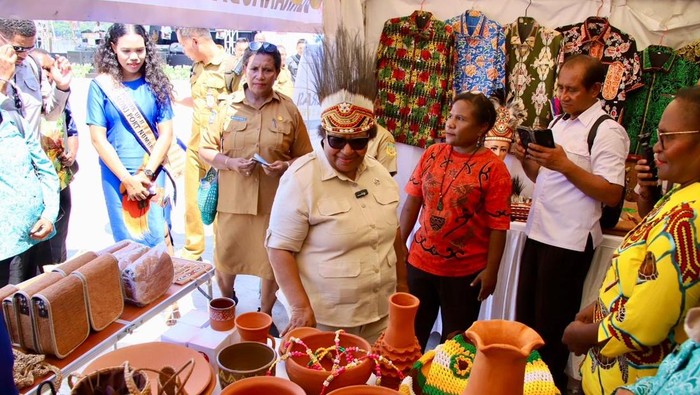
As visitors moved from booth to booth to view handmade noken bags, local fashion products, processed food items and creative works by small entrepreneurs from all over Papua, the aroma of freshly brewed Papuan coffee and the sounds of traditional music filled the exhibition area.
For many participants, the Papua Micro, Small, and Medium Enterprises (MSME) Festival in Jayapura was not just a business exhibition. It was a chance to showcase local products to wider markets, build networks and demonstrate how small enterprises are increasingly becoming an important pillar of Papua’s economy.
There was also a bigger message in the event. While governments across Indonesia are seeking ways to strengthen economic resilience at the grassroots level at this time, Papua is positioning its micro, small and medium enterprises as a key driver of inclusive growth, job creation and community welfare.
That message was reiterated on June 21, 2026, when Indonesia’s Deputy Minister of Home Affairs, Ribka Haluk, officially opened the MSME exhibition and affordable market programme in Jayapura. She stressed during her visit that supporting local entrepreneurs is an investment for the future of Papuan communities, not just an economic agenda. “The strengthening of the people’s economy must start from the grassroots,” Ribka said at the opening ceremony, Antara reported. She said small businesses have a strategic role to play in creating employment opportunities, reducing poverty and generating sustainable income for families.
Her comments resonated with many of the business owners who attended the festival, particularly those who have spent years developing products while struggling for market access, capital, packaging, and business licensing.
A Celebration of Papua’s Economic Potential
The festival turned the exhibition venue into a vibrant showcase of Papua’s entrepreneurial energy.
The visitors found products that integrated traditional knowledge with modern innovation. Local food producers exhibited processed sago products, coffee, spices, honey and fishery products. Artisans showcased woven crafts, wood carvings, and cultural merchandise. Young entrepreneurs brought in fashion brands and digital businesses that are slowly branching out beyond Papua.
What made the event unique was the variety of participants.
Urban entrepreneurs shared space with rural-based community producers. Indigenous Papuan women stood behind booths of traditional products while young business owners explained how to market through social media and e-commerce platforms.
The scene showed how Papua’s economy is developing while staying in the local culture.
Supporting Businesses Beyond the Exhibition Hall
Government officials stressed that exhibitions are not enough on their own.
“MSMEs need to be supported through a comprehensive ecosystem which consists of training, financing, certification and market access,” said Ribka Haluk.
She encouraged business owners to obtain the necessary permits and product certifications to access larger markets. “Business legality is important because it allows products to compete more broadly and gain greater consumer trust,” she explained.
For many small businesses, permits and certifications are still one of the greatest challenges.
The festival was also used by officials as not just a promotional event but an educational platform where entrepreneurs could receive information on licensing procedures, business development programmes and government assistance schemes.
Papua’s Creative Economy Continues to Expand
Recently Papua’s creative economy has been growing steadily.
Young entrepreneurs increasingly link the local cultural identity with modern business practices. Fashion products now incorporate traditional motifs. Indigenous ingredients are being turned into commercial food products. Community-based tourism initiatives are generating new economic opportunities.
This change was obvious at the festival.
Many of the exhibitors were a new generation of Papuan entrepreneurs who see culture not just as heritage but as an economic asset that can create jobs and build local pride.
Indigenous Women at the Centre of Local Business
One of the most visible aspects of the festival was the large participation of Indigenous Papuan women.
Women entrepreneurs manned booths, promoted products and interacted directly with customers across the space.
Their presence reflects a broader trend in Papua’s economy where women play an increasing role in household income generation and community development.
A lot of the products on display were from small family enterprises.
For these entrepreneurs, the festival provided exposure that would be difficult to get through normal business channels.
Several participants said to local media that such events help them reach new customers while also boosting confidence in the quality of their products.
Building a Grassroots Economy
The concept of a “people’s economy” has emerged as a central theme in discussions on Papua’s development.
As the rollout of major infrastructure projects across the region continues, policymakers are increasingly focused on ensuring economic benefits are passed on to local communities.
MSMEs are strategically placed in this endeavour, as they are closely associated with day-to-day economic activities.
On the other hand, small businesses tend to employ people from the local area and distribute income locally.
This is why government officials consider MSME development an important element of inclusive growth.
Creating Jobs Through Entrepreneurship
The economic data always indicates that small businesses are among the biggest sources of employment in Indonesia.
Papua is no different.
As each year goes by, more young people are entering the workforce, and entrepreneurship is increasingly considered the pragmatic way to create jobs and reduce reliance on the public sector.
The festival was a display of companies that started small and then increased their production and hired more workers over time.
They hope such examples could inspire other young Papuans to think of entrepreneurship as a career option.
Linking Culture and Commerce
A common theme throughout the festival was the link between culture and economic development.
Many products exhibited had a strong cultural element.
Commercial products integrated traditional weaving techniques, native ingredients, local stories and customary designs while maintaining their cultural significance.
This reflects an increasing belief that economic development and cultural preservation can be mutually reinforcing.
When you look at entrepreneurship, it can create incentives around the preservation of culture rather than replacing it.
The Role of Local Identity in Modern Markets
Consumers are increasingly seeking products with authentic stories and special origins.
Papuan products have a natural advantage in this regard.
From highland coffee to sago-based food products, from traditional handicrafts to indigenous fashion designs, local businesses are able to offer products that differentiate themselves in increasingly competitive markets.
“The challenge is scaling up producers without compromising on quality and authenticity.”
That process is expected to be aided by government programmes, training initiatives, and promotional events such as the Papua MSME Festival.
A Broader Development Agenda
The festival is part of wider efforts by the Indonesian government and regional administrations to boost economic resilience across eastern Indonesia.
Infrastructure improvements have improved connectivity in many parts of Papua and enabled local products to reach wider markets.
Small businesses can also sell products across provincial borders because of digital technology.
“When combined with strong support for entrepreneurs, these trends could lead to significant economic growth,” officials say.
The involvement of the Ministry of Home Affairs also shows the national government’s commitment to develop local economies in Papua.
Connecting MSMEs with Future Opportunities
Several exhibitors were optimistic about the future.
Better transport links, a spreading web of nets, and rising consumer demand are opening up opportunities that were far less accessible a decade ago.
Many entrepreneurs hope that the continued support from the government will help them move from local markets to regional and national supply chains.
Some already see signs of progress.
Digital platforms and business partnerships are expanding the sale of products that were previously sold only to local communities, allowing access to customers in other provinces.
More Than a Festival
The exhibition may have lasted only a few days, but organisers are looking at its impact in the much longer term.
Events like Papua MSME Festival are important in creating visibility for entrepreneurs, building business networks and encouraging public appreciation for local products.
They also carry an important message about the economic future of Papua.
Development in the region is not driven only by major projects or state spending. It is also made up of thousands of little entrepreneurs who produce products, create jobs and keep local economies turning.
The importance of the festival was more and more evident as visitors, laden with locally produced goods, made their way out of the exhibition hall.
Behind every product on display was a story of grit, vision and aspiration.
Together, those stories make up an important chapter in Papua’s ongoing economic transformation.
Conclusion
The Papua MSME Festival in Jayapura proved that small businesses are increasingly becoming a foundation for economic growth, creative industry development, and community empowerment throughout Papua. The event was more than a marketplace for products, but a place where entrepreneurs, government institutions and consumers could come together. It was a place of innovation, of cultural preservation and economic inclusion. Papua continues to create opportunities for local entrepreneurs. The success of its MSMEs will become increasingly important in creating jobs, boosting household incomes and ensuring that development benefits are felt directly by communities across the region.

