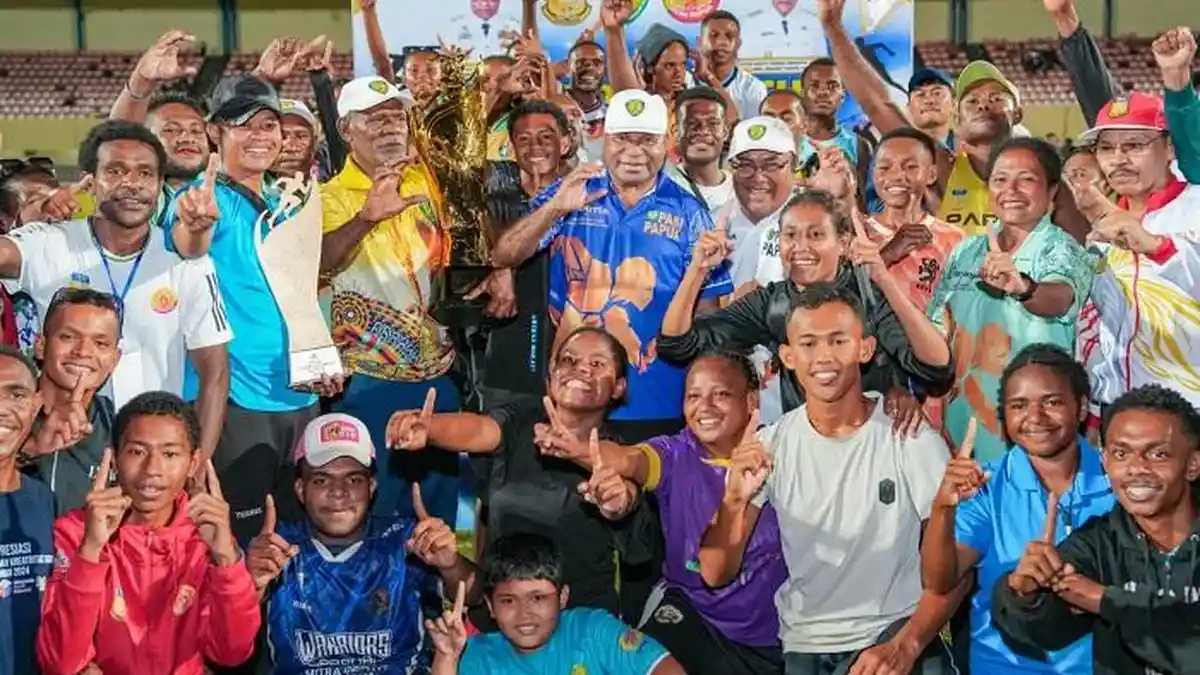
As the morning sun rose above Mandala Stadium, Jayapura City, the sound of starting pistols echoed across the track. Young runners burst from the blocks, long-jump athletes prepped for their final attempts, and coaches yelled encouragement from the sidelines.
For three days, from June 18 to 20, 2026, the capital of Papua became the center of one of the most important sporting events in the province. The 2026 Papua Governor’s Cup Athletics Championship (Kejurda Atletik Piala Gubernur Papua) was a sporting event that united athletes from the province’s districts and cities in a competition that meant so much more than medals and trophies.
For a lot of the participants, the championship was a chance to show what they could do. It also provided a platform for coaches and sports officials to discover potential athletes who will represent Papua at the national level. And for provincial leaders, it was part of a grander vision: to make sure Papua remains one of Indonesia’s strongest contributors in the fields of athletics and competitive sports.
Jayapura Regency was the overall champion after the final medal tally on June 20, having collected 15 gold medals, three silver medals, and 11 bronze medals. However, the organizers said that the real success of the championship was not only the podium finishes but also the emergence of new talent that could wear the colors of Papua at the 22nd National Sports Week (PON) in Nusa Tenggara Barat (West Nusa Tenggara) and Nusa Tenggara Timur (East Nusa Tenggara) in 2028.
A Province with a Strong Sporting Tradition
Athletics has a special place in the sporting history of Papua.
Athletes from Papua have been recognized nationally for decades in track and field, football, boxing, weightlifting, and other disciplines. One of the hallmarks of Papua’s contribution to Indonesian sport has been the region’s reputation as a source of talented athletes.
The championship showed that legacy.
Spectators filling sections of Mandala Stadium witnessed intense competition across multiple events, from sprint races and middle-distance competitions to field events that tested strength, technique, and endurance.
A lot of the participants were still teens.
Competing in a provincial championship was a major milestone for them.
Some had come from distant districts for the event. For some, it was the first chance to compete against athletes from beyond their hometowns.
Building the Road to PON 2028
“The championship is part of Papua’s preparations for future national competitions,” officials said.
The National Sports Week is two years away in 2028, but sports administrators feel that the talent identification needs to start much earlier.
Organizers said the aim of Kejurda Atletik 2026 is to create a database of potential athletes who can be developed through systematic training programs.
It’s not just about competing in future events but also about keeping Papua competitive with stronger, more professional rivals from all over Indonesia.
Governor Fakhiri Calls for Stronger Athlete Development
Papua Governor Mathius Fakhiri, in opening the championship on 18 June, stressed the importance of investing in young athletes.
“The competition is an important mechanism to discover future sporting stars while promoting healthy lifestyles among young people,” he said.
According to Fakhiri, athletic achievement can bring pride to communities and create opportunities for education, careers, and national representation.
He encouraged athletes to compete with discipline and sportsmanship, telling participants that most of the big achievements start with local competitions such as the Governor’s Cup.
Many coaches are supporters of his message, seeing grassroots competitions as the bedrock for long-term success.
More Than a Medal Race
“Winning was just one part of the event,” officials throughout the championship said time and again.
Also important was the opportunity to evaluate athletic potential.
Coaches closely monitored performances, documenting times, distances, and technical skills that could indicate future potential.
Many of today’s losers will be tomorrow’s elite competitors.
Papua is developing its athletes for the next national sports event, and this approach is becoming increasingly important.
Jayapura Regency Dominates the Competition
After the competition ended, Jayapura Regency was at the top of the standings.
The contingent won 15 gold medals, three silver medals, and 11 bronze medals because its athletes performed consistently well across many disciplines.
The success came after years of investment in coaching, athlete development, and sports infrastructure.
Local officials lauded the commitment and determination of athletes during the championship.
A Result Built on Preparation
There were observers who noted that the success of Jayapura Regency was not accidental.
Many of its athletes have participated in regular training programs and regional competitions.
The coaches credited the strong results to consistent preparation and the athletes’ willingness to stay disciplined throughout the year.
Officials also emphasized the need for further development and warned against complacency while celebrating the achievement.
The next challenge they said will be to take success at the provincial level to the national stage.
Discovering Papua’s Next Generation of Athletes
One of the most important results of the championship may be the emergence of previously unknown athletes.
Each major sporting region relies on a continuous regeneration of talent.
Eventually, the competitive performance suffers due to the lack of new athletes entering the system.
That reality is why contests like the Governor’s Cup are viewed as strategic investments.
Opportunities for Young Athletes
Despite their lack of competitive experience, several contestants impressed with their performances.
For many young athletes the championship was an opportunity to experience higher levels of competition and professional coaching environments.
Officials hope the experiences will inspire participants to continue to hone their skills.
While the journey from provincial to national representation remains challenging, events like Kejurda serve as a crucial initial step.
Sports as a Tool for Social Development
The championship also showcased the broader role of sports in Papua’s development aside from competition.
Government leaders increasingly recognize sport as a means of empowering youth, fostering social inclusion, and engaging communities.
Participation in organized sports helps instill discipline, teamwork, and healthy lifestyles.
It can also create positive opportunities for young people who may have few recreational choices.
Investing in Human Capital
The championship is part of a broader provincial strategy that emphasizes human resource development.
Education programs are built to increase academic opportunity, while sports programs are built to develop physical ability and character.
They both believe that the approaches prepare young Papuans for leadership in the future.
In this way, athletics is more than just competition.
It’s about developing confidence, resilience, and ambition too.
Growing Public Interest in Athletics
The mood at Mandala Stadium showed that athletics still has a fair amount of public support.
Sports enthusiasts, community leaders, families, and students attended the various sessions during the competition.
They set a tone that motivated athletes and pointed out the importance of the occasion.
A Foundation for Future Success
Sports experts say that one major factor in the growth of athletics is the intense public interest.
Communities support athletes to perform at their best.
Competitions that attract passionate fans give birth to thriving sports cultures.
The Governor’s Cup proved that the athletes can still attract that kind of support in Papua.
Looking Toward 2028
The focus is already shifting to the future, despite the awarding of medals and the crowning of champions.
The next National Sports Week in 2028 is an important target for Papua’s athletics community.
Officials believe the athletes seen at this year’s championship could form the backbone of future provincial teams.
The journey forward will be full of intensive training, more competitions, and constant evaluation.
Success at the national level is no guarantee.
But competitions like the Governor’s Cup help ensure that promising athletes get opportunities to develop.
Conclusion
The 2026 Papua Governor’s Cup Athletics Championship showcased both the depth of athletic talent across the province and the commitment of local leaders to developing future generations of competitors. Jayapura Regency’s impressive performance with 15 gold medals was proof of the benefits of continuous investment in athlete development. More importantly, the championship was an occasion to find young talents for Papua to send to the 2028 National Sports Week. “This event is a significant bridge to national achievement through grassroots as Papua develops its sporting ecosystem.