
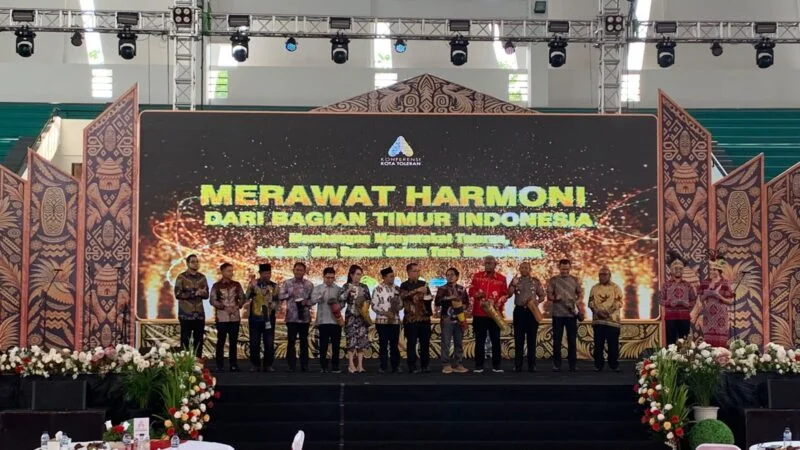
The national conference on tolerance in Timika has brought regional leaders and representatives from across Indonesia to Papua’s easternmost region for a national discussion on protecting diversity and strengthening social cohesion. The second National Conference on Tolerant Cities, known as Konferensi Kota Toleran (KKT) II 2026, officially opened at the Mimika Sport Complex on November 15, under the theme “Nurturing Harmony from Eastern Indonesia: Building a Tolerant, Inclusive, and Peaceful Society within the Framework of Diversity.”
The gathering placed Timika at the center of a national conversation about how Indonesia can preserve its multicultural character while ensuring that every community has equal opportunities to participate in public life. Leaders attending the event included representatives of local governments, religious institutions, civil society organizations, and academic communities. Their presence reflected a shared recognition that tolerance is not simply a matter of peaceful relations between religious groups. It is also closely connected to democracy, public services, social stability, and sustainable regional development.
For Mimika, hosting the conference was an opportunity to demonstrate how communities with different ethnic, religious, and cultural backgrounds can build a common civic life. For Indonesia more broadly, the meeting offered a platform to exchange experiences and discuss practical measures to maintain national unity across a country with hundreds of ethnic groups, languages, traditions, and beliefs.
Regional leaders arrive in Timika for a national gathering
The conference began taking shape as delegates and invited guests arrived in Mimika ahead of the opening ceremony. On November 15, Mimika Regent Johannes Rettob and Deputy Regent Emanuel Kemong personally welcomed several visiting officials at Mozes Kilangin Airport in Timika.
Among those arriving were the Mayor of Singkawang, the Regent of Sambas, the Regent of Serdang Bedagai, the Deputy Mayor of Sukabumi, the Mayor of Banjarmasin, the Mayor of Surakarta, and several regional and religious leaders. Other officials included representatives of regional administrations and government institutions, as well as the Papua Tengah (Central Papua) Police Regional Chief and the Head of the Papua Tengah Natural Resources Conservation Agency.
The arrival of leaders from different parts of the country gave the event a distinctly national character. Their participation also provided an opportunity for local officials to exchange experiences with administrations that have developed their own approaches to managing diversity and maintaining community relations.
Rettob said the presence of regional leaders demonstrated the interest of local governments in strengthening tolerance and building more inclusive communities.
He described diversity as a national strength rather than a reason for division, emphasizing the importance of collaboration in developing shared strategies to maintain harmony.
The conference was officially opened later that day at the Mimika Sport Complex. Its theme, centered on nurturing harmony from eastern Indonesia, placed Papua Tengah not merely as the location of the meeting but as an active contributor to the national effort to strengthen Indonesia’s pluralistic society.
The central government describes KKT as a national consolidation forum
The strategic significance of the event was highlighted by Akmal Malik, Director General of Politics and General Government at Indonesia’s Ministry of Home Affairs.
Speaking at the opening ceremony, Akmal said the conference should be understood as more than a meeting for exchanging ideas. He described it as a national consolidation forum intended to strengthen collective commitment to diversity, fraternity, and equal rights.
He said the gathering was an opportunity to ensure that every Indonesian citizen could live safely and peacefully while receiving equal rights and opportunities, regardless of background.
Indonesia’s national identity, Akmal noted, had been built on diversity and underpinned by the principles of Pancasila, the 1945 Constitution, and Bhinneka Tunggal Ika, the national motto commonly translated as “Unity in Diversity.”
These principles remain important as communities respond to social and political changes that can test relations between different groups.
Akmal also outlined several challenges facing efforts to build tolerant communities. These included prejudice, discrimination, and exclusivist attitudes, as well as social polarization based on ethnicity, religion, culture, or political preference.
He warned that misinformation, hate speech, and provocative narratives circulating through social media could damage relations between communities. Social tensions could also emerge from economic inequality, competition over resources, boundary disputes, and disagreements related to religious life.
Another challenge, he said, was ensuring that tolerance and inclusion were reflected in public services, government policies, and development programs rather than remaining only as formal commitments.
“Toleration is a shared responsibility,” Akmal said, stressing that it should not be left solely to religious leaders or religious organizations.
His remarks placed responsibility on government institutions and society as a whole to protect social cohesion. They also connected the conference’s objectives with the broader national framework of equality, citizenship, and unity.
Mimika presents tolerance as a foundation for democracy
One of the main discussions at the conference focused on the relationship between tolerance, democracy, and inclusive development. The first plenary session, titled “Tolerant Cities as a Foundation for Democracy and Inclusive Development,” brought together speakers from local government, religious affairs institutions, and academia.
The speakers included Mimika Regent Johannes Rettob, Singkawang Mayor Tjhai Chui Mie, Head of the Religious Harmony Centre at the Ministry of Religious Affairs, H. Muhammad Adib Abdushomad, and Papuan academic Dr. Septinus Saa.
Their discussion examined how tolerance can strengthen democratic participation, maintain national unity, and ensure that different groups have fair opportunities to contribute to regional development.
For Mimika, the subject has particular relevance. Rettob explained that the regency has a population of approximately 325,000 people, representing various ethnic communities, religious groups, cultural backgrounds, and associations.
He described this diversity as an important social asset that should be maintained through dialogue, mutual respect, and cooperation.
“We want Mimika to become a shared home for all ethnic groups, religions, and communities. Harmony is not merely about living side by side but about respecting one another and working together to build the region’s future,” Rettob said.
The regent also pointed to practical steps taken by the local administration to support religious life. According to his remarks reported during the conference, the Mimika Regency Government allocates annual grants for places of worship and supports religious activities.
Around 1,000 religious leaders in the regency also receive monthly assistance of Rp 1 million from the regional budget.
These measures, he explained, form part of the government’s effort to support religious communities. However, he stressed that tolerance must also be visible in everyday relationships, including cooperation between people of different faiths in social and community activities.
Rettob warned that the spread of information containing ethnic, religious, racial, and intergroup issues through social media could undermine harmony. Religious leaders, traditional figures, government institutions, and younger generations therefore all have a role in maintaining communication and preventing misunderstandings from escalating into conflict.
Singkawang’s experience offers lessons for other regions
The participation of Tjhai Chui Mie, Mayor of Singkawang in Kalimantan Barat (West Kalimantan), brought another regional perspective to the discussion.
Singkawang has experience in managing a diverse population and promoting cooperation among different religious and cultural communities. Its participation allowed delegates in Timika to consider how local government initiatives and community engagement can help maintain harmony in practice.
The wider purpose of the exchange was not to suggest that one region could simply copy another’s policies. Each area has its own demographic composition, cultural traditions, and social challenges. Rather, the conference provided a space for local leaders to identify approaches that could be adapted to their respective circumstances.
For Mimika, such exchanges are particularly valuable because its social composition includes Indigenous communities, migrants from other parts of Indonesia, and residents with different religious affiliations. A successful approach to tolerance must take account of these differences while ensuring that all residents can participate in community life.
The discussion also reinforced the idea that public policy and community initiatives need to work together. Government regulations can establish a framework for equality, but lasting harmony depends on how people interact in schools, neighborhoods, workplaces, and public institutions.
SETARA Institute calls for concrete action beyond discussion
The role of civil society was another important theme during the conference.
Dr. Halili Hasan, Director of SETARA Institute, said the KKT should produce practical initiatives rather than remain a forum for meetings and the exchange of ideas.
He argued that the concept of a tolerant city should be understood broadly. It is not limited to administrative areas formally designated as cities. Regencies, provinces, and civil society organizations also have responsibilities in building tolerant communities.
Halili explained that the conference should encourage regional governments to strengthen local initiatives, promote cross-sector cooperation, and expand education on tolerance and diversity.
He also highlighted three forms of leadership that are important in building an inclusive society: political leadership, economic leadership, and social leadership.
Political leadership is needed to ensure that public policy protects equality and supports peaceful coexistence. Economic leadership can help create opportunities that allow different communities to participate in development. Social leadership, meanwhile, encourages trust, dialogue, and cooperation at the community level.
Halili also emphasized the role of the Forum for Religious Harmony, known as FKUB, as an important part of the social infrastructure supporting communication and peaceful relations between religious communities.
In his view, government policy alone cannot resolve every challenge associated with diversity. The involvement of community organizations and ordinary citizens is essential to ensure that differences do not become sources of division.
His remarks added an important dimension to the conference: tolerance must be translated into everyday practice and measurable initiatives if it is to produce lasting results.
A cultural evening showcases the vibrant diversity of Indonesia
Beyond formal discussions, the conference also used cultural activities to strengthen relationships between participants.
On Sunday evening, the Mimika Sport Center hosted a cultural program featuring traditional dances, regional clothing, music, and religious performances. The event offered delegates an opportunity to experience the cultural diversity of Indonesia through artistic expression.
Performances from different parts of the country were presented alongside displays of traditional clothing associated with the Amungme and Kamoro communities, two Indigenous groups of Mimika.
The Amungme Arrow Dance, which reflects the spirit and courage associated with the mountain communities of Papua, was among the performances attracting attention. It was followed by Kamoro dances and other Papuan cultural presentations.
The program also included acoustic music and ukulele performances, creating a relaxed atmosphere for interaction among delegates. A Qasidah performance by the local branch of the Badan Kontak Majelis Taklim (BKMT) added a religious and cultural dimension to the evening.
These performances demonstrated how different traditions can share the same public space without losing their individual identities. For visitors from other provinces, the event also provided an opportunity to become more familiar with the cultural heritage of Mimika’s Indigenous communities.
The cultural program was therefore more than entertainment. It formed part of the conference’s wider message that mutual understanding can grow through direct encounters, shared experiences, and appreciation of one another’s traditions.
Interfaith greetings symbolize shared commitment
The conference program also included a gala dinner that brought participants together in a setting designed to encourage friendship and dialogue.
A feature of the gathering was the exchange of greetings across religious traditions. The interfaith greetings reflected the conference’s emphasis on mutual respect and the ability of people with different beliefs to share public life.
Such gestures may appear simple, but they can carry meaning in a society where religious identity is an important part of community life. They provide opportunities for participants to meet beyond formal institutional roles and reinforce personal relationships that can support cooperation after the event.
The emphasis on direct interaction also complemented the discussions on the responsibilities of government, religious institutions, and civil society. Building trust requires more than official declarations. It depends on consistent communication and a willingness to engage with people whose backgrounds and beliefs may differ.
From national dialogue to inclusive development
The conference’s wider significance lies in its connection between tolerance and development.
A region’s progress is not measured only through roads, buildings, investment, or economic output. It also depends on whether residents feel respected, whether public services are accessible, and whether different groups have fair opportunities to participate in decisions that affect their lives.
In this context, tolerance contributes to the social conditions needed for sustainable development. Communities that maintain constructive relationships are better placed to cooperate on local priorities, resolve disagreements, and support public programs.
For Papua Tengah, hosting a national conference on tolerance also demonstrates the province’s role in discussions about Indonesia’s national identity and future. It provides an opportunity for local leaders and communities to share their experiences with the rest of the country, while learning from approaches developed elsewhere.
However, the real test will come after the delegates leave Timika. The recommendations and ideas discussed during the event will need to be reflected in local regulations, public services, educational initiatives, and sustained community programs.
Local administrations can contribute by strengthening dialogue between religious and traditional leaders, supporting FKUB activities, encouraging inclusive public participation, and responding promptly to tensions that may threaten social harmony.
The involvement of younger generations is equally important. In an increasingly digital society, young people need the ability to assess information critically, recognize misinformation, and engage constructively with people from different backgrounds.
Conclusion
The second National Conference on Tolerant Cities in Timika has provided a national platform for regional leaders, government officials, academics, and civil society representatives to discuss how Indonesia can protect diversity while strengthening social cohesion.
Through its plenary sessions, cultural performances and interfaith activities, the event brought the principles of Bhinneka Tunggal Ika into a practical setting. It also highlighted the contribution of Papua Tengah to the national conversation on tolerance, democracy, and inclusive development.
The messages delivered by the Ministry of Home Affairs, Mimika Regent Johannes Rettob, and SETARA Institute Director Halili Hasan shared a common point: tolerance cannot be sustained by government policy or religious institutions alone. It requires cooperation among public authorities, community leaders, educational institutions, businesses, and citizens.
For Mimika, the conference offers an opportunity to build on its diverse social foundations and strengthen its reputation as a place where different communities can work together. For Indonesia, it reinforces the importance of maintaining national unity through equality, respect, and shared responsibility.
The lasting value of KKT II 2026 will ultimately depend on the actions that follow. If the ideas exchanged in Timika are translated into practical policies and stronger community partnerships, the conference can contribute to a more inclusive society and a stronger sense of national belonging, from eastern Indonesia to every corner of the archipelago.
Read Also
Papua Pegunungan Gives Rp30.3bn to 26 Religious Institutions
TNI Supports Papua Culture Through Creative Movement Competition

