
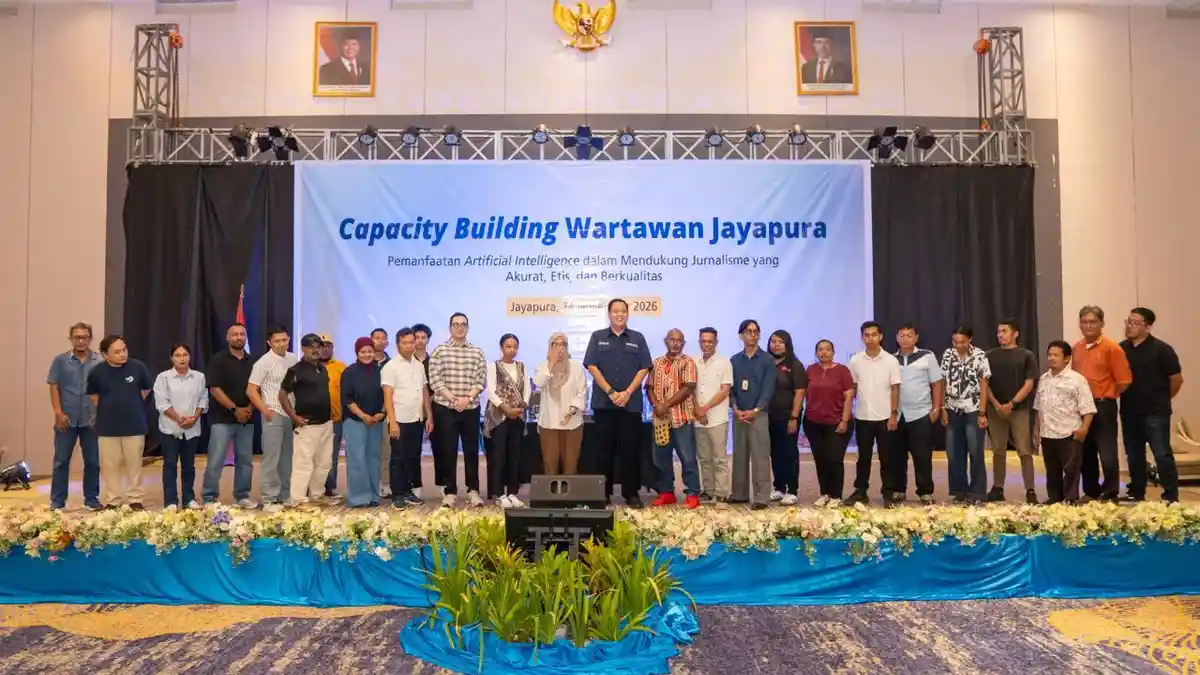
As artificial intelligence (AI) reshapes newsrooms around the world, Bank Indonesia’s Papua Representative Office is helping local journalists adapt to the changing media landscape. On November 14, 2026, the central bank’s regional office brought together 42 journalists in Jayapura for a training programme on the responsible use of AI, with a clear objective: to improve the accuracy, ethics and quality of news reporting.
The event, held at Hotel Suni Abepura, was organised under the theme Using Artificial Intelligence to Support Accurate, Ethical and Quality Journalism. It formed part of Bank Indonesia Papua’s broader journalist capacity-building programme throughout 2026.
The training addressed a growing challenge for the media industry. AI tools can help journalists process information, organise material and work more efficiently. But their growing availability also raises questions about factual accuracy, editorial independence, misinformation and the responsibility of journalists for the content they publish.
For Bank Indonesia, the message was that technology should strengthen journalism, not replace the professional judgement that gives credible reporting its value.
Building Journalists’ Capacity in a Changing Media Environment
The programme brought together 42 journalists from print and electronic media operating in Jayapura. Its focus was not simply on introducing a new technology but on helping reporters understand how AI could be used without compromising the standards expected of professional journalism.
The event was opened by Sasongko Agung Nugroho, Head of the Policy Implementation Team at Bank Indonesia’s Papua Representative Office. He delivered remarks on behalf of Warsono, Head of the Bank Indonesia Papua Representative Office.
In his address, Warsono emphasised that the rapid expansion of digital information and AI had made the role of journalists more important than ever.
Social media platforms have enabled almost anyone to distribute information to a wide audience. While the internet has expanded access to news, it has also made it more difficult for readers to distinguish verified reporting from rumours, misleading claims and inaccurate content.
Warsono argued that the public increasingly needs journalism that is accurate, balanced and verified, rather than news produced simply to be the first to appear online.
Sasongko conveyed the central message of the address: speed without accuracy can produce disinformation.
The emphasis reflects a wider concern within the media industry. As competition for online audiences intensifies, news organisations are pressured to publish quickly. Yet a mistake can damage public confidence, particularly when inaccurate information concerns public policy, economic conditions or sensitive social issues.
For journalists in Papua, maintaining credibility is especially important because reporting often involves complex local circumstances, geographical challenges and communities with distinct cultural and social backgrounds.
AI Is a Tool, Not a Replacement for Journalists
One of the key messages from the programme was that AI should be treated as an assisting technology rather than as an independent source of journalistic authority.
Warsono said that digital platforms and AI could help journalists broaden the reach and depth of their reporting. However, the ability to understand context and substance remained a human responsibility.
This distinction is central to responsible AI use in newsrooms.
AI systems can assist with repetitive tasks, help organise large amounts of information and support the early stages of research or content preparation. They can also help reporters think of new ways to give information to their readers.
However, these capabilities do not automatically guarantee that the resulting information is correct. AI-generated material can contain factual errors, omit important context or present uncertain information as established fact.
A journalist must therefore verify names, dates, figures, quotations and claims against reliable sources before publication. The journalist and editor must ultimately make the final decision about what to report, how to explain it, and whether it meets editorial standards.
Warsono underlined this principle by saying that the journalist’s role in understanding context and substance could not be replaced by technology.
The message was particularly relevant to the programme’s participants, who work in a media environment where digital tools are increasingly integrated into everyday reporting.
Accuracy Over Speed: A Principle for the Digital Newsroom
The training placed strong emphasis on the principle of accuracy over speed. Warsono reminded journalists not to sacrifice the truth simply to become the first media outlet to publish a story.
He described layered verification as the main safeguard that allows journalistic work to remain a reliable source of information for the public.
The principle has practical implications for the use of AI.
For example, a journalist may use an AI tool to summarise a lengthy document, but the original document must still be examined to confirm that the summary has not omitted or distorted any important details. Similarly, AI may help prepare questions for an interview, but it cannot replace direct confirmation from the person concerned.
The same applies to photographs, videos and other digital material. Technology can help process content, but journalists remain responsible for establishing its origin, context and accuracy.
In a fast-moving news environment, these checks may require additional time. Yet the cost of publishing false or misleading information can be considerably greater than the short delay required for proper verification.
For Bank Indonesia, promoting this approach is part of encouraging a stronger relationship between media organisations and the communities they serve.
Dr Rasna Explains the Opportunities and Risks of AI
The main training session featured Dr Rasna, S.T., M.Cs., Dean of the Faculty of Computer Science at Universitas Yapis Papua.
Drawing on her academic and technology expertise, Rasna discussed the opportunities and challenges created by AI in modern journalism.
According to a report by Cepos Online, she explained that AI could improve newsroom efficiency by reducing repetitive administrative work, supporting efforts to optimise website traffic and helping online media increase the time readers spend engaging with their content.
These applications can be useful for news organisations that operate with limited resources. Journalists often have to manage several responsibilities, from gathering information and conducting interviews to preparing stories for publication across different platforms.
AI-supported tools may help streamline some of these processes, allowing reporters and editors to devote more attention to research, interviews and editorial decisions.
Rasna also referred to international developments in which AI has increasingly been used in podcast production and other digital media formats.
However, she cautioned against treating technological convenience as a substitute for professional responsibility.
AI systems operate through data and algorithms. They may not fully understand the social, cultural and local context behind a particular story. This limitation is particularly relevant in Papua, where local knowledge, customary practices and community perspectives can be essential to understanding an event accurately.
Rasna stressed that technology could help journalists work faster, but it did not possess human conscience or moral responsibility.
Her central point was clear: responsibility for published journalism remains with people, not machines.
Three Principles for Responsible AI Use
During the session, Rasna highlighted three principles that should guide newsrooms as they integrate AI into their work.
Human control must remain central
Journalists and editors must retain control over the production and publication process. AI-generated information should be reviewed, checked and edited before it becomes part of a news report.
The editorial team must retain the final decision on whether a story is accurate, relevant, and suitable for publication.
This principle helps prevent newsrooms from becoming overly dependent on automated systems, particularly when dealing with sensitive information or stories that require an understanding of local circumstances.
Transparency helps maintain public trust
The second principle concerns transparency. Media organisations should be open with their audiences about the extent to which AI has been involved in producing content when such disclosures are relevant.
Transparency can help readers understand how information was prepared and whether automated tools played a significant role in the process.
It also reinforces the distinction between technology-assisted reporting and content that has been generated without sufficient human oversight.
Editorial independence must be protected
The third principle is the protection of editorial independence.
AI systems may suggest headlines, summarise documents or recommend ways to organise information. They should not determine the editorial position of a news organisation or dictate which stories deserve publication.
The responsibility for selecting news, assessing public interest and determining editorial priorities belongs to journalists and editors.
Together, these principles provide a framework for using AI without weakening the professional standards that underpin credible journalism.
Why Responsible AI Matters for Papua
The training has significance beyond the technical skills of the 42 participants. It also relates to the quality of information available to people throughout Papua.
Local journalists play an important role in explaining public policy, economic developments and government programmes to communities. Their reporting can help residents understand issues such as inflation, currency management, digital payments, business opportunities and public services.
However, reporting on these subjects often requires more than translating technical information into simple language. Journalists must explain how policies affect everyday life, verify official claims and include perspectives that help readers understand the broader situation.
Bank Indonesia has a particular interest in this relationship because its responsibilities include monetary policy, currency management and payment systems. The public needs reliable information about these subjects to make informed decisions.
In his remarks, Sasongko highlighted the importance of media in communicating Bank Indonesia’s work and policies to the wider public.
The training therefore also supports the role of journalism in making economic information more accessible. Well-researched reporting can help readers understand the implications of economic developments and the services provided by public institutions.
For communities in Papua, where access to reliable information may vary across different areas, the ability of local media to produce clear and verified reporting remains valuable.
Strengthening Cooperation Between Bank Indonesia and the Media
The AI training was part of a series of journalist capacity-building activities organised by Bank Indonesia’s Papua Representative Office throughout 2026.
The programme reflects an ongoing effort to strengthen cooperation between the regional central bank and local media organisations.
Sasongko noted that previous activities had provided journalists with a range of materials concerning developments in modern journalism. The November session added a focus on the practical use of AI in contemporary news production.
He also expressed appreciation for the cooperation between Bank Indonesia and journalists in Papua, acknowledging their role in communicating the institution’s information, policies and activities to the public.
This relationship is important because central bank policies can be technically complex. Information about currency management, payment systems and inflation control needs to be explained in ways that are understandable to different groups of readers.
Journalists serve as an important bridge between institutions and the public. Their ability to explain economic issues clearly can contribute to broader financial and economic literacy.
At the same time, effective cooperation should not compromise editorial independence. The role of the media is to report and scrutinise information in the public interest, while institutions such as Bank Indonesia provide information and opportunities for journalists to improve their understanding of relevant issues.
Preparing Papua’s Media for the Next Digital Phase
The growing use of AI is likely to continue changing how news is gathered, produced and distributed. For local media organisations, adapting to these developments will require both technical knowledge and a clear understanding of their professional responsibilities.
The Jayapura programme offers a starting point by bringing together journalists, a central bank representative and an academic with expertise in information technology.
The next challenge is translating the lessons into newsroom practice. Journalists and editors will need to establish internal procedures for checking AI-generated material, protecting confidential information, verifying sources and maintaining transparency where appropriate.
Media organisations may also benefit from continued training and collaboration with universities and professional journalism institutions.
For Papua, these efforts could help strengthen the capacity of local newsrooms to report on regional developments while maintaining standards that meet the expectations of national and international audiences.
Conclusion
The training provided by Bank Indonesia Papua for 42 journalists in Jayapura represents a practical investment in the region’s media capacity at a time when AI is rapidly changing the global information landscape.
The programme brought together journalists and an academic technology expert to talk about both the benefits of AI and the dangers of using automated systems without proper supervision.
The central message from Warsono, conveyed by Sasongko Agung Nugroho, was that accuracy must take priority over speed and that technology should remain a supporting tool. Dr Rasna reinforced the point by emphasising human control, transparency and editorial independence.
Ultimately, the quality of journalism will not be determined by how quickly a newsroom adopts new technology, but by how responsibly it uses that technology. If the training’s principles are consistently applied, journalists in Papua can use AI to improve efficiency while protecting the accuracy, credibility and public value of their reporting.
For Jayapura and the wider Papua region, stronger digital journalism can help communities access clearer information, understand important economic developments and participate more confidently in public life. The future of journalism may increasingly involve AI, but its most important foundation will remain human judgement, integrity and responsibility.
Read Also
How Hoaxes Shape Perceptions of the Papua Conflict
Papua Tengah and Media Join Fight Against Disinformation

