
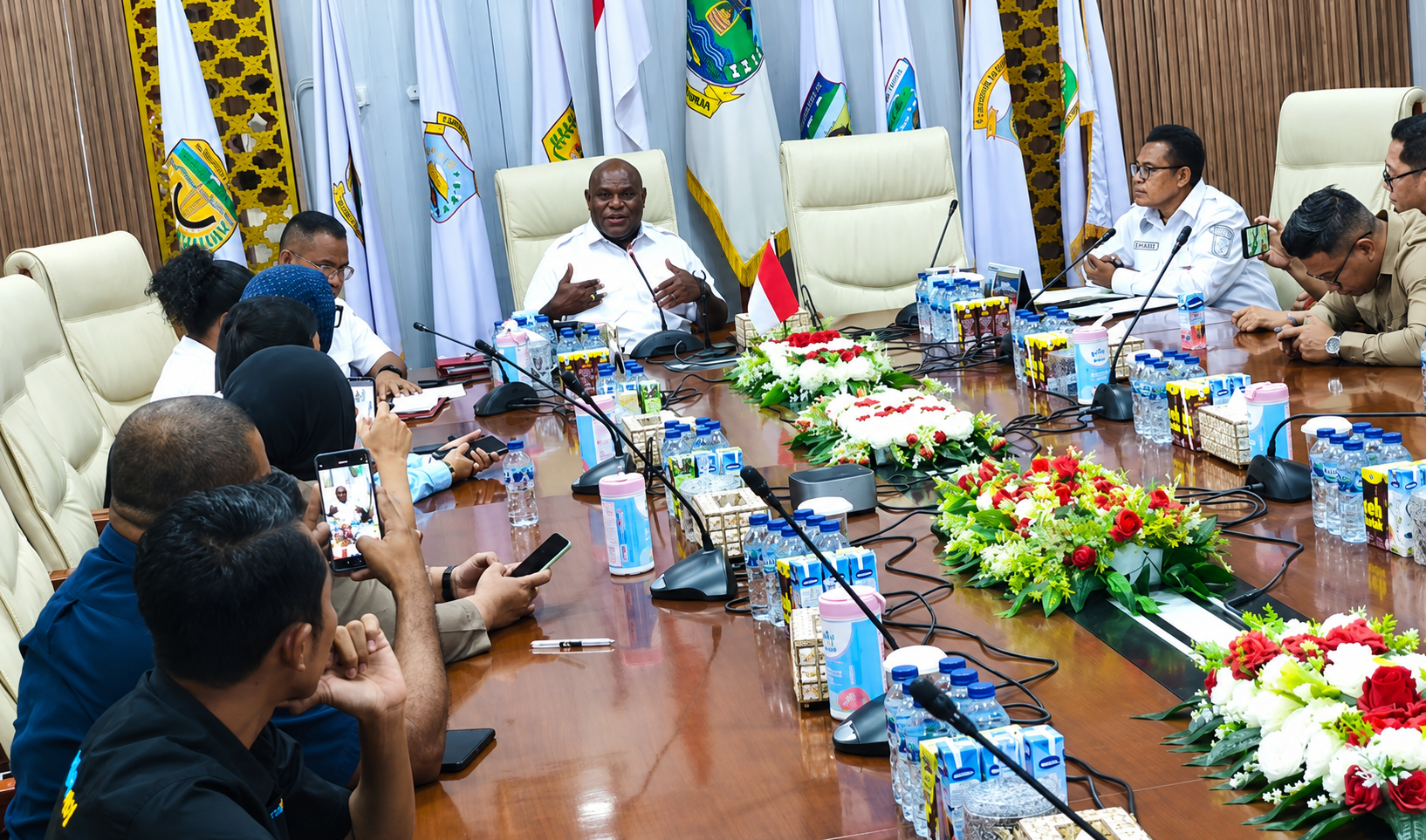
In Papua Tengah (Central Papua), authorities increasingly view the fight against disinformation as a crucial aspect of the broader development challenge. The provincial government has strengthened cooperation with dozens of media organizations, seeking to make public information more accurate, accessible, and useful while helping communities navigate a rapidly changing digital environment.
The initiative, announced in Nabire on August 19, 2026, brought the Papua Tengah provincial government together with media representatives through a cooperation agreement and a coffee morning hosted by Governor Meki Nawipa. Reports from ANTARA, Salam Papua, and Papua Pos Nabire show that the partnership is intended not simply to increase government publicity but also to encourage journalism that verifies information, examines government programs, and helps the public understand how policies affect their daily lives.
That distinction matters in a region where geography, uneven connectivity, and the speed of social media can make reliable information difficult to obtain. For Papua Tengah, strengthening the relationship between government institutions and professional media is therefore also becoming part of a wider effort to build public trust.
A New Approach to Public Communication in Papua Tengah
The agreement with media organizations represents a more structured approach to communication between the provincial government and communities.
According to ANTARA, the Papua Tengah government is working with 30 media organizations in 2026, including Indonesia’s national news agency ANTARA, to disseminate verified information about development programs. Salam Papua reported that the latest cooperation involved 31 media partners from different platforms, while Papuapos Nabire described the agreement as involving 31 media partners representing print, electronic, and online outlets.
The difference in the reported figure appears to reflect how the participating organizations were counted. What is clear from the reports is that the provincial administration is seeking broad cooperation with the local press rather than relying on a single communication channel.
Governor Meki Nawipa said media organizations have an important role in providing accurate and educational information. He also urged journalists to look beyond official ceremonies and examine whether government programs are actually reaching their intended beneficiaries.
This is an important shift in emphasis.
Government communication can easily become focused on announcements, speeches, and official events. But for citizens, the more important question is often whether a policy has produced a tangible change in their lives.
Nawipa encouraged journalists to examine the implementation of programs by provincial government agencies and to speak directly with people receiving government assistance. Such reporting, he said, could help determine whether programs were addressing the needs of communities and delivering their intended benefits.
From Government Announcements to Public Accountability
The partnership is therefore not presented solely as a publicity arrangement.
Salam Papua quoted Nawipa as saying media should also monitor the work of government officials and agencies, helping identify what has been accomplished and what still needs evaluation. He emphasized that journalism should be based on clear sources and information that can be accounted for by both reporters and media organizations.
That principle is particularly relevant for development reporting in remote areas.
Papua Tengah covers geographically challenging terrain, and the distance between government offices and communities can complicate the flow of information. A policy may be announced in a provincial capital, but its actual impact may only become visible much farther away.
Professional journalism can help close that gap.
Rather than simply repeating an official statement, reporters can ask whether schools have received promised support, whether students have actually benefited from educational assistance, or whether infrastructure projects are functioning as intended.
In this sense, the relationship between government and media can serve two purposes at once. It can help the government explain its policies while allowing journalists to independently examine their implementation.
Why Disinformation Matters for Papua’s Development
The provincial government’s concern about disinformation comes at a time when information travels faster than ever.
A headline, photograph, or short video can reach thousands of people within minutes. Yet many readers may see only the headline without opening the full story. Nawipa specifically highlighted this tendency and called on media outlets to provide clear, data-based information that gives audiences sufficient context.
The problem is not unique to Papua. Around the world, governments, journalists, and civil society organizations are confronting the consequences of false or misleading information circulating through social media.
However, in regions where political, security, and social conditions closely intertwine with public trust, the consequences can be especially significant.
In Papua, information about government programs, security incidents, public services, and social issues can attract strong public attention. Unverified claims can quickly generate confusion, suspicion, or unnecessary tension.
For that reason, the most effective response is not simply to label information as false. It is to provide credible alternatives that people can verify.
That requires accessible reporting, transparent data, and journalists who are willing to explain complicated issues in language ordinary citizens can understand.
Media as a Partner in Public Education
One of the more significant aspects of the Papua Tengah initiative is the government’s intention to expand the role of media beyond conventional news reporting.
ANTARA reported that the provincial administration wants media organizations to participate in efforts to improve public literacy, particularly among students as technology becomes increasingly influential in everyday life. The provincial public relations office is expected to involve media organizations in focus group discussions on improving community literacy.
This approach recognizes that media literacy is becoming as important as access to information itself.
People need to know where to get information and how to judge its credibility.
For younger generations in Papua Tengah, media literacy is increasingly relevant. Students are growing up in an environment where digital platforms often present news, entertainment, political commentary, and personal opinions together.
The ability to distinguish verified reporting from speculation is therefore an important civic skill.
Making Government Programs Easier to Understand
The government also wants journalists to help explain administrative and financial terms that frequently appear in public discussions.
Nawipa cited terms such as SiLPA, or the remaining budget financing balance; budget surplus; and unexpected expenditure, known in Indonesia as BTT. These concepts may be familiar to government officials and financial specialists but can be difficult for ordinary citizens to interpret.
Explaining such terminology may appear mundane, but it has wider implications.
When citizens understand how public finances work, they are better positioned to evaluate government performance. They can ask more informed questions about budgets, priorities, and outcomes.
In that respect, journalism becomes a bridge between technical government information and everyday public understanding.
Education Offers a Concrete Test
The governor’s reference to education provides an example of how the partnership could work in practice.
According to ANTARA, Papua Tengah’s 2026 free education program covers approximately 58,000 junior high, senior high, vocational, and special-needs students, as well as around 6,000 university students. Nawipa urged journalists to verify such figures in the field and determine whether students actually received the promised assistance.
Salam Papua similarly reported that the governor wanted media organizations to focus on the experiences of beneficiaries rather than limiting coverage to government ceremonies.
This approach could make development reporting more meaningful.
A government announcement tells citizens what is supposed to happen. A field report can show what actually happened.
For international observers, that distinction is important. Development is ultimately measured not only by the amount of money allocated or the number of programs launched, but also by whether those programs improve people’s access to education, health, infrastructure, and economic opportunity.
Building Trust Through Verification
The central theme running through the government’s message is verification.
Nawipa called for journalists to ensure that information published for the public has gone through verification and confirmation.
That expectation also places responsibility on government institutions.
If authorities want the media to publish accurate information, they need to provide accessible data, respond to questions, and allow journalists to investigate how programs are implemented.
A healthy public information environment depends on both sides.
The media cannot perform its watchdog function effectively without reliable access to information. At the same time, government communication becomes more credible when journalists are allowed to ask difficult questions and independently check claims.
The cooperation announced in Papua Tengah could therefore become more valuable if it maintains this balance.
The objective should not be uniform reporting. It should be better reporting.
A Wider Development and Governance Challenge
The initiative also reflects a broader reality in Papua Tengah: development depends on communication.
Infrastructure projects, education programs, health services, and economic initiatives all require communities to understand what is being offered, how they can access it, and where they can raise concerns.
Poor communication can leave communities unaware of programs that could benefit them. Conversely, incomplete or misleading information can create unrealistic expectations.
Reliable journalism can help manage both problems.
This is particularly important as Papua Tengah continues to develop its institutional capacity as a relatively new province. Effective public communication can help establish a stronger relationship between government agencies and citizens while encouraging communities to participate in evaluating development outcomes.
Papuapos Nabire reported that the provincial government views the cooperation as a way to expand public access to information about policies, development programs, and regional agendas. The partnership is also expected to strengthen transparency and encourage greater public participation in development.
The Numbers Show an Expanding Partnership
The evolution of the partnership is notable.
According to Salam Papua, the provincial government worked with 21 media organizations in 2025, increasing that number to 30 in 2026.
The expansion suggests that the provincial administration sees media cooperation as an increasingly important component of its communication strategy.
But the long-term value of the partnership will depend less on the number of media outlets involved than on the quality of the information produced.
More media organizations do not automatically mean better public communication.
The real test will be whether citizens receive information that is timely, accurate, understandable, and relevant to their circumstances.
An Opportunity for Papua Tengah’s Digital Future
Papua Tengah’s initiative comes at a decisive moment for the region’s digital development.
As internet access and smartphone use continue to change how communities consume information, traditional boundaries between local news and global information are becoming less meaningful.
A story published in Nabire can now reach readers across Indonesia and around the world almost instantly.
That creates opportunities for Papua Tengah. Accurate reporting can showcase development achievements, local economic potential, cultural initiatives, and community stories to audiences far beyond the province.
It also creates responsibilities.
Errors, rumors, and misleading claims can travel just as quickly.
For that reason, strengthening professional journalism and public media literacy can be viewed as an investment in the province’s broader development environment.
Internal Reading: Papua’s Broader Development Story
The information strategy also fits into a wider conversation about development and public trust in Papua.
For readers following Papua’s social and political developments, related coverage on West Papua Voice can provide additional context on issues including public security, infrastructure, education, and social development.
The central lesson is straightforward: development needs more than physical infrastructure. It also needs an information infrastructure capable of connecting government policies with the people they are designed to serve.
That information infrastructure includes journalists, local media organizations, public institutions, schools, and increasingly, ordinary citizens who consume and share information online.
Conclusion
Papua Tengah’s cooperation with local media is ultimately an experiment in building a stronger public information ecosystem.
The provincial government’s decision to work with dozens of media organizations shows recognition that government announcements alone are not enough. Communities need reporting that explains policies, checks implementation, and gives citizens a voice in evaluating results.
At the same time, the media’s role must remain grounded in professional journalism. Cooperation with government should not remove the need for verification, independent reporting, or public scrutiny. Instead, it should make reliable information more accessible while preserving journalism’s responsibility to question and evaluate.
That balance will be crucial as Papua Tengah continues its development.
If the partnership succeeds, its impact could extend beyond countering hoaxes. It could help create a more informed public, improve understanding of government programs, encourage accountability, and strengthen participation in regional development.
In an era when misinformation can cross borders in seconds, credible local journalism is not merely a communication tool. It is part of the foundation of public trust.
For Papua Tengah, the challenge ahead is to ensure that the growing flow of information becomes a source of knowledge and participation rather than confusion. The quality of that information may ultimately prove just as important as the development programs it seeks to explain.

