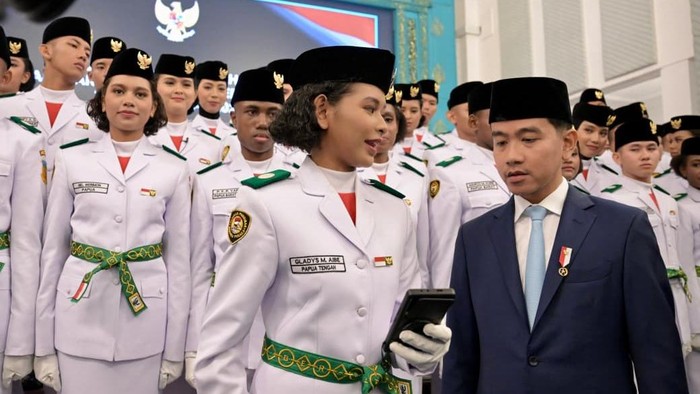
For a teenager from Papua Tengah (Central Papua), the journey to Jakarta for Indonesia’s Independence Day ceremony is already a remarkable achievement. For Papua Paskibraka 2026 member Gladys Manuella Aibekob, however, the experience became deeply personal when she was able to speak with her parents back home in Papua while accompanied by Vice President Gibran Rakabuming Raka.
The emotional moment came after the formal inauguration of 76 members of the Indonesia’s National Flag Raising Troop, or Pasukan Pengibar Bendera Pusaka (Paskibraka), at the State Palace in Jakarta on 15 August. The young representatives, selected from all 38 provinces, have been entrusted with an important role in the 81st anniversary of Indonesia’s independence on 17 August 2026.
For Gladys, the moment connected two distant settings: the formal atmosphere of the presidential complex in Jakarta and her family home in Papua Tengah. The video call offered a glimpse into the human side of a national ceremony, where an achievement celebrated in the capital was also being experienced by a family far away.
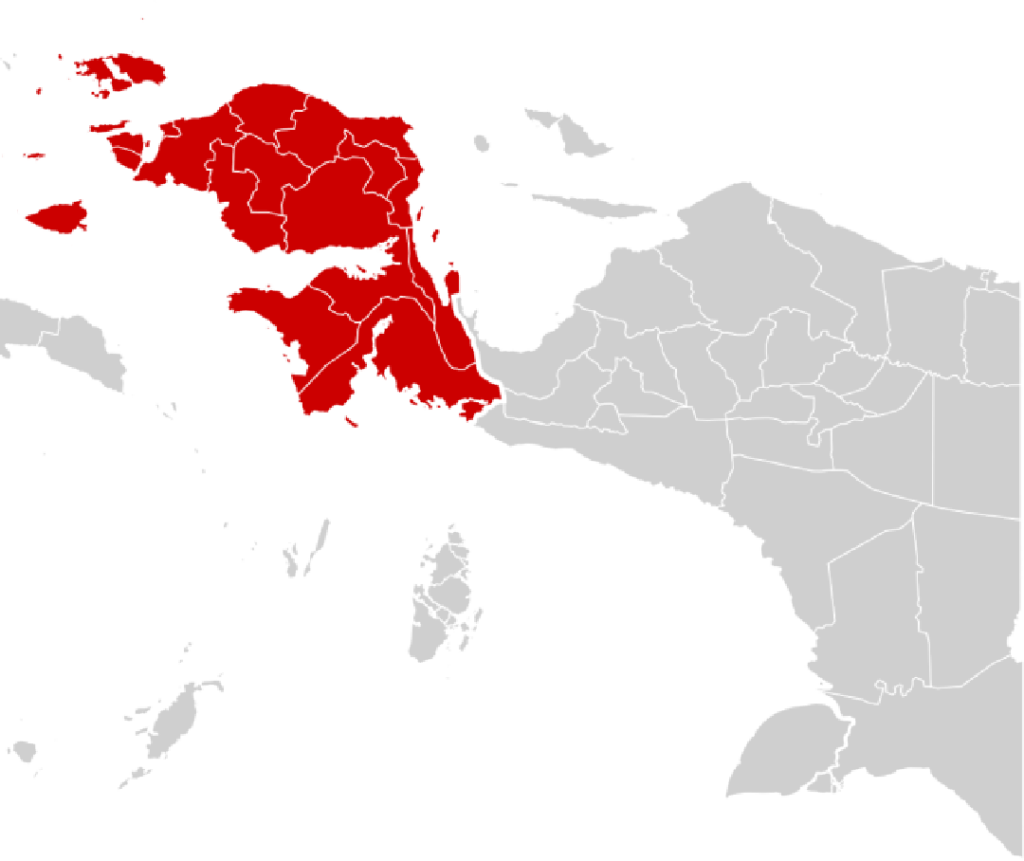
Her story also places Papua’s young people within a broader national picture. Six provinces in the Papua region are represented in the 2026 national Paskibraka selection, including Papua Tengah, Papua, Papua Barat, Papua Selatan, Papua Pegunungan, and Papua Barat Daya.
76 Young Indonesians Prepare for a National Duty
The 76 Paskibraka members represent 38 provinces, with two students selected from each province. Their selection followed a national process involving thousands of young Indonesians.
According to information released by the Agency for Pancasila Ideology Education, or Badan Pembinaan Ideologi Pancasila (BPIP), 119,441 applicants participated in the 2026 selection process. A total of 228 candidates from 38 provinces reached the central verification stage before 76 were ultimately selected.
The selection process was conducted in stages from the regency and city levels through the provincial level and finally the national level. BPIP said the process was designed around transparency, professionalism, objectivity, and accountability.
That context matters when looking at Gladys’s achievement.
Her presence in Jakarta was not simply the result of an invitation or symbolic representation. She was one of two young people selected to represent Papua Tengah at the national level. The other representative from the province is Christopher Leon Bringga Tabuni.
The selection gives the two students an opportunity to participate directly in one of Indonesia’s most visible annual state ceremonies.
A National Team Drawn from 38 Provinces
The composition of the 2026 Paskibraka carries a straightforward message about the country’s geographic diversity.
Students from Aceh, Sumatra, Java, Bali, Kalimantan, Sulawesi, Maluku, Papua, and other regions will stand together as one national formation.
For Papua, the participation of representatives from all six provinces of the region is particularly notable.
The six Papua provinces each sent two students to the national contingent. The list includes Johanes Matius Paulus Rumsayor and Neeltje Deliana Insjowi Werimon from Papua; Pieter Felix Paskah Yapen and Vila Delvia Nauri from Papua Barat Daya; Marco Marcel Kurei and Hasna Iriani Rumbiak from Papua Barat; Vinsensius Renaldi Oey Yolmen and Kristina Ndiken from Papua Selatan; Christopher Leon Bringga Tabuni and Gladys Manuella Aibekob from Papua Tengah; and Michael Marchel Winka Fakdawer and Julia Maharani Dabi from Papua Pegunungan.
Their participation gives the national ceremony a distinctly diverse character.
It also provides a visible platform for young Papuans to participate in a national institution through achievement, discipline, and public service.
Gladys and a Call That Crossed Thousands of Kilometers
The most touching episode surrounding the ceremony involved Gladys and her parents.
Following the inauguration, Gladys contacted her family in Papua through a video call. Vice President Gibran accompanied her during the conversation, creating an intimate moment that was captured by Indonesian media.
For parents, seeing their daughter standing in Jakarta as part of the national Paskibraka contingent is likely to carry a meaning that goes beyond the ceremony itself.
The distance between Papua Tengah and Jakarta is considerable. For a young student, traveling from her home province to the national capital represents a significant transition. The video call briefly brought the two worlds together.
There was no grand political speech in the moment. Instead, the scene was defined by something much simpler: a daughter speaking with her parents while sharing an extraordinary experience.
That human dimension is what made the episode resonate with audiences.
National ceremonies often appear formal from the outside. Uniforms, rehearsals, protocol, and strict formations dominate the images. Yet behind every participant is a family that has watched a young person grow, study, and work toward the opportunity to represent their region.
Gladys’s call offered a glimpse of that story.
From Papua Tengah to the National Stage
Gladys’s participation is also significant within the broader development of youth opportunities in Papua.
Papua’s young population is increasingly participating in national educational, cultural, sporting, and civic programs. Such participation can create opportunities for students to develop confidence, discipline, and networks outside their home regions.
The Paskibraka program combines several of those elements.
Students are required to undergo intensive preparation before carrying out their duties. The experience involves physical training, teamwork, discipline, and familiarity with ceremonial responsibilities.
For participants from remote or geographically distant regions, the experience can also expose them to a wider part of Indonesia.
That exposure works in both directions.
Papua’s representatives bring their own experiences, cultures, and regional identities to Jakarta, while their participation allows young people from other parts of Indonesia to meet peers from Papua.
In this sense, a national youth program can become an informal space for cultural exchange.
Representation that Goes Beyond Ceremony
The presence of Papua Tengah’s Gladys and Christopher is not important merely because they will appear in an Independence Day formation.
Their achievement demonstrates that young Papuans are competing and succeeding in national selection processes.
That message is particularly relevant in discussions about human capital development in Papua.
Infrastructure and economic investment remain important, but the development of people is equally significant. Young people need opportunities to demonstrate their abilities, acquire new experiences, and build aspirations beyond their immediate surroundings.
Programs such as Paskibraka can contribute to that process, although they are only one part of a much broader education and youth development ecosystem.
The long-term value will depend on whether experiences gained during programs like this translate into continued educational opportunities and leadership development after the ceremony.
The Meaning of 17 August for a New Generation
Indonesia’s Independence Day is marked by ceremonies across the country every 17 August. At the national level, however, the flag-raising ceremony at the State Palace carries particular visibility.
The 2026 ceremony will mark the 81st anniversary of Indonesia’s independence.
The government has adopted the theme “Indonesia Berdaulat, Adil, dan Makmur,” or “A Sovereign, Just, and Prosperous Indonesia,” for the anniversary. Government officials have described the celebration as an occasion intended to involve citizens across the country.
The Paskibraka contingent represents nationwide participation in a particularly visible manner.
Each province sends two young representatives, creating a national formation made up of students with different cultural, geographic, and social backgrounds.
For Papua, the symbolism is straightforward: young people from the region are participating directly in the country’s central Independence Day ceremony.
For Gladys, that national role began with a selection process in her home province and eventually brought her to Jakarta.
Youth, Identity, and National Belonging
The Paskibraka experience also illustrates how national identity can coexist with regional identity.
Papua has a rich diversity of cultures, languages, and traditions. Young Papuans can maintain strong connections to their communities while participating in national programs.
Gladys’s journey demonstrates that these identities do not necessarily need to be viewed as competing.
Her appearance as a representative of Papua Tengah at the national ceremony allows her regional identity to remain visible within a broader Indonesian setting.
This is particularly relevant for younger generations.
National identity is often experienced through ordinary interactions rather than political declarations. A student meeting peers from other provinces, learning together, training together, and ultimately standing in the same formation can create a practical understanding of diversity.
The Paskibraka program is one small example of how that process can occur.
A Broader Investment in Papua’s Young People
Papua’s development debate frequently focuses on infrastructure, public services, and economic growth. Those areas remain critical, but investment in human capital is equally important.
Young people who receive access to quality education, leadership experiences, and national networks are better positioned to contribute to their communities.
The challenge is to sustain those opportunities.
Participation in a national ceremony should not be viewed as an endpoint. For students like Gladys, it can become the beginning of further educational and leadership opportunities.
Schools, local governments, and national institutions can build on such experiences through scholarships, youth leadership programs, cultural exchanges, and professional development.
That would give the symbolic importance of Paskibraka a practical dimension.
A Moment that Reached Beyond Jakarta
The image of Gladys speaking with her parents from the State Palace is likely to remain one of the more personal stories surrounding this year’s Paskibraka preparations.
The significance lies partly in its simplicity.
Behind the national ceremony is a young person from Papua Tengah who has traveled far from home. Behind her achievement are parents who watched their daughter reach a milestone that few students experience.
The presence of the vice president during the call added another layer to the moment, bringing national leadership into an otherwise deeply private family exchange.
It also helped make visible something often absent from official ceremonies: the families behind the young people selected to represent Indonesia.
Papua’s Place in Indonesia’s Youth Story
The participation of Papua’s representatives in the 2026 Paskibraka contingent comes at a time when the region continues to receive attention through national development programs.
Youth participation provides another dimension to that story.
Development is not measured only by roads, bridges, schools, or economic indicators. It is also reflected in whether young people from different regions can access opportunities and see themselves participating in national life.
Gladys’s journey provides one example.
Her selection does not erase the complex challenges faced by Papua. Nor should a single ceremonial achievement be presented as a solution to those challenges.
What it does show is that young Papuans can occupy highly visible national spaces through their achievements.
That is a meaningful development in itself.
Conclusion
The formal inauguration of 76 national Paskibraka members for Indonesia’s 81st Independence Day placed young people from all 38 provinces at the center of the country’s annual celebration. Among them is Gladys Manuella Aibekob from Papua Tengah, whose emotional video call with her parents, accompanied by Vice President Gibran Rakabuming Raka, gave the national ceremony a distinctly human dimension.
For Papua, the story is larger than one student’s journey to Jakarta. Twelve young people from the six Papua provinces are part of the national contingent, creating a visible representation of the region at one of Indonesia’s most important public ceremonies.
Gladys’s experience also illustrates the value of giving young Papuans opportunities to participate in national programs based on achievement, discipline, and leadership. Such opportunities can strengthen confidence, broaden horizons, and create connections between young people from different parts of the country.
The flag ceremony on 17 August will last only a short time. The experience gained by the students, however, can remain with them for years. For Gladys and her family in Papua Tengah, the moment may ultimately be remembered not simply as a national ceremony but as the day a young woman from their community stood on a national stage and shared that achievement with the people who had supported her from home.