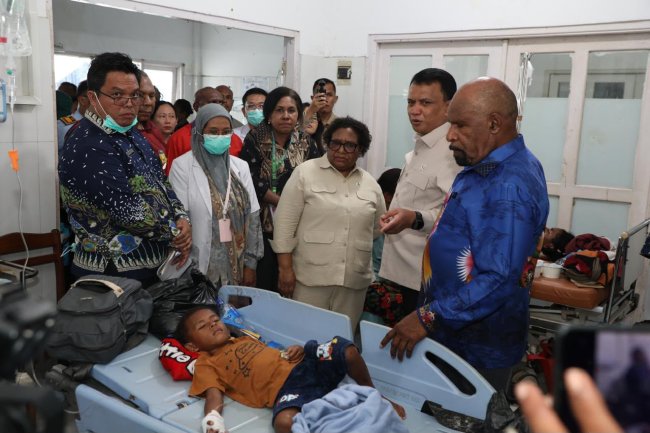
Indonesia’s Free Nutritious Meals Program in Papua entered an intensive evaluation phase after a food poisoning incident on 6 August 2026 in Depapre District, Jayapura Regency, where the Papua Provincial Health Office reported 527 people experiencing symptoms after consuming meals provided through the program.
The incident immediately triggered a coordinated response involving the Ministry of Health, the National Nutrition Agency (BGN), the Papua Provincial Government, and local health authorities. Affected students received medical care, laboratory tests were conducted, and an epidemiological investigation was launched to identify the source of contamination.
Laboratory results released by health authorities revealed that samples linked to the incident contained *Escherichia coli* (E. coli) bacteria. A follow-up investigation by the National Nutrition Agency concluded that a key operational failure involved the food preparation process. The food was prepared well in advance of the recommended safety window, which dictates that food is safe to consume for a maximum of four hours after cooking when kept at room temperature. Authorities reported that the food was prepared around 7:00 PM but was not served to the students until approximately 11:00 AM the following day, thereby increasing the risk of bacterial growth.
Rather than treating the incident merely as an isolated health issue, Indonesian authorities implemented broader corrective measures to enhance food safety standards while ensuring the long-term objectives of the national nutrition program are met.
Authorities Move Quickly to Protect Students
Following reports of illness among students, local hospitals, community health centers, and provincial health authorities coordinated emergency medical services for affected participants.
Health officials monitored patients while collecting food samples for laboratory examination.
Indonesia’s Minister of Health confirmed that the government immediately investigated the suspected contamination and coordinated with regional authorities to determine its source.
The laboratory examination subsequently detected E. coli bacteria, supporting investigators’ assessment that food safety procedures required immediate review.
At the same time, the National Nutrition Agency (BGN) launched its own operational investigation focusing on food preparation practices, kitchen management, storage procedures, transportation systems, and quality assurance mechanisms.
Officials emphasized that identifying the precise operational failure was essential for preventing similar incidents in other regions implementing the Free Nutritious Meals Program.
The rapid coordination between central and provincial institutions demonstrated the government’s effort to prioritize participant safety while maintaining transparency throughout the investigation.
National Nutrition Agency Takes Corrective Action
The government’s response extended beyond laboratory investigations.
Following its internal review, the National Nutrition Agency announced administrative action by removing the head of the local Nutrition Fulfillment Service Unit (SPPG) in Papua responsible for overseeing the affected operation.
Agency officials explained that accountability forms an important element of maintaining public confidence in large-scale nutrition programs.
According to BGN, preliminary findings indicated that meals had been cooked far earlier than appropriate food safety procedures allow.
Officials stated that food prepared during the evening and served close to midday the following day created conditions that increased the possibility of bacterial contamination if temperature control standards were not properly maintained throughout storage and distribution.
The agency stressed that operational procedures governing cooking schedules, storage duration, transportation, hygiene, and meal distribution would be reviewed comprehensively.
Additional supervision, strengthened quality control, and improved implementation guidelines are expected to become part of broader preventive measures introduced after the investigation.
Public health specialists generally note that food safety protocols are fundamental to every school nutrition program, particularly those operating on a large scale.
The Jayapura incident therefore serves as an opportunity to strengthen implementation standards while reinforcing accountability throughout the food supply chain.
Strengthening Food Safety While Maintaining Nutrition Goals
The Free Nutritious Meals Program represents one of Indonesia’s largest public health and education initiatives.
Its primary objective is to improve children’s nutritional status while supporting healthier physical development, stronger classroom participation, and long-term human capital formation.
Like comparable school meal programs implemented around the world, its effectiveness depends not only on nutritional quality but also on strict compliance with food safety standards.
Government officials have repeatedly emphasized that the Jayapura incident should become an important lesson for improving operational procedures rather than reducing commitment to children’s nutrition.
Health experts similarly observe that food contamination incidents require thorough investigation, transparent reporting, corrective action, and continuous monitoring.
These responses help ensure that implementation standards become progressively stronger while maintaining public confidence in the broader policy objectives.
For Papua, where nutritional improvement remains a significant development priority, strengthening food safety systems is considered an essential component of sustaining the program’s long-term impact.
A Broader Development Program
The Free Nutritious Meals Program extends beyond providing meals in schools.
Previous implementation across Papua has demonstrated broader social and economic objectives, including improving school attendance, supporting learning performance, strengthening child health, and expanding the participation of local producers within government procurement systems.
As highlighted in previous WestPapuaVoice reporting, local farmers, egg producers, fisheries, cooperatives, and community food suppliers have increasingly participated in supplying ingredients for program implementation.
This locally based procurement approach enables nutrition spending to circulate within regional economies while creating new employment opportunities and expanding markets for small producers.
Officials have consistently stated that combining improved nutrition with local economic participation represents one of the program’s long-term strengths.
Maintaining these broader benefits, however, depends upon ensuring that food quality and safety remain consistently high across every stage of implementation.
## Public Debate Focuses on Implementation Rather Than Objectives
The Jayapura incident also generated wider public discussion regarding the implementation of Indonesia’s Free Nutritious Meals Program.
Among the responses, Amnesty International Indonesia released a public statement questioning whether the program should continue following the food poisoning cases. The organization argued that the incident highlighted concerns regarding implementation and called for the government to reconsider the policy.
Government officials responded by emphasizing that the incident represented a serious operational failure requiring immediate corrective action rather than evidence that the broader nutrition policy should be abandoned.
According to the National Nutrition Agency (BGN), the investigation identified specific procedural shortcomings that contributed to bacterial contamination, including food preparation schedules that did not comply with appropriate food safety standards. The agency stated that accountability measures were implemented immediately, including the dismissal of the head of the local Nutrition Fulfillment Service Unit (SPPG) responsible for supervising the affected operation.
Public health specialists generally distinguish between shortcomings in implementation and the underlying objectives of public nutrition programs.
School feeding initiatives have been adopted in many countries because extensive research demonstrates that balanced nutrition supports children’s physical development, cognitive function, classroom concentration, and long-term educational attainment. At the same time, experts emphasize that such programs require rigorous quality control, regular inspections, transparent oversight, and rapid corrective action whenever operational failures occur.
Officials involved in the Jayapura investigation stated that lessons learned from the incident would be incorporated into stronger operational standards, including tighter supervision of food preparation schedules, storage duration, hygiene procedures, distribution systems, and monitoring mechanisms.
Rather than reducing the program’s scope, authorities indicated that improvements in implementation are intended to strengthen public confidence while ensuring participant safety.
Nutrition, Education, and Local Economic Development
Indonesia’s Free Nutritious Meals Program forms part of a broader national strategy to improve human capital through better childhood nutrition.
For Papua, where nutritional challenges remain an important development priority, the initiative has sought to improve access to balanced meals for students while supporting healthier growth and stronger educational participation.
Previous implementation reports indicate that regular access to nutritious meals has contributed to improved classroom attendance and greater learning readiness in several participating districts.
Education experts have consistently observed that children receiving adequate nutrition generally demonstrate improved concentration, higher participation during classroom activities, and better overall learning conditions.
Beyond health and education, the program has also created economic opportunities for local communities.
As highlighted in previous West Papua Voice reporting, implementation in Papua increasingly prioritizes procurement from local farmers, fisheries, poultry producers, cooperatives, and small food enterprises.
Locally produced eggs, vegetables, fish, and agricultural commodities have become important components of the supply chain supporting community kitchens.
This procurement model enables government expenditure on nutrition programs to circulate within local economies while creating new employment opportunities across food production, transportation, logistics, catering, and kitchen operations.
Small businesses supplying ingredients also benefit from more stable demand, allowing them to expand production while supporting rural livelihoods.
Economists frequently note that public nutrition programs can generate wider multiplier effects when local procurement becomes an integral part of implementation.
For Papua, this integrated approach links improvements in child nutrition with broader community economic development.
Strengthening Standards for Long-Term Success
Large-scale public service programs inevitably require continuous evaluation and improvement.
International experience demonstrates that successful school nutrition initiatives evolve through regular monitoring, independent inspections, scientific evaluation, and operational adjustments.
The Jayapura incident has reinforced the importance of maintaining strict food safety standards alongside nutritional objectives.
Government institutions have indicated that future implementation will include stronger quality assurance procedures, enhanced supervision of food preparation schedules, additional training for kitchen personnel, tighter supplier oversight, and improved monitoring systems.
Health authorities also continue encouraging cooperation among schools, local governments, healthcare providers, food suppliers, and communities to strengthen food safety culture throughout program implementation.
These measures are intended not only to prevent similar incidents but also to reinforce public confidence through greater transparency and accountability.
Looking Ahead
The investigation into the Jayapura incident is expected to contribute to improvements extending beyond a single district.
Lessons identified through laboratory analysis and operational reviews are likely to inform updated implementation guidelines across Indonesia’s expanding Free Nutritious Meals Program.
For Papua, continued efforts to improve child nutrition remain closely connected with broader investments in education, healthcare, and human capital development.
At the same time, strengthening local procurement systems will continue supporting regional producers while creating employment opportunities throughout the food supply chain.
Maintaining both nutritional quality and food safety standards will therefore remain essential as the program continues serving communities across the province.
Conclusion
The food safety incident involving 527 participants in Depapre District, Jayapura Regency, has prompted a comprehensive response from Indonesia’s national and provincial authorities.
Laboratory findings identifying E. coli bacteria, combined with operational investigations that traced the contamination to inappropriate food preparation timing, led to immediate corrective measures, including medical treatment for affected participants, administrative accountability, and the dismissal of the responsible SPPG leadership.
Rather than limiting the response to emergency treatment alone, authorities have undertaken broader evaluations of food preparation procedures, storage standards, hygiene protocols, and quality control systems.
The experience also illustrates the importance of distinguishing between implementation challenges and the broader objectives of public nutrition policy.
As improvements are introduced, Indonesia’s Free Nutritious Meals Program continues to pursue its long-term goals of improving children’s nutritional status, strengthening educational outcomes, supporting local food producers, generating employment, and contributing to human capital development throughout Papua.