The people’s school in Papua programme is entering a new phase as Indonesia builds three permanent integrated schools in Kota Jayapura, Sarmi and Biak Numfor, a government investment designed to expand educational access for children across the country’s easternmost region.
The three campuses are being developed with a combined capacity of 3,780 students, or 1,260 students at each location. The Ministry of Public Works is constructing the projects with an estimated budget of around Rp1 trillion from the national budget, or APBN. Construction began approximately one month before officials inspected the sites in September 2026, with completion targeted for March 2027.
The announcement came into sharper focus on September 18, when Coordinating Minister for Infrastructure and Regional Development Agus Harimurti Yudhoyono, accompanied by Deputy Minister of Public Works Diana Kusumastuti, visited the people’s school site at the Balai Latihan Kerja Industri in Tanjung Ria, North Jayapura District.
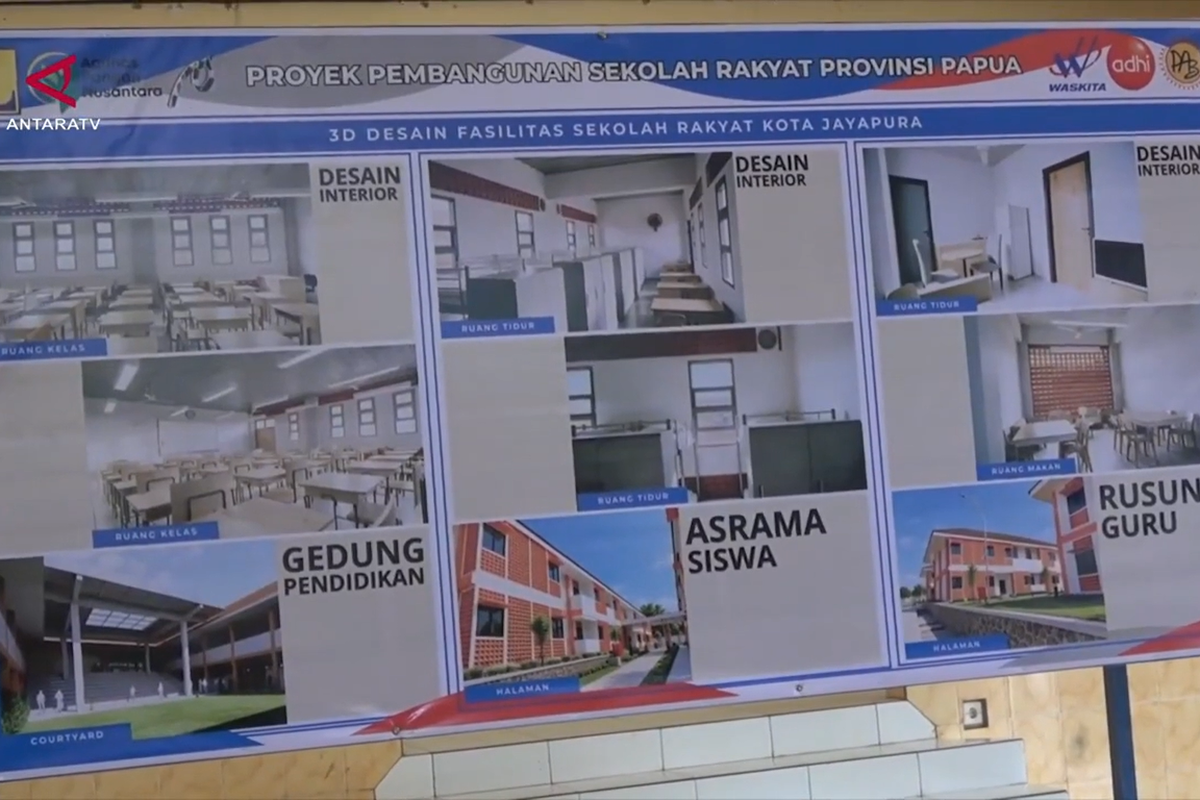
For a region where distance can determine whether children can reach public services, the project is more than a construction programme. The schools are being designed as integrated residential education facilities, combining classrooms with student dormitories, teacher accommodation, places of worship, sports facilities, canteens and other supporting buildings.
The government aims to establish an environment that goes beyond classroom instruction, addressing students’ daily needs and fostering their development.
Three Locations, One National Education Programme
The decision to build three permanent people’s school campuses in Papua reflects an effort to expand the programme beyond temporary or adapted facilities.
The three locations are spread across different parts of Papua. In Kota Jayapura, the permanent campus is being built in Skouw Mabo, Muara Tami District. In Sarmi, construction is taking place at the Balai Diklat site. In Biak Numfor, the campus is located along Jalan Adibai Kilometre 15, Ibdi, East Biak District.
Each campus has been designed with a capacity of 1,260 students.
That gives the three schools a combined capacity of 3,780 students once construction is completed and the facilities become operational.
The scale is significant, but the geographical distribution is equally important.
Papua’s population is spread across urban centres, coastal communities, islands, valleys and remote inland areas. Education policy therefore has to confront a challenge that goes beyond the number of classrooms available.
A school can exist on paper, but reaching it can still be difficult if families live far away or transportation is unreliable.
The integrated boarding model is intended to address part of that problem by combining learning and accommodation within the same educational complex.
From Site Preparation to Construction
The physical development process began approximately one month before Diana Kusumastuti inspected the project in September.
At that point, the overall construction progress was around 4 per cent. The Ministry of Public Works said the project was targeting completion in March 2027.
The construction is being handled by the Directorate General of Strategic Infrastructure at the Ministry of Public Works, with Waskita Adhi Pab KSO appointed as the service provider.
The work includes several stages, beginning with site preparation and land development before moving into structural and architectural construction. The project also encompasses mechanical, electrical, and plumbing work, landscaping, sports facilities, and other supporting infrastructure.
Diana said the initial construction focus was on the education buildings, student dormitories and teacher apartment buildings.
This sequencing is crucial because the programme aims to create a comprehensive educational environment, not just a series of classroom blocks.
The buildings have to function together.
Students need somewhere to learn, but they also need accommodation, food, recreation, worship and a safe environment outside classroom hours.
What an Integrated School Looks Like
The three campuses share a broad design concept.
In Kota Jayapura, the site covers approximately 60,000 square metres, or six hectares. It is planned to accommodate 1,260 students and includes three education buildings, eight student dormitories, two teacher apartment buildings, three canteens, a multipurpose building, a church, another worship facility, sports facilities and other supporting buildings.
The Sarmi campus covers approximately 66,359 square metres, or about 6.6 hectares.
It has the same planned student capacity of 1,260 and includes three education buildings, eight student dormitories, two teacher apartment buildings, three canteens, a multipurpose building, worship facilities, sports infrastructure and other supporting facilities.
The Biak Numfor campus is larger in land area, covering approximately 96,302 square metres, or 9.63 hectares.
It is also designed for 1,260 students and includes the same broad mix of education, accommodation, worship, sports and supporting facilities.
The similarity in capacity and facilities indicates an effort to create a consistent standard across the three locations.
At the same time, the different land sizes show that each site has its own geographical and spatial characteristics.
Why Boarding Matters in Papua
The residential component is one of the most important features of the project.
In many parts of Papua, distance remains a practical barrier to education. Children often reside far from secondary schools, and limited transport options arise from terrain, weather, and road conditions.
A boarding school changes that equation.
Students can live within the education complex rather than travelling long distances every day.
That does not eliminate every barrier. Families still need access to the school, and students require support from teachers, administrators and communities. But residential facilities can reduce the daily burden of distance for students who otherwise might have difficulty attending school regularly.
The programme is therefore particularly relevant to the broader challenge of educational equity.
The Papua60Detik report described the three permanent schools as part of an effort to expand educational access into eastern Indonesia.
The significance goes beyond buildings.
If a student can remain in a stable educational environment, access to teachers, learning facilities and daily necessities becomes more consistent.
Education Beyond the Classroom
The government is also positioning the people’s school concept as more than conventional academic education.
Diana said the integrated schools would include facilities intended to support students’ development outside academics.
That includes sports facilities, multipurpose spaces and religious facilities.
The idea is that students should grow in an environment that supports physical, social and personal development alongside formal learning.
For children living in boarding facilities, this is especially important.
School life extends beyond the classroom. Students eat, sleep, study, exercise and interact with their peers in the same environment.
This means that the quality of the campus environment is an integral part of the overall educational experience.
The presence of teacher accommodation is another important element.
Two teacher apartment buildings are planned at each of the three campuses.
This can help create a closer relationship between teaching staff and residential students, although the actual effectiveness of the model will depend on staffing arrangements and how the schools are managed once operational.
A Rp1 Trillion Education Investment
The three campuses are expected to require approximately Rp1 trillion in total construction spending.
The funding comes from the national budget, or APBN.
The investment illustrates the scale of the central government’s infrastructure commitment to the programme.
But the financial figure also places an important responsibility on the institutions involved.
The value of the investment will ultimately depend not simply on whether the buildings are completed, but on whether the facilities can operate effectively over the long term.
The first stage is construction.
After completing the campuses, the education system will require teachers, school administrators, residential supervisors, food services, learning materials, maintenance systems, and other operational resources.
The coordination between the Ministry of Public Works and the institutions responsible for education and social policy will therefore remain important after the construction phase ends.
AHY’s Visit Brings Infrastructure and Education Together
The September 18 inspection by Agus Harimurti Yudhoyono provided a broader context for the project.
The Coordinating Minister for Infrastructure and Regional Development visited the people’s school facility at Tanjung Ria in North Jayapura while reviewing infrastructure development in Papua.
Diana Kusumastuti accompanied him during the inspection.
The visit linked education infrastructure with the wider national effort to improve development conditions in Papua.
That connection is significant because schools depend on more than school buildings.
They need roads, electricity, water, communications, sanitation and access to surrounding communities.
In remote regions, infrastructure and education are therefore closely connected.
A new school may increase educational capacity, but reliable infrastructure is necessary to keep the campus functioning and accessible.
The Challenge of Reaching Every Child
The three schools represent an expansion of educational capacity, but they are not presented in the sources as a complete solution to Papua’s education challenges.
The combined capacity of 3,780 students is substantial, yet Papua has a much larger population of school-age children distributed across six provinces.
That makes the location of schools important.
The September reports also indicate that Papua’s provincial government hopes to eventually develop people’s school facilities in more locations. ANTARA’s report on the wider programme referenced an expectation of additional campuses across Papua.
This suggests that the three permanent schools should be viewed as part of a broader expansion rather than the final stage.
The immediate challenge is to complete the three campuses on schedule.
The longer challenge is to ensure that similar educational opportunities reach communities that remain geographically distant from existing facilities.
The Meaning of Equal Access
The language of educational equality is particularly relevant in Papua.
For families living in cities, access to schools can appear straightforward. For families living in remote communities, the calculation can be completely unique.
Distance, transportation expenses, household income and the availability of nearby schools can all influence whether a child attends regularly.
An integrated residential school addresses several of those barriers at once.
The approach is not without challenges.
Boarding schools require careful management of children’s welfare, safety, health and relationships with their families and communities.
The success of the programme will therefore depend on more than construction standards.
It will depend on the quality of education and the ability of school administrators to create a supportive residential environment.
Papua’s Human Capital Agenda
The government has increasingly connected infrastructure investment with human resource development in Papua.
The people’s school programme fits within that broader approach.
The logic is straightforward.
Infrastructure can improve access to economic activity and public services, but people need education and skills to take advantage of those opportunities.
A student who receives a stronger education may eventually enter higher education, vocational training or the labour market with better preparation.
The government has described the broader people’s school programme as an instrument for expanding educational opportunities, particularly for children from vulnerable households.
The permanent campuses in Papua bring that policy into a physical form.
They create places where the programme can operate at a larger scale and over a longer period.
A Long Road From Construction to Results
The current figures also remind us that the programme remains at an early stage in these three locations.
Construction progress was approximately 4 per cent when Diana spoke in Jayapura.
The March 2027 completion target therefore remains ahead.
Between now and then, the project will pass through structural construction, architectural work, installation of utilities, construction of supporting facilities and completion of the wider campus environment.
The logistical challenge should not be underestimated.
Construction materials and equipment must reach three separate locations. Each site has different land conditions and access requirements.
Maintaining quality while meeting the deadline will require continued coordination between the Ministry of Public Works, contractors and local authorities.
The government will also need to prepare the educational operation in parallel.
A completed building is not yet a functioning school.
What Success Will Look Like
The first measure of success will be whether the three campuses are completed as planned.
The second will be whether they can open with adequate teachers, accommodation, food services and learning resources.
The third will be whether children who previously faced barriers to education can actually access the programme.
The fourth will be educational outcomes.
Over time, policymakers will need to assess attendance, completion rates, academic achievement, student wellbeing and the transition of graduates into higher education or employment.
The ongoing construction of the three permanent campuses prevents the measurement of those results.
For now, the measurable facts are the planned capacity, the physical scale of the campuses, the budget and the construction schedule.
That distinction is important.
It allows the public to recognise the scale of the investment while leaving room for future evaluation of whether the programme delivers its intended social outcomes.
A New Educational Landscape for Papua
The three campuses in Kota Jayapura, Sarmi and Biak Numfor could eventually become important points in Papua’s education network.
Their residential model is designed to bring together education and daily support in one location.
The facilities are also large enough to accommodate more than 1,000 students at each campus.
For Papua, where geographical distance has long influenced access to public services, that approach offers a different way of organising education.
It does not replace the need for schools in smaller communities.
Rather, it adds another layer to the educational system, particularly for children who can benefit from a residential learning environment.
The programme’s longer-term significance will depend on how it is connected with local communities and the wider education system.
Conclusion
The construction of three permanent people’s school campuses in Kota Jayapura, Sarmi and Biak Numfor marks another step in Indonesia’s effort to expand educational access in Papua.
Together, the three schools are planned to accommodate 3,780 students, with each campus designed for 1,260 pupils. The combined construction budget is approximately Rp1 trillion from the APBN.
The campuses are not simply classroom complexes.
They include student dormitories, teacher accommodation, canteens, multipurpose buildings, worship facilities, sports areas and other supporting infrastructure. The intention is to create integrated residential education environments that can support students both inside and outside the classroom.
Construction had reached around 4 per cent by September 2026, with the government targeting completion in March 2027.
That deadline will be the first major test.
The more important test will come afterwards.
A successful people’s school campus will not be measured only by its buildings. It will be measured by whether children can enter, learn, live safely, receive adequate support and complete their education with stronger prospects for the future.
For Papua, where geography can make equal access to public services particularly difficult, that distinction matters.
A school building can open a door.
The real achievement will be ensuring that children can walk through it.
Read Also
People’s School Breaks Ground in Biak, Papua
Indonesia Advances People’s School Initiative in Papua
Papua People’s Schools Set to Expand Education Access