
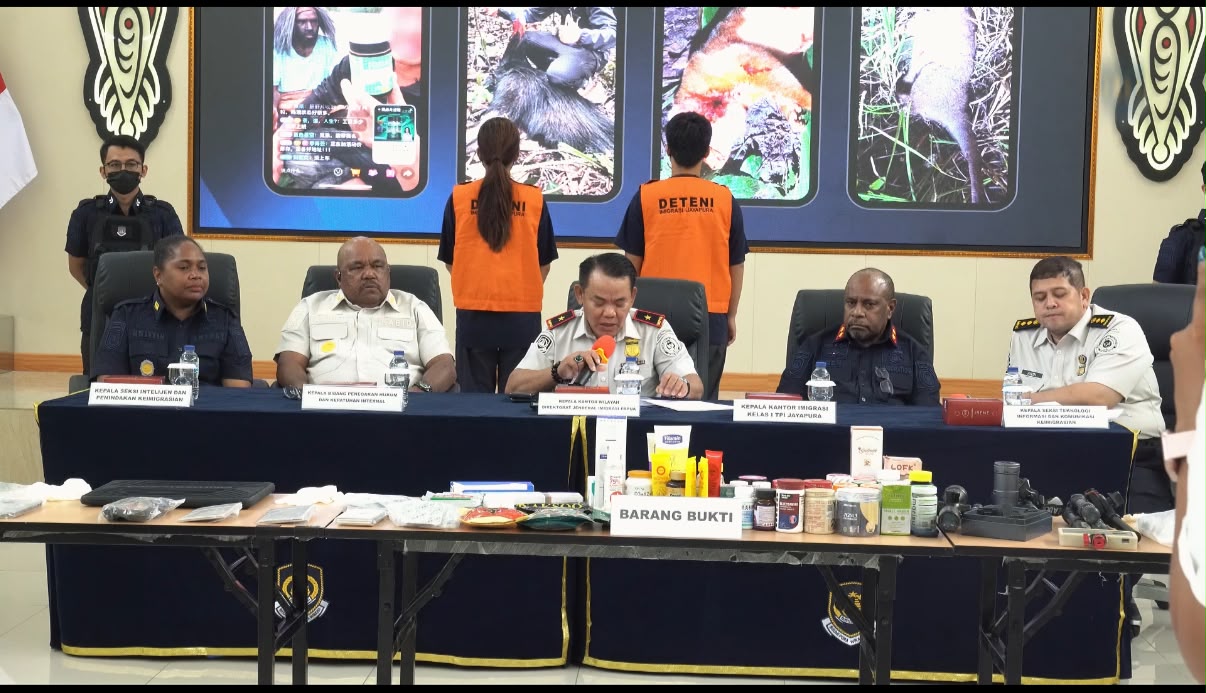
A deportation case involving two Chinese nationals has drawn attention to the intersection of immigration enforcement, wildlife protection, and the growing role of social media in documenting activities in remote parts of eastern Indonesia. The two, identified by Indonesian authorities as YH and NZ, were deported after immigration officials in Jayapura concluded that they had undertaken activities inconsistent with their immigration status, while investigators found photographs and videos showing YH participating in the hunting of protected wildlife, including cassowaries and cuscus.
The case began with a public report received by the Jayapura Immigration Office in March 2026 and developed several months later after immigration intelligence officers obtained more specific information and analyzed digital evidence posted on social media. The couple was eventually located and taken into custody in Jayapura on August 14 before undergoing immigration examinations.
The episode is significant not because of the nationality of those involved, but because it illustrates the challenges faced by authorities in Papua, where tourism, cross-border movement, local livelihoods, digital content creation, and conservation increasingly overlap.
It also offers a useful reminder to foreign visitors that travel to Papua comes with the same legal obligations that apply elsewhere in Indonesia. Tourism and cultural exploration are permitted within the terms of an individual’s immigration status, but activities that breach those conditions can trigger administrative enforcement.
From a Tourism Visit to an Immigration Investigation
According to the Jayapura Immigration Office, the two individuals are a married couple identified by the initials YH and NZ. Authorities said they entered Indonesia on July 3, 2026, through Soekarno Hatta International Airport using a business visit visa.
YH, according to the examination reported by Indonesian media, works as an electronics repair technician in China. He told immigration officials that he had visited Indonesia approximately 10 times since 2023, including trips to destinations in Papua such as Jayapura, Wamena, and Merauke. NZ, meanwhile, was making her first visit to Indonesia and said she had accompanied her husband.
Their activities in Papua, however, attracted the attention of local authorities.
The first report concerning the couple was received by the Jayapura Immigration Office on March 30, according to the Kanwil Directorate General of Immigration in Papua. At that stage, officials did not immediately take enforcement action because more information was needed.
A development came on July 27, when immigration intelligence officers obtained more specific leads. Officials then conducted further investigation and examined digital material, including videos uploaded to social media platforms.
The investigation eventually led officers to the couple in Jayapura on August 14.
Following their detention, immigration officials examined their identities, travel documents, immigration permits, and activities during their stay in Indonesia. Authorities subsequently imposed administrative immigration action in the form of deportation.
Why the Wildlife Evidence Matters
Cassowaries and Cuscus Are Part of Papua’s Natural Heritage
The wildlife element makes the case particularly relevant to Papua.
Immigration officials said photographs and videos found during the examination showed YH participating in hunting activities involving protected wildlife, including cassowaries and cuscus. Officials said the activities took place with local residents in Skanto Village.
The material was not merely stored privately. According to the immigration investigation, photographs and videos from the activities were intended for social media content. The couple reportedly acknowledged the hunting activities during the examination.
That detail is important in today’s digital environment. Activities that might once have remained known only to a small group can now quickly become visible to a much wider audience through livestreams, short videos, and social media platforms.
In this case, digital content became part of the evidence used by immigration investigators.
For Papua’s conservation agenda, the incident also emphasizes the necessity of protecting wildlife that forms part of the region’s distinctive ecological identity.
The cassowary, in particular, is strongly associated with Papua’s forests and cultural landscape. Cuscus species are also among the animals associated with Papua’s unique biodiversity. The protection of such species is therefore not simply an environmental issue. It is connected to the preservation of natural heritage and the long-term value of Papua’s ecosystems.
Immigration Rules and Foreign Visitors
A Visa Is Not a Blanket Authorization
One of the central lessons from the case concerns the difference between entering a country legally and complying with the conditions attached to a particular immigration status.
The couple entered Indonesia using a business visit visa, according to the immigration examination. Authorities subsequently determined that activities undertaken during their stay were inconsistent with the purpose and conditions of their immigration status.
Indonesian immigration authorities have emphasized that foreign nationals are expected to comply with the purpose of their stay and with Indonesian laws.
The legal basis cited in the case was Article 75 of Indonesia’s Immigration Law No. 6 of 2011, under which immigration authorities may take administrative action against foreign nationals whose activities are considered to threaten public order or who violate applicable immigration provisions.
In the Jayapura case, the authorities chose deportation rather than allowing the individuals to continue their stay.
The decision illustrates the administrative nature of immigration enforcement. Deportation does not necessarily mean that every element of an incident becomes a criminal prosecution. In this case, the immigration authority imposed an administrative immigration measure based on its examination and findings.
That distinction is important when reporting the incident internationally.
Social Media Has Changed Immigration Enforcement
The investigation also highlights a growing reality for immigration agencies around the world: social media can become a source of both information and evidence.
In Papua, the geographical challenges facing authorities can be considerable. Remote settlements, forests, and long distances can make conventional monitoring difficult. Digital traces can sometimes provide investigators with information about activities that would otherwise be difficult to identify.
In this case, immigration intelligence officers analyzed videos uploaded through social media after receiving more specific information in July. The digital investigation helped authorities establish a clearer picture of the couple’s activities before they were located in Jayapura.
YH was also reported to have conducted livestreams through Douyin to promote products brought from China, including shampoo and fish oil.
This does not mean that social media activity itself constituted the basis for deportation. Rather, the platforms became an investigative source through which authorities could examine activities associated with the individuals.
For immigration agencies, that represents an increasingly important capability.
Papua’s Tourism Potential Requires Responsible Visitors
Papua has considerable potential as a destination for nature tourism and cultural travel. Its forests, mountains, coastal areas, and diverse communities attract visitors seeking experiences that are different from conventional mass tourism.
But tourism growth also creates responsibilities.
Visitors who enter remote communities need to understand local customs and environmental rules. Activities involving wildlife should receive particular attention because the ecological consequences can extend beyond a single encounter.
Responsible tourism is ultimately about more than protecting animals. It helps preserve the very landscapes and cultural environments that make Papua attractive to visitors.
A visitor who respects conservation regulations contributes to the sustainability of the tourism sector. Someone who ignores those rules can instead create risks for ecosystems and local communities.
This is why immigration enforcement and conservation policy can sometimes intersect.
The Jayapura case demonstrates that foreign visitor monitoring is not limited to checking passports or visa validity. Authorities may also need to examine whether visitors are conducting activities that comply with Indonesian law.
Cooperation With Local Communities
Another aspect of the case is the role of local residents.
Immigration authorities said YH participated in hunting activities with residents of Skanto Village whom he had known for some time.
The involvement of local communities makes conservation more complicated than simply enforcing rules against foreign visitors.
Wildlife protection in Papua requires cooperation with communities living closest to forests and wildlife habitats. Local people often possess detailed knowledge of the environment, animal populations, and changing conditions.
At the same time, enforcement authorities have to distinguish between customary practices, lawful activities, and conduct prohibited by national conservation regulations.
The case therefore points toward the importance of education and dialogue alongside enforcement.
For Papua’s conservation efforts to succeed, local communities should not simply be viewed as subjects of regulation. They can also become important partners in protecting forests and wildlife.
Immigration as Part of National Border Security
The Director General of Immigration of the Ministry of Immigration and Correctional Affairs, Hendarsam Marantoko, has placed the Jayapura case within a broader national security context.
Indonesia has thousands of potential entry points across its vast archipelago, including airports, seaports, and land borders. The Directorate General of Immigration has argued that this geography requires more than conventional administrative immigration services. It also requires stronger national immigration and border security capabilities.
That argument is particularly relevant to Papua.
The province includes extensive international borders and remote areas where government agencies face difficult geographic conditions. Monitoring foreign nationals, therefore, requires intelligence gathering, community cooperation, digital analysis, and coordination between institutions.
The Jayapura operation demonstrates how these elements can work together.
A public report triggered the initial inquiry. Later intelligence produced more specific information. Digital evidence helped investigators understand the individuals’ activities. Officers then located and examined the two foreign nationals before imposing administrative immigration measures.
The sequence shows a gradual investigative process rather than an immediate assumption of wrongdoing.
A Broader Message for International Travelers
The deportation of the two Chinese nationals also carries a straightforward message for international visitors to Papua: the region is open to tourism and legitimate international activity, but visitors are expected to respect Indonesian laws.
This is particularly important as Papua’s tourism sector develops.
Foreign travelers can contribute to local economies by staying in hotels, using local transportation, purchasing local products, and visiting cultural and natural attractions. Yet sustainable tourism depends on responsible behavior.
Wildlife encounters should never be treated simply as entertainment or social media content.
The growth of influencer culture has created a new incentive to discover unusual experiences that generate attention online. But what looks like compelling content to an audience can have serious consequences when it involves protected wildlife or violates local regulations.
The Papua case demonstrates why travelers should understand the rules before participating in activities involving animals, forests, or local communities.
Strengthening Conservation Through Enforcement
The immediate outcome of the case was deportation. The broader question is whether such enforcement can help strengthen conservation awareness.
The answer depends partly on what follows.
Immigration enforcement can prevent individuals who breach regulations from continuing their activities in Indonesia. Conservation agencies and local governments, meanwhile, can continue educating communities and visitors about protected species.
Tourism operators can also play a role by establishing clear standards for wildlife encounters and discouraging activities that could harm animals or encourage illegal hunting.
Digital platforms have a role as well. Content showing illegal or harmful treatment of wildlife can normalize behavior if it is presented as entertainment. Conversely, responsible content can educate audiences about conservation and encourage respect for local ecosystems.
Papua’s biodiversity has value far beyond the region itself. Protecting it contributes to Indonesia’s environmental responsibilities while preserving resources for future generations.
Conclusion
The deportation of two Chinese nationals from Papua following an immigration investigation into alleged misuse of their stay permits and documented hunting activities involving protected cassowaries and cuscus highlights the increasingly interconnected nature of immigration control, conservation, and digital technology.
The case began with a community report, developed through immigration intelligence and digital evidence, and culminated in the detention and examination of the two individuals before deportation was imposed.
For Indonesia, the episode demonstrates the importance of maintaining effective oversight of foreign nationals while ensuring that Papua remains accessible to legitimate tourism and international engagement. For visitors, it reinforces a simple principle: entering Indonesia legally also means respecting Indonesian laws, conservation regulations, and the conditions attached to one’s immigration status.
For Papua, the larger priority is protecting the natural and cultural assets that make the region unique. Cassowaries, cuscus, and Papua’s forests are not merely attractions for photographs or online content. They are part of a living ecosystem and a valuable inheritance.
As Papua’s tourism and international connectivity continue to develop, stronger immigration supervision and conservation awareness can work together. The goal should not be to discourage responsible foreign visitors but to ensure that international engagement takes place lawfully and sustainably.
In that sense, the Jayapura case is a reminder that Papua’s openness to the world and its responsibility to protect its natural heritage do not have to be competing objectives. With effective enforcement, community participation, and responsible tourism, both can advance together.

