
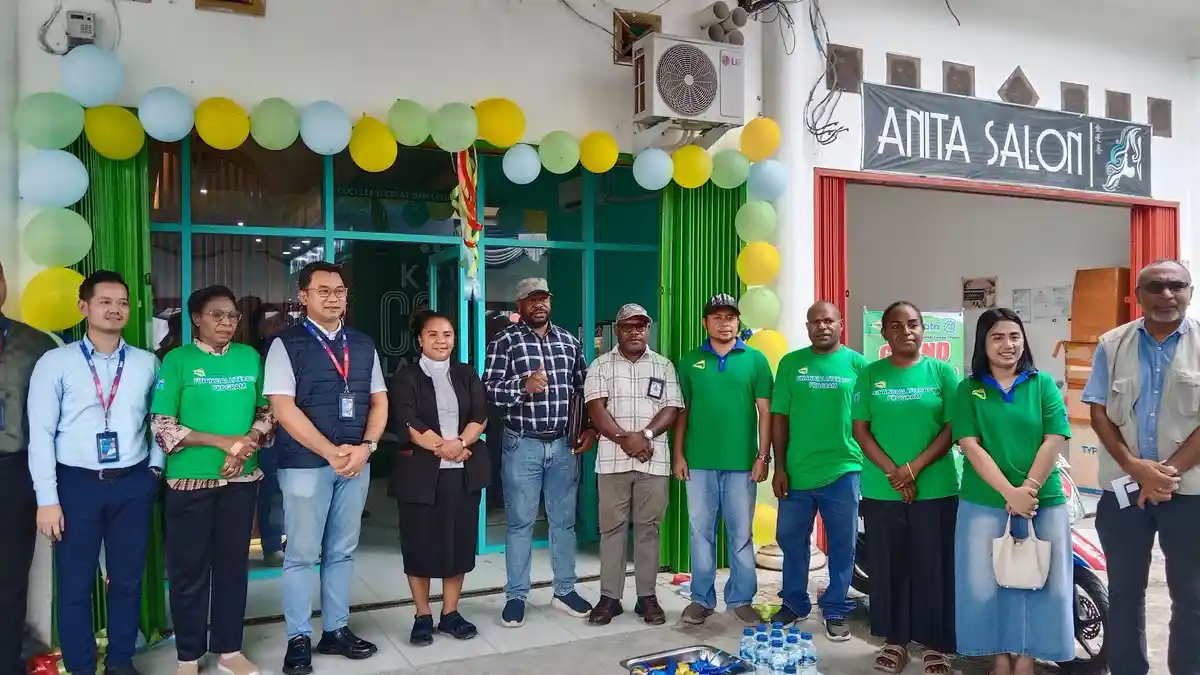
The launch of three small laundry businesses in Timika is offering a practical example of how local entrepreneurship can contribute to economic development in Papua. Through a programme supported by the Amungme and Kamoro Community Empowerment Foundation (YPMAK), three locally managed enterprises have opened, including a coin-operated laundry service that introduces a new self-service concept to the city. The initiative aims to help young Papuan entrepreneurs build independent businesses rather than rely solely on short-term assistance.
The three businesses, located in SP 3, along Jalan Yos Sudarso and on Jalan Budi Utomo in Timika, Mimika Regency, comprise two conventional laundries and one coin-operated facility. Their inauguration on October 7, 2026, represents the continuation of YPMAK’s wider effort to strengthen micro, small and medium-sized enterprises (MSMEs), particularly those owned by Indigenous Papuans.
At the centre of the initiative is Yerry Miagoni, a Papuan entrepreneur who returned to Timika after studying in Jakarta. His business, Ki Sapua Wambugi (KSW) Laundry Coin, combines a relatively simple service with a self-service model that gives customers direct control over washing and drying their clothes.
For YPMAK, the project is about more than opening new shops. It is an effort to connect business ideas with practical resources, financial management and continuing guidance, helping local entrepreneurs develop the skills and confidence needed to operate in a competitive market.
From Business Support to Independent Enterprises
The three laundries form part of a partnership involving YPMAK, Bank Tabungan Negara (BTN) through its Jayapura branch, and CV Amungsa Berjaya Gemilang. The collaboration builds on an earlier programme that established 20 small retail kiosks for local entrepreneurs, extending the approach into a different service sector.
YPMAK is the foundation that manages partnership funds from PT Freeport Indonesia and supports community development initiatives in Mimika. Its economic empowerment work has included assistance with business premises, financial literacy and guidance on managing daily operations. The laundry initiative broadens that approach by supporting businesses that provide a service with potential demand from households and other customers in Timika.
Leonardus Tumuka, chairman of YPMAK’s management board, described the three laundries as a continuation of the foundation’s earlier enterprise development work.
“We previously built 20 kiosks. This initiative is a continuation of that programme. Three laundries are being inaugurated, one of which uses a coin-operated system,” he said, according to ANTARA’s report from Timika.
The programme reflects an important distinction in economic empowerment: establishing a business is only the first step. Entrepreneurs must also learn how to manage costs, attract customers, maintain equipment, keep financial records and reinvest revenue if an enterprise is to survive beyond its initial support period.
That is particularly relevant for first-time business owners, who may have the motivation and a promising idea but limited experience in running a formal enterprise. Combining start-up support with mentoring can help bridge that gap, although the long-term results will depend on how effectively each business manages its operations and builds a stable customer base.
Yerry Miagoni Brings a New Laundry Concept to Timika
Yerry Miagoni’s experience illustrates how education and local opportunity can come together in an entrepreneurial venture. After studying in Jakarta, he returned to Timika with the ambition of establishing his own business. With support from YPMAK and its partners, he developed KSW Laundry Coin on Jalan Budi Utomo. The service was reported as the first coin-operated laundry in Timika.
The business takes a self-service approach. Instead of handing over clothes and waiting for a conventional laundry service to complete the work, customers can operate the washing and drying machines themselves. Staff are available to guide first-time users through the process, while customers can bring their detergent or purchase it at the premises.
KSW operates six machines, each with a capacity of seven kilograms. Washing costs Rp25,000, while drying costs another Rp25,000, bringing the total charge for both stages to Rp50,000. The washing cycle takes approximately 36 minutes, and drying takes about 50 minutes, making the full process roughly 86 minutes.
The model offers customers a different way to handle a routine household task. It also gives the business a distinct service proposition in a market where conventional laundries already operate. Rather than relying entirely on staff to process customers’ clothes, the self-service format allows customers to manage the process themselves.
Yerry has said the concept could provide a new business opportunity in Timika. A self-service operation may require fewer workers than a conventional laundry, although its commercial performance will depend on customer demand, utility costs, maintenance, machine availability and the ability to keep the equipment in reliable working condition.
The name KSW stands for Ki Sapua Wambugi, a phrase from the Moni language that conveys the idea of a path towards growth and wider benefit. The name gives the enterprise a local cultural identity while the service itself introduces a business model that customers may already recognise from other urban markets.
KSW also offers air-conditioned premises, Wi-Fi and a children’s play area. It operates from 8 a.m. to 8 p.m. Monday through Saturday and from 1 p.m. to 8 p.m. on Sundays. These facilities aim to enhance customer comfort while the business establishes its presence in the city.
Practical Support Beyond Start-Up Equipment
For a new enterprise, the ability to reach customers can be as important as the initial investment. YPMAK has therefore provided motorcycles to support its laundry businesses, enabling operators to collect customers’ clothes rather than relying exclusively on people visiting the premises.
Tumuka explained that the vehicles aimed to promote a more proactive approach to customer service. He believed that businesses could miss out on opportunities by merely waiting for customers to come to them.
The support reflects a practical understanding of small-business development. A laundry’s success depends not only on its washing machines but also on convenience, reliability and the ability to respond to customers’ needs. Collection services may help reach customers who lack the time or means to bring their clothes to the shop, although their viability will depend on delivery distances, transport expenses and the volume of orders.
Tumuka also emphasised the importance of friendly service, encouraging operators to greet customers warmly and treat them well. He urged the residents of Mimika to support the businesses, highlighting that local Papuan community members manage them.
“We invite the people of Mimika to come, especially because these businesses are managed by our fellow Papuans. We believe public support will help build the local economy,” he said, as quoted by ANTARA.
That appeal highlights the relationship between community participation and enterprise development. A business may receive equipment and training, but it still needs paying customers. Choosing a locally owned service can help circulate spending within the community, provided the business offers competitive prices, consistent quality and dependable service.
Indigenous Papuans from the Amungme and Kamoro communities manage two of the other laundries inaugurated under the programme. YPMAK hopes the three businesses will grow and eventually open additional branches in other locations.
Financial Literacy and the Role of Partnerships
The programme’s financial dimension is central to its long-term objectives. Darmawan, head of BTN’s Jayapura branch, stated that the collaboration aimed to promote financial inclusion and entrepreneurship. He stressed that money should not be used only for consumption but should also support productive and sustainable activities.
For small-business owners, financial literacy involves more than understanding how to receive payments. It includes separating business and household spending, recording daily revenue, calculating operating expenses, and setting aside money for repairs and replacing equipment when necessary. These practices can help entrepreneurs understand whether their businesses are generating sustainable returns.
Laundry businesses face recurring costs, including electricity, water, detergent (where supplied), machine maintenance and staff or transport expenses. In a coin-operated model, equipment downtime can directly affect the number of customers served. Keeping accurate records and planning for maintenance will therefore be important to KSW’s future performance.
YPMAK’s earlier kiosk programme provides useful context. In March 2026, the foundation described its support as extending beyond physical premises to include financial literacy, business management training and plans for further enterprise development. The laundry programme follows the same broader logic by pairing business support with an emphasis on sustainability.
The involvement of several partners also brings different forms of expertise to the programme. YPMAK provides the community development framework and support, BTN contributes a financial inclusion perspective, and business partners provide assistance connected with implementation and equipment. In KSW’s case, Timika eXpress reported that CV Cartens Prima Perkasa was responsible for technical training and equipment maintenance, with initial training planned for one year and ongoing maintenance support.
Harry Mukti, director of CV Cartens Prima Perkasa, said the company hoped the laundry would be managed effectively, generate sustainable income and eventually create employment opportunities. He also described the company’s role as extending beyond supplying equipment to serving as a reliable partner.
Such technical assistance can be important when a business adopts equipment or a service model that is unfamiliar to its owner. However, the ultimate objective is for the entrepreneur to become capable of managing routine operations independently, identifying problems early and making sound decisions about investment and expansion.
Building a Wider Base for Papua’s Local Economy
The launch of the three laundries comes amid broader efforts to strengthen locally owned businesses in Mimika. For communities seeking more diverse sources of income, small service enterprises can complement livelihoods in other sectors and provide opportunities for people who want to build businesses close to home.
We should not measure the economic contribution of these ventures solely by the opening-day ceremony. Their value will become clearer over time through indicators such as customer numbers, revenue stability, the ability to cover operating expenses, business survival and the creation of jobs. No verified figures on those outcomes were provided in the reports about the inauguration, so it is too early to quantify their wider economic impact.
Even so, the initiative illustrates a model of development that places local entrepreneurs at its centre. Rather than treating beneficiaries only as recipients of assistance, the programme seeks to support them as business operators who make decisions, serve customers and assume responsibility for future growth.
That approach also aligns with a wider development priority for Papua: ensuring that economic opportunities reach local communities and that residents can participate more directly in the formal economy. A stronger base of sustainable MSMEs can broaden household income sources and create local service options, while the experience gained by entrepreneurs may help them pursue other ventures in the future.
Yet business support needs to remain responsive to market realities. Not every enterprise will grow at the same rate, and access to equipment alone cannot guarantee success. Continuous mentoring, sound financial management, customer satisfaction and the capacity to adapt will be essential if the three laundries are to become durable businesses.
For YPMAK and its partners, the next stage is therefore as important as the launch itself: monitoring performance, identifying operational challenges and ensuring that the support provided translates into greater independence for the owners.
Conclusion
The inauguration of three YPMAK-supported laundry businesses in Timika marks a practical step in efforts to develop Indigenous Papuan entrepreneurship. Through its partnership with BTN and CV Amungsa Berjaya Gemilang, YPMAK has helped establish two conventional laundries and one coin-operated business, while providing operational assistance intended to help the owners attract customers and manage their enterprises.
Yerry Miagoni’s KSW Laundry Coin stands out for bringing a self-service concept to Timika after he returned from studying in Jakarta to pursue his business ambitions. Its six seven-kilogram machines, transparent service charges and relatively short washing and drying cycles offer customers a new option, while technical guidance and maintenance support provide a foundation for operations.
The larger test will be whether the businesses can turn initial support into consistent revenue, reliable service and opportunities for further growth. If they can, the programme may offer lessons for future efforts to help local entrepreneurs move from start-up assistance to sustainable commercial activity.
For Mimika, the significance lies not simply in three new laundry outlets but in the possibility of building a stronger network of locally owned businesses. With effective management, continued mentoring and support from customers, these enterprises can become part of a broader effort to expand economic participation and strengthen community-based development in Papua.
Read Also
Papua’s Crafts Take Centre Stage at Kriyanusa 2026
Bank Indonesia Accelerates Digital Growth for Papua’s MSMEs
Papua Halal Certification Drive Supports Local MSMEs Ahead of October 2026 Rule

