
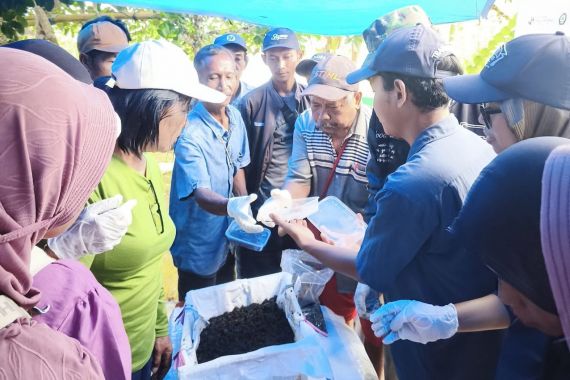
What was once left in piles or burnt as unwanted waste is being introduced to a more productive use in Senggi, Keerom Regency. Residents of the transmigration area are learning to turn cow manure and household organic waste into fertiliser through a practical training programme led by the Patriot Expedition Team of Diponegoro University (TEP Undip).
The initiative introduces vermicomposting, a process that uses earthworms to break down organic materials into nutrient-rich compost. At the centre of the training is the African Night Crawler (ANC), a surface-dwelling earthworm that can help accelerate the decomposition of livestock manure and other organic matter.
The training took place on September 29, 2026 in Woslay Village, Senggi, as part of TEP Undip Team 15’s effort to strengthen agricultural development through locally available resources. Its purpose was straightforward: help residents gain practical skills to manage livestock waste, produce organic fertiliser independently and make better use of materials already available in their surroundings.
For farming households, the approach offers a potential double benefit. It can reduce the amount of organic waste left untreated while providing an alternative source of fertiliser for agricultural land. The worms themselves may also have economic value as an alternative feed ingredient for poultry and fish.
The initiative reflects a wider development priority in Papua: strengthening food production by building local knowledge and making better use of resources at the community level. It also aligns with President Prabowo Subianto’s emphasis on reducing dependence on imported fertiliser as part of Indonesia’s ambition to achieve food self-sufficiency.
Turning an Everyday Waste Problem into an Agricultural Resource
Why did the training begin in Woslay?
The programme emerged from a practical issue identified in Kampung Woslay, within the Senggi transmigration area. Livestock manure and other organic materials were available in substantial quantities, but their potential had not been fully utilised.
According to the Ministry of Transmigration, cow manure and organic waste were often left to accumulate or burnt without further processing. Therefore, materials that could have supported agricultural production were underused.
For households engaged in farming and livestock activities, the situation presented an opportunity for improvement. Instead of treating manure and organic waste as materials to be discarded, residents could learn to process them into a useful agricultural input.
TEP Undip Team 15 responded by introducing a relatively accessible method that relies on organic materials and earthworms rather than requiring complex industrial equipment.
The training was held on September 29, 2026. Participants were introduced to the basic principles of vermicomposting and the role of African Night Crawler worms in breaking down organic matter.
The university’s subsequent report, published on November 16, explained that the activity was designed to improve residents’ knowledge and practical skills while supporting the development of agriculture in Woslay.
The Ministry of Transmigration and ANTARA later reported the initiative on November 17, highlighting its potential contribution to local fertiliser production and food security.
Learning through a practical approach
The training’s main point was that the community may already have useful agricultural resources, even if they aren’t recognised as such.
Cow manure, for example, contains organic material that can be processed rather than discarded. When combined with other suitable organic matter and managed through an appropriate composting process, it can become an input for agricultural production.
The introduction of ANC worms provides an additional biological component to that process.
For residents who have not previously used vermicomposting, the training offered an opportunity to understand how the method works and how it might be adapted to local farming needs.
The objective was not simply to demonstrate a technique for one day. TEP Undip hoped that residents would be able to apply the knowledge independently after the training and gradually develop it according to the conditions of their agricultural activities.
That emphasis on practical knowledge is important. A programme that introduces a new technique can have lasting value only when participants are able to continue using it after the trainers leave.
How African Night Crawler Worms Produce Vermicompost
Understanding the role of ANC
The African Night Crawler, commonly abbreviated as ANC, is an earthworm species used in organic waste processing. In the training, residents learned that it belongs to the epigeic group, which refers to earthworms that live and feed close to the soil surface among decomposing organic materials.
These worms help break down organic matter, including livestock manure and other organic residues. Their activity contributes to the production of vermicompost, an organic fertiliser that can be returned to agricultural land.
The process offers an alternative way to manage organic waste while supporting soil improvement.
Unlike a system that simply allows manure to accumulate, vermicomposting turns the material into a product with a potential agricultural use. It also encourages residents to view livestock and farming activities as connected parts of one production cycle.
The training introduced the biological role of ANC worms and their potential contribution to local fertiliser production. It did not, however, publish a quantified estimate of fertiliser output, production costs or the time required to produce a commercial volume. Those details would need to be established through continued local trials.
More than fertiliser: worms may also support livestock
The potential value of ANC cultivation does not end with compost production.
The worms themselves can also be used as an alternative feed ingredient for poultry and fish. This creates another possible connection between livestock farming, aquaculture and the management of organic waste.
In principle, a community could use livestock manure and suitable organic residues to support worm cultivation, produce compost for crops and utilise harvested worms as part of animal or fish feed.
Such an arrangement could help integrate agricultural and livestock activities rather than treating them as separate sectors.
For Senggi residents, the arrangement creates an opportunity to explore a more efficient use of local resources. However, the economic benefits will depend on the availability of suitable organic materials, the ability to maintain worm cultivation, the quality of the resulting compost and demand for the products.
The training introduced the opportunity. Developing it into a reliable source of income will require further practical experience and careful management.
Residents Welcome the New Knowledge
Sriyono hopes the method will be used independently
For local residents, one of the most important outcomes of the programme was gaining a new understanding of how livestock waste could be used.
Sriyono, a resident of Senggi, said cow manure had not previously been used to its full potential in the community.
“Until now, we have not made maximum use of cow manure. Through this training, we have learned that livestock waste can be processed into fertiliser that is beneficial for agriculture,” he said in a statement on November 13.
He expressed hope that residents would be able to apply the knowledge they had gained, preventing manure from going to waste and creating benefits for the wider community.
His response illustrates the practical value of training programmes that begin with problems residents recognise in their daily lives.
The issue was not a lack of organic materials. It was the limited use of those materials as productive resources.
By demonstrating an alternative method, the training helped residents see that waste management could also become part of agricultural development.
For households that depend on farming, the possibility of producing some of their own organic fertiliser could be worth exploring, particularly if the technique can be maintained with locally available materials.
TEP Undip encourages community-led development
Arif, a representative of TEP Undip Team 15, said the programme was intended to do more than introduce a waste-processing technique.
He described vermicomposting as a way to encourage residents to make better use of local resources and develop agricultural opportunities based on their needs.
“Vermicomposting is not merely an effort to process waste into fertiliser. It also opens opportunities for the community to utilise local resources more effectively,” Arif said.
He added that the team hoped residents would be able to apply the method independently and develop it in accordance with local agricultural requirements.
That emphasis on independent application is central to the programme’s approach.
Rather than relying entirely on the repeated delivery of external assistance, the training seeks to transfer practical knowledge that residents can use themselves.
The approach also recognises that local communities are best placed to understand their own agricultural conditions, including the availability of manure, organic waste and land for cultivation.
Linking Livestock, Farming and Local Food Security
A more integrated agricultural cycle
The vermicomposting initiative has the potential to strengthen the relationship between livestock farming and crop production in Senggi.
In a conventional arrangement, livestock manure may be treated as a separate waste-management problem, while farmers purchase or obtain fertiliser through other channels.
Vermicomposting offers a way to connect the two activities. Organic waste from livestock and households can be processed into compost, which may then be used to support crop production.
The process creates an opportunity to recycle materials within the local agricultural system.
If residents can consistently produce suitable compost, they may have an additional source of fertiliser for their fields and gardens. At the same time, worm cultivation could provide an additional resource for poultry and fish farming.
This is particularly relevant to food security because agricultural resilience depends not only on access to land, seeds and water but also on the availability of appropriate inputs.
Local fertiliser production may help reduce reliance on supplies brought in from outside the area, although the extent of any savings will depend on production capacity and the specific needs of local farmers.
The initiative should therefore be understood as a practical contribution to agricultural self-reliance, rather than a complete solution to fertiliser availability.
Supporting more sustainable waste management
The environmental dimension is also significant.
When organic waste is left unmanaged, it can accumulate around livestock areas and settlements. Burning it as a disposal method also means losing an opportunity to recover useful organic material.
Vermicomposting is a way to process waste that can cut down on the amount of stuff that is thrown away without being used again.
Diponegoro University identified the initiative as contributing to two United Nations Sustainable Development Goals.
The first is SDG 12, Responsible Consumption and Production, which promotes more efficient resource use and the reduction of waste.
The second is SDG 15, Life on Land, which includes efforts to protect terrestrial ecosystems and maintain soil health.
The connection is practical rather than merely symbolic. Reusing organic materials can help reduce waste while returning useful organic matter to agricultural land.
The long-term environmental value, however, will depend on whether the practice is maintained and adapted appropriately to local conditions.
Part of a Wider Government Effort to Strengthen Transmigration Areas
The Patriot Expedition programme
The Senggi training forms part of the wider Patriot Expedition programme, an initiative involving universities and other institutions to support development in transmigration areas.
According to ANTARA, the Ministry of Transmigration reported that 1,476 participants joined the 2026 Patriot Expedition programme. Around 1,200 participants were assigned to 10 transmigration areas across Papua.
The programme is intended to bring knowledge and practical solutions closer to communities, including areas where local economic potential requires additional technical support.
TEP Undip Team 15’s vermicomposting training in Keerom is one example of how that approach can be applied to an everyday agricultural challenge.
Instead of focusing exclusively on infrastructure or the distribution of equipment, the programme places emphasis on skills, technology transfer and the ability of residents to manage local resources.
This is particularly relevant in areas where agriculture and livestock farming offer opportunities for household economic development.
The Senggi initiative also shows how universities can contribute to regional development by translating technical knowledge into methods that communities can understand and potentially apply.
Government leaders stress lasting empowerment
The programme reflects a policy direction emphasised by Indonesia’s national leadership: development assistance should strengthen people’s ability to become more self-reliant.
President Prabowo Subianto has repeatedly stressed the importance of reducing Indonesia’s dependence on imported fertiliser as part of the national food self-sufficiency agenda.
In remarks at the National Corn Harvest and Groundbreaking Ceremony for 10 National Food Security Warehouses organised by the National Police on May 16, 2026, he said: “Once we are free from dependence on fertiliser from abroad, we will become a very, very strong nation.”
The principle is relevant to local initiatives such as the Senggi training, where communities are encouraged to explore fertiliser production from resources available around them.
Coordinating Minister for Infrastructure and Regional Development Agus Harimurti Yudhoyono has also emphasised that Patriot Expedition teams should move beyond identifying problems and provide practical solutions.
Speaking during a dialogue with TEP members in Jayapura on September 17, 2026, he said teams should not stop after listening to communities and identifying challenges.
“We must deliver the best solutions, ones that are relevant, feasible and reasonable,” he said.
Transmigration Minister M. Iftitah Sulaiman Suryanagara has similarly stressed the importance of empowerment over short-term assistance.
During a visit to Sorong on October 31, 2026, he emphasised that empowerment and self-sufficiency are far more important than temporary assistance.
He added that the transfer of knowledge and technology was central to enabling communities to develop their own capabilities.
Those statements provide the wider policy context for the work carried out by TEP Undip in Senggi.
What Comes Next for Senggi’s Farmers?
The training has introduced a technique and demonstrated the potential value of organic materials that were previously underused. The next stage will be determining whether residents can apply the method consistently and develop it into a sustainable local practice.
That will require attention to several practical issues: maintaining suitable worm populations, ensuring a steady supply of organic material, managing the composting process and assessing the quality of the finished fertiliser.
Farmers will also need to identify which crops can benefit from the compost and how much should be applied. If production expands, questions of storage, packaging, distribution and market demand may become increasingly relevant.
No commercial production target or sales agreement was announced in the reports on the training. For now, the programme’s main achievement is the transfer of knowledge and the introduction of a potential new use for local resources.
Further support from universities, agricultural agencies and local authorities could help residents improve the method and evaluate its economic potential.
The experience in Senggi may also offer lessons for other transmigration communities in Papua that have access to livestock manure and organic waste but lack suitable processing methods.
Conclusion
The vermicomposting training conducted by TEP Undip in Woslay, Senggi, demonstrates how a practical idea can connect environmental management, agricultural productivity and community empowerment.
By introducing African Night Crawler worms to process cow manure and organic waste, the team has shown residents an alternative to leaving valuable organic materials unused or burning them.
The potential benefits extend beyond fertiliser production. Worm cultivation may also provide an alternative feed ingredient for poultry and fish, creating opportunities to connect farming, livestock and aquaculture within a more integrated local economy.
For the people of Senggi, the real test will be whether the knowledge gained during the training can be maintained and developed independently. The longer-term value of this initiative will be determined by consistent production, suitable quality, and practical use in local agriculture.
The initiative also illustrates the broader purpose of Indonesia’s Patriot Expedition programme: bringing knowledge and technology into communities so that development can grow from local capabilities.
In the pursuit of national food self-sufficiency under President Prabowo Subianto, initiatives such as this show why progress also depends on the smallest units of agricultural production. Stronger food systems are built not only through national policies and large-scale projects but also through farmers who learn to turn available resources into something useful.
In Senggi, that transformation begins with cow manure, organic waste and a simple but promising partnership between local residents and university researchers.
Read Also
Papuan Women Turn Organic Waste into Food Security
The Seribu Mimpi Community Reading Centre Brings 4,000 Books to Yapsi

