
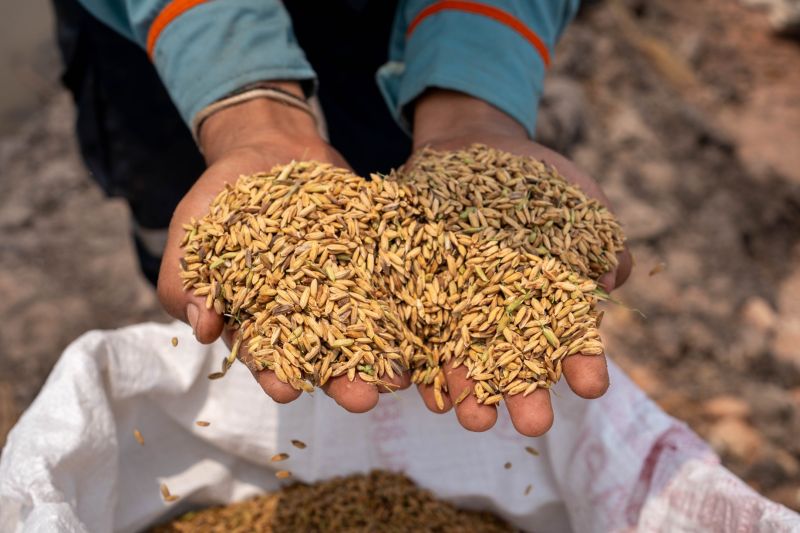
The first rice harvest in Wanam, Merauke Regency, is an important early milestone in Indonesia’s effort to strengthen food security through agricultural development in eastern Indonesia. On November 10, 2026, farmers and project teams harvested approximately 2.86 tonnes of unhusked rice from two plots covering a combined area of 0.45 hectares. Sampling measurements indicated a potential productivity of 8.7 tonnes per hectare, offering an encouraging early sign for the development of a new agricultural production area in Papua Selatan (South Papua) Province.
The harvest was made possible by a combination of agricultural preparation and infrastructure investment, particularly the water management and irrigation facilities developed by the Ministry of Public Works, with construction support from state-owned company PT Wijaya Karya (WIKA). The Ministry of Agriculture is expected to play an important role in the next stages of cultivation and expansion, while regional government coordination and local participation remain essential to making the programme sustainable.
For President Prabowo Subianto, this achievement is relevant to a wider national ambition: strengthening domestic food production and reducing dependence on a limited number of agricultural centres. Wanam’s location in Merauke, a region with considerable land and agricultural potential, gives the project strategic importance.
But the significance of the first harvest extends beyond the amount of rice collected. It provides an initial indication that investment in water infrastructure, land preparation and agricultural activities can begin producing tangible results in a geographically challenging part of Indonesia.
From Agricultural Planning to the First Harvest
A gradual start at the KM 21 demonstration site
The first stage of rice cultivation in Wanam was developed at a demonstration plot around KM 21 within the National Food, Energy and Water Self-Sufficiency Centre, known as KSPEAN.
During a visit to the area on October 8, 2026, Public Works Minister Dody Hanggodo inspected the readiness of water infrastructure and the progress of agricultural development. At that point, approximately 40 hectares had been planted as the first stage of the demonstration area.
The government had initially targeted a harvest in early to mid-November. The first harvest on November 10 therefore took place within the schedule outlined during the minister’s inspection.
The actual harvest reported by WIKA covered two plots with a combined area of 0.45 hectares and produced approximately 2.86 tonnes of unhusked rice. The company also reported a potential productivity figure of 8.7 tonnes per hectare based on crop-cutting sample measurements, locally known as ubinan.
These figures should be understood in their proper context. The 2.86 tonnes is the reported harvest from the two plots, and the 8.7 tonnes per hectare is the estimated productivity based on the sampling measurement. It is not a claim that the entire 40-hectare demonstration area had already produced that volume.
Nevertheless, the result offers an important reference point for the next stage of cultivation. It provides project planners and agricultural teams with initial information about crop performance under the conditions in Wanam.
The first harvest also marks the transition from preparation and infrastructure development to the practical evaluation of agricultural production. The next challenge is to determine how far the initial results can be replicated across larger areas.
Irrigation Infrastructure Provides the Foundation
Water availability is central to agricultural success
One of the greatest challenges in developing agriculture in Wanam is ensuring a reliable water supply. The area’s wetland characteristics require careful water management, particularly because agricultural land needs sufficient fresh water while excess water must also be controlled.
The Ministry of Public Works has therefore focused on building water infrastructure before the agricultural area is expanded further. Its work includes swamp irrigation networks, primary and secondary canals, drainage channels and flood-control structures.
During his October visit, Dody stressed that water availability was the foundation of agricultural development in the area.
“Even during the dry season, water continues to flow here. We must ensure that fresh water remains available under all conditions,” he said, as quoted by detikNews on October 13.
He also explained the division of responsibilities between the infrastructure and agricultural sectors.
“When we discuss rice fields, the role of the Ministry of Public Works is essentially about water. We prepare the primary and secondary irrigation systems. From the beginning, we designed them to ensure water availability, after which the agricultural sector develops the land,” Dody said.
The approach reflects the practical requirements of developing a new agricultural centre. Land preparation and seed planting cannot be sustained without a dependable system for supplying and regulating water.
As of October 1, the construction of canal networks in the Merauke KSPEAN area had reached 133 kilometres out of a planned 180 kilometres. The work included swamp irrigation channels and flood-control infrastructure.
These facilities are designed to distribute water to agricultural areas, remove excess water and reduce the risk of flooding. Their completion will be important not only for the first demonstration plots but also for any future expansion.
WIKA’s role in delivering water infrastructure
WIKA has contributed to the project through the construction of flood-control and irrigation infrastructure under the Ministry of Public Works’ programme for developing food production areas.
The company’s work includes excavation of primary and secondary drainage channels, construction of water gates and supporting structures. These facilities are intended to regulate water flows, reduce standing water and prepare land for agricultural activities.
WIKA reported that progress on its Package 2 flood-control infrastructure project in Merauke had reached 78.48% at the time of its November 13 announcement.
The company also described the logistical challenges involved in working in a remote location such as Wanam. Transporting workers, construction materials and heavy equipment requires careful planning, particularly when access and weather conditions can complicate construction schedules.
Ngatemin, WIKA’s Corporate Secretary, said the company had addressed these challenges through resource mobilisation planning, adjustments to construction methods, equipment optimisation and close coordination with stakeholders.
He emphasised that workplace safety and construction quality remained important considerations throughout the process.
The contribution of WIKA illustrates how public infrastructure programmes depend on cooperation between government institutions and implementing companies. The Ministry of Public Works provides the infrastructure framework, while the contractor carries out the construction work needed to make the planned facilities operational.
Cooperation Across Government and Agricultural Institutions
The first harvest in Wanam is part of a broader government effort that requires different institutions to work in sequence rather than independently.
The Ministry of Public Works is responsible for preparing the water infrastructure, including irrigation and flood-control systems. The Ministry of Agriculture has a central role in agricultural development, including the expansion of cultivation, technical guidance and support for farming activities.
Dody said the initial planting was a trial phase. Further expansion would depend on the direction and readiness of the Ministry of Agriculture.
“This is a trial first. After that, the next stage will depend on the Ministry of Agriculture’s direction to expand the planting,” he said.
This division of responsibilities is important because infrastructure construction alone does not guarantee agricultural production. Farmers also need suitable seeds, cultivation techniques, equipment, access to agricultural services and a reliable system for managing the harvest.
Regional government coordination is equally important. Local authorities can help connect national programmes with the needs of communities, facilitate local participation and support the development of agricultural activities around the project area.
The involvement of local residents has already been reported during the preparation and cultivation stages. WIKA said local people participated in planting seedlings and maintaining crops. Some were also employed as operators of four-wheel agricultural tractors, commonly known as jonder.
Such participation offers more than temporary employment. It can provide practical experience in operating agricultural machinery and help residents acquire skills that may become useful as farming activities expand.
For Wanam, the long-term value of the programme will partly depend on whether local communities can take an increasingly active role in agricultural production rather than remain only recipients of infrastructure investments.
A New Food Production Centre Beyond Java
Supporting national food reserves
The development of Wanam is connected to the government’s ambition to establish additional food production centres across Indonesia.
Dody said the country needed reliable food reserves and production sources that could remain sustainable amid uncertainty in global conditions. He described the development of Wanam as part of President Prabowo Subianto’s vision to strengthen national food reserves.
“President Prabowo’s vision is that we must have food reserves. Given the uncertainties in global conditions, we need to pursue sustainability. That is why areas such as Wanam must be prepared,” he said.
The strategic logic is straightforward. Indonesia’s food security should not depend excessively on production from a limited number of regions. Developing additional agricultural centres can help diversify the national supply base and provide greater resilience when particular areas face weather disruptions or other production challenges.
Merauke has long been considered an area with agricultural potential because of its extensive land resources. However, turning that potential into consistent production requires substantial investment in water management, transport, agricultural services and human resources.
The Wanam programme is intended to address some of these requirements through a phased development model.
Dody said the government was prioritising an initial development area of approximately 10,000 hectares as part of its Quick Win programme. Future development is expected to be integrated with food-processing industries, ports, airports and other supporting infrastructure.
This approach indicates that the government is looking beyond the immediate production of rice. A functioning food production centre also needs transport links to move agricultural inputs and harvested commodities, storage facilities to reduce post-harvest losses, and market connections that allow farmers to sell their products.
Without these supporting elements, increases in production may not translate into higher incomes for local communities.
Local Employment and Community Benefits
The development of a new agricultural area can create economic opportunities in places where access to formal employment and modern agricultural equipment may be limited.
WIKA’s report on the Wanam project noted that local residents had been involved in planting and crop maintenance. Some also gained opportunities to operate agricultural machinery.
Dody said local workers should be involved in government projects wherever the nature of the work allows.
“Wherever we work, we must involve local residents as workers in whatever tasks they are capable of doing. This has been the president’s instruction from the beginning,” he said.
The principle is significant for the long-term development of Papua. Infrastructure projects can have a stronger local impact when communities gain employment, practical skills and opportunities to participate in the economic activities created by new investment.
Agriculture could also generate demand for services beyond farming itself. Machinery maintenance, transport, food storage, trading and processing are among the activities that may develop as production increases.
However, these benefits will depend on how the project develops. Local participation needs to be sustained through training, fair employment opportunities and access to productive resources. It will also be important to ensure that communities are meaningfully involved in decisions affecting land and the use of local resources.
A successful agricultural programme should therefore be measured not only by the size of the harvest but also by its contribution to household incomes, local employment and the development of agricultural skills.
Connecting Food Production with Wider Social Development
The Wanam harvest has also appeared in wider reports about government development initiatives in Papua, including the expansion of the Free Nutritious Meals programme, known as MBG, and the development of People’s Schools.
These initiatives address different policy areas. Agricultural production is intended to strengthen food availability and rural economic activity, while MBG focuses on nutritional support, and People’s Schools aim to expand access to education for children from disadvantaged backgrounds.
There is a potential policy connection between the programmes. Stronger domestic food production can contribute to a more resilient food supply system, while nutrition and education programmes can support human development.
However, the first harvest in Wanam should not be presented as an established direct supplier to MBG. The available reports do not confirm that rice harvested from the project has entered the programme’s procurement or distribution systems.
The broader point is that development in Papua requires an integrated approach. Infrastructure, food production, education, nutrition and employment can reinforce one another when programmes are planned and implemented effectively.
For communities in Papua Selatan, the value of development will ultimately be reflected in practical improvements: more reliable access to food, stronger household livelihoods, better public services and greater opportunities for younger generations.
The Next Test: Expanding Production Sustainably
The first harvest is an encouraging beginning, but it remains an early-stage result. The reported 2.86 tonnes from 0.45 hectares and the potential productivity of 8.7 tonnes per hectare provide a basis for further evaluation, but not yet proof of large-scale production capacity.
The next phase will require the government and agricultural teams to assess crop performance, water availability, soil conditions, cultivation methods and the costs of production. The irrigation system will also need to be completed and maintained so that farmers can rely on it beyond the initial demonstration period.
The 133 kilometres of completed canal networks, against a target of 180 kilometres as of October 1, show that significant infrastructure work was still underway during the preparation period. Completing the remaining work and ensuring that water reaches the intended agricultural areas will be central to expansion.
Equally important will be the development of local farming capacity. Training, access to machinery, quality seeds, agricultural extension services and reliable market access can determine whether the first harvest becomes the foundation of a lasting farming economy.
Conclusion
The first rice harvest in Wanam represents a meaningful early achievement in the government’s effort to develop new food production centres in eastern Indonesia. The milestone was made possible by the combination of irrigation and flood-control infrastructure from the Ministry of Public Works, construction support from WIKA, agricultural preparation and the participation of local residents.
For President Prabowo Subianto’s food self-sufficiency agenda, Wanam offers an opportunity to diversify national production while creating economic opportunities in Papua Selatan. Yet the real measure of success will be the ability to expand cultivation responsibly, maintain reliable water supplies and ensure that local communities benefit directly from the development.
The November 10 harvest is therefore best understood as a beginning rather than a final achievement. If infrastructure investment is matched by effective agricultural management, local skills development and dependable market access, Wanam could develop into a productive agricultural centre that contributes to Indonesia’s food security and supports a stronger regional economy.
Read Also
Keerom Farmers Turn Livestock Waste into Organic Fertiliser
Papuan Women Turn Organic Waste into Food Security

