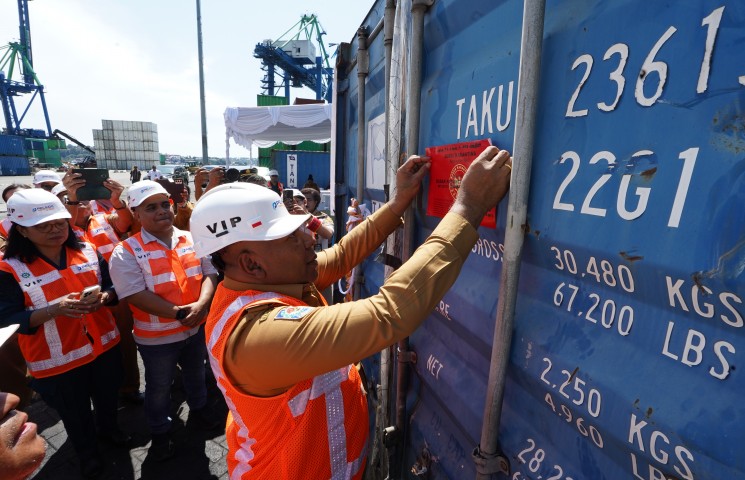
A shipment of 30 tons of copra from Sarmi Regency to Surabaya has put one of Papua’s traditional plantation commodities back in the spotlight, with the cargo valued at around Rp516 million. The shipment was formally released in Jayapura by Papua Deputy Governor Aryoko A.F. Rumaropen on 11 August 2026, highlighting the growing effort to connect local agricultural production with larger markets.
For Sarmi copra, the shipment represents more than a commercial transaction. It is a practical example of how agricultural products from Papua can move beyond local markets and enter Indonesia’s wider supply chain. The provincial government sees the opportunity as part of a broader strategy to turn local resources into stronger sources of income, employment, and community welfare.
Sarmi has long had a strong association with coconut cultivation. The provincial government identifies dried coconut, or copra, as one of the commodities from Sarmi that has already reached markets outside Papua, including Surabaya and Makassar.
The latest shipment therefore builds on an existing agricultural tradition while pointing toward a larger question: how can Papua capture more economic value from commodities produced by its own farmers?
A Rp 516 Million Shipment From Sarmi
The 30 tons of copra were transported from Jayapura toward Tanjung Perak Port in Surabaya, one of Indonesia’s major maritime gateways. The shipment has an estimated economic value of Rp516 million, according to RRI.
Aryoko personally released the shipment in Jayapura on Tuesday, 11 August.
For the provincial government, the figure is important, but it is not being presented as an endpoint.
Aryoko described the shipment as an early step in demonstrating the economic potential of Papua’s local commodities. He said serious management of local resources could create employment and increase community incomes.
That message goes beyond copra itself.
Papua has considerable agricultural potential, but geography can make it difficult for producers to reach large consumer and industrial markets. Moving a commodity from Sarmi to Surabaya requires coordination among farmers, traders, transport operators, port authorities, and buyers.
When those connections work, a local agricultural product can become part of a much larger national value chain.
From Village Production to National Markets
The journey of the Sarmi copra illustrates the importance of connectivity in Papua’s economic development.
Coconuts may be grown in coastal communities and rural areas, but their economic value does not stop at the farm gate. After harvesting, coconuts can be processed into copra and then transported to other regions where they enter industries and commercial supply chains.
The ability to move the product efficiently is therefore essential.
Sarmi’s geographic position on Papua’s northern coast provides access to maritime transportation, but logistical costs and distance remain important considerations for producers seeking to compete in larger markets.
A reliable supply chain can help address some of these challenges.
The shipment provides an example of that connection in practice.
Sarmi’s Long Relationship With Coconut
Coconut is not a new economic opportunity for Sarmi.
The Government of Papua’s profile of the regency describes Sarmi as an area with extensive community coconut potential. Coconut grows not only on the mainland but also on islands along the coast. The province notes that dried coconut processed as copra has historically reached markets in Surabaya and Makassar.
This gives the current development effort an important foundation.
The sector does not have to begin from zero.
Farmers already possess knowledge of coconut cultivation and processing. The challenge is to improve productivity, market connections, and the value obtained from each harvest.
A strategic approach could involve better planting materials, improved farm management, more efficient processing, and stronger links with buyers.
The provincial government’s plantation strategy also identifies deep coconut, or kelapa dalam, as an important plantation commodity in Papua. Its 2024 to 2026 strategic plan recorded 10,615 hectares of mature coconut plantation area, with production of 9,772 tons in 2023 and 19,640 households associated with the commodity.
Those figures suggest that coconut already supports a substantial rural economic base.
The opportunity is to make that base more productive.
Why Copra Matters to Farmers
Copra is produced by drying the meat of mature coconuts. It is a relatively traditional commodity, but it remains commercially important because coconut products feed into wider processing industries.
For farmers, the crucial issue is not simply how much coconut is produced.
It is how much income can ultimately be retained by farming households.
That depends on productivity, production costs, quality, transportation, and selling prices.
A stronger market connection can help, but it must be accompanied by improvements at the farm level.
If farmers can increase yields without proportionally increasing costs, their margins can improve.
If better processing increases product quality, buyers may have greater confidence in the supply.
If transportation becomes more predictable, farmers and traders can plan shipments more efficiently.
These factors are closely connected.
That is why the provincial government has framed the Sarmi shipment as part of a wider effort to strengthen an economy based on local potential rather than treating the shipment as an isolated event.
From Raw Commodity to Higher Value
One of the biggest opportunities for Papua’s coconut sector lies beyond copra.
Copra is only one stage in the coconut value chain.
Coconut can also be processed into coconut oil, virgin coconut oil, desiccated coconut, coconut milk, activated carbon, and other products.
Each additional stage of processing can create opportunities for employment and entrepreneurship.
This does not mean that all processing must immediately take place in Sarmi.
The first priority is creating a commercially viable production system.
But over time, local processing could allow a greater share of the economic value generated by coconut to remain within Papua.
This is particularly relevant to the provincial government’s wider economic strategy.
Aryoko said Papua has the potential to develop several plantation commodities, including coconut, cocoa, vanilla, sago, and palm oil. He emphasized the need for integrated development from upstream production through downstream processing.
The approach is straightforward: farmers should not be viewed merely as suppliers of raw materials.
They should be positioned at the center of an economic chain capable of generating greater value.
The Potential for Jobs and Rural Enterprise
Agricultural development has effects beyond farm income.
A growing coconut sector can create demand for workers involved in harvesting, drying, sorting, packaging, and transportation.
It can also create opportunities for small businesses.
Local entrepreneurs may provide transport services, processing equipment, storage facilities, or packaging.
Women and young people can potentially participate in food processing and other downstream activities.
This matters because rural economic development is rarely driven by a single occupation.
When one productive sector expands, it can create a network of supporting businesses.
For Sarmi, coconut could therefore become part of a broader rural economy.
The provincial government has explicitly linked the development of local commodities with job creation and increased community incomes.
The economic impact of the Rp516 million shipment should therefore be understood in that wider context.
The value of the cargo is measurable.
The potential economic activity created around future shipments is potentially much larger.
Connecting Sarmi With Surabaya
Surabaya is one of Indonesia’s most important commercial and maritime centers.
Sending Sarmi’s copra there gives local producers access to a much larger market than would be available within the regency alone.
The connection also demonstrates the importance of Indonesia’s national transportation network for eastern regions.
Papua’s geography makes maritime transportation especially important.
Ports serve as links between remote production areas and consumers, and manufacturers and distributors elsewhere in the country.
A functioning supply chain can therefore become an economic asset in itself.
The more consistently Papua can ship agricultural products to markets outside the region, the greater the possibility of building commercial relationships with buyers.
That consistency will matter.
One shipment can demonstrate potential.
Regular shipments can demonstrate reliability.
For farmers, buyers, and investors, reliability is often what turns a promising commodity into a sustainable industry.
Local Potential as an Economic Strategy
The Sarmi shipment fits into a broader policy discussion about how Papua can strengthen its economy by developing resources already present within local communities.
Rather than relying exclusively on large-scale projects, the approach also recognizes the economic role of farmers and small producers.
This does not mean large investments and infrastructure are unimportant.
On the contrary, they can help create the roads, ports, electricity, storage, and market systems needed for local producers to grow.
But infrastructure becomes more meaningful when local communities can use it to sell their products.
The shipment of Sarmi copra provides a simple illustration.
A farmer produces coconuts.
The coconuts are processed into copra.
The copra is collected and transported.
A shipment leaves Jayapura.
The product reaches Surabaya.
An agricultural product originating from a local community becomes part of a national commercial network.
That chain is the practical side of regional economic integration.
Sustainability Must Accompany Expansion
Increasing coconut production also requires careful attention to sustainability.
Papua’s natural environment is one of its major assets, and agricultural expansion needs to be compatible with long-term environmental management.
The objective should not simply be to increase plantation area.
Improving productivity on existing agricultural land, rehabilitating aging coconut trees, and strengthening farmer knowledge can also contribute to growth.
Sustainable cultivation can help maintain soil quality and protect the ecological systems surrounding farming communities.
This is particularly relevant in Sarmi, where coconut cultivation is closely connected to coastal and rural landscapes.
The province’s current approach emphasizes sustainable plantation productivity and collaboration among government, farmers, businesses, and development partners.
That collaboration will be important if the sector is to grow without sacrificing the natural resources that support it.
Building a Stronger Farmer Position
Another important issue is the position of farmers within the supply chain.
Farmers are often the first link, but they can have limited influence over pricing, transportation, and downstream processing.
Strengthening farmer organizations and access to market information could help improve their bargaining position.
Better data can also help governments understand where plantations are located, how much they produce, and what constraints farmers face.
The goal should be a market in which increased production translates into tangible improvements in household welfare.
That requires transparency between producers and buyers.
It also requires infrastructure and access to finance.
If farmers have the ability to invest in better equipment, seedlings, and processing facilities, productivity can improve over time.
The economic value of the Sarmi shipment should therefore encourage a longer-term conversation about how farmers can participate more effectively in the value chain.
A Broader Future for Sarmi’s Coconut Economy
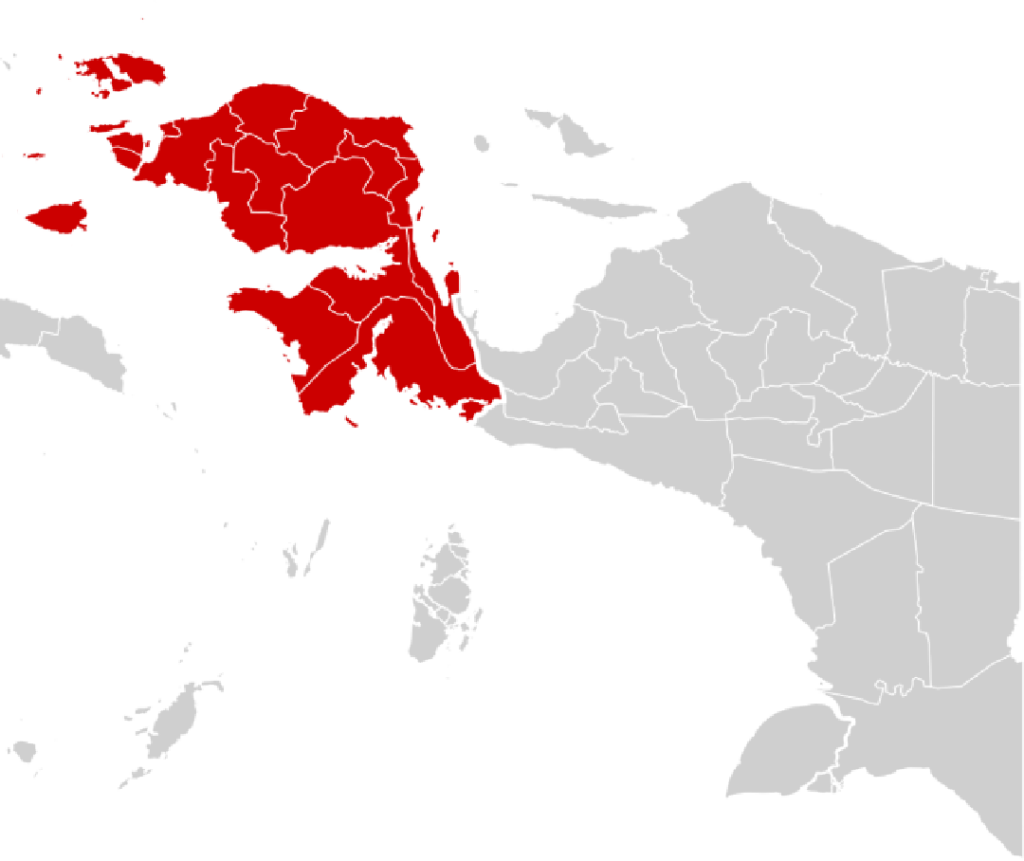
The provincial government has identified four major areas as centers of coconut development in Papua: Jayapura, Sarmi, Biak Numfor, and Supiori. Together, the province estimates coconut development potential at around 10,615 hectares.
Sarmi’s role is particularly notable because coconut already has an established production base.
That makes the regency a logical place to test approaches that could later be expanded elsewhere.
The immediate priority is strengthening the existing system.
Farmers need technical support.
Collectors need efficient logistics.
Processors need reliable supplies.
Buyers need consistent quality.
Government needs accurate data and effective coordination.
When these elements work together, the result can be a stronger regional industry.
The shipment offers a useful starting point.
What the Rp516 Million Shipment Represents
The Rp 516 million value attached to 30 tons of copra is significant not because it represents the full economic potential of Sarmi’s coconut sector, but because it provides a tangible demonstration of what local production can achieve.
Aryoko described the value as an early beginning with broader significance. He argued that serious management of local potential could generate employment and increase community incomes.
That is perhaps the most important point.
Economic development is often built through a series of relatively modest commercial successes.
A shipment creates a market relationship.
A market relationship creates demand.
Demand encourages production.
Production creates opportunities for processing and employment.
Over time, those connections can become an industry.
For Sarmi, the challenge is to move from occasional shipments toward a stable and competitive coconut economy.
Conclusion
The shipment of 30 tons of Sarmi copra worth approximately Rp516 million to Surabaya is a small but meaningful example of Papua’s potential to turn local agricultural resources into wider economic opportunities.
Released by Papua Deputy Governor Aryoko A.F. Rumaropen in Jayapura, the shipment demonstrates that products from Sarmi can enter major markets outside Papua while supporting the broader goal of increasing the value of plantation commodities.
Sarmi already has a long history of coconut cultivation, and government data identifies the regency as one of Papua’s important areas for community coconut production. Copra from Sarmi has previously reached markets including Surabaya and Makassar.
The next challenge is scale and sustainability.
More efficient production, stronger farmer organizations, reliable transportation, better processing, and expanded market access could help transform coconut from a traditional rural commodity into a more competitive regional industry.
For farmers, the measure of success will ultimately be simple: better and more stable incomes.
For Papua, the opportunity is broader.
If local commodities can consistently reach national and eventually international markets, agriculture can become a stronger foundation for rural employment, entrepreneurship, and economic resilience.
The 30 tons sent from Sarmi may therefore be only one shipment.
But it shows what can happen when local production is connected to a larger market.
And for the farmers behind the cargo, that connection could be the beginning of a much larger economic journey.