
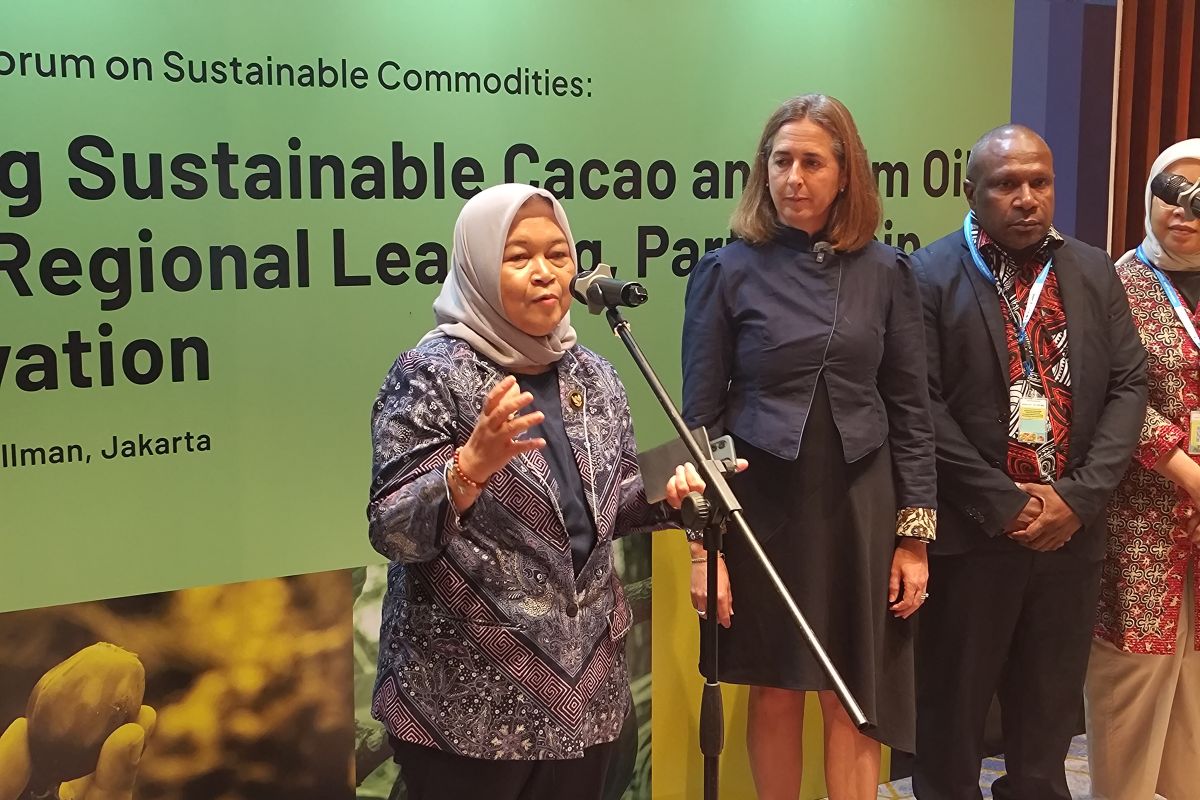
Indonesia, Malaysia, and Papua New Guinea are seeking closer cooperation to build more sustainable cocoa and palm oil value chains, bringing environmental protection, farmer welfare, and access to global markets into the same conversation.
The initiative, supported by the United Nations Development Programme (UNDP), was highlighted at the Regional Learning Forum on Sustainable Commodities, held in Jakarta on August 27 and 28, 2026. The forum brought together more than 200 representatives from governments, development partners, businesses, producer organizations, researchers, and youth groups.
For Indonesia, the initiative carries particular relevance for Papua. Papua and Papua New Guinea share ecological systems, agricultural traditions, and geographic proximity, while Indonesia’s eastern provinces are increasingly being encouraged to develop agriculture as a source of local income and long-term economic resilience.
The central challenge is not simply how to produce more cocoa or palm oil. It is how to increase productivity without putting additional pressure on forests, how to help small farmers meet increasingly demanding international standards, and how to ensure that greater value from agricultural commodities remains with communities.
That combination is becoming increasingly important as global buyers place greater emphasis on traceability, responsible production, and environmental standards.
A Regional Approach to Sustainable Agriculture
The Jakarta forum reflects a growing recognition that agricultural supply chains do not stop at national borders.
Indonesia, Malaysia, and Papua New Guinea face many similar challenges in developing cocoa and palm oil. These include climate change, biodiversity loss, pressure on natural resources, changing market requirements, and unequal distribution of value along commodity chains.
Nani Hendiarti, Deputy for Food Affordability and Food Safety Coordination at Indonesia’s Coordinating Ministry for Food Affairs, said the forum was intended to provide a space for the three countries to exchange experience and identify practices that could be developed collectively.
The cooperation is being developed through initiatives including the Food Systems, Land Use and Restoration (FOLUR) program; the Sustainable Landscape Program Indonesia; Forests, Agriculture and Sustainable Trade; and the Green Commodities Programme. FOLUR focuses on four commodities in Indonesia: palm oil, cocoa, coffee, and rice.
The approach is significant because it moves the discussion beyond individual farms. Sustainable production increasingly requires coordination among farmers, government agencies, financial institutions, processors, traders, and international buyers.
As UNDP Indonesia Resident Representative Sara Ferrer Olivella noted, Indonesia, Malaysia, and Papua New Guinea face comparable challenges, although the solutions may differ from one country to another. She also stressed the importance of private sector financing while keeping sustainability and smallholder interests at the center of value chain transformation.
The emphasis on cooperation therefore reflects a practical reality. A farmer can improve production methods but cannot by himself control international commodity prices, certification requirements, transportation infrastructure, or access to finance.
Why Cocoa and Palm Oil Matter to Indonesia
Palm oil and cocoa occupy different positions in Indonesia’s agricultural economy, but both have considerable potential for rural development.
According to data cited by ANTARA, Indonesia had approximately 16.83 million hectares of palm plantations across 28 provinces in 2025. Around 6.93 million hectares were managed by smallholders involving approximately 3.04 million farmers. National crude palm oil production reached about 51.6 million tonnes in 2025, up 7.5 percent from the previous year.
The scale illustrates why sustainability policies cannot focus exclusively on large companies. Millions of farmers are part of the palm oil economy, making smallholder productivity and compliance an important component of Indonesia’s long-term strategy.
Cocoa presents a somewhat different challenge. Indonesia recorded approximately 616,103 tonnes of cocoa production in 2025 from about 1.36 million hectares, with an average productivity of around 714 kilograms per hectare.
The government is now preparing a cocoa rejuvenation program because many plantations contain aging trees. Better planting material is considered essential to raising productivity.
Nani said the government is targeting national cocoa production of 634,000 tonnes by 2029, with strategies covering downstream processing, value-added agricultural production, sustainable farming, traceability, and conservation.
The target reflects a broader shift in Indonesian agricultural policy. Instead of relying primarily on the expansion of cultivated land, the government is seeking to increase output through productivity, technology, better planting material, and stronger downstream industries.
Rejuvenation as a Path to Higher Productivity
For cocoa farmers, rejuvenation can be particularly important.
Older trees may remain productive, but their yields can decline over time. Replacing them with higher quality planting material can improve productivity without necessarily requiring farmers to clear new land.
Indonesia’s government has set a national target to rejuvenate 5,000 hectares of cocoa plantations in 2026, according to ANTARA. The implementation is linked to the availability of quality seedlings and relevant agricultural regulations.
The government has also prepared approximately 280 million cocoa and coconut seedlings nationally in 2026, while the Agriculture Ministry has allocated Rp9.95 trillion for the provision and development of strategic plantation commodity seedlings, including cocoa.
The significance extends beyond production figures.
A successful rejuvenation program can potentially improve farmer income, create demand for agricultural services, support local processing industries, and make rural economies less vulnerable to declining productivity.
But rejuvenation also creates a transition period. Farmers replacing old trees may temporarily lose part of their production while new trees mature. Access to financing, technical assistance, and alternative income, therefore, becomes critical.
This is one reason why the regional partnership is potentially important. Cooperation is not only about exchanging agricultural techniques. It can also help governments compare approaches to farmer financing, certification, processing, and market access.
Papua’s Opportunity in the Regional Value Chain
The cooperation also has a clear geographic dimension for eastern Indonesia.
Papua is positioned close to Papua New Guinea and has significant agricultural potential, although infrastructure, logistics, access to technology, and market connectivity remain important considerations.
The regional forum specifically identified opportunities in cocoa for Indonesia and Papua New Guinea, including processing infrastructure and capacity building for smallholders. A business forum connected sustainable initiatives with potential investors and buyers.
For Papua, developing local processing could be particularly valuable.
Raw agricultural commodities often generate less economic value than processed products. Improving fermentation, drying, packaging, and downstream processing could allow producers to capture a larger share of the final value.
Such development would also complement broader Indonesian policies aimed at increasing downstream economic activity.
For communities in Papua, the objective should not simply be increasing the volume of commodities leaving the region. A more important measure is whether farmers, local businesses, and workers participate meaningfully in the value generated by those commodities.
That requires roads, electricity, digital connectivity, storage facilities, agricultural extension services, financing, and reliable access to buyers.
The regional partnership can provide useful knowledge, but implementation will ultimately depend on local capacity.
Sustainability is Becoming an Economic Issue
The sustainability debate surrounding palm oil and cocoa has often focused primarily on environmental concerns. The Jakarta forum suggests that the economic dimension is becoming equally important.
International markets are increasingly demanding evidence that commodities can be traced to their source and produced responsibly.
UNDP’s Sara Ferrer Olivella emphasized that sustainable commodity production is increasingly connected to economic competitiveness and market access. Indonesia has therefore been working on productivity, domestic processing, and traceability while seeking to avoid expansion that would place additional pressure on forests.
Indonesia has also strengthened its palm oil governance through the Indonesian Sustainable Palm Oil certification system, or ISPO. The framework includes rules for plantations, processing industries, and businesses that make bioenergy from palm oil, and it also has guidelines for certifying small farmers and helping them get funding for certification.
For producers, the framework means sustainability is increasingly becoming part of the commercial equation.
Farmers who cannot meet traceability or quality requirements may face difficulties accessing certain markets. Conversely, farmers who can meet those standards may gain access to buyers seeking responsibly produced commodities.
The challenge is ensuring that the cost of compliance does not fall disproportionately on smallholders.
Malaysia and Papua New Guinea Bring Different Experiences
The value of the three-country partnership lies partly in the different experiences each participant brings.
Malaysia is a major palm oil producer with extensive experience in plantation management, processing, and international commodity markets. Papua New Guinea has considerable agricultural potential and a strong rural population dependent on commodities, while Indonesia combines enormous production capacity with a huge smallholder base.
The forum provides a mechanism for these experiences to be compared rather than developed in isolation.
ANTARA reported that participants discussed integrated landscape management, institutional strengthening, traceability, market access, sustainable financing, certification, and smallholder capacity building.
The discussions also include the participation of women and young people, reflecting an understanding that agricultural transformation is not only a technical question.
For Papua, youth participation could become particularly important. A modern agricultural economy requires more than traditional farming skills. It increasingly needs people who understand digital tools, supply chain management, financial services, quality control, and international markets.
From Dialogue to Practical Cooperation
The most important question now is whether the Jakarta discussions can move beyond forums and produce measurable programs.
Indonesia’s Coordinating Ministry for Food Affairs has indicated that further cooperation proposals could emerge from the discussions. Nani said the opportunities could eventually involve government, the private sector, academics, young people, smallholders, and development partners.
That approach is consistent with the scale of the challenge.
Government alone cannot transform commodity chains. Farmers need financing and technology. Businesses need reliable suppliers and infrastructure. Investors need predictable regulations. International buyers need traceability. Communities need economic opportunities that do not undermine their environment.
The forum’s proposed South-South cooperation could therefore become useful if it produces practical pilot projects, shared standards, farmer training programs, and investment partnerships.
For Papua and Papua New Guinea in particular, cooperation could also strengthen cross-border understanding of agricultural development in the wider New Guinea region while remaining within the respective national regulatory frameworks.
What It Could Mean for Papua’s Economy
The potential benefits for Papua should be viewed through a long-term development lens.
Cocoa already has a place in Papua’s agricultural economy, and the region has conditions suitable for further development. Yet expanding production without improving productivity, processing, and market access would limit the economic impact.
A sustainable value chain offers a different model.
Instead of measuring success simply by hectares planted or tonnes produced, policymakers can look at farmer income, productivity per hectare, local processing capacity, employment, traceability, and environmental performance.
That would align agricultural development with broader efforts to strengthen Papua’s regional economy.
It could also help Indonesia reach its goal of making development more open to everyone. If smallholders are incorporated into formal supply chains, they can potentially gain better access to financing, training, technology, and stable markets.
The environmental component is equally important. Sustainable agriculture must protect the forests, watersheds, and biodiversity that underpin the long-term productivity of rural communities.
A Regional Opportunity with Local Consequences
The Indonesia-Malaysia-Papua New Guinea initiative is therefore more than an agricultural cooperation program. It reflects a wider shift in how governments approach commodities in an era of climate pressure, changing consumer expectations, and increasingly sophisticated global markets.
For Papua, the opportunity is considerable, but it will depend on execution.
Regional cooperation can provide knowledge, investment connections, and technical expertise. It cannot replace local institutions, infrastructure, or farmer participation.
The most credible measure of success will ultimately be whether farmers see tangible improvements in productivity and income while landscapes remain productive and protected.
Conclusion
Indonesia’s collaboration with Malaysia, Papua New Guinea, and UNDP on sustainable cocoa and palm oil development comes at a time when agricultural competitiveness is becoming inseparable from environmental responsibility.
The Regional Learning Forum on Sustainable Commodities has created a platform for the three neighboring countries to exchange experience and explore new cooperation. More than 200 representatives are participating, while discussions cover smallholder livelihoods, traceability, sustainable finance, landscape management, and market access.
For Indonesia, the strategy combines cocoa rejuvenation, palm oil replanting, downstream processing, and stronger sustainability standards. For Papua, it could provide an opportunity to strengthen cocoa production and processing while connecting local farmers with wider regional and international value chains.
The next test will be whether the commitments discussed in Jakarta become concrete projects on the ground.
If they do, the partnership could offer a useful model for sustainable commodity development in the Asia Pacific: higher productivity without unnecessary expansion, stronger farmer participation, greater local value creation, and better protection of the natural resources on which future generations depend.
As Indonesia, Malaysia, and Papua New Guinea confront many of the same pressures, cooperation may prove most valuable not because the three countries have identical circumstances, but because each can learn from what the others have already tried.

