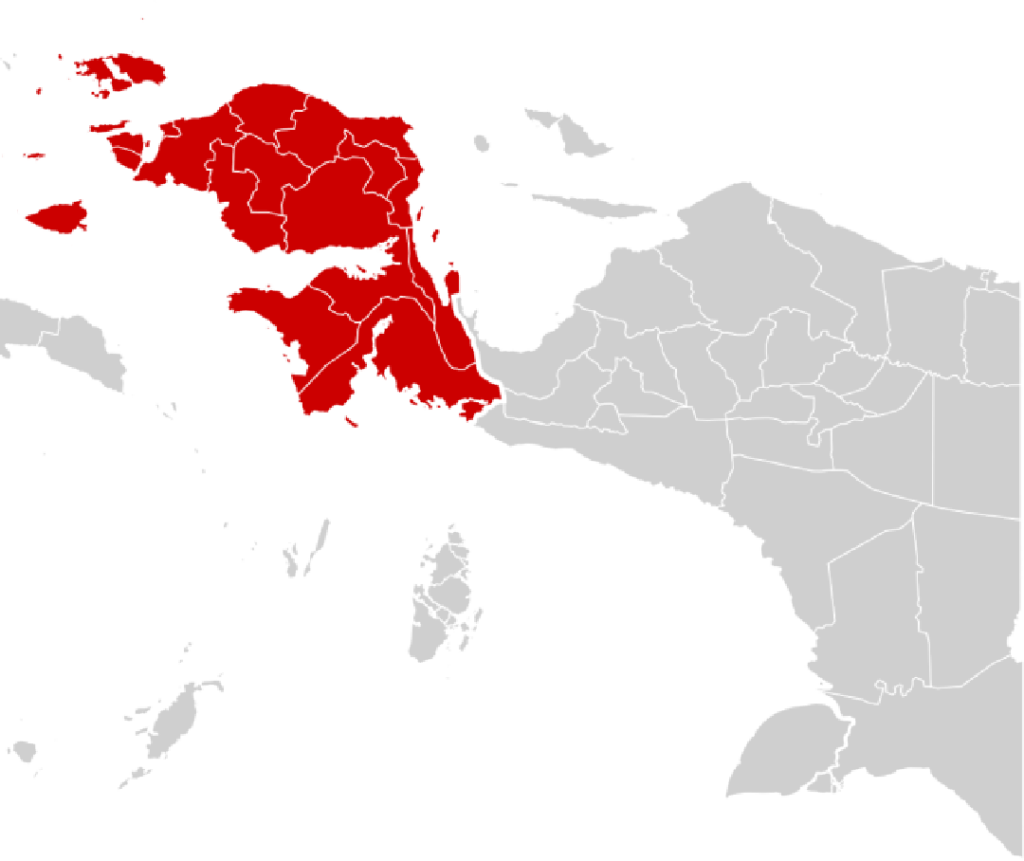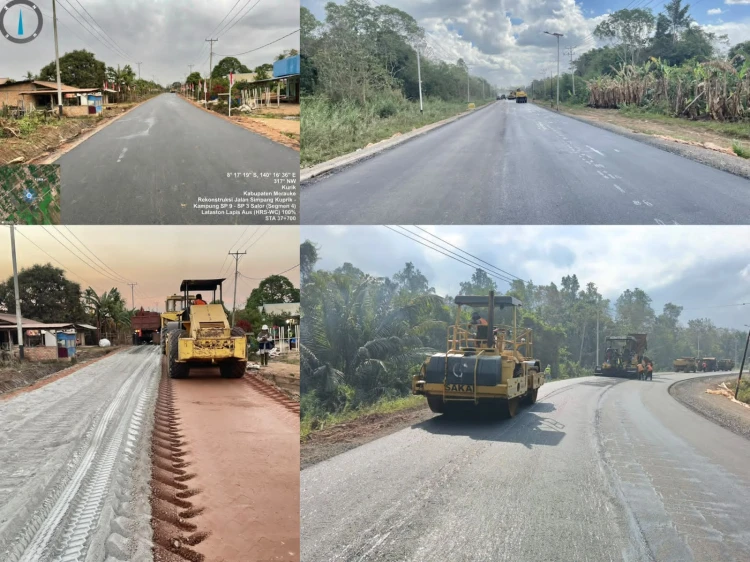
The Merauke-Salor road project is being accelerated as Indonesia pushes to strengthen connectivity around the new administrative center of Papua Selatan (South Papua), with the Ministry of Public Works stepping up supervision of construction and setting a year-end completion target.
The project connects Merauke with the Papua Selatan provincial government complex in Salor through the Simpang Kuprik, Kampung SP9, and SP3 Salor corridor. The road is expected to make it easier for government officials and residents to reach the new administrative area while supporting the movement of goods and services across the southern part of Papua.
For a region where distance has long been one of the practical challenges of delivering public services and moving agricultural products, the significance of the project extends beyond asphalt and bridges. Better roads can shorten travel times, improve access to government facilities, and create stronger links between rural communities and economic centers.
The Indonesian government has also positioned infrastructure development in Papua Selatan within the broader effort to make the province’s new administrative structure function effectively.
A Road Built Around a New Administrative Center
Papua Selatan is one of Indonesia’s newer provinces, and the development of its administrative center in Salor requires supporting infrastructure to operate effectively.
The Ministry of Public Works is handling the road through its Directorate General of Highways. According to the ministry’s latest update reported by Inilah.com, two reconstruction packages are being implemented along the Simpang Kuprik, Kampung SP9, and SP3 Salor routes.
The first package covers a five-kilometer section known as the Simpang Kuprik to Kampung SP9 to SP3 Salor Segment 4. Physical progress has reached 56.13 percent.
The second package covers another 6.8 kilometers and has reached 50.42 percent completion.
Together, the two packages cover approximately 11.8 kilometers of road infrastructure. The government has set December 31, 2026, as the target for the provisional handover of the two projects.
That timetable makes the remaining months of 2026 particularly important for the construction teams and government agencies overseeing the project.
Dody Hanggodo’s Direct Oversight
Minister of Public Works Dody Hanggodo has emphasized that infrastructure is an essential component of the development of a new autonomous region.
In a statement reported on 11 August 2026, Dody said the development of a new autonomous region needed adequate infrastructure so that local institutions could carry out their responsibilities and provide services to the public. He also stressed the importance of cooperation between central and regional governments.
“The development of a new autonomous region needs to be supported by adequate infrastructure,” Dody said, adding that central and local government cooperation was important to ensure that development matched local needs and supported public services.
His approach reflects a broader view of the road as part of an administrative system rather than an isolated construction project.
A government center cannot function efficiently if officials, residents, and service providers struggle to reach it.
That is why access roads are becoming a priority as the Papua Selatan provincial administration develops its new center in Salor.
From Road Access to Public Services
Road infrastructure often receives attention because of its visible physical impact. But its less visible effect may be just as important.
A functioning road can influence how quickly residents reach hospitals, schools, government offices, and markets. It can affect transportation costs for farmers and traders. It can also make it easier for public agencies to deliver services beyond major urban centers.
In Papua Selatan, these considerations are particularly relevant because settlements and economic activities are spread across a large geographic area.
The road to Salor therefore has significance for government employees traveling to work, but its potential users extend much further.
Residents traveling to administrative offices may benefit from better access. Businesses can gain from more predictable transportation. Farmers may have better opportunities to move agricultural products. Contractors and service providers can operate more efficiently when transport infrastructure improves.
The Ministry of Public Works has said that the project is expected to support mobility for both government personnel and the wider public.
That distinction matters.
Infrastructure designed around government facilities can still generate wider public benefits when it becomes part of the region’s transportation network.
Why Connectivity Matters for Papua Selatan
Papua Selatan has significant agricultural and natural resource potential, but economic potential alone does not guarantee economic growth.
Markets need connections.
Farmers need access to buyers. Producers need transportation. Businesses need reliable logistics. Workers need mobility.
Roads are one part of that system.
The Merauke Salor corridor could therefore become more important as economic activity around the provincial administrative center develops.
Better access can encourage businesses to establish supporting services around growing areas. Small shops, food businesses, accommodation providers, transport operators, and other service enterprises may benefit from increased movement.
Over time, infrastructure can change the geography of economic activity.
A road that initially serves a government complex can eventually become part of a larger network connecting residential areas, agricultural production zones, and commercial centers.
This is one reason the government has linked the project to regional integration and economic growth.
Dody said the infrastructure program in Papua Selatan was not only intended to improve accessibility but also to strengthen territorial integration, support community economic growth, and accelerate more balanced development in southern Papua.
A Wider Economic Effect
The economic impact of roads is rarely limited to the construction period.
During construction, projects generate demand for labor, equipment, materials, transportation, and supporting services.
Once completed, the infrastructure can reduce travel barriers and improve commercial connections.
For Papua Selatan, the second effect could become more important over the long term.
The region’s economy includes agriculture, fisheries, trade, and services. Each of these sectors depends, to varying degrees, on transportation.
When transportation becomes easier, the distance between producers and consumers effectively becomes smaller.
That can create opportunities for communities that previously faced higher logistical costs.
Salor and the Future of Papua Selatan
The development of the government center in Salor is part of the institutional formation of Papua Selatan as a new province.
The physical construction of government buildings is only one part of that process.
Administrative infrastructure requires roads, water systems, drainage, electricity, telecommunications, and other basic services.
Earlier in 2026, Minister Dody visited the Papua Selatan government center in the Salor area and emphasized the importance of supporting infrastructure, including attention to drainage and flood prevention. The Ministry of Public Works has described the wider development of the area as requiring infrastructure that is resilient and suitable for local conditions.
The road project should therefore be viewed as part of a broader infrastructure system.
A modern administrative center needs more than offices.
It needs to be accessible.
It needs reliable utilities.
And it needs to connect with the population it serves.
The road linking Merauke with Salor addresses one of the most basic requirements: physical accessibility.
Managing Construction Quality and Deadlines
With the two road packages currently at different stages of completion, construction management will be critical during the second half of 2026.
The first package has reached 56.13 percent, while the second stands at 50.42 percent. Both are scheduled for provisional handover at the end of December.
The Ministry of Public Works says it is continuing to supervise construction and control quality to keep the work on schedule.
That emphasis is important because infrastructure in Papua faces conditions that can differ significantly from projects in more densely developed parts of Indonesia.
Climate, rainfall, terrain, logistics, and the availability of construction materials can all affect project implementation.
Completing a road quickly is therefore only one measure of success.
The road also needs to remain functional and safe after construction.
Infrastructure That Lasts
A high-quality road can serve communities for years, while poorly maintained infrastructure can quickly lose its economic value.
For that reason, the current emphasis on construction quality should eventually be followed by a clear maintenance strategy.
The long-term objective should be a transportation corridor capable of supporting government operations and economic activity without creating excessive maintenance burdens.
This is especially important for a new provincial center.
As more government functions move toward Salor, traffic could increase. The road will need to accommodate not only current demand but also future growth.
Infrastructure and Regional Equality
Indonesia’s infrastructure policy in Papua has increasingly focused on improving connections between communities and centers of economic activity.
For the government, the broader objective is to reduce disparities in access to infrastructure and public services.
The Ministry of Public Works has said its support for Papua Selatan’s infrastructure is intended to strengthen connectivity and contribute to more evenly distributed development.
This approach is particularly relevant to a province that is still developing its administrative institutions.
A new province requires the physical ability to deliver government services across its territory.
Roads can help make that possible.
They can also provide communities with better access to markets and economic opportunities.
In that sense, the Merauke Salor project is not simply about connecting two points on a map.
It is about connecting people with institutions, producers with markets, and communities with opportunities.
The Importance of Central and Local Cooperation
The project also highlights the role of coordination between Jakarta and Papua’s regional government.
Dody has emphasized that the development of Papua Selatan’s new autonomous administration requires cooperation between central and regional authorities.
Such coordination is important because infrastructure responsibilities can involve several institutions.
The central government provides funding, technical standards, and implementation support, while regional authorities understand local priorities and community needs.
Effective coordination can help prevent delays and ensure that infrastructure projects complement other development programs.
The experience of Salor could therefore provide lessons for other new administrative centers in Papua.
Infrastructure works best when roads, public facilities, economic programs, and community needs are planned together.
What the Project Could Mean for Local Communities
For residents, the success of the project will ultimately be measured in practical terms.
How long does it take to travel?
How much does transportation cost?
How easily can people reach government services?
Can farmers transport their products more efficiently?
Can businesses reach customers more reliably?
These questions are more important to daily life than construction statistics alone.
A completed road does not automatically guarantee economic development. It creates an enabling condition.
The next step is ensuring that communities can use that infrastructure productively.
That means connecting road development with agricultural programs, small business support, tourism, public services, and other local economic initiatives.
The road can become a platform for growth, but other policies must build on it.
Looking Beyond 2026
The end 2026 target for provisional handover provides a clear immediate milestone.
But the larger measure of success will come after construction ends.
If the road improves travel between Merauke and Salor, supports government operations, and encourages economic activity, its value will extend far beyond its construction budget.
The emergence of Salor as an administrative center could gradually reshape movement patterns in Papua Selatan.
More public institutions may operate there.
More people may travel there.
Businesses may follow.
Services may expand.
And surrounding communities may find new economic opportunities.
That process will take time.
Infrastructure is rarely transformative overnight. Its impact accumulates as people and businesses begin using it.
Conclusion
The accelerated construction of the Merauke-Salor road reflects Indonesia’s broader effort to strengthen infrastructure in Papua Selatan as the province develops its administrative and economic foundations.
Two reconstruction packages covering approximately 11.8 kilometers are currently underway, with physical progress exceeding 50 percent on both sections and provisional handover targeted for 31 December 2026.
Minister Dody Hanggodo’s direct attention to the project underscores the importance attached to infrastructure supporting the new provincial administration.
Yet the project’s significance reaches beyond government offices.
A reliable connection between Merauke and Salor can support public mobility, strengthen regional integration, and make it easier for economic activity to develop around the new administrative center.
For Papua, where geography remains an important factor in the cost and accessibility of development, connectivity can have an outsized impact.
The road will not solve every challenge facing Papua Selatan.
But if construction is completed to a high standard and followed by effective maintenance and complementary economic programs, it can become an important piece of the province’s development infrastructure.
The broader goal is straightforward: infrastructure should make daily life easier, public services more accessible, and local economic activity more competitive.
In Salor, that ambition is taking shape one kilometer at a time.