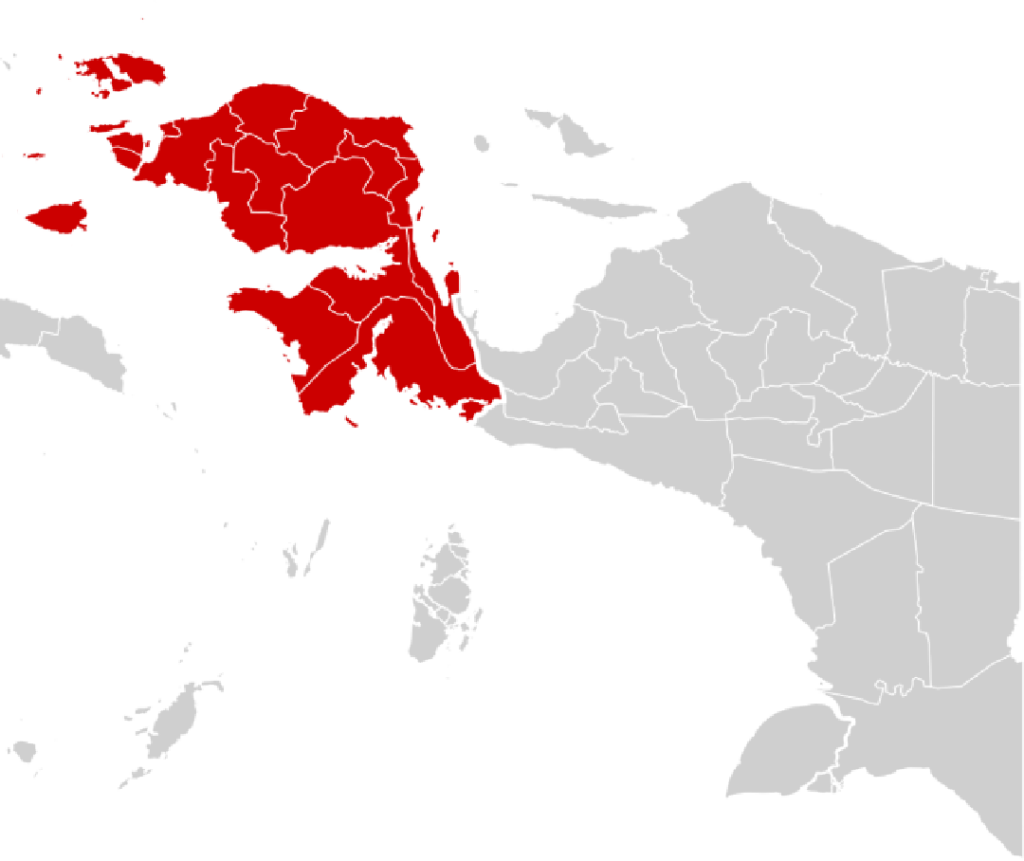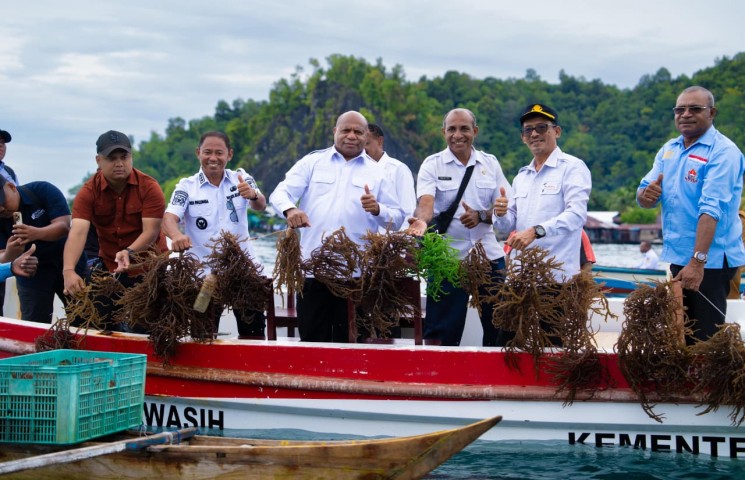
When Governor Mathius Fakhiri arrived in the coastal area of Sarawandori in the Yapen Islands Regency this month, the conversation quickly moved beyond fishing boats and village docks.
What drew the provincial government’s attention instead was seaweed.
On May 21, during meetings with local officials, farmers, and community representatives in Yapen, Fakhiri said Papua’s government wanted to transform seaweed cultivation from a small coastal activity into a larger downstream industry capable of supporting long-term economic growth in the province.
According to provincial officials, the strategy will not stop with cultivating alone. The government plans to strengthen the entire production chain, from farming and harvesting to factory development and market access for local communities.
“Seaweed in Sarawandori must become a leading economic sector for Papua,” provincial officials stated during discussions covered by regional media on May 21.
For many residents in Yapen, the statement reflected something they had rarely heard before: the idea that a commodity already growing quietly along their coastline could eventually become one of Papua’s main economic strengths.
Yapen’s Coastline Already Familiar With Seaweed Farming
Seaweed cultivation is not new in the Yapen Islands.
In several coastal villages around Sarawandori, local residents have worked with seaweed farming for years, usually on a modest scale. Farmers typically dry their harvests under the sun before selling them to collectors or traders, often at fluctuating prices.
But despite the region’s marine potential, most farmers have remained dependent on raw commodity sales.
That was one of the concerns discussed by Governor Mathius Fakhiri during his visit this month.
According to local reports, Fakhiri said Papua should begin building stronger downstream industries instead of continuing to send raw commodities outside the province without added local value.
“We cannot keep selling raw materials continuously,” he said during discussions in Yapen. “Papua must begin processing its products.”
Several officials accompanying the governor explained that the provincial government now sees seaweed as one of the sectors capable of creating broader community participation because cultivation already exists naturally in coastal areas.
Provincial Government Prepares Downstream Industry
Cultivation Alone No Longer Considered Enough
During meetings held in May, provincial officials repeatedly used the term “hilirisasi,” referring to downstream industrial development.
In practice, the government wants the seaweed sector in Yapen to move beyond simple harvesting activities.
Officials said the plan includes improving cultivation methods, strengthening harvest management, preparing processing facilities, and connecting farmers with more stable markets.
According to statements released by the Papua Provincial Government, seaweed development in Yapen will involve coordination between fisheries agencies, local governments, and community groups.
Provincial authorities believe stronger downstream systems could increase income for farmers while also creating additional employment opportunities in processing, packaging, and distribution sectors.
Factory Development Becomes Key Focus
One of the most discussed parts of the initiative involved plans for seaweed processing factories in the Yapen Islands.
Governor Fakhiri reportedly told local residents that Papua should not depend solely on outside industries to process marine commodities harvested in the province.
Instead, he said local processing capacity must be developed gradually inside Papua itself.
According to reports from meetings in Yapen, the provincial government is preparing industrial support so seaweed farmers can eventually access higher-value economic activities.
Several officials explained that processed seaweed products generally provide stronger returns compared with selling raw dried harvests alone.
For farmers in coastal villages, the prospect of processing facilities closer to cultivation areas could also reduce transportation burdens and market uncertainty.
Sarawandori Chosen as Strategic Development Area
Coastal Conditions Considered Favorable
Provincial authorities described Sarawandori as one of the areas most suitable for expanding seaweed cultivation in Papua.
The government focused on the region due to its relatively calm waters and existing community farming activities.
Officials from Papua’s fisheries sector said the area has potential not only for larger production volumes but also for long-term industrial development if infrastructure support improves gradually.
During his visit, Governor Fakhiri reportedly encouraged local communities to remain involved directly in the sector’s development rather than leaving economic opportunities entirely to outside actors.
Farmers Ask for Stable Markets
While many local residents welcomed the government’s attention toward seaweed farming, several farmers also raised practical concerns during discussions.
According to reports from the meetings, some community representatives said farmers still struggle with unstable prices and inconsistent buyer access.
Transportation expenses between islands also remain expensive in several areas.
Provincial officials acknowledged those problems openly and said market access would become part of the broader downstream development strategy.
“We must prepare the market together with the production sector,” one provincial representative said during discussions in Yapen.
Papua Looks Beyond Extractive Industries
The seaweed initiative also reflects wider economic conversations now taking place across Papua.
For years, Papua’s economy has been heavily associated with mining and other extractive industries. But local governments increasingly argue that community-based sectors such as fisheries, agriculture, and marine cultivation offer more direct economic participation for ordinary residents.
Seaweed became one of the sectors highlighted because it matches Papua’s geography and does not require massive industrial investment during the early stages.
Provincial authorities believe marine industries can create broader village-level economic activity, especially in coastal regions where employment opportunities remain limited.
Several local officials also said younger Papuans should begin seeing marine industries as realistic economic careers rather than temporary subsistence work.
Challenges Still Remain
Infrastructure and Logistics Continue to Affect Farmers
Despite the optimism surrounding the program, officials admitted the development process will not be simple.
Transportation remains one of the greatest challenges in Papua’s coastal economy.
Moving products between islands or toward larger markets often requires high operational expenses, especially in remote areas.
Some farmers in Yapen reportedly told provincial officials that logistics problems frequently affect selling prices and buyer consistency.
Government representatives said improving coordination between production centers and market distribution networks would become important moving forward.
Long-Term Commitment Needed
Another issue raised during discussions involved consistency.
Several community members noted that previous economic programs in Papua sometimes slowed after initial launch phases.
Because of that, local farmers reportedly asked the government to maintain long-term assistance involving training, infrastructure, and business support.
Provincial officials responded by saying seaweed development would require gradual and sustained work rather than short-term intervention alone.
Seaweed Industry Seen as Coastal Opportunity
For many coastal residents in Yapen, the government’s new attention toward seaweed farming has started changing perceptions about local economic possibilities.
What was once viewed mainly as a small village activity is now being discussed at the provincial level as a potential leading sector for Papua’s economy.
Officials believe that if cultivation, processing, and market systems can eventually work together, the industry may help strengthen incomes for coastal communities while creating wider economic participation.
Conclusion
The Papua Provincial Government’s effort to develop a downstream seaweed industry in the Yapen Islands Regency reflects broader attempts to build stronger community-based economic sectors across the province.
During meetings in May 2026, Governor Mathius Fakhiri said Papua should move beyond exporting raw commodities and begin strengthening industries capable of creating more local value.
Through plans involving cultivation support, processing factories, and market access, provincial authorities hope seaweed can become one of Papua’s future economic strengths.
Challenges involving logistics, infrastructure, and market stability remain real. But in coastal areas like Sarawandori, many residents now see seaweed not only as part of daily marine life but also as a possible path toward stronger economic resilience for Papua’s coastal communities.
se