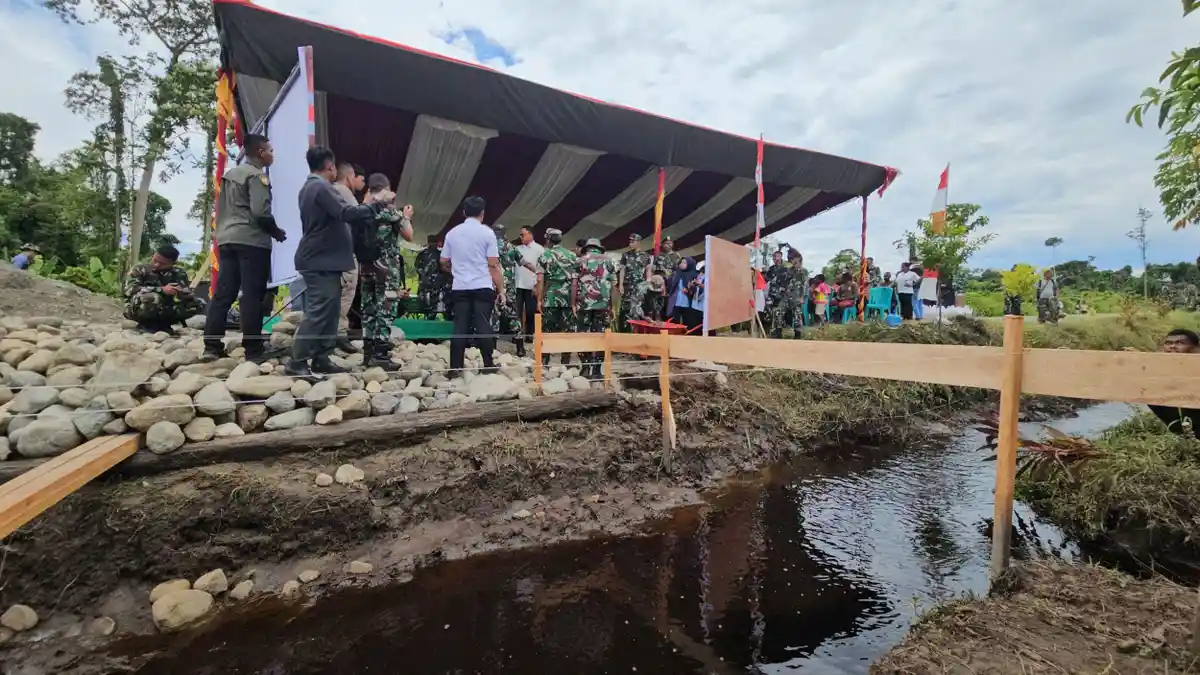
Before sunrise, vehicles had already started arriving.
Motorcycles.
Pickup trucks.
Construction equipment is moving slowly through muddy roads.
Residents gathered near open land where temporary tents had been erected.
In several districts across Papua, groundbreaking ceremonies for the Garuda Pioneer Bridge program did not look particularly grand.
But people still came.
For many communities, bridges are often treated as extraordinary infrastructure.
They are usually discussed as something more practical.
A shorter trip to market.
An easier route to school.
Less dependence on small boats when rivers rise.
That atmosphere could be seen again during recent groundbreaking activities connected to the Garuda Pioneer Bridge initiative, a program local authorities say will expand connectivity in some of Papua’s most difficult geographical areas.
Construction Begins As Papua Expands Connectivity Projects
The latest ceremonies mark the beginning of infrastructure work expected to continue throughout several regions.
Officials in Central Papua announced plans involving eleven Garuda Pioneer bridges.
Local leaders, religious figures, security personnel, and residents recently attended groundbreaking activities in areas such as Deiyai and Nabire, where preparations for construction took place.
Regional governments increasingly view the projects as infrastructure priorities rather than optional investments.
In many districts, rivers still dictate the movement of people and goods.
Security Personnel Attend Groundbreaking Activities
Indonesian Armed Forces (TNI) personnel were also present during several ceremonies.
Officers involved in border and mobile security operations attended groundbreaking activities while emphasizing support for strategic infrastructure development.
During public remarks, security officials stated that support activities would primarily focus on ensuring construction and logistics can operate safely in difficult terrain.
Several officers also stressed that infrastructure development requires cooperation between communities, contractors, government institutions, and security stakeholders.
In Papua, Bridges Often Matter More Than Distance
Maps usually do not explain transportation problems in Papua.
A village may appear close.
Travel time tells another story.
Heavy rainfall can isolate roads.
River crossings sometimes become impossible.
Temporary wooden structures deteriorate quickly.
This partly explains why local governments increasingly treat bridge construction as urgent.
A missing bridge may only appear as a small gap on maps.
For residents, it can mean hours of additional travel.
Rivers Still Shape Daily Activities
Officials discussing the program repeatedly pointed toward geography.
Large river systems.
Mountainous terrain.
Remote settlements.
High logistics costs.
Several regional authorities argue these conditions continue slowing economic movement between districts.
Farm products become harder to transport.
Building materials cost more.
Public services become slower.
Infrastructure planners increasingly describe connectivity as one of the largest barriers facing regional development.
Why Local Communities Pay Attention To Bridge Projects
Local communities pay attention to bridge projects because they recognize their potential impact on connectivity and regional development.
People rarely celebrate infrastructure because of concrete.
They celebrate what changes afterward.
Near several project areas, conversations surrounding bridge construction quickly moved toward practical concerns.
Can farmers reach markets easier?
Will transport costs fall?
Will children spend less time traveling?
These questions appeared repeatedly.
Officials say improved mobility remains one of the program’s main objectives.
Economic Effects Begin Before Bridges Finish
Construction itself already changes local economies.
Workers are hired.
Vehicles move materials.
Food stalls appear around project sites.
Transport services become busier.
Infrastructure economists often note that projects create temporary economic activity long before final completion.
That pattern is beginning to appear around several construction locations.
TNI Role Increasingly Visible in Infrastructure Support
Security involvement in infrastructure activities across Papua is not entirely new.
TNI personnel have frequently supported logistics, transportation assistance, disaster response, and remote access operations.
Within the bridge program, officials describe TNI participation primarily as supporting stability and assisting difficult operational environments.
Several local leaders attending recent ceremonies argued that development in remote regions frequently requires multi-institution cooperation rather than isolated approaches.
Building In Papua Remains Difficult And Expensive
Even supporters acknowledge bridge construction in Papua is often complex.
Transporting steel and concrete costs more.
Remote locations slow equipment movement.
Rain frequently changes schedules.
Contractors working in Papua have long described geography as one of the biggest variables affecting infrastructure timelines.
Because of these challenges, local governments increasingly warn communities that construction phases may require patience.
Expectations Rise Faster Than Construction
One common occurrence at the start of projects is that expectations immediately increase.
Expectations immediately increase.
Residents ask when bridges finish.
Whether roads follow.
Whether transportation improves quickly.
Officials acknowledge that these questions appear almost immediately after groundbreaking ceremonies.
Currently, most construction teams are concentrating on early preparation work.
Connectivity Becoming Central to Papua Development
Infrastructure discussions across Papua increasingly revolve around one recurring theme.
Access.
Road programs require bridges.
Healthcare requires mobility.
Schools require transport routes.
Agriculture requires logistics.
Officials therefore increasingly describe connectivity projects not as isolated construction programs, but as foundations supporting broader development goals.
Conclusion
Bridge construction usually begins quietly.
Survey teams arrive.
Equipment follows.
Concrete appears later.
The Garuda Pioneer projects launched across Papua still face difficult geography, weather challenges, and long construction phases.
But for communities accustomed to measuring travel in hours rather than kilometers, expectations remain simple.
A bridge does not always change everything.
Occasionally it simply makes everyday life less difficult.