
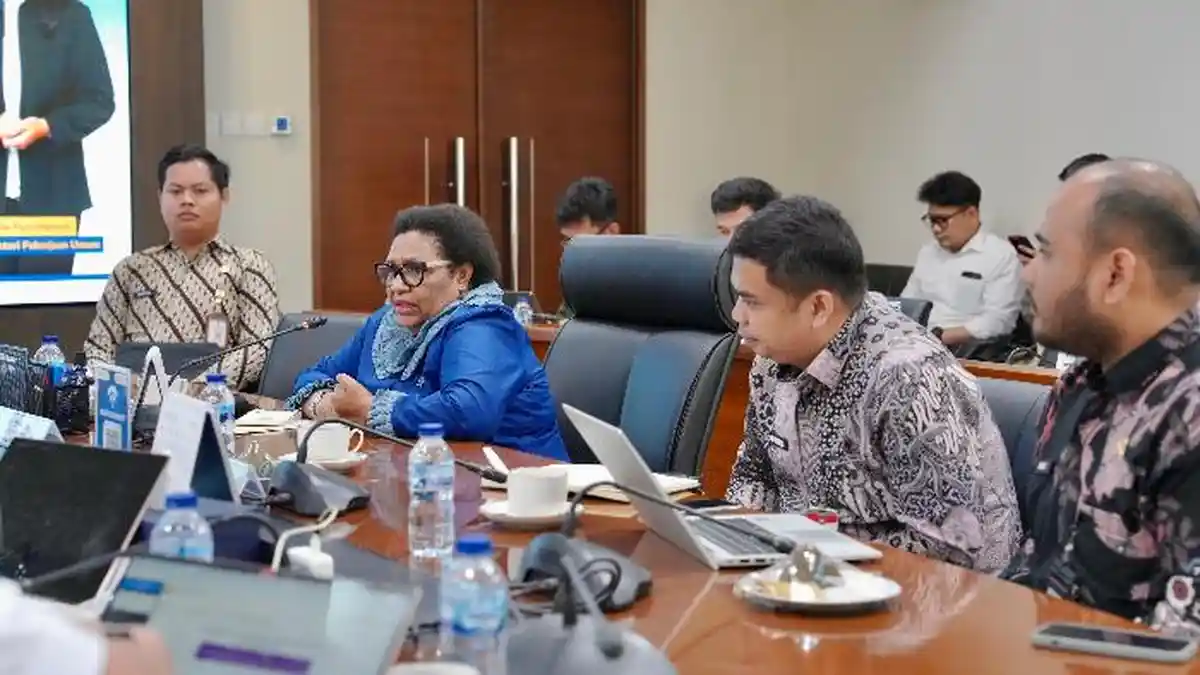
The development of Papua’s four new government centres is entering a crucial phase, with the Indonesian government targeting full operation by 2028. Deputy Home Affairs Minister Ribka Haluk reaffirmed the commitment on November 19, 2026, during a coordination meeting with the Ministry of Public Works in Jakarta. The discussions focused on construction progress, funding requirements and the steps needed to ensure that the new administrative centres in Papua Barat Daya (Southwest Papua), Papua Tengah (Central Papua), Papua Selatan (South Papua) and Papua Pegunungan (Highland Papua) can begin operating as planned.
The target represents an important stage in Indonesia’s broader effort to strengthen governance following the establishment of four new autonomous provinces, known nationally as Daerah Otonomi Baru (DOB). Beyond constructing government offices, the initiative is intended to provide the institutional infrastructure needed for provincial administrations to function more effectively and deliver public services closer to the people they serve.
For Papua, where communities are spread across extensive mountainous terrain, forests, coastal areas and islands, the location and accessibility of government institutions matter. A functioning provincial administration requires more than political leadership and an official address. It needs offices, roads, sanitation facilities, legislative institutions and supporting infrastructure that allow government employees and public representatives to carry out their responsibilities.
The November meeting therefore carried significance beyond a routine construction review. It brought the central government, the Ministry of Public Works and regional administrations together to address outstanding requirements and maintain the 2028 target.
Ribka Haluk Reinforces the 2028 Government Centre Target
The latest commitment was delivered by Ribka Haluk during the Coordination Meeting on the Evaluation of Government Centre Development in Papua’s New Autonomous Provinces, held at the Ministry of Public Works headquarters in Jakarta on November 19, 2026.
The meeting reviewed construction developments in all four provinces, examined outstanding infrastructure requirements and discussed the funding needed to maintain progress.
Ribka expressed appreciation for the Ministry of Public Works and its commitment to supporting the construction of government infrastructure in the four new provinces.
“I would like to express my appreciation and gratitude to the Ministry of Public Works for its commitment to developing infrastructure in the four new autonomous provinces of Papua,” she said.
For Ribka, the availability of government facilities is directly connected to the ability of regional administrations to perform their duties and serve residents. Without adequate offices and supporting infrastructure, provincial institutions may face difficulties coordinating their activities, managing public programmes and providing services.
She also called for stronger coordination between the central government and regional administrations to ensure that construction continues without unnecessary delays.
“I also encourage stronger coordination and a shared commitment between the central and regional governments so that all government centre areas in Papua’s new autonomous provinces can operate by 2028,” she said.
Her statement underlined the government’s intention to maintain the target while recognising that different provinces face different stages of development and construction needs.
Four Provinces, One National Development Agenda
The government development programme for regional centres covers four provinces established through Indonesia’s administrative restructuring.
They are Papua Barat Daya, Papua Tengah, Papua Selatan and Papua Pegunungan. Each has its own administrative leadership, provincial institutions and development priorities.
The creation of these provinces has increased the need for supporting government infrastructure. New provincial administrations require facilities for governors and their staff, regional legislative institutions, representative bodies and public administration departments.
The government centre areas are therefore expected to become the physical foundations of provincial governance.
The development programme includes facilities for governors’ offices, regional legislative institutions and the Majelis Rakyat Papua (MRP), or Papuan People’s Assembly. It also covers supporting infrastructure such as roads and sanitation facilities.
These components are important because government operations depend on an integrated working environment. Administrative buildings cannot function effectively if access roads, basic utilities and supporting public facilities remain inadequate.
The Ministry of Home Affairs and the Ministry of Public Works have consequently been working together to coordinate planning, construction and the institutional requirements of the four provinces.
The initiative also forms part of the government’s broader national development agenda, which seeks to strengthen regional administration and improve the delivery of public services across Indonesia.
Construction Progress Varies Across the Four Provinces
One of the main issues discussed during the November evaluation was the different pace of construction in each province.
According to the information presented in February 2026 by Public Works Deputy Minister Diana Kusumastuti, three of the four provinces had already demonstrated significant progress.
At that time, Papua Barat Daya’s government centre development had been completed, while facilities in Papua Selatan had already entered functional use. Papua Tengah had begun moving into the construction implementation stage.
Papua Pegunungan, however, required additional preparation before major construction could accelerate.
The government was still waiting for essential planning documents, including a feasibility study and a master plan. These documents are important because they establish the technical, spatial and economic foundations for a large infrastructure development project.
The Ministry of Public Works expected the necessary documents to become available during 2026, allowing the government to proceed with more detailed preparations.
The different construction stages illustrate why the government has continued to conduct evaluations rather than rely solely on a single completion schedule.
Each province has its own geographical conditions, land requirements, administrative needs and technical challenges. A construction strategy that works in one location may require adjustments elsewhere.
The government is therefore seeking to maintain a common 2028 operational target while addressing the specific requirements of each provincial centre.
Papua Pegunungan Receives Particular Attention
Among the four provinces, Papua Pegunungan received particular attention during the November 19 meeting.
Ribka explained that construction in the other three provinces had already progressed, making the acceleration of the Papua Pegunungan government centre a priority in the next stage of development.
The province presents a distinct geographical setting. Its mountainous landscape and highland settlements require careful consideration in planning infrastructure, transport access and the delivery of government services.
The availability of the feasibility study and master plan is therefore an important prerequisite for moving the project forward.
Ribka encouraged the government to secure certainty over the 2027 budget, particularly for the development of the Papua Pegunungan government centre.
The funding requirement is expected to determine when the construction tender can proceed and how the project can be organised over the following two years.
Public Works Deputy Minister Diana Kusumastuti said her ministry was coordinating with the Directorate General of Budget at the Ministry of Finance to clarify the funding requirements.
If the budget arrangements are confirmed, the government plans to bring forward the tender process for the Papua Pegunungan government centre in 2027.
The proposed approach is to use a Multi-Year Contract (MYC) scheme covering the 2027-2028 period.
This arrangement would allow construction to continue across two budget years under a coordinated contract, rather than depending entirely on separate annual procurement processes.
The objective is to provide greater certainty for contractors and project managers while helping the government maintain the completion schedule.
The proposed tender remains conditional on budget confirmation. This distinction is important because the 2028 operational target will depend not only on planning but also on the availability of funding and the timely completion of procurement procedures.
Papua Selatan’s MRP Office Also Needs Completion
The November evaluation also highlighted the need to complete the office of the Majelis Rakyat Papua in Papua Selatan.
The MRP is an important institution within Papua’s special autonomy framework. It represents cultural and customary interests and has a role in the implementation of policies connected with the protection of indigenous Papuan communities.
Providing adequate facilities for the institution is therefore part of strengthening the administrative structure of the new province.
Ribka encouraged the government to secure the necessary funding for the completion of the Papua Selatan MRP office during the 2027 budget cycle.
The issue reflects a wider requirement across the four provinces: the development of government centres must accommodate not only executive offices but also representative institutions that form part of the regional governance structure.
The effectiveness of a provincial administration depends on the ability of its institutions to work together. Adequate facilities can support coordination, institutional meetings and the performance of official responsibilities.
For Papua Selatan, completing the MRP office is consequently an important element of ensuring that the province’s institutional infrastructure develops alongside its executive and legislative facilities.
Funding Remains a Central Challenge
The government’s determination to complete the four government centres by 2028 comes amid continuing discussions about the financial capacity of the new provinces.
In July 2026, Ribka had already raised concerns about the relatively limited fiscal capacity of regional governments in the newly established provinces.
During a coordination meeting in Merauke on July 15, she said the central government was seeking to strengthen national budget support for government office construction.
“We are also continuing to pursue this initiative together with the Minister of Home Affairs and Commission II of the House of Representatives, because we understand that the regional budget capacity of the provinces is currently weak, including Papua Selatan,” she said.
The July discussion also addressed the proposal to include government centre development in the National Strategic Projects programme, known as the PSN.
Ribka explained that stronger support from the national budget could help ensure construction continuity without placing excessive pressure on the limited budgets of the new provinces.
She said the proposal had received attention from the Ministry of National Development Planning and that discussions were continuing.
The funding issue is particularly relevant because newly established provincial administrations must allocate resources for a wide range of responsibilities. These include staffing, public services, institutional operations, infrastructure and development programmes.
If the costs of major government buildings were left entirely to provincial budgets, other development priorities could face additional pressure.
The central government’s involvement is therefore intended to help distribute financial responsibilities and ensure that the construction programme can proceed more sustainably.
Earlier Progress in Papua Selatan Offers an Example
The July evaluation also highlighted progress made by Papua Selatan in establishing its provincial administration.
Ribka praised the provincial government for accelerating the development of its institutional infrastructure.
According to the July 15 report, the physical construction of the Governor’s Office, the Papua Selatan Regional House of Representatives building, and the civil servant apartments was completed in December 2025.
The progress demonstrated that the development of a new provincial administration requires sustained coordination between central institutions and local leadership.
However, completing several major buildings does not mean that all supporting infrastructure and institutional requirements have been resolved.
The July meeting also discussed the need for further government office development and the importance of ensuring that available funding was used effectively.
Ribka encouraged regional civil servants to communicate more actively with ministries and national agencies when facing administrative or funding obstacles.
She also emphasised that the Ministry of Home Affairs was still ready to facilitate coordination between regional administrations and central government institutions.
Her message was intended to encourage provincial officials to take an active role in resolving problems rather than waiting for difficulties to become more complicated.
The ministerial support, combined with the progress in Papua Selatan, provides an important reference for the other provinces as they work towards the 2028 deadline.
Building Government Centres to Improve Public Services
The construction programme should ultimately be assessed through its contribution to public administration and service delivery.
Government buildings are important, but their value comes from the institutions and services operating inside them.
For residents, a functioning provincial government centre should support more effective administrative coordination, improve access to government officials and help ensure that public programmes are implemented consistently.
It can also create a more organised environment for provincial planning and coordination among regional agencies.
In Papua, where some communities live far from major urban centres, the quality of public administration is closely connected to the ability of government institutions to coordinate services across difficult geographical conditions.
The development of government centres may also create opportunities for local economic activity during construction and subsequent operations. Demand for construction materials, transport, accommodation, food services and other supporting activities can provide opportunities for local businesses.
However, the scale of these benefits will depend on project implementation, procurement arrangements and the participation of local workers and businesses.
The government will therefore need to ensure that construction quality, accountability and operational readiness receive the same attention as the completion deadline.
A building that is physically complete but lacks adequate staff, utilities or supporting facilities cannot deliver the full benefits expected from the investment.
Coordination Between Ministries and Regional Governments
The November 19 meeting demonstrated the importance of coordination between the Ministry of Home Affairs and the Ministry of Public Works.
The Ministry of Home Affairs is responsible for supporting regional governance and ensuring that the new provincial administrations can function effectively. The Ministry of Public Works has a central role in infrastructure planning and construction.
The Ministry of Finance is also important because the funding requirements must be clarified before procurement and construction schedules can be finalised.
At the regional level, governors and local government agencies must ensure that administrative preparations, land requirements and supporting facilities are aligned with the national construction programme.
The November meeting was attended by Public Works Ministerial Expert Staff for Integrated Development Pantja Dharma Oetojo, Head of the Regional Infrastructure Development Agency Adenan Rasyid and other relevant officials.
Their participation reflected the cross-institutional nature of the programme.
The government’s approach is to maintain a shared commitment across ministries and regional administrations while addressing technical and budgetary obstacles through coordinated evaluation.
This is especially important for the Papua Pegunungan government centre, where the next construction stage depends on the completion of planning documents and the confirmation of funding.
Conclusion
The government’s target to bring all four new provincial government centres in Papua into operation by 2028 represents a significant milestone in Indonesia’s regional development agenda. The renewed commitment by Deputy Home Affairs Minister Ribka Haluk, supported by the Ministry of Public Works, demonstrates that the central government is continuing to monitor construction progress and address the requirements of each province.
The progress is not uniform. Papua Barat Daya’s government centre had been reported completed by February 2026, Papua Selatan had already begun using its facilities, and Papua Tengah had entered the construction stage. Papua Pegunungan requires particular attention, especially regarding planning documents, budget certainty and the proposed 2027-2028 multi-year construction contract. Completion of the Papua Selatan MRP office is another priority identified in the latest evaluation.
The coming two years will therefore be decisive. Securing funding, completing procurement, maintaining construction quality and preparing government institutions to operate will all be essential to meeting the deadline.
Ultimately, the success of the programme should not be measured only by the number of buildings completed or the date of their inauguration. Its real value will lie in whether the new provincial institutions can deliver faster, more accessible and more accountable public services.
If the central government and regional administrations maintain their coordination and fulfil the outstanding requirements, the 2028 target could mark an important step toward stronger governance and more effective development in Papua. For residents of Papua Barat Daya, Papua Tengah, Papua Selatan and Papua Pegunungan, the most meaningful outcome will be a government that is not only closer in administrative terms but also more responsive to their everyday needs.
Read Also
Papua Special Autonomy Funds: Ribka Haluk’s Vision
Ribka Haluk Tightens Oversight of Papua Otsus Funds

