
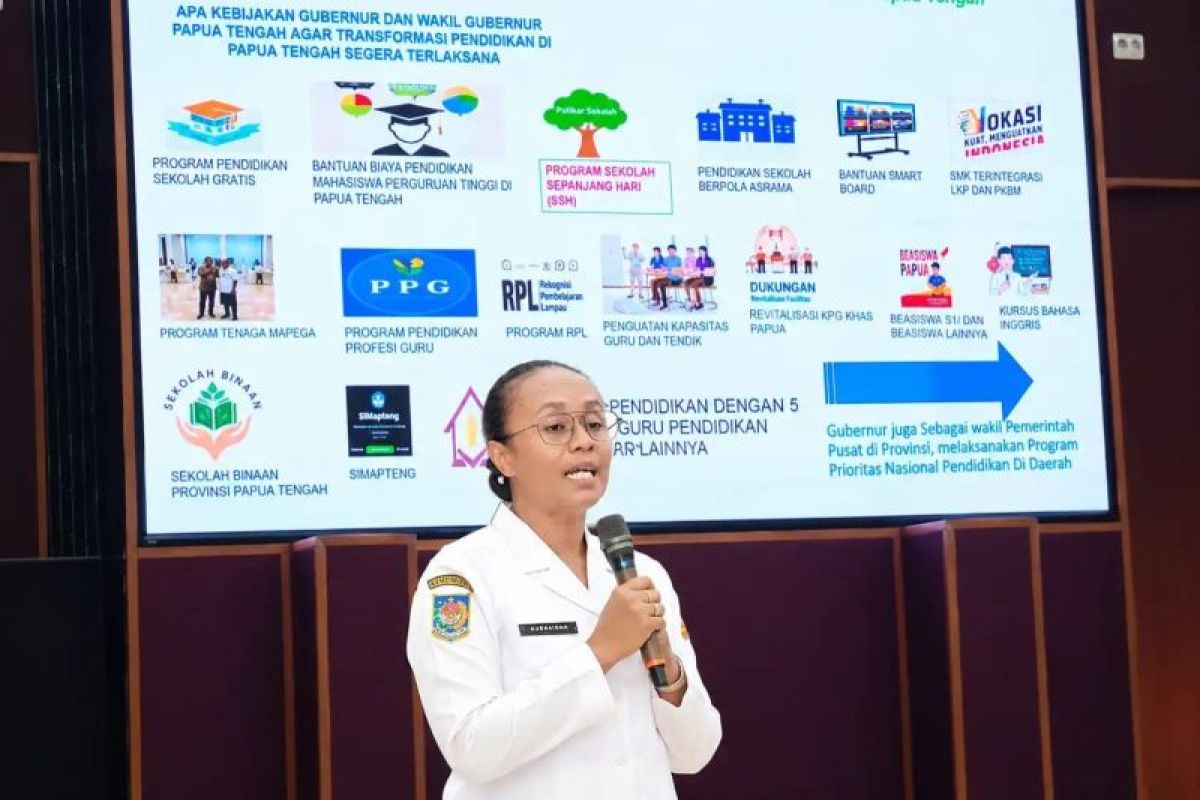
Improving the quality of education in Papua Tengah (Central Papua) requires more than building classrooms or expanding school facilities. It also depends on the people standing in front of students every day. Recognising these challenges, the provincial government has stepped up efforts to improve teacher qualifications through a programme that combines university education, professional certification and cooperation with local administrations.
The initiative, known as the Papua Tengah teacher qualification programme, has enabled 160 teachers to pursue undergraduate degrees through a partnership between the Provincial Education and Culture Office and Universitas Pendidikan Muhammadiyah Sorong (UNIMUDA). The programme uses the Recognition of Prior Learning (RPL) scheme, allowing eligible teachers to have relevant previous learning and professional experience recognised as part of their academic path.
At the same time, the government is accelerating the Teacher Professional Education programme, or Pendidikan Profesi Guru (PPG), with a target of 900 additional teachers completing the certification process by 2026. This follows the successful completion of PPG by 801 teachers in 2025.
The two initiatives address different but closely related requirements. One helps teachers obtain the necessary academic qualifications, while the other strengthens their professional competence and certification. Together, they form part of a broader effort to improve teaching standards across Papua Tengah’s eight regencies.
A Regional Challenge Requiring Long-Term Action
The scale of the task became clearer through education data presented by provincial officials and the Papua Special Autonomy Development Acceleration Steering Agency (BP3OKP).
According to figures from the Directorate General of Teachers and Education Personnel, cited by the New Guinea Kurir, Papua Tengah had approximately 11,204 teachers serving across its eight regencies as of April 2026. Of that number, 1,660 had not yet obtained an undergraduate qualification in education.
The figure was also highlighted by BP3OKP Papua Tengah Head Petrus Waine, who said the teachers were already registered in the national Basic Education Data system, known as Dapodik, and held an Educator and Education Personnel Identification Number (NUPTK), but had not completed the required undergraduate qualifications.
The situation presents a considerable challenge for a province seeking to improve learning outcomes across a geographically diverse region. Teachers serve communities with different levels of access to educational institutions, transport, infrastructure and professional development opportunities.
For educators working in remote areas, pursuing a university degree can be difficult without financial assistance and a flexible study arrangement. The cost of tuition, travel and accommodation can also become obstacles, particularly for teachers who must continue their professional responsibilities while studying.
The provincial government’s RPL initiative is designed to address part of this problem by providing a structured route for teachers to continue their education.
Rather than treating professional experience as separate from academic learning, the scheme recognises eligible prior learning as part of the process of obtaining a formal qualification.
From National Coordination to Provincial Implementation
The groundwork began in 2024
The current programme did not emerge overnight. Its implementation followed coordination involving national ministries, provincial administrations and higher education institutions across Papua.
According to Petrus Waine, BP3OKP had been working with relevant ministries, including the education and finance ministries, as well as six provincial governments in Papua to synchronise the programme’s implementation.
The process began in 2024 and involved identifying the needs of teachers, aligning government responsibilities and establishing cooperation with universities offering education-related study programmes.
The policy framework is Minister of Education, Culture, Research and Technology Regulation No. 44 of 2023, concerning the accelerated fulfilment of teacher needs through teacher education programmes in Papua.
The objective is to improve the availability of qualified teachers through a coordinated approach involving central and regional governments.
For Papua Tengah, the programme began to take practical shape in 2026 through cooperation between the Provincial Education and Culture Office and UNIMUDA Sorong.
This arrangement was significant because the provincial government does not directly manage every level of schooling. Government Regulation No. 106 of 2021 limits provincial authority over certain educational institutions, including the provincial role in managing special education institutions such as special needs schools and community academies.
However, the provincial government retains responsibilities in supporting education financing. Acting Head of the Papua Tengah Education and Culture Office Nurhaidah explained that the administration could support education funding from early childhood education through to higher education.
The RPL programme therefore became one way for the provincial government to contribute to teacher development despite the division of administrative responsibilities between different levels of government.
2026: The RPL programme begins with 160 teachers
The partnership with UNIMUDA Sorong was implemented through two stages involving a total of 160 teachers.
The first stage included 100 participants, followed by another 60 in the second stage.
Nurhaidah confirmed that all 160 participants had been registered in Indonesia’s Higher Education Database, known as PDDikti, and had received their official student identification numbers from UNIMUDA.
This registration provides formal recognition of their status as university students and establishes an administrative basis for monitoring their academic progress.
The programme focuses on teachers working at early childhood education centres, kindergartens, primary schools and junior secondary schools. It also gives priority to Indigenous Papuan teachers, known locally as Orang Asli Papua (OAP).
That focus is important for a region where strengthening the capacity of local educators is closely connected to the long-term development of communities and the next generation.
By enabling teachers to pursue undergraduate qualifications while drawing on their previous learning and experience, the RPL scheme offers an alternative route to higher education for educators who may otherwise face significant barriers to returning to university.
Professional Certification: The Second Priority
Obtaining an undergraduate qualification is only one part of the process. Teachers must also complete professional education and meet the requirements for educator certification.
For this reason, the Papua Tengah government has been running the RPL initiative alongside efforts to accelerate PPG.
Nurhaidah reported that 801 teachers completed PPG in 2025. For 2026, the provincial government has set a target of 900 additional teachers completing the programme.
The initiative particularly includes educators serving in disadvantaged, frontier and outermost areas, commonly referred to in Indonesia as 3T regions.
The focus reflects the need to extend professional development opportunities beyond major population centres. Teachers in remote communities must also have access to the training and certification pathways available to their counterparts in more accessible areas.
The two programmes serve complementary purposes. RPL helps eligible teachers meet academic qualification requirements, while PPG provides professional preparation and certification.
In practical terms, completing an undergraduate degree does not automatically mean that a teacher has completed the professional certification process. Both stages must be addressed through appropriate education and assessment.
Different figures highlight the remaining workload
The available reports provide slightly different figures for the number of teachers who have yet to complete PPG or obtain professional certification.
Petrus Waine, as quoted by Tomei.id and Papuapos Nabire, referred to 2,175 teachers who had not yet participated in PPG. Other reporting cited a figure of 2,160 teachers who had already obtained undergraduate qualifications, with 459 still lacking educator certification.
These figures describe different categories and should not be treated as interchangeable. They also underline why accurate and regularly updated teacher records are essential for effective planning.
The provincial government has acknowledged that improving academic qualifications and professional certification must proceed together. A degree is an important milestone, but it is not the final measure of professional readiness.
BP3OKP Calls for Stronger Cooperation Across Eight Regencies
The programme has received support from Petrus Waine, Head of the BP3OKP representative office in Papua Tengah.
Waine praised the Education and Culture Office for financing the studies of 160 teachers, noting that the provincial administration had taken action despite limitations in its direct authority over many education institutions.
“Although Government Regulation No. 106 limits the provincial government’s authority to managing special education institutions such as special needs schools and community academies, we greatly appreciate the commitment shown by the Head of the Education Office,” Waine said, as reported by Tomei.id.
For BP3OKP, the next challenge is ensuring that the remaining teachers who lack undergraduate qualifications receive similar opportunities.
Waine said the agency would oversee coordination with the eight regency governments to encourage the use of Special Autonomy funds to accelerate teacher qualification programmes.
“We will oversee the eight regencies to ensure that special autonomy funds are used to accelerate the completion of undergraduate qualifications for the remaining 1,500 teachers,” he said, according to Papuapos Nabire.
His remarks place responsibility for the programme beyond the provincial administration alone. The regency governments, local education offices and school principals will also need to contribute to identifying eligible teachers and ensuring that funding reaches the intended beneficiaries.
This cooperation is particularly important because education administration in Papua involves different levels of government, each with specific responsibilities.
The success of the programme will therefore depend not only on the number of scholarships or funded study places but also on coordination, data accuracy and sustained financial support.
Accurate Teacher Data Considered Essential
Another issue raised by Nurhaidah concerns the accuracy of teacher records in Dapodik.
She has asked all eight regency governments and school principals to verify and validate the data, particularly to identify teachers who are still actively working.
Teachers who are no longer active should be removed from the relevant records so that the government can calculate actual needs and avoid allocating resources based on outdated information.
The issue may appear administrative, but reliable data is essential to the effectiveness of education policy.
If inactive teachers remain listed in the system, the number of educators requiring academic support or professional certification may not accurately reflect conditions in schools.
Incorrect records can also affect budget planning, programme targets and the distribution of assistance.
For Papua Tengah, a reliable teacher database would help the provincial and regency governments identify which educators need undergraduate qualifications, which have already completed their degrees and which still require PPG.
Nurhaidah has emphasised that future planning should be based on accurate information so that education funding, including Special Autonomy allocations, can be used more effectively.
A Target to Complete the Programme by 2029
The provincial government has set 2029 as its target for completing the wider effort to improve teacher qualifications.
The target is ambitious given the number of educators who still need to complete undergraduate studies and professional certification.
The 160 teachers currently funded through the RPL programme represent an initial group within a much larger pool of educators who need support. Based on the reported figure of 1,660 teachers without undergraduate qualifications, around 1,500 remain after accounting for the 160 participants.
That calculation provides a useful indication of the scale of the remaining work, although the final number will depend on updated records and verification by the relevant authorities.
The government will also need to monitor whether the 900-teacher PPG target for 2026 is achieved and how many additional educators remain without certification.
For the eight regencies, the 2029 target means that teacher development will need to remain a priority in education planning and budgeting over the coming years.
It also creates an opportunity to strengthen cooperation with universities and other educational institutions that can provide accessible and relevant professional development programmes.
Investing in Teachers Means Investing in Papua’s Future
The quality of a school is shaped by many factors, including facilities, learning materials, leadership and the availability of qualified educators. Among these, teachers remain central to the daily experience of students.
A teacher with stronger academic preparation and professional training is better positioned to develop lesson plans, understand subject matter, assess student progress and respond to different learning needs.
In a region as geographically diverse as Papua Tengah, improving teacher capacity is particularly relevant. Children in remote communities deserve access to qualified educators and meaningful learning opportunities, regardless of where they live.
The RPL programme also recognises that many teachers have accumulated years of practical experience. Providing them with a pathway to formal qualifications can help connect that experience with academic standards and professional development.
However, the long-term impact will depend on more than graduation certificates. Schools will need to ensure that newly qualified teachers can apply their knowledge in classrooms, while education authorities monitor teaching quality and student progress.
The provincial initiative is therefore best understood as part of a broader education development process rather than a single intervention.
Conclusion
Papua Tengah’s efforts to improve teacher qualifications reflect an important investment in the region’s human resources.
Through the partnership with UNIMUDA Sorong, 160 teachers have been given the opportunity to pursue undergraduate degrees using the RPL scheme. Alongside these efforts, the provincial government has reported 801 PPG graduates in 2025 and set a target of 900 additional graduates in 2026.
The remaining challenge is substantial. Around 1,500 teachers are still reported to lack undergraduate qualifications, while thousands more require attention in the professional certification process.
Achieving the 2029 target will require sustained cooperation between the provincial administration, the eight regency governments, BP3OKP, universities and school leaders.
Accurate teacher data, transparent funding and continued access to professional education will be essential to maintaining progress.
Ultimately, the value of the programme will be measured not simply by the number of teachers who earn degrees or certificates, but by whether students experience better teaching and stronger learning opportunities in their schools.
For Papua Tengah, developing qualified local educators is an investment that reaches far beyond the classroom. It is part of building the skills, confidence and knowledge that future generations will need to participate in the region’s social and economic development.
Read Also
Puncak Regency Sends 15 Papuan Students Abroad to Build Human Capital
UNICEF and YNS Strengthen Education in Papua Pegunungan

