
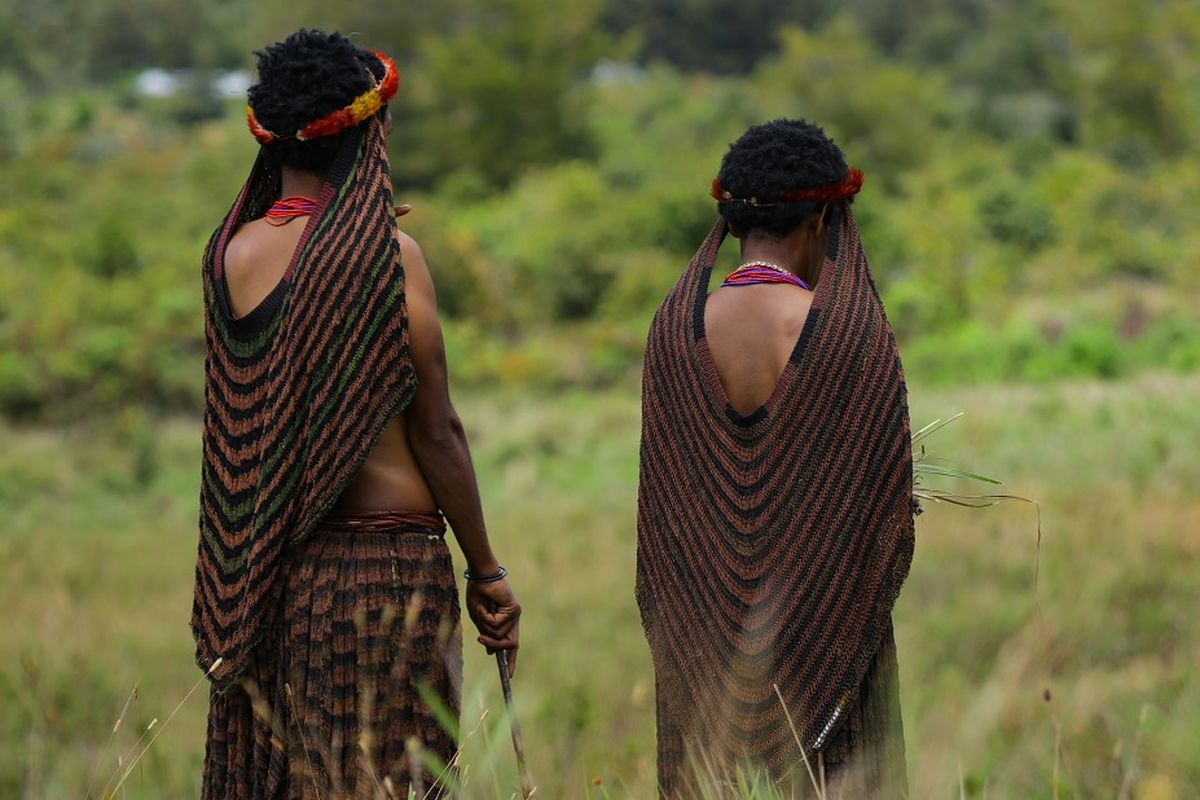
A mother carrying her baby, a farmer transporting vegetables from the garden, or a community exchanging gifts during a traditional gathering may all have one object in common: the noken. At first glance, it looks like a simple handmade bag. Howeve in Papua, its meaning reaches far beyond its everyday function. Noken represents life, maternal care, solidarity, cultural identity and the relationship between people and the natural environment. UNESCO’s recognition of it as a world heritage site in 2012 helped bring attention to a cultural tradition that is still essential to the lives of Papuan communities.
Made by hand using natural fibres, noken is traditionally worn with its strap resting across the forehead, allowing the bag to hang behind the wearer. Its practical uses range from carrying agricultural produce and household goods to holding babies and small animals. However, the significance of noken cannot be understood through its appearance or function alone. Each knot and woven strand reflects knowledge passed between generations, the creativity of Papuan women and the values that shape community life.
The philosophy behind noken has been explored in the 2025 book Filosofi Noken, written by Papuan scholar and cultural advocate Titus Pekei. The publication presents noken as more than a traditional handicraft. It describes the bag as a reflection of human relationships, environmental wisdom and the cultural principles that have shaped Papuan society over generations.
For international audiences, understanding noken offers an opportunity to discover a different way of looking at cultural heritage. It demonstrates how an ordinary object can preserve a community’s history, communicate social responsibilities and connect traditional knowledge with contemporary life.
UNESCO Recognition: From Local Tradition to Global Heritage
The international recognition of Noken followed years of efforts to document and promote its cultural importance.
Titus Pekei, a Papuan academic and founder of Yayasan Noken Papua, was among the figures who promoted the recognition of noken as an important element of Indonesia’s intangible cultural heritage. His biographical account in Filosofi Noken identifies 2008 as the beginning of his initiative to bring Noken to UNESCO’s attention.
The effort highlighted the need to protect a tradition that was increasingly facing challenges from modernisation, changing lifestyles and competition from factory-produced bags.
On December 4, 2012, UNESCO officially inscribed Noken on the List of Intangible Cultural Heritage in Need of Urgent Safeguarding during the seventh session of its Intergovernmental Committee in Paris, France. The decision recognised the cultural importance of the handmade knotted or woven bags used by communities in Papua, Indonesia.
Importantly, the designation was not simply an award for an attractive traditional product. The urgent safeguarding designation also reflected concerns about the declining number of people making and using noken, weakening transmission of traditional knowledge, competition from manufactured alternatives and difficulties in obtaining traditional raw materials.
The UNESCO recognition therefore carries two messages. First, noken is a cultural achievement worthy of international appreciation. Second, its survival depends on continued participation by the communities that have maintained the tradition.
In his biography, Pekei identifies himself as the initiator of the proposal and a long-standing advocate for noken preservation. His work also includes promoting cultural education, establishing the Yayasan Noken Papua and encouraging the development of a Noken museum.
The publication of Filosofi Noken in March 2025 represents another contribution to this effort, documenting the cultural meanings and traditional knowledge associated with the bag.
Noken as a Symbol of Motherhood and the Circle of Life
One of the most profound meanings associated with ‘noken’ is its connection to motherhood.
In several Papuan cultural traditions, noken is understood as a second womb or an extension of maternal care. This interpretation comes from its traditional use as a carrier for newborn babies. The bag provides a place for infants to rest while their mothers continue daily activities, including travelling, working in gardens and attending community gatherings.
The symbolism is powerful. A mother’s responsibility does not end with childbirth. Care, protection and affection continue as the child grows and begins to experience the wider world. Noken becomes a practical expression of this relationship.
The book Filosofi Noken describes the bag as a protective space that represents the transition from the mother’s womb into the wider environment. Its woven structure allows air to circulate while providing a supportive place for the baby.
This symbolism is also reflected in the way noken is used to carry agricultural produce and other necessities. The same object that protects a child can also be used to carry food gathered to support a family. In this sense, noken represents the responsibilities of nurturing, providing and sustaining life.
UNESCO’s official description confirms that noken is used for carrying plantation produce, fish caught from rivers, lakes or the sea, firewood, babies and small animals. It can also be used for shopping, storing household belongings and as a gift during traditional occasions.
The connection between noken and motherhood is therefore not merely symbolic. It is rooted in everyday practices that place women, family responsibilities and community survival at the centre of cultural life.
A Symbol of Peace, Unity and Social Solidarity
Another important philosophy of Noken is its representation of peace and togetherness.
The bag is constructed through a process of connecting individual strands into a functional whole. This process provides a meaningful metaphor for social relationships. Just as separate fibres are joined to create a strong woven structure, individuals and communities contribute to a wider network of relationships.
In a province characterised by diverse ethnic communities, languages and customary traditions, this symbolism has particular significance. Noken is used across different Papuan communities, although its names, designs, materials and techniques vary from one area to another.
The book Filosofi Noken describes Noken as a cultural connection that extends across different communities. Its significance is not confined to one particular ethnic group. Instead, it forms part of a broader cultural identity that can be recognised through shared practices and values.
UNESCO also notes that noken can be used as a peace offering. This illustrates how an everyday object can acquire meaning in relationships between individuals and communities. A gift of noken may communicate respect, goodwill and a willingness to maintain harmonious relations.
The philosophy of its woven structure offers a wider lesson about cooperation. Strong relationships, like strong woven bags, require patience, commitment and the contribution of many individual elements.
For Papua, where cultural diversity is an important part of social identity, the preservation of shared traditions such as noken can support mutual understanding and strengthen appreciation of the province’s cultural richness.
The Making of Noken and the Journey to Womanhood
The traditional process of making noken is another important part of its philosophy.
In many Papuan communities, women have traditionally been the principal makers of noken. The knowledge is passed from older women to younger generations through observation and practice. Girls learn to prepare fibres, create threads and form the knots that eventually become a functional bag.
The process requires patience, manual skill and an understanding of natural materials. UNESCO describes how branches, stems or bark from certain small trees and shrubs are cut, heated over a fire and soaked in water. The remaining fibres are dried and spun into strong threads or strings. Natural dyes may be used to produce different colours before the fibres are knotted by hand into bags of various sizes and patterns.
Mastering the technique requires considerable practice and can take several months.
In some Papuan communities, the ability to make noken is also associated with a young woman’s transition into adulthood. Learning the craft represents more than acquiring a practical skill. It reflects patience, responsibility, creativity and readiness to contribute to family and community life.
A report published by the Cimahi municipal government describes this tradition as a marker of female maturity, noting that girls learn to make noken from an early age and that proficiency has traditionally been associated with readiness for marriage in certain communities.
However, cultural practices differ across Papua. This interpretation should not be treated as a universal rule applying to every Papuan woman or ethnic group. Rather, it illustrates how traditional knowledge and women’s roles are connected in particular cultural settings.
The ability to make noken also gives women the opportunity to preserve and develop a skill that can support their household income. As demand for traditional handicrafts grows, noken-making can connect cultural preservation with economic opportunities for women artisans.
Noken, Local Democracy and the Value of Collective Decisions
The cultural significance of noken also extends to aspects of local political life.
In some highland communities, particularly in areas where the customary noken electoral system is practised, the bag has become associated with collective decision-making and local democratic traditions.
The General Elections Commission of Nduga Regency, in an article published on October 10, 2025, explained how noken is used as a symbol and mechanism in certain local electoral practices. According to the commission, customary deliberations allow community members to discuss and reach a collective decision, with an appointed traditional representative communicating the agreed choice.
The process reflects the importance of consensus, customary leadership and collective responsibility in the communities concerned.
It is also important that the noken electoral system is recognised by law. The Nduga election commission refers to Constitutional Court Decision No. 47-48/PHPU.A-VI/2009 as a legal foundation for recognising the customary system in relevant electoral contexts.
Nevertheless, the use of noken in elections is specific to certain communities and areas. It should not be interpreted as a uniform voting practice throughout Papua or as a replacement for the constitutional principles governing Indonesian elections.
The philosophical connection is found in the emphasis on deliberation and agreement. Noken becomes a visual representation of the idea that political decisions can be shaped by local customs while remaining part of Indonesia’s broader democratic framework.
This example demonstrates how cultural heritage can remain relevant in contemporary public life. It also highlights the importance of ensuring that customary practices are implemented with respect for applicable electoral rules and the rights of individual voters.
A Living Relationship Between People and Nature
Noken also carries an environmental message.
Traditional materials are obtained from the natural surroundings in which Papuan communities live. Depending on local availability and customary practices, makers use fibres from tree bark, leaves, pandan plants and other natural sources.
The process requires knowledge of the environment, including an understanding of which plants can provide suitable fibres and how these materials should be prepared.
This relationship between craftsmanship and nature is central to the philosophy explored in Titus Pekei’s book. The natural environment is not simply a source of raw materials. It is part of the cultural knowledge that makes the craft possible.
The process of producing noken also encourages an appreciation for patience and resourcefulness. Rather than relying entirely on industrial production, traditional makers transform locally available materials through skills developed over generations.
However, the environmental value of noken should not be understood as an automatic guarantee of sustainability. The continued availability of natural fibres depends on responsible harvesting and the protection of the ecosystems that provide them.
The book’s discussion of noken preservation therefore connects cultural continuity with environmental responsibility. Protecting the plants and forests associated with traditional materials helps maintain the conditions needed for future generations to continue the craft.
This is particularly relevant at a time when environmental sustainability and the preservation of indigenous knowledge have become important issues internationally.
Noken and Bilum: A Cultural Connection Across Papua
The traditional woven bag also has a strong cultural presence in neighbouring Papua New Guinea, where it is widely known as bilum.
Although noken and bilum are associated with different national and cultural contexts, they share several characteristics. Both are handmade bags, traditionally produced by women, and used for carrying food, personal belongings and babies.
A January 31, 2026 report by Jubi, drawing on reporting by RNZ Pacific, described bilum as an important part of everyday life in Papua New Guinea. The bags are found in markets, villages, schools, hospitals and homes, carrying everything from food and clothing to books and infants.
The report also explained that different communities in Papua New Guinea use distinct names and patterns to communicate the purpose and cultural meaning of their bilum. Some designs are associated with particular stages of life, social responsibilities or ceremonial traditions.
This comparison provides an interesting perspective on the cultural connections across the island of New Guinea. It shows how handmade woven bags remain important in societies where traditional knowledge is communicated through objects, patterns and everyday practices.
Nevertheless, noken and bilum should not be treated as identical cultural products. Each has its own history, terminology, regional variations and social meanings. Their similarities offer an opportunity for cultural appreciation and dialogue across borders, while their differences deserve equal recognition.
Preserving Noken for Future Generations
Despite its international recognition, noken faces challenges that require sustained attention.
UNESCO has identified declining numbers of makers and users, weakening intergenerational transmission, competition from factory-made bags and difficulties in obtaining traditional raw materials among the factors threatening its continuity.
These challenges demonstrate that cultural recognition alone cannot guarantee preservation. A tradition remains alive only when people continue to practise it, teach it and incorporate it into everyday life.
The publication of Filosofi Noken by Titus Pekei is one contribution to documenting the knowledge and values associated with the craft. The book also presents a wider vision for preservation through cultural education, research, community empowerment and the development of a noken museum.
In the foreword, Indonesia’s Minister of Human Rights, Natalius Pigai, expresses appreciation for Pekei’s work and describes the book as a valuable contribution to understanding Papuan cultural values. Pigai also recounts his support for the effort to bring Noken to UNESCO’s attention.
Meanwhile, Professor Wiendu Nuryanti, a former Indonesian Deputy Minister of Education and Culture, emphasises the importance of passing the philosophy of noken to future generations. Her foreword presents the tradition as a reflection of balance between human beings, nature and the wider spiritual dimension of life.
These perspectives underline the importance of cooperation among government institutions, cultural organisations, educational institutions, researchers and Papuan communities.
The Indonesian government’s role in protecting cultural heritage can include supporting documentation, cultural education, artisan development and opportunities for traditional crafts to reach wider audiences. Local communities, however, remain central to deciding how their knowledge and traditions should be maintained and passed on.
For younger generations, learning to make and appreciate noken can help ensure that the craft remains a living part of Papuan identity rather than becoming merely an object displayed in museums or sold as a souvenir.
More Than a Bag, a Message for the World
Noken tells a story that begins with a simple collection of natural fibres but extends into the deepest aspects of human life. It represents motherhood through the care of infants, solidarity through its woven structure, women’s knowledge through the process of making it, collective decision-making through certain customary practices and environmental awareness through its relationship with natural materials.
UNESCO’s recognition on December 4, 2012, brought international attention to this heritage and emphasised the critical need to safeguard it. More than a decade later, its preservation remains a shared responsibility.
The true value of noken is not just its craftsmanship or international recognition, but also the philosophy it passes down. By protecting the knowledge, skills and natural resources behind its production, Indonesia and the people of Papua can ensure that this cultural treasure continues to contribute to education, community identity and sustainable development. Noken is more than a traditional bag. It is a living reminder that a society’s strength is woven through its relationships, its respect for nature and its commitment to preserving the wisdom of its ancestors.
Conclusion
Noken represents far more than a traditional Papuan woven bag. It embodies the values of motherhood, unity, women’s knowledge, collective decision-making and harmony between human beings and nature. Its recognition by UNESCO in 2012 has strengthened international appreciation of Papua’s cultural heritage while highlighting the importance of safeguarding its traditional craftsmanship. Through cultural education, community participation and support for local artisans, Indonesia can help ensure that the knowledge and philosophy behind noken continue to reach future generations. Ultimately, preserving noken means protecting not only an extraordinary handicraft but also the identity, wisdom and living traditions of Papua as an important part of Indonesia’s cultural richness and the world’s shared heritage.
Read Also
Six Traditional Papuan Clothes and How to Wear Them
Koteka: A Timeless Symbol of Papua’s Highland Identity, Masculinity, and Cultural Wisdom

