
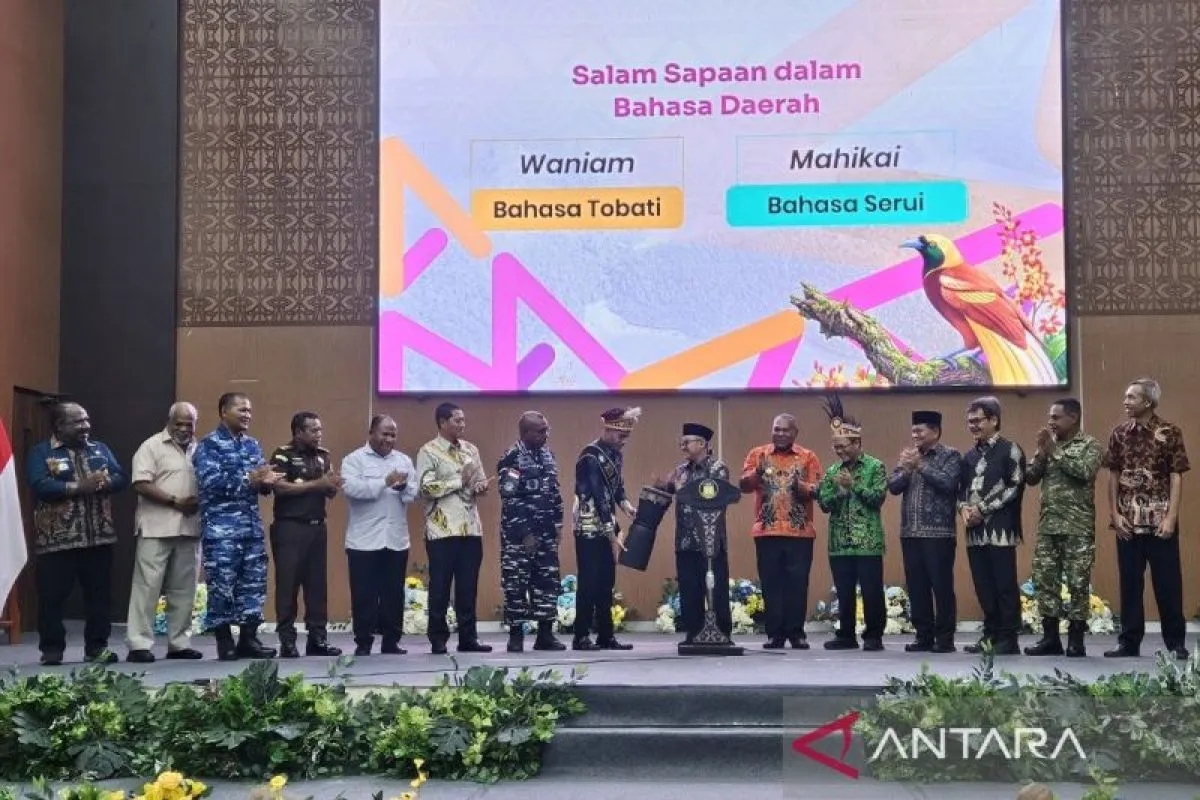
Papua language preservation has taken on renewed importance as Indonesia seeks to protect its extraordinary linguistic diversity while preparing younger generations for an increasingly connected world. At the opening of the 2026 National Regional Language Congress in Jayapura, Education Minister Abdul Mu’ti urged local governments to make Indigenous and regional languages part of everyday life, rather than treating them solely as cultural artifacts. The challenge is significant: Indonesia has 718 regional languages still in active use, and 428 are recorded across Tanah Papua and several other eastern Indonesian provinces, according to figures presented at the congress.
The gathering on Monday, October 19, 2026, brought the issue into sharper focus. Government officials called for practical policies that connect language preservation with family life, school education, customary activities, and digital technology. Their message was clear: documentation is important, but a language is most likely to survive when children hear it, learn it, and use it in their daily conversations.
For Papua, where linguistic diversity is closely connected to community identity, oral traditions, and local knowledge, the task requires sustained cooperation. The national government can establish policy direction and provide educational support, but regional administrations, teachers, parents, cultural practitioners, and Indigenous communities will determine whether those efforts become part of everyday life.
Jayapura Congress Puts Language Preservation on the Agenda
A National Discussion with Local Significance
The first National Regional Language Congress of Indonesia in Jayapura opened with Abdul Mu’ti and Papua Deputy Governor Aryoko Rumaropen. The event brought together national and regional perspectives on the need to protect languages that carry the histories, knowledge, and cultural expressions of communities across the archipelago.
Mu’ti called on local governments in Papua to strengthen language preservation by encouraging people to use their mother tongues at home, in schools, and in daily social interactions. He stressed that the effort must extend beyond Papua’s languages alone, reflecting the broader responsibility to safeguard Indonesia’s linguistic heritage.
“Preserving regional languages is not enough if they are only documented as cultural heritage,” was the substance of the minister’s message. He emphasized that languages must continue to function as tools of communication and social cohesion if they are to be passed on to future generations.
The distinction matters. Recording vocabulary, grammar, stories, and traditional expressions can help prevent knowledge from disappearing. Yet documentation cannot by itself ensure that children will speak a language naturally. That depends on whether the language remains useful and valued within the community.
For communities in Papua, where local languages are closely tied to family relationships, customary practices, and oral histories, the congress offered an opportunity to consider how preservation can be translated into long-term policy.
Regional Governments Call for Practical Measures
Aryoko Rumaropen underlined that safeguarding regional languages is a shared responsibility requiring concrete policies, budgetary support, qualified personnel, and active community participation.
The congress reported that Tanah Papua recorded 428 of Indonesia’s 729 regional languages. The difference between this figure and the commonly cited national total of 718 reflects the use of different datasets or classifications. The figures should therefore be read in their respective reporting contexts rather than treated as directly interchangeable.
Aryoko also identified several pressures affecting the transmission of mother tongues, including changing social habits, globalization, technological developments, and declining use of local languages within families. These pressures do not mean that younger Papuans must reject Indonesian or international languages. Rather, they emphasize the necessity to ensure that acquiring new language skills does not come at the expense of their linguistic inheritance.
The deputy governor called for recommendations that could strengthen language use in family life, education, customary activities, and public spaces, adapted to the circumstances of each community. His remarks reflected a central policy challenge: a national commitment to cultural preservation must be translated into programs that respond to local conditions.
Schools Can Help Make Mother Tongues Part of Daily Life
Building Pride Among Younger Generations
One of the clearest messages from the congress concerned the role of schools. Mu’ti asked educators in Papua to build pride in regional languages while maintaining the central position of Bahasa Indonesia as the national language.
“Schools need to build a sense of pride in regional languages while continuing to prioritize the position of Indonesian,” Mu’ti said, according to ANTARA’s report from the congress.
The approach does not require a choice between national unity and cultural diversity. Bahasa Indonesia enables communication across regions and ethnic groups, while local languages preserve distinctive forms of knowledge, expression, and community identity. Education can help children develop competence in both.
Mu’ti said schools could strengthen regional languages and literature through local-content lessons and by incorporating folk stories, songs, rhymes, traditional games, and oral traditions into learning activities. He also encouraged the development of reading materials and educational media that reflect local cultural contexts.
These methods can make language learning more engaging than memorising vocabulary alone. A traditional story, for example, can introduce children to local expressions while teaching them about community values, relationships with the natural environment, and the experiences of earlier generations. Songs and games can create opportunities to practice pronunciation and conversation in a familiar setting.
Teachers and other education personnel also have an important role in connecting local knowledge with classroom experiences. Where appropriate, learning materials can draw on the language and cultural practices of the community in which a school operates.
However, these initiatives require practical support. Schools need suitable materials, teachers who are confident in using the relevant languages, and cooperation with local speakers who can contribute knowledge of pronunciation, vocabulary, stories, and customary expressions. The needs of one community may differ substantially from those of another, making local consultation essential.
Language Transmission Begins at Home
The minister also stressed that school-based programs will have limited impact if children rarely encounter their mother tongue outside the classroom.
Mu’ti said language preservation should create connected spaces across homes, schools, communities, and public life so that the transmission of languages between generations is not interrupted.
Parents and grandparents can be central to this process. Everyday conversations, family stories, songs, and customary expressions allow children to experience a language as a living means of communication rather than simply as a school subject.
Community leaders and cultural practitioners can reinforce those efforts through customary gatherings, storytelling sessions, cultural performances, and other activities where local languages remain relevant. Regional administrations can help by supporting these initiatives and ensuring that preservation efforts continue beyond a single festival, congress, or commemorative event.
The challenge is to make the use of regional languages natural and worthwhile for children growing up amid television, social media, digital entertainment, and increasingly mobile lifestyles. Digital tools can contribute to the solution, provided that communities have the resources and skills to use them effectively.
From Policy Commitments to Long-Term Implementation
Turning Recommendations into Measurable Action
The Jayapura congress is expected to produce recommendations for more measurable and sustainable language-preservation policies. Mu’ti pointed to family life, education, customary activities, and digital technology as areas where such policies could be strengthened.
The next step is implementation. Regional governments could begin by working with schools, cultural institutions, language specialists, and Indigenous communities to identify which languages are being used by children and which require more urgent support. Such assessments should be sensitive to local circumstances and avoid assuming that every language faces the same challenges.
Practical programs could include the preparation of age-appropriate reading materials, teacher training, community storytelling activities, and audio or video documentation produced with the participation of fluent speakers. Digital archives may help preserve recordings and vocabulary, while locally produced content can provide younger people more opportunities to encounter their languages through familiar platforms.
Monitoring should also examine whether these initiatives lead to greater everyday use. The number of books produced, teachers trained, or recordings archived can demonstrate activity, but it does not necessarily show that a language is being passed on successfully. Measures of progress could include children’s ability to understand and speak their mother tongue, the frequency of intergenerational conversations, and the continued use of regional languages in community activities.
A further consideration is funding. Aryoko’s call for practical policies and budgetary support emphasizes the necessity for regional administrations to treat language preservation as a sustained public responsibility. Consistent funding and coordination are more likely to deliver lasting results than isolated activities without follow-up.
Education Infrastructure Provides a Complementary Foundation
Language preservation is also taking place alongside broader efforts to improve education in Papua. On October 19, the Education Ministry reported that 214 schools in Papua Province had signed cooperation agreements for a 2026 revitalization program with a total budget of Rp208.56 billion. The program is intended to improve school facilities and expand access to suitable learning environments.
At SMA Negeri 2 Jayapura, the ministry’s support of Rp2.09 billion is being used to construct three new classrooms in a two-story structure and rehabilitate four existing classrooms, according to acting principal Lea Ansanai.
School infrastructure and language preservation are distinct policy areas, and the revitalization budget should not be interpreted as funding specifically allocated to regional-language programs. Nevertheless, both initiatives concern the conditions in which children learn. Suitable facilities can support a broader educational environment, while culturally relevant teaching can help students connect formal learning with their family and community experiences.
The long-term value of these parallel efforts will depend on implementation. Better classrooms do not automatically produce stronger learning outcomes, just as language lessons do not automatically ensure that children will use their mother tongues outside school. Both require effective teaching, local participation, and continued evaluation.
Preserving Diversity While Strengthening National Unity
A Shared Responsibility Across Generations
Papua’s linguistic diversity is a cultural resource for Indonesia and a source of knowledge for the communities that maintain it. Regional languages can carry local histories, customary practices, ecological knowledge, and ways of understanding relationships between people and their surroundings. When a language falls out of use, some of that knowledge may become harder to transmit.
Preservation should therefore be approached not as resistance to change, but as a way to ensure that cultural inheritance remains meaningful as communities adapt to modern life. Children can learn Bahasa Indonesia for communication across the country and acquire additional languages for education, work, and international engagement while continuing to value the languages of their families.
That balance is consistent with the message delivered in Jayapura. The national government has called for a stronger role for schools and regional administrations, while Papua’s provincial leadership has emphasized concrete policy, funding, and community involvement. The practical responsibility is shared: central authorities can provide direction and support, local governments can tailor programs to community needs, and families and cultural practitioners can sustain everyday use.
For international audiences, the initiative also illustrates a broader issue facing linguistically diverse societies. Globalization and digital communication create new opportunities, but they can also reduce the space available for smaller languages if education, public life, and family habits increasingly favor only a few widely used tongues.
Conclusion
The 2026 National Regional Language Congress in Jayapura has placed a clear priority before Indonesian policymakers: regional languages must remain living forms of communication, not merely entries in an archive or symbols displayed during cultural celebrations.
The government’s call for stronger cooperation among local administrations, schools, families, and communities provides a useful framework. Its success, however, will be judged through sustained action: the availability of appropriate learning materials, trained educators, consistent regional support, and, above all, the willingness and ability of children to use their mother tongues in everyday life.
The scale of the task is considerable. With 428 languages recorded in Tanah Papua in the figures presented at the congress, preservation efforts must recognize the differences between communities rather than apply a single model everywhere. Some initiatives may focus on strengthening everyday use, while others may need to prioritize documentation, teaching resources, or the transmission of knowledge from fluent older speakers to younger generations.
Indonesia’s commitment to Bahasa Indonesia as a unifying national language need not diminish the value of its regional languages. The two can reinforce one another when education respects cultural diversity and equips children to participate confidently in national and global life.
Ultimately, Papua’s languages will endure not simply because governments announce preservation policies, but because those policies help communities keep speaking, teaching, recording, and passing them down. Jayapura has provided a platform for that work. The lasting test will be whether the recommendations become practical programs that reach households, classrooms, and communities across the region.
Read Also
Papua’s Vanishing Languages Face a Race Against Time
Papua to Host Language Congress in 2026

