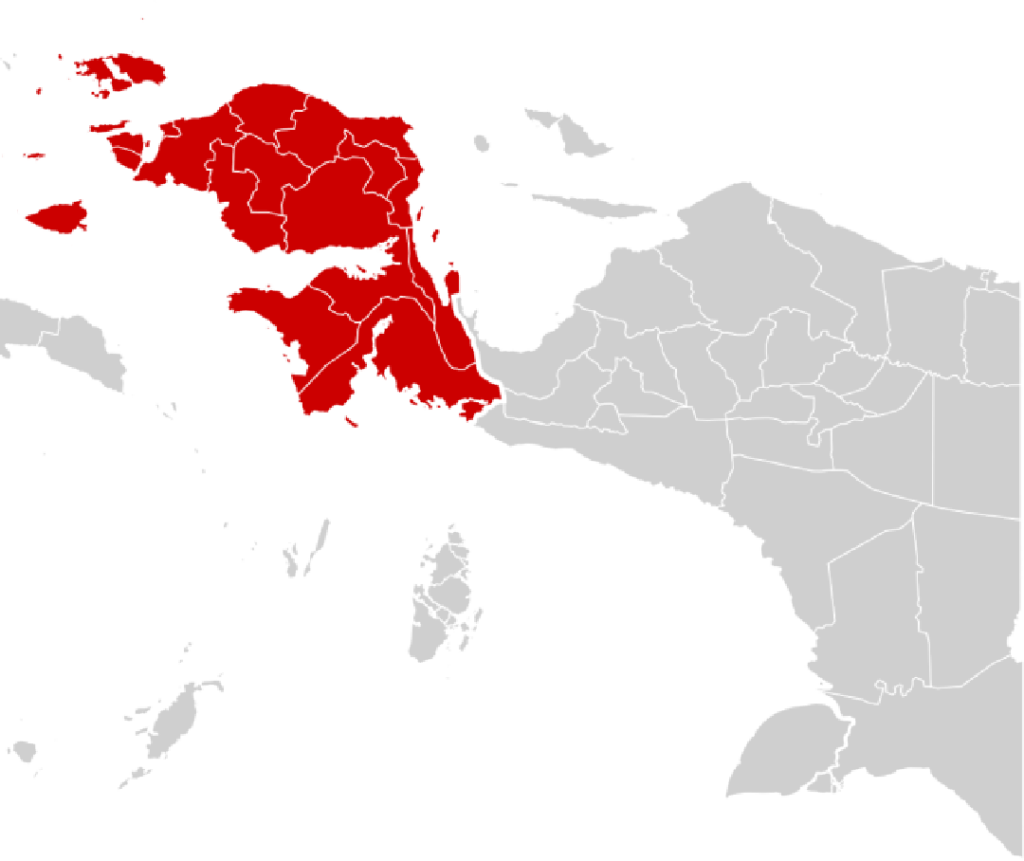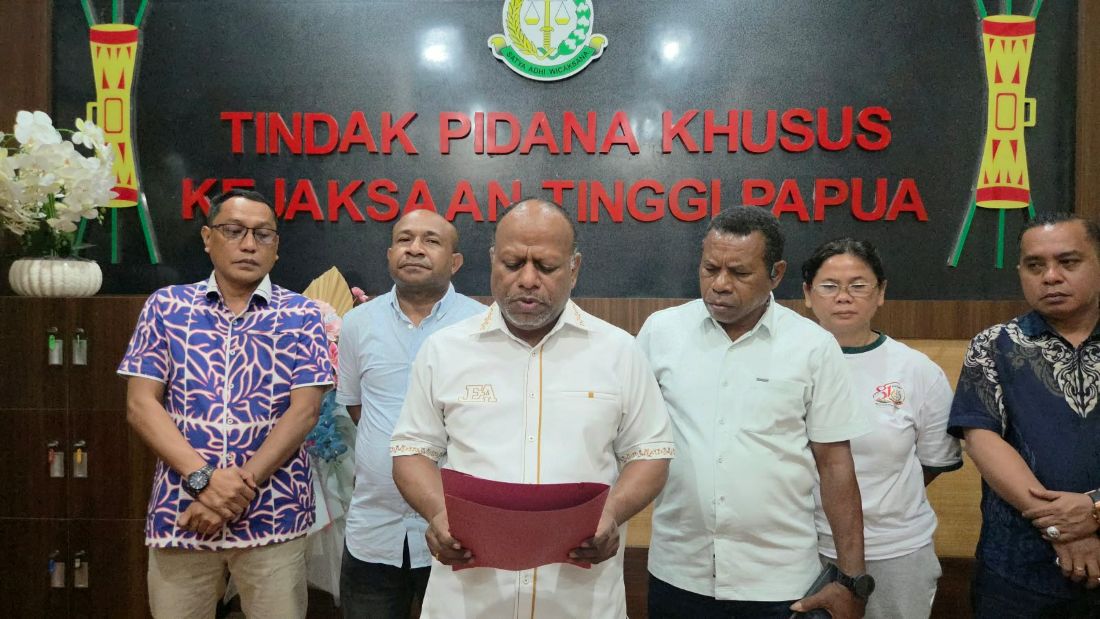
Prosecutors in Papua have searched the home of a former regional parliamentary secretary and the secretariat of the Papua People’s Representative Council (DPR Papua), stepping up an investigation into suspected irregularities in official travel spending over a decade.
The searches, conducted on September 24, 2026, targeted documents linked to a total travel budget of Rp44.236 billion for the 2015 to 2025 period. The Papua High Prosecutor’s Office (Kejati Papua) said the records could help investigators examine how the funds were managed, how official trips were administered, and how expenditure was accounted for.
The operation is an important development in a case involving public funds allocated to support the work of Papua’s legislature. It also places renewed attention on financial oversight and the responsibility of public institutions to demonstrate that government spending serves its intended purpose.
The investigation remains at the evidence-gathering stage. Prosecutors have not announced a suspect, and the amount under examination should not be confused with a confirmed state loss.
Two Locations Searched in Jayapura
Investigators from the Special Crimes division of Kejati Papua conducted the searches on Thursday, September 24.
The first location was the private residence of J.J.W., a former secretary of the Papua legislature. The investigators then proceeded to the DPR Papua Secretariat office in Jayapura, where they anticipated finding administrative records related to official travel.
According to the prosecutor’s office, the search at J.J.W.’s home began at 1:25 p.m. local time and ended at 3:10 p.m. Investigators then moved to the parliamentary secretariat, where the search ran from 3:20 p.m. to 4:45 p.m.
The searches were conducted under an official warrant issued by the head of Kejati Papua on September 24, registered as Print-939/R.1.5/Fd.2/09/2026.
The office said the purpose was to locate, obtain, and secure letters, records, and other documentary evidence connected to the suspected misuse of official travel funds.
The operation was led by Jusak E. Ayomi, the prosecutor’s assistant for special crimes, accompanied by Yedivia Rum, the assistant for intelligence, and members of the investigative team. The prosecutor’s office said the searches proceeded safely and without significant disruption.
Seven Boxes of Documents Reported Seized
The searches resulted in the collection of a substantial volume of paperwork.
A report by Cenderawasih Pos, republished by CEPOS Online, said investigators secured seven document containers: three from the former secretary’s residence and four from the DPR Papua Secretariat. The records are to be examined as part of the investigation.
ANTARA, however, reported that six boxes of documents were secured from the two locations. The discrepancy between the reported totals has not been reconciled in the available accounts. Both reports agree that investigators collected documents for further examination.
The documents are expected to help prosecutors reconstruct the administrative process behind official travel, including the records used to authorize trips and account for spending.
In cases involving travel budgets, documentary evidence can be central to determining whether expenditure was properly authorized, whether trips took place as recorded, and whether financial reports accurately reflect the activities undertaken.
The prosecutor’s office has not publicly detailed the contents of each box or identified particular documents as proof of wrongdoing. Their significance will depend on the results of the ongoing review and how they relate to other evidence.
A Decade of Travel Spending Under Investigation
The case concerns the management of official travel funds at the DPR Papua Secretariat between 2015 and 2025.
The total budget identified by Kejati Papua for that period was Rp44,236,994,000, or approximately Rp44.2 billion. J.J.W. served as the secretariat’s secretary during the period under investigation.
The distinction between the total budget and suspected losses is essential.
The Rp44.2 billion figure represents the value of the travel budget being examined, not a final calculation of money allegedly stolen or lost. Prosecutors said the Papua Provincial Inspectorate would conduct an audit to determine whether state finances had suffered losses and, if so, their amount.
That audit could become a key part of the process, helping investigators compare budget allocations and expenditure records with the supporting documentation.
The decade-long period also means that the inquiry may involve records created under different administrative circumstances and across multiple budget years. Investigators will need to establish which transactions are relevant and whether the available documents provide a reliable account of the spending.
Prosecutors Have Questioned More Than a Dozen Witnesses
The searches followed a series of witness examinations.
Kejati Papua has questioned more than a dozen people in connection with the investigation. Those called for questioning included individuals from within the DPR Papua Secretariat and representatives of Garuda Indonesia, the national airline.
The involvement of airline personnel indicates that investigators are examining information beyond the legislature’s own administrative files. Airline-related records and testimony may help clarify aspects of travel arrangements, although the prosecutor’s office has not publicly specified what information it requested from the company.
Witness statements can help investigators establish how official travel was arranged, who was involved in processing or approving documents, and how the expenses were recorded.
The examination of witnesses and the collection of documents are complementary parts of the inquiry. Records may establish what was formally reported, while testimony can help explain how the procedures operated in practice.
At this stage, however, the available information does not establish that any particular witness or official committed a crime.
Jusak Ayomi: Evidence Is the Focus of the Searches
Jusak E. Ayomi said the searches were part of the formal investigation and were intended to secure evidence related to the suspected corruption case.
He explained that investigators were seeking documents and correspondence connected to the management and accountability of official travel spending at the DPR Papua Secretariat between 2015 and 2025.
The statement reflects the evidentiary purpose of the operation. A search is an investigative measure, not a finding of guilt.
The records collected from the two locations will need to be reviewed, compared, and assessed alongside witness statements and other material gathered by the prosecutors.
Investigators must also establish whether any administrative discrepancies amount to criminal conduct, rather than errors or shortcomings that may have other explanations.
That distinction is particularly important in a case involving a large public budget and a long period of administrative activity.
Why the Investigation Matters for Public Accountability
Official travel budgets are intended to support the work of public institutions. For a legislature, that can include activities related to representation, oversight, meetings, and other official duties.
The public interest lies in whether allocated funds were used for legitimate purposes and properly accounted for.
When questions arise over expenditure, a credible investigation can help establish what happened and whether corrective or legal action is warranted.
For Papua, where government budgets support a wide range of public responsibilities, financial accountability is closely connected to confidence in public administration. Transparent procedures and reliable records can help ensure that public resources are managed according to the rules and that any proven wrongdoing is addressed through the legal system.
The case also illustrates the role of oversight institutions. Prosecutors are responsible for investigating suspected criminal conduct, while the provincial inspectorate’s audit is expected to help determine whether there was a financial loss to the state.
Those functions are related, but they are not identical. An audit can assess financial records and calculate potential losses, while prosecutors must establish whether the evidence supports criminal charges under applicable law.
The Next Steps: Document Review and Financial Audit
Kejati Papua said the investigation would continue through a deeper examination of the evidence and information obtained from witnesses.
The documents seized during the searches are now part of that process. Investigators will need to assess their relevance to the travel budget, including the administration and financial accountability of the trips recorded during the period.
The provincial inspectorate is expected to conduct an audit to determine whether state losses occurred and to calculate any potential amount.
As of the latest official information, prosecutors had not named a suspect.
That means the investigation remains open, and its eventual direction will depend on the evidence. If investigators identify sufficient grounds to proceed against an individual, any further legal action must follow the applicable procedures and respect the rights of those involved.
For the public, the next significant developments will be the outcome of the document review, the audit findings, and any formal announcement by prosecutors about the status of the case.
A Test of Institutional Transparency
The investigation is also a test of how public institutions respond when questions arise over the use of public money.
The DPR Papua Secretariat is responsible for administrative support to the legislature. The inquiry concerns travel spending managed through that secretariat, rather than establishing that the legislature as a whole or any particular elected representative is guilty of wrongdoing.
Maintaining that distinction is important for accurate reporting.
The search of an office does not by itself establish institutional culpability. Equally, the existence of a budget allocation does not automatically demonstrate that every expenditure was proper. The task of the investigation is to establish the facts from records, testimony, and financial analysis.
Public confidence will depend in part on whether the process is conducted professionally, whether findings are explained clearly, and whether any proven misconduct is addressed through due process.
The authorities’ ability to communicate verified information as the case progresses can help prevent speculation from replacing evidence.
Conclusion
The September 24 searches mark a significant step in Kejati Papua’s investigation into official travel spending at the DPR Papua Secretariat from 2015 to 2025.
Investigators searched the residence of former secretariat secretary J.J.W. and the parliamentary secretariat office, collecting boxes of documents for examination. More than a dozen witnesses have also been questioned, including people from the secretariat and Garuda Indonesia. The provincial inspectorate is expected to audit the spending to establish whether state losses occurred and, if so, their value.
The central question is not simply how much money was budgeted, but whether the spending was properly administered, supported by genuine records, and consistent with the rules governing public expenditure.
The Rp44.2 billion figure is the total travel budget under investigation, not a confirmed loss or proof of criminal conduct. No suspect had been announced in the official information available at the time of reporting.
For Papua, the case is an opportunity to demonstrate the importance of evidence-based law enforcement and transparent management of public resources. A thorough investigation, a clear audit, and due process can help establish accountability while protecting the rights of everyone involved.
Ultimately, the credibility of the case will rest on what the evidence shows. The task now facing investigators is to turn the documents and testimony they have gathered into a clear, verifiable account of how the travel budget was used.
Read Also
KPK Probes Trillion Rupiah Papua Operational Funds
Guarding Billions, Protecting Trust: How Indonesia’s Attorney General Is Overseeing Strategic Projects in Papua to Fight Corruption