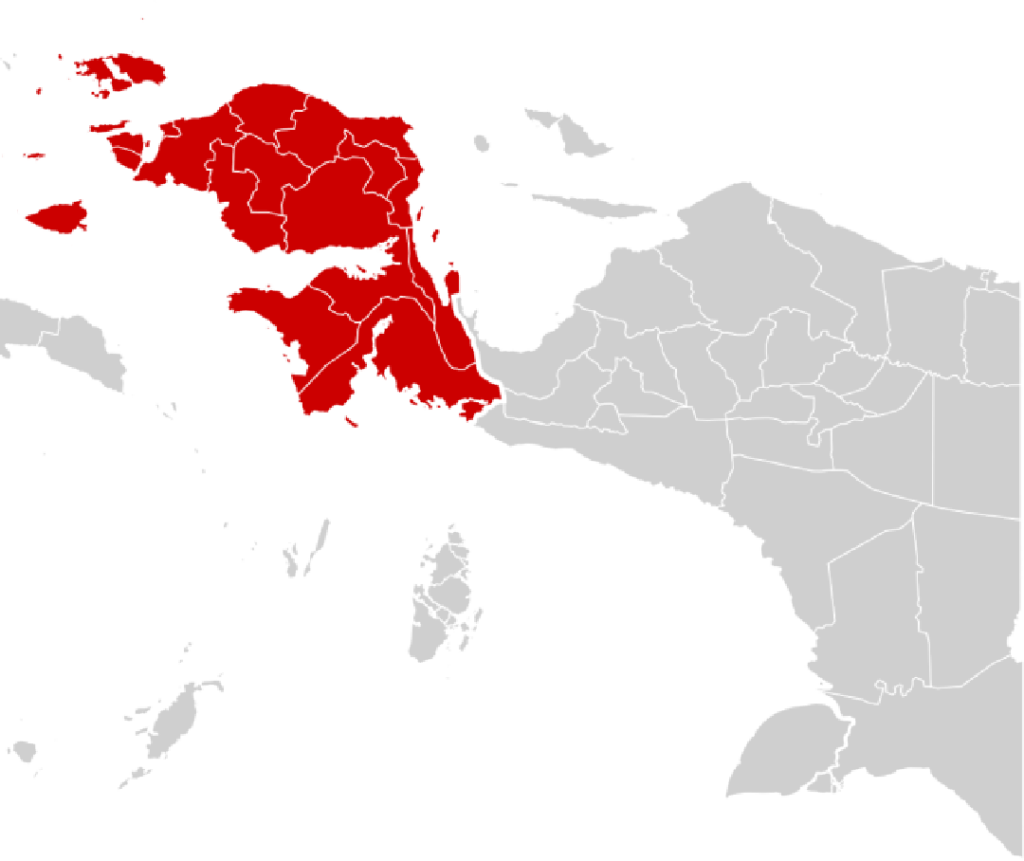
The Indonesian National Army Forces’ (TNI) community service in Papua Tengah (Central Papua) is taking shape through a series of practical programmes aimed at improving connectivity, strengthening village economies and supporting basic health services. In September 2026, military personnel in Papua Tengah completed 20 bridges, finished six outlets for the Merah Putih Village Cooperatives, and organised blood donations, free medical treatment and first aid training for residents and students in Nabire.
The activities, reported by ANTARA on September 20, illustrate how the Indonesian military is participating in a wider government effort to address practical challenges faced by communities in one of the country’s most geographically demanding regions. The projects range from physical infrastructure in Mimika, Nabire, Deiyai and Puncak to health services delivered directly in Nabire.
The initiatives are different in nature, but they share a common theme: bringing essential services and economic access closer to communities.
For residents in areas where transport remains difficult, a bridge can determine whether agricultural products reach a market or whether people can reach schools and public services. For villages, a cooperative outlet can eventually become a channel for distributing daily necessities and marketing local products. In Nabire, meanwhile, a bag of donated blood can become a critical resource for a patient in an emergency.
The TNI’s role, as described by Regional Military Command 173/Praja Vira Braja, or Korem 173/PVB, extends beyond its traditional defence and security responsibilities.
As Brigadier General TNI Vivin Alivianto, commander of Korem 173/PVB, put it during the health programme in Nabire: “The TNI does not exist solely for national security or defence; its soldiers also stand at the forefront of providing service to the community.” ANTARA translated the context as an expression of the military’s service to the public alongside its defence responsibilities.
Twenty Bridges Open New Routes Across Papua Tengah
The first part of the story begins with the region’s geography.
On September 20, ANTARA reported that Korem 173/PVB had completed 20 of 28 Garuda Merah Putih bridges being constructed in Papua Tengah. The bridges are spread across four regencies: Mimika, Nabire, Deiyai and Puncak. Eight additional bridges remain under construction.
Colonel Inf. Fajar Wibawa Angkasa, head of the territorial section at Korem 173/PVB, said the remaining eight bridges consist of two locations in Mimika, four in Nabire and two in Puncak.
According to Fajar, communities can already use the 20 completed structures.
Their purpose is straightforward but important: to connect areas that previously faced transportation limitations and make it easier for residents to move between communities.
The bridges are also intended to support everyday economic and social activity.
Fajar said the infrastructure can help residents transport agricultural products, reach educational facilities and carry out economic and social activities.
For communities separated by rivers or difficult terrain, such access can affect more than travel time.
A farmer needs a route to transport produce. A student needs a way to reach school. Families need access to markets and public services. Local traders need to move goods in both directions.
The bridge programme therefore represents more than a construction project.
It is an attempt to address one of the most basic barriers to economic and social connectivity in remote areas.
Different Bridges for Different Landscapes
The 28 Garuda Merah Putih Bridges are not all built to a single design.
According to Fajar, the construction specifications have been adapted to the geographical conditions and needs of each location. The structures include pioneering bridges, concrete bridges and Armco-type bridges.
One of the largest structures is in Mimika.
The bridge is approximately 50 metres long and 10 metres wide and can accommodate four-wheeled vehicles as well as larger vehicles.
That capacity is particularly relevant to the movement of goods.
A bridge capable of carrying larger vehicles can provide a more practical route for transporting agricultural production and other community goods, according to the Korem 173/PVB official.
The remaining eight bridges show that the programme is not yet complete.
Two are still being built in Mimika, four in Nabire and two in Puncak.
Fajar also said additional bridge construction could be considered if proposals are submitted by territorial military units or local governments.
He explained that requests from Kodim units or regencies would be reported so that the construction process could be accelerated where there is a recognised need.
That mechanism places local needs in the infrastructure planning process.
Bridges as Economic Infrastructure
Viewing the programme from the perspective of local economies clarifies its significance.
In many remote parts of Papua, distance is not simply a geographical measurement. It can influence the price of goods, the time required to reach markets and the ability of producers to sell what they grow.
A road without a bridge can remain effectively disconnected.
The completed Garuda Merah Putih Bridges are intended to change that by opening routes between communities and improving access to centres of economic activity.
ANTARA reported that the bridges are expected to make travel between areas easier and improve access to service centres and economic activities.
The reporting does not yet provide measured data on changes in household income, agricultural production or transportation expenses following completion. Those outcomes will require time and further assessment.
For now, the immediate achievement is physical connectivity.
In a region where geography can pose significant obstacles to development, achieving physical connectivity is a crucial starting point.
From Bridges to Village Cooperatives
The second part of the TNI’s community service programme moves from physical connectivity to the local economy.
ANTARA reported that six outlets for Red and White Village Cooperative (Koperasi Desa Merah Putih, or KDMP), had been completed in Papua Tengah. Four are located in Nabire and two in Mimika.
The cooperative outlets are part of the government’s wider effort to establish economic infrastructure at the village level.
Korem 173/PVB received a physical construction assignment to support the government programme.
But completing the buildings is only the beginning.
Lieutenant Colonel Arh Dwi Palwanto Tirta Mentari, commander of Kodim 1705/Nabire, stressed that the buildings would not immediately be handed over for full operation.
There is another stage: mentoring.
Six Outlets Completed, More Potential Sites Identified
In Nabire, seven KDMP locations are currently under construction.
Four have been completed, while the other three had reached more than 95 per cent progress at the time of ANTARA’s report. That means all seven locations in Nabire were approaching completion.
In Mimika, two targeted outlets had been fully completed.
The programme could eventually expand.
Fajar said four potential new sites had been identified in Nabire and another three in Mimika. However, construction at those additional sites depends on meeting requirements and ensuring that land is ready.
Technical considerations include a minimum land area of 600 square metres and electricity capacity of at least 5,500 watts.
Population is another consideration.
Fajar explained that the basic concept is one KDMP per village, but locations will also be assessed according to population conditions. Areas with at least 500 families are prioritised, particularly more densely populated locations that can support cooperative operations.
The approach shows that the programme is not simply about constructing as many buildings as possible.
The government and military authorities are also considering whether a location has the population base and infrastructure required to sustain cooperative activity.
The Building Is Not the Business
Perhaps the most important detail in the KDMP programme is what happens after construction.
Dwi Palwanto made the point explicitly: a completed building does not automatically mean a functioning cooperative.
He said mentoring would be provided to prepare cooperative administrators for operations. The assistance is expected to cover administration, supply chains, sales and the improvement of management capabilities.
That distinction is crucial.
A cooperative requires more than walls, shelves and electricity.
It needs people who understand bookkeeping, procurement, inventory, marketing and customer service. It needs suppliers and buyers. It needs a management structure that can operate consistently.
The KDMP outlets are therefore being positioned as economic infrastructure that still requires human capacity.
If the model functions as intended, the outlets are expected to support the distribution of community necessities and create wider marketing channels for locally produced goods once the cooperatives become operational.
The authorities’ emphasis on mentoring indicates their recognition that organisational capability must complement physical infrastructure.
Health Services Reach Nabire Communities
The third element of the TNI’s community service programme took place in Nabire on September 20.
Korem 173/PVB, Kodim 1705/Nabire, Lanal Nabire, Brigif and Yonif personnel participated in a health service programme held as part of preparations for the 81st anniversary of the TNI.
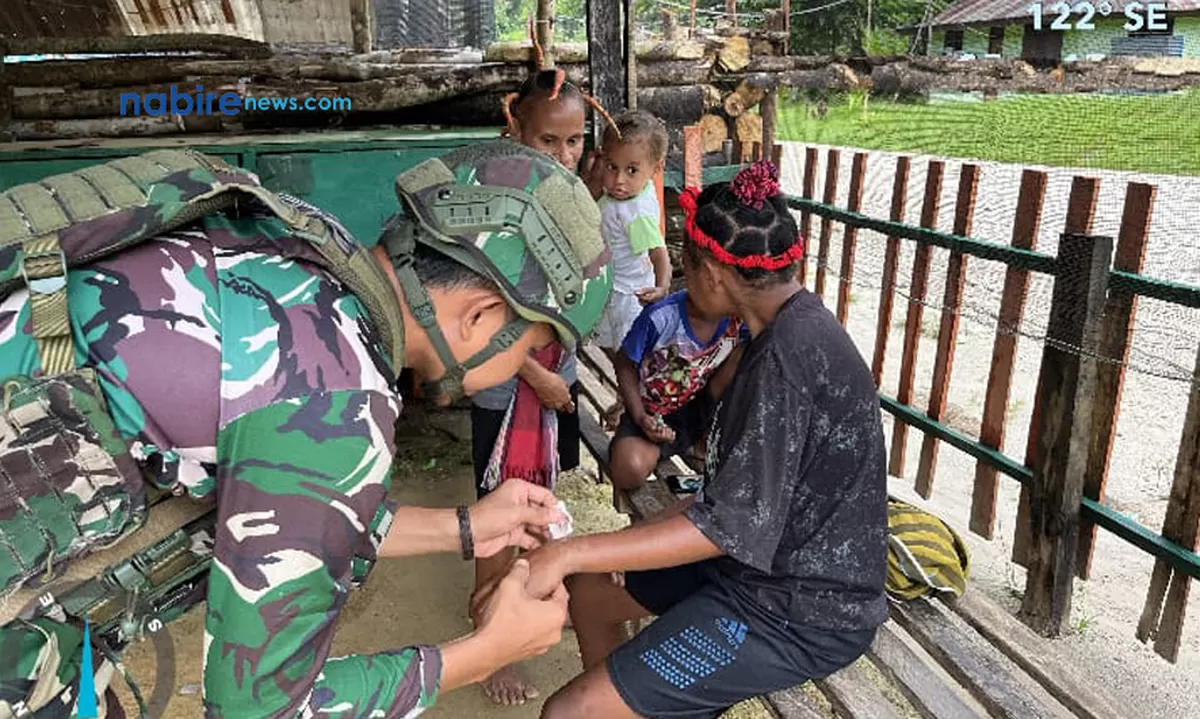
The programme included blood donations, basic life support training and free medical examinations and treatment.
The health activity added a different dimension to the infrastructure and economic initiatives.
While bridges and cooperatives are intended to produce longer-term benefits, the medical programme addressed immediate needs.
For some residents, the most important service available that day was not a new structure or economic facility but a medical examination and medication.
152 Soldiers Donated Blood
The blood donation was conducted by military personnel serving in Nabire.
The original target was 150 donors.
A total of 152 soldiers participated, according to Korem 173/PVB.
Following medical screening, 50 bags of blood were declared eligible to be handed over to the hospital.
The difference between the number of people who attempted to donate and the final number of accepted blood bags is significant.
Not every donor automatically qualifies.
Irto F. Kala Padang, head of the Nabire Hospital Blood Management Unit, said the collected blood underwent another examination at the hospital before being stored and distributed to patients who needed it.
He explained that some potential donations were excluded because donors had low haemoglobin levels or had not yet reached the required three-month interval since their previous donation.
For hospitals, such screening is part of maintaining the safety and suitability of the blood supply.
Irto said blood availability was particularly important when hospitals have patients requiring urgent treatment.
He added that TNI personnel also donate blood periodically when hospitals need additional supplies.
Free Medical Treatment for Children and Adults
The health programme was not limited to blood donations.
Residents were also able to receive medical examinations and free treatment.
Captain Dr Theresia Marlen Loinenak of Polkes 17.09.03 Nabire said doctors identified several common complaints among adult patients, including hypertension and high cholesterol.
Among children, the most common complaints included acute respiratory infections such as coughs, colds and fever, as well as several skin infections.
Patients who underwent examinations received medication according to their complaints and medical findings.
The number of patients was relatively modest but meaningful for a community service event.
Dr Theresia estimated that there were around 20 adult patients and approximately 20 children who received the medical service.
The activity provided a direct connection between military personnel and residents.
Instead of meeting communities only through security or territorial functions, soldiers participated in a health service that addressed everyday medical needs.
Teaching Young People Basic Life Support
The health programme also looked beyond immediate medical treatment.
Around 300 students from SMA YPPK Sion Samabusa and SMAN 3 Nabire participated in basic life support training.
The training was designed to teach students how to provide initial assistance when encountering someone who is unconscious or has stopped breathing.
For Vivin Alivianto, this type of education is part of strengthening the relationship between the military and society.
He said the training was intended to strengthen the TNI’s relationship with the community while demonstrating soldiers’ readiness to assist when residents face emergency situations.
He also emphasised the importance of public support for maintaining regional stability.
“Support from the community is crucial,” Vivin urged, encouraging residents and the military to collaborate in fostering a stable environment.
The message places the health programme within a broader concept of community resilience.
A student who knows how to respond when someone collapses may be able to provide assistance before professional medical personnel arrive.
Basic first aid knowledge can be particularly useful in remote areas, where travel to health facilities can take time.
Three Forms of Service, One Community Focus
Taken together, the three initiatives present different forms of public service.
The bridge programme addresses mobility.
The cooperative programme addresses local economic infrastructure.
The health programme addresses immediate healthcare needs and community preparedness.
Their connection is perhaps most visible in the idea of access.
A bridge improves access to markets, schools and other services.
A cooperative outlet is intended to improve access to goods and markets for local products.
A health programme improves access to medical examinations, medicines and blood supplies.
None of these activities alone can solve all of Papua Tengah’s development challenges.
But each addresses a practical obstacle experienced by communities.
A Broader Role for Territorial Units
The activities also illustrate the role of Indonesia’s territorial military structure in supporting government programmes at the local level.
Korem 173/PVB and its subordinate units are involved in projects that range from infrastructure construction to health and community engagement.
In the bridge programme, the military is directly involved in construction work.
The KDMP programme assigns physical construction tasks to the military while cooperative administrators receive additional mentoring.
In health services, military personnel become donors, trainers and providers of free medical services.
The three roles are different, but they all involve direct interaction with communities.
For the TNI, that interaction is being presented as part of its service to society alongside its defence responsibilities.
Building Connectivity Before Measuring Impact
The bridge programme serves as a useful example of the need to measure development results over time.
Twenty bridges have been completed, but the remaining eight are still under construction.
The immediate output is clear.
The longer-term outcome remains something that will need to be observed.
Will transportation become cheaper? Will agricultural products reach markets more easily? Will school attendance improve? Will access to public services become more reliable?
The ANTARA report does not yet provide those measurements.
What it does establish is that 20 bridges have been completed and are already available for community use.
That distinction is important for credible development reporting.
Infrastructure creates an opportunity. Communities and other government institutions then determine how effectively that opportunity is used.
Connecting Economic Infrastructure with Local Communities
The KDMP programme presents a similar situation.
Six outlets have been completed, but the cooperative institutions still require administrative and operational preparation.
Dwi Palwanto’s remarks about mentoring highlight the importance of this transition.
If the cooperatives eventually become functioning distribution and marketing centres, their value will depend on how effectively local producers and consumers use them.
That could include selling agricultural products, distributing household goods and creating new local business relationships.
However, the source report has not yet measured those outcomes.
For now, the government and TNI have established physical infrastructure and are preparing the human systems needed to operate it.
A More Visible Social Role
The health programme enhances the overall picture.
Vivin Alivianto’s statement that the TNI is not only responsible for defence and security but also has a role in serving society represents the institutional message behind the activity.
The blood donation, free medical treatment and student training are relatively simple interventions.
Yet they provide opportunities for direct interaction between military personnel and civilians.
In a region where maintaining public trust and communication is important, such interactions can have value beyond the immediate service provided.
Again, the source does not quantify a long-term change in public trust, so such an outcome should not be assumed.
The immediate facts are more concrete: 152 military personnel participated in the blood donation, 50 bags passed screening, around 300 students received basic life support training, and dozens of adults and children received medical examinations and treatment.
The Wider Development Picture in Papua Tengah
The three initiatives are taking place within a wider development process in Papua Tengah.
Connectivity remains one of the region’s major practical challenges. Economic development requires channels through which products can reach consumers. Public health requires reliable medical services and adequate emergency resources.
The bridge, cooperative and health programmes address these areas from different directions.
They also show why development in Papua cannot be reduced to a single project.
A bridge may improve physical access, but communities also need economic institutions.
A cooperative may provide a market channel, but people also need healthcare.
Health services can address immediate needs, but communities also require roads and economic opportunities.
Development becomes more meaningful when these systems operate together.
Conclusion
The TNI’s latest community activities in Papua Tengah show three different ways in which public service can reach communities.
Twenty Garuda Merah Putih bridges have been completed across Mimika, Nabire, Deiyai and Puncak, with eight more still under construction. The completed structures are intended to improve movement, agricultural transportation, access to schools and connections to economic and social activities.
Six KDMP outlets have also been completed in Nabire and Mimika. However, officials have emphasised that the buildings are merely the initial phase. Before the cooperatives can operate fully, they will need administrative, supply chain, and sales mentoring.
In Nabire, the TNI’s health service produced 50 eligible blood bags from 152 participating military donors, while around 300 students received basic life support training and adults and children received free medical examinations and treatment.
For Korem 173/PVB commander Brigadier General Vivin Alivianto, these activities are part of the military’s service to society alongside its defence role.
The broader lesson is that development in Papua Tengah is often built through practical steps.
A bridge can shorten a journey. A cooperative can create a new commercial connection. A blood donation can help a hospital respond to an emergency. A student trained in basic life support can potentially assist someone before professional help arrives.
None of these actions alone defines development.
Together, however, they show how infrastructure, local economic capacity and public health can become interconnected parts of community welfare.
For Papua Tengah, the next question will be whether these newly completed facilities can be maintained, used effectively and expanded where genuine needs remain.
That is where the value of today’s construction and community service will ultimately be measured.
Read Also
Papua Pegunungan Accelerates Cooperative Development to Strengthen Local Economies
76 Garuda Bridges Connect 142 Villages in Papua