
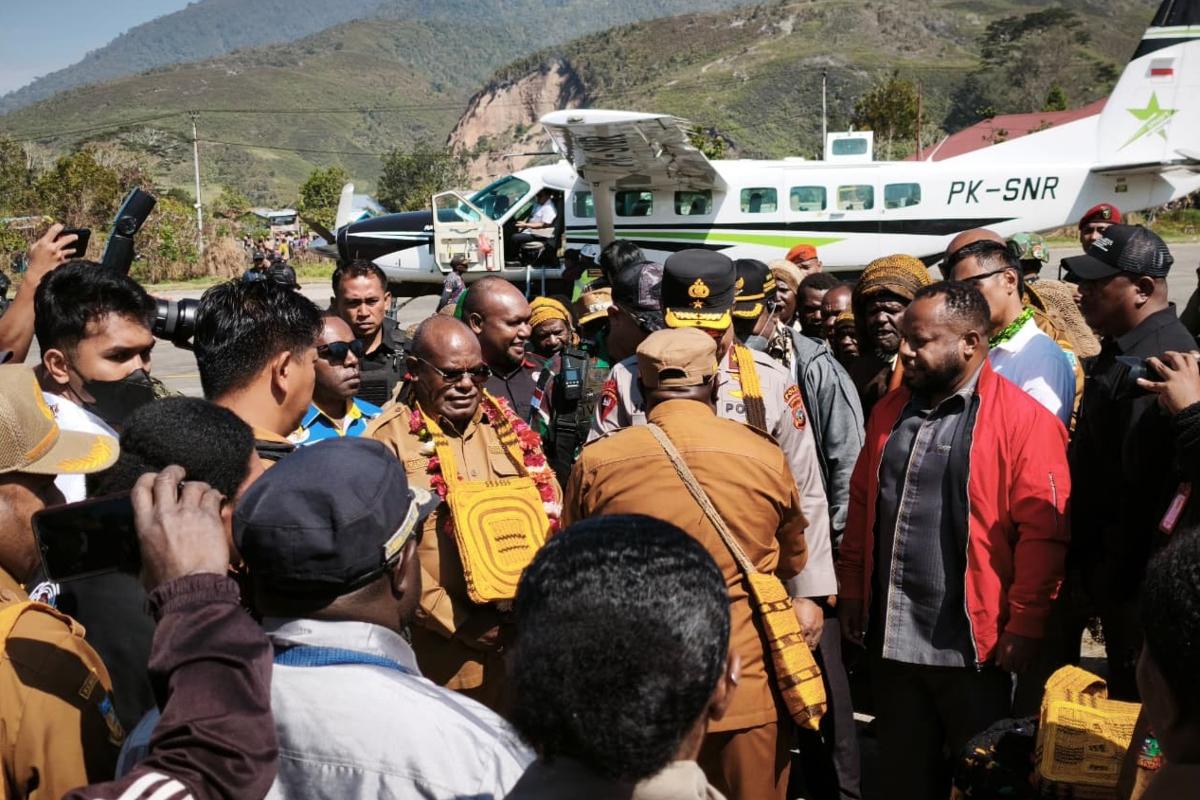
When Papua Tengah (Central Papua) Governor Meki Fritz Nawipa arrived in Dogiyai on September 7, the visit was more than a routine government inspection. It was an attempt to bring provincial decision-making closer to communities that live far from the administrative centre and to see firsthand whether development programmes are producing the intended results.
Nawipa’s working visit to Dogiyai and Deiyai combines several priorities: listening to residents, reviewing infrastructure and education projects, strengthening coordination with district governments, supporting young people’s economic activity and engaging with traditional and community leaders. The agenda reflects a practical approach to governance in a province where geography can make distance between government and citizens a significant policy challenge.
The visit began in Dogiyai before continuing to Deiyai on September 8. Provincial officials described the tour as part of Nawipa’s regular effort to monitor priority programmes directly, collect community aspirations and strengthen cooperation between provincial and district administrations.
For Papua Tengah, the trip’s importance is not just in the projects being inspected, but in the governance method: development is being evaluated where it is actually happening.
Bringing Government Closer to the Community
Papua is geographically vast, and Papua Tengah’s mountainous interior presents particular challenges for public service delivery.
In such an environment, government programmes can look different on paper than they do on the ground. A road may be completed but remain difficult to use. A school may exist but lack adequate accommodation or teachers. A programme designed to support local businesses might fail to reach the people it was intended to serve.
This situation is why direct field visits matter.
Nawipa’s spokesperson, Emanuel You, said the Dogiyai and Deiyai visits were intended to ensure that development programmes were “tepat sasaran”, or properly targeted, while strengthening relations between government and communities. The governor was also expected to gather residents’ aspirations directly so they could inform future policies.
That approach places community feedback alongside physical project monitoring.
Rather than relying entirely on reports from administrative offices, the governor and his team are using the visit to see projects, meet residents and hear local concerns directly.
For a young province such as Papua Tengah, this type of provincial and district coordination can be particularly important. Effective decentralised governance depends on the ability of different levels of government to identify problems early and respond before they become more expensive or difficult to solve.
Dogiyai: Education, Roads and Economic Opportunity
Dogiyai was the first major stop on the governor’s tour.
The visit included a groundbreaking ceremony for the SMP YPPK St. Fransiskus Asisi boarding facility in Mapia, as well as the inauguration of other boarding facilities, including the STP and STA Bomomani dormitory and the SMP YPPK St. Fransiskus Asisi Moanemani dormitory.
The education component is significant because boarding facilities can reduce one of the practical barriers faced by students living in remote and mountainous communities.
The provincial government has said the new Mapia facility is intended to provide students with a more suitable place to live and study without requiring them to travel excessively far from their communities. The planned facility will also receive basic furnishings, including beds and mattresses.
Nawipa has also raised the possibility of developing integrated education facilities covering elementary, junior secondary and senior secondary levels in the Mapia area.
The idea is straightforward: if children can continue their education closer to home, families face fewer costs associated with relocation, while communities retain greater access to educated young people.
Roads and Services Must Develop Together
Education, however, cannot be separated from connectivity.
Dogiyai Regent Yudas Tebai told Nawipa that the district has been working to open and improve roads, with seven of its 10 districts already having road access, although conditions remain uneven. He asked the provincial government to pay particular attention to roads under provincial authority because better connectivity would support economic activity and access to government services.
Nawipa’s visit therefore provides an opportunity to examine development as a connected system.
A school needs students and teachers, but students need roads and transportation to reach it. Farmers need productive land, but they also need transport routes to take their products to markets. Health facilities require medical workers, medicines and reliable logistics.
This is particularly relevant in mountainous areas, where distance can magnify the cost of delivering even basic services.
ANTARA reported that the provincial government views road access, electricity, schools and telecommunications as interconnected elements that can reduce the isolation of mountain communities.
Supporting Youth Through Local Economic Activity
Another visible element of the Dogiyai visit was economic assistance for young Indigenous Papuans.
The provincial government provided 34 motorcycles to young Indigenous Papuans in Dogiyai, intended primarily to support motorcycle taxi services and other productive economic activities. ANTARA reported that the recipients were expected to use the vehicles not only to transport passengers but also to support agricultural trading and other local businesses.
The broader programme involved 68 motorcycles, with 34 allocated to Dogiyai and another 34 to Deiyai. Local motorcycle taxi communities welcomed the assistance, saying the vehicles could help improve transportation services and strengthen household incomes.
The policy is noteworthy because it attempts to connect transportation support with local economic production.
Nawipa has encouraged recipients to use the motorcycles to collect agricultural products from farmers and deliver them to cooperatives and markets. Coffee is one of the commodities highlighted by the provincial government.
Dogiyai is known for its Moanemani Arabica coffee, and local officials see opportunities to develop the commodity through stronger cooperative-based marketing.
This creates a potential supply chain that connects farmers, motorcycle operators, cooperatives, and markets.
If developed effectively, such a system could create economic opportunities beyond the immediate income earned from motorcycle taxi services.
Turning Transport Into an Economic Network
The initiative also reflects a broader understanding of rural transportation.
In remote regions, a motorcycle is not merely a means of moving people. It can become a small logistics asset.
A farmer can reach a buyer more easily. A trader can collect produce from several villages. A student can travel to school. A health worker can reach communities more quickly.
The economic value therefore depends on how the asset is integrated into the wider local economy.
Dogiyai’s fertile land and agricultural potential provide an important foundation. The district has horticultural products, fruit, coffee and ornamental plants such as orchids. Its position along the economic route connecting Nabire, Deiyai and Paniai also gives it strategic potential as a local trading corridor.
Deiyai: Development Meets Culture
After completing the Dogiyai agenda, Nawipa travelled to Deiyai, where he received a distinctly cultural welcome.
The governor was welcomed in Waghete by Deiyai Regent Melkianus Mote, local officials, security and community representatives, as well as hundreds of residents wearing traditional Mee attire. The ceremony included the presentation of a noken, the placing of a traditional crown on the governor’s head and traditional dancing.
The welcome carried political and social significance without needing to be reduced to politics.
Traditional ceremonies remain an important part of public life in Papua, particularly when government leaders visit local communities. Such events can provide a culturally familiar setting for dialogue and reinforce the relationship between provincial institutions and residents.
For the Deiyai government, the visit was presented as an opportunity to strengthen cooperation and ensure development reaches communities at the village level.
The agenda also reflects a broader development approach, linking education, culture, small businesses and public infrastructure.
Listening at the Market and in the Community
One of the scheduled activities in Deiyai was a visit to the Mama Papua Market, where Nawipa and his delegation were expected to meet small business operators.
This part of the programme is particularly important because markets provide a direct view of household economic conditions.
Government officials can assess formal economic indicators, but conversations with traders can reveal practical issues such as transportation expenses, access to customers, availability of goods, purchasing power and working capital.
The governor’s agenda also included visits to cultural facilities and boarding school construction sites before a meeting at the Deiyai regent’s office involving assistance distribution and direct discussions with residents.
The schedule shows an attempt to combine administrative monitoring with community engagement.
Rather than focusing exclusively on government offices, the visit includes schools, cultural spaces, markets and construction sites.
That breadth matters because development is experienced differently by different groups.
For a student, development may mean a functioning dormitory. For a trader, it may mean better access to customers. For a farmer, it may mean a reliable route to market. For a family, it may mean better health services.
A successful regional development strategy needs to account for all of these perspectives.
Education Remains a Central Priority
The Deiyai visit also places education high on the provincial agenda.
Naftali Pekei, a young KINGMI youth representative in Deiyai, welcomed the governor’s visit and highlighted the importance of the planned inspection of the SMTPK Baida Troutman Gakokebo boarding facility and the KINGMI Center Deiyai boarding facility in Epadoutou, Bomou.
He argued that the facilities could provide students from different areas with safer and more suitable accommodation while supporting continuity in education.
The emphasis on boarding facilities is consistent with the challenges facing students in geographically dispersed communities.
For many families, the availability of a school is only one part of the equation. Students also need somewhere safe and affordable to stay if their homes are far from the classroom.
This makes education infrastructure a practical tool for reducing geographic inequality.
The provincial government can strengthen that impact further by ensuring that new facilities are accompanied by adequate teachers, learning materials, sanitation, electricity and long-term maintenance.
Community Feedback as a Policy Tool
Perhaps the most important element of the governor’s visit is the decision to listen.
Dogiyai Regent Yudas Tebai publicly thanked Nawipa for coming to the district and hearing the concerns of local government and residents directly. He raised issues ranging from road infrastructure and healthcare to education, agricultural development and employment.
Dogiyai currently has 15 inpatient community health centres and one regional hospital, according to the regent. Local authorities are working to improve health facilities and personnel, but additional support is still needed, including doctors and specialists.
Education faces a similar challenge.
Dogiyai has 66 elementary schools, 14 junior secondary schools and four senior secondary or vocational schools, while local authorities continue to face shortages of teachers.
These figures illustrate why direct consultation is important.
A provincial government cannot respond effectively to local needs without accurate information from districts and communities.
The challenge now is to convert the concerns heard during the visit into measurable programmes, budget decisions and follow-up actions.
Development Must Be Measured After the Ceremony
A working visit can generate political visibility, but its real value is determined by what happens afterward.
A groundbreaking ceremony is meaningful only when construction continues according to schedule. A motorcycle assistance programme is meaningful when beneficiaries use the vehicles productively. A community meeting is meaningful when concerns raised by residents are incorporated into policy.
This situation is where monitoring becomes essential.
Nawipa’s emphasis on properly targeting programmes offers a valuable framework. Provincial and district governments can strengthen that approach through clear indicators, public progress reports and regular field verification.
For infrastructure, the question should be whether facilities are completed and functioning.
For education, the indicators could include student attendance, graduation and teacher availability.
For economic assistance, the focus could include beneficiary income, business activity and market access.
For healthcare, service availability and patient access provide more meaningful measures than simply counting buildings.
Such a results-based approach would make provincial development more transparent and easier for communities to evaluate.
Culture, Government and Social Trust
The traditional welcomes in Dogiyai and Deiyai also underline another dimension of governance in Papua: social trust.
Development is more sustainable when communities feel that they are participants rather than passive recipients.
The presence of traditional leaders, religious communities, youth groups, traders, students and local officials during the governor’s visits creates multiple channels through which government can understand community expectations.
Jhon Iyowogi Nawipa, a young KINGMI intellectual, described the governor’s visits as an opportunity to strengthen communication between the government and young people and urged communities to view the visits constructively. He argued that direct visits allow government leaders to understand conditions more closely and build stronger relationships with local communities.
This type of engagement can become particularly valuable when it is maintained beyond ceremonial occasions.
Regular consultation creates institutional memory. It allows government officials to compare conditions over time and identify whether programmes are actually improving people’s lives.
A Broader Development Strategy for Papua Tengah
The Dogiyai and Deiyai visits should therefore be understood within a broader development strategy for Papua Tengah.
The province is attempting to combine infrastructure development with human capital investment, local economic empowerment and stronger government coordination.
The approach is visible in several elements of the governor’s itinerary.
Education is addressed through boarding facilities. Connectivity is addressed through roads and transportation. Youth employment is supported through motorcycle assistance. Local agriculture is linked to cooperative development. Culture is incorporated into public engagement. Community aspirations are collected directly.
These initiatives are not substitutes for one another.
They reinforce each other.
A farmer with access to a market needs transportation. A student needs both a classroom and accommodation. A trader needs customers and reliable mobility. A health worker needs infrastructure and access to remote communities.
The challenge for the Papua Tengah government is to connect these individual programmes into a coherent regional development system.
Conclusion
Governor Meki Fritz Nawipa’s working visits to Dogiyai and Deiyai offer a clear example of development governance that begins with physical presence.
The governor has used the visits to inspect projects, meet district governments, listen to communities, support education facilities, encourage youth economic activity and engage with local cultural institutions.
The message from local communities is equally clear. They want development that is visible, practical and sustained.
Dogiyai has called for better roads, stronger education and healthcare services, agricultural development and employment opportunities. Deiyai has placed education, culture, small businesses and community facilities in focus.
The next stage is implementation.
For the visits to produce lasting value, community aspirations must be translated into concrete programmes, adequate budgets, transparent monitoring and measurable outcomes.
That is where the credibility of provincial development policy will ultimately be tested.
For Papua Tengah, the opportunity is significant. If the government can maintain direct communication with communities while improving coordination with district administrations, development programmes can become more responsive to local realities.
The journey from Dogiyai to Deiyai is therefore more than a provincial tour.
It is a reminder that in Papua’s mountainous communities, effective development begins by going where the people are, listening to what they need and then making sure that government programmes reach them.
Read Also
PAPEDA Summit Puts Indigenous Rights at the Center
Central Papua Governor Meki Nawipa: Delivering Aid, Reuniting Families, and Advocating Peace in Puncak’s Gome and Sinak
Papua Tengah Pledges Rp56 Billion for Education

