
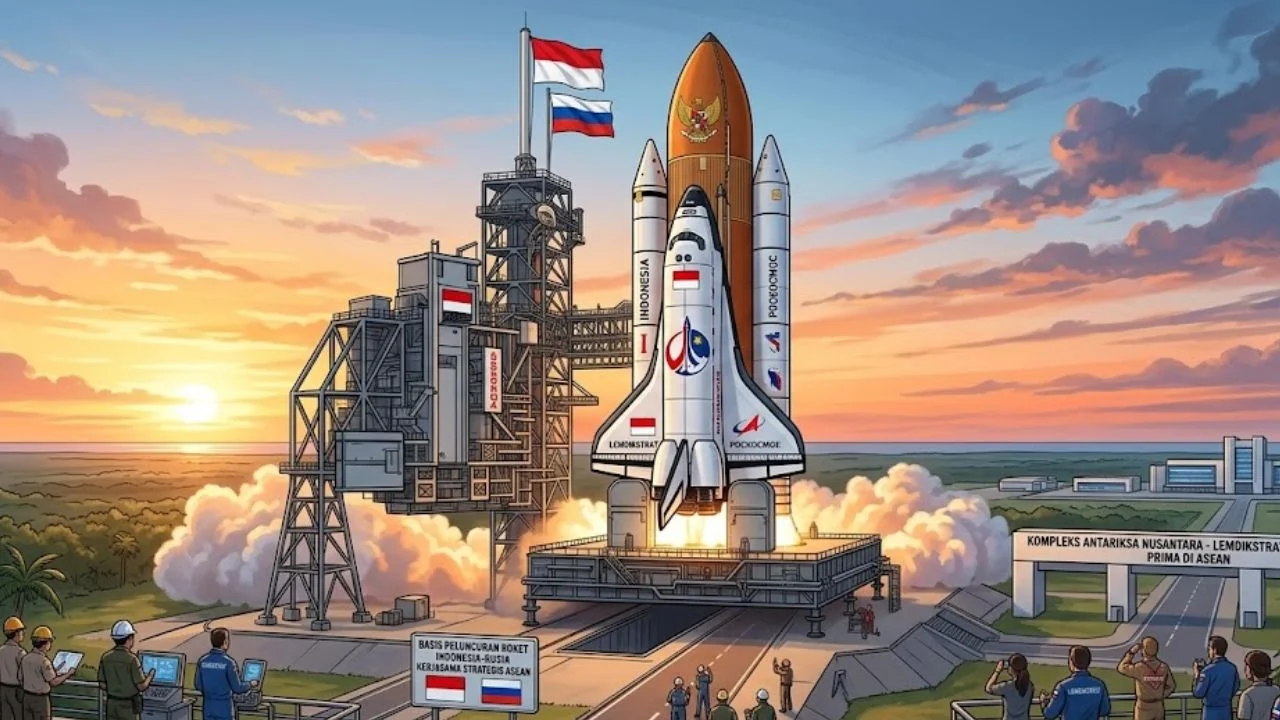
Indonesia’s plan to establish a national spaceport in Biak, Papua, has entered a new stage of international attention after Russia expressed its willingness to support the project through its state space corporation, Roscosmos. At the same time, Moscow has moved to clarify that discussions with Indonesia remain preliminary and that the proposed facility is not intended to become a Russian military base.
The clarification is significant because Biak occupies a strategically important position in eastern Indonesia and the wider Asia-Pacific region. Yet the project, as presented by Indonesian authorities, is fundamentally about developing a domestic space ecosystem, reducing dependence on foreign launch services and creating new opportunities in science, technology and the regional economy.
Russian Ambassador to Indonesia Sergei Tolchenov said on August 26 that Indonesia and Russia were still discussing possible cooperation. He emphasised that no formal agreement had been signed and that discussions between Indonesia’s National Research and Innovation Agency, or BRIN, and Roscosmos were still in their early stages.
The distinction matters. Russia has expressed strong interest in helping Indonesia, but it has not yet secured a formal role in the project.
Biak Becomes the Focus of Indonesia’s Space Ambition
The proposed spaceport in Biak Numfor is part of a much broader Indonesian effort to develop an independent national space capability.
BRIN Chairman Arif Satria has described the proposed facility as more than a launch site. In his view, a national spaceport would become a central component of Indonesia’s space ecosystem and strengthen the country’s ability to launch satellites from its territory.
That objective reflects a practical problem.
Indonesia increasingly relies on satellites for communications, navigation, environmental monitoring, disaster management, agriculture, maritime surveillance and other public services. Yet launching satellites still requires access to facilities outside Indonesia.
A domestic launch capability could eventually reduce those dependencies.
BRIN has also argued that an Indonesian spaceport could stimulate industries associated with spacecraft and launch services, including advanced materials, avionics, telemetry, logistics, mission control and other technology-intensive businesses.
For Biak and Papua, the potential impact could extend beyond the space sector itself.
A large technology project can create demand for transportation, telecommunications, construction, technical services, education and skilled labour. If properly integrated with local development policies, the project could contribute to a wider transformation of Biak into a technology and logistics hub in eastern Indonesia.
Why Biak?
The choice of Biak has been under consideration for years.
Its geographical position has been identified as advantageous for space launch activities because of its proximity to suitable orbital trajectories. BRIN has described Biak as one of the locations considered scientifically efficient for a national launch facility.
The location also has an established connection with Indonesia’s space activities. BRIN maintains a ground station in Biak, while planning for a dedicated spaceport has been discussed for more than a decade. BRIN research has previously identified Biak Numfor as a candidate location for Indonesia’s spaceport.
In June 2026, BRIN and the Papua provincial government signed a memorandum of understanding concerning planning and development of the spaceport in Biak Numfor. BRIN subsequently said that it had engaged local government representatives and traditional community figures regarding the project.
This makes the project part of an established national policy process rather than a sudden proposal linked exclusively to Russia.
Russia Offers Roscosmos Expertise
Russia’s interest is nevertheless important.
Roscosmos has extensive experience in launch systems, spacecraft, propulsion technology and space operations. Russia has operated launch infrastructure for decades and possesses technological capabilities that could potentially support Indonesia’s ambition to develop its own space ecosystem.
In April 2026, BRIN Chairman Arif Satria said cooperation with Russia could be important because of the country’s established space technology capabilities. He specifically linked potential cooperation with Russia to Indonesia’s plan to develop a spaceport on Biak.
Moscow has now reaffirmed that interest.
Tolchenov said Russia remains prepared to support Indonesia if BRIN ultimately chooses Roscosmos as a partner. But he also made clear that the decision belongs entirely to Indonesia.
“If Roscosmos and Russia are chosen,” Tolchenov said Moscow would be pleased to participate and confident it could help realise the project for Indonesia.
The wording is revealing.
Russia is positioning itself as a potential technology partner rather than claiming ownership of the project.
That distinction is especially important because BRIN is reportedly exploring cooperation with other countries as well. India, for example, has also been involved in discussions concerning space cooperation with Indonesia.
Indonesia therefore appears to be maintaining strategic flexibility over the eventual choice of partners.
No Russian Military Base, Moscow Says
The most politically sensitive part of the latest discussion concerns speculation that a Russian-supported spaceport could become a military facility.
Tolchenov explicitly rejected that interpretation.
According to ANTARA and Republika, the ambassador said the Biak spaceport would remain an Indonesian facility and would not become a Russian military base or a dual-use facility serving the military interests of a foreign country.
He also stressed that Indonesia is a sovereign country and would not be expected to allow its territory to become a military base for another state.
The statement addresses concerns that have emerged because space technology and national security are increasingly interconnected.
Modern satellites have both civilian and strategic applications. Communications, navigation, Earth observation and remote sensing technologies can serve civilian purposes while also having potential defence applications.
Tolchenov acknowledged that distinction.
He said that if Indonesia eventually chose to launch military satellites or other space facilities from Biak, that would be an Indonesian decision.
In other words, the potential military application of an Indonesian satellite does not mean that the facility itself would constitute a Russian military installation.
That distinction should be maintained when discussing the project.
A National Indonesian Facility, Not a Russian Outpost
The available information points to a fundamentally Indonesian project.
BRIN is the institution leading the national spaceport initiative. The Indonesian government has also established a regulatory framework through Government Regulation No. 22 of 2026 concerning the operation of spaceports, issued in May.
The Russian role remains prospective.
No bilateral agreement concerning construction or operation of the Biak spaceport has been signed, according to Tolchenov. The current stage consists of preliminary discussions between BRIN and Roscosmos.
The project is important for international observers.
Describing the project as a Russian space base would go beyond the evidence currently available.
The more accurate description is that Indonesia is developing a national spaceport and is exploring whether Russian technology and expertise could become part of that effort.
That approach also provides Jakarta room to compare technological, financial and strategic options before selecting a partner.
Biak Could Become an Economic Gateway
The strategic significance of the project is not limited to rockets.
BRIN has argued that the spaceport could become a catalyst for an emerging space economy. A functioning launch facility would require supporting industries, skilled personnel, logistics networks, telecommunications infrastructure and specialised engineering services.
For Papua, that could create a new economic dimension.
Biak has traditionally been known for its maritime position, tourism potential and role in eastern Indonesia’s transportation network. A national spaceport could add a high technology component to that economic profile.
The opportunity, however, depends on implementation.
A major infrastructure project does not automatically produce broad local benefits. The long-term value for Papua would depend on whether local workers receive access to training, whether local businesses can participate in supply chains and whether educational institutions are connected to the emerging technology ecosystem.
This is where Indonesia’s broader development policy becomes important.
Human Capital Will Matter
A spaceport requires more than launch pads and rockets.
Engineers, technicians, safety specialists, data analysts, telecommunications experts, logistics professionals and administrators are all needed to operate a modern space facility.
Consequently, education and skills development should become a central part of the Biak project.
Universities and vocational institutions in Papua could potentially become partners in developing technical talent. Training programmes could also help young Papuans access employment in areas traditionally concentrated in Indonesia’s major urban centres.
If such a model succeeds, the spaceport could become not only a physical infrastructure project but also a human capital project.
That would give the development greater relevance to Papua’s long-term economic transformation.
Geopolitical Significance in the Asia Pacific
Biak’s location also provides the project a wider geopolitical dimension.
Indonesia is located between the Indian and Pacific oceans and has increasingly positioned itself as an important actor in the Indo-Pacific. Developing independent space capabilities could strengthen its technological position in Southeast Asia.
A successful national launch facility could eventually allow Indonesia to provide launch services to friendly countries in the region.
BRIN has explicitly pointed to this possibility, saying that the facility could eventually support satellite launches for other countries with close relations with Indonesia.
That would give Biak significance beyond Papua.
Indonesia could potentially emerge as a regional provider of space-related services, particularly as demand for satellites increases across Southeast Asia and the Pacific.
The project could therefore become part of Indonesia’s broader strategy to increase technological independence while strengthening its economic and diplomatic position.
Why Russian Support Matters
Russian participation, if eventually formalised, could accelerate Indonesia’s learning curve.
Russia’s long history in space technology offers access to expertise that would otherwise take Indonesia considerable time and resources to develop independently.
At the same time, cooperation with Russia would require Indonesia to carefully manage technological, regulatory and geopolitical considerations.
The current preliminary stage provides Jakarta an opportunity to establish clear rules regarding technology transfer, ownership, financing, operational control and security.
Those issues will matter more than the symbolism of having Russia involved.
The central question should be whether any partnership strengthens Indonesia’s own capabilities.
Papua’s Strategic Development Dimension
For Papua, the Biak project also carries an important development message.
The spaceport is being presented by BRIN as part of Indonesia’s effort to strengthen national technological independence. At the same time, the government has indicated that the project should generate economic opportunities and involve local stakeholders.
That combination will determine how the project is ultimately viewed locally.
Large strategic infrastructure projects are most sustainable when national objectives and local interests can reinforce one another.
For Biak, this means that discussions surrounding land, environmental safeguards, employment, local participation and community consultation should continue alongside technical planning.
A spaceport can be a symbol of national technological ambition, but its success will ultimately be measured by what it contributes to people living around it.
Conclusion
Russia’s latest statement provides an important clarification about the proposed Biak spaceport.
Moscow has expressed its willingness to support Indonesia through Roscosmos, citing Russia’s established space technology capabilities. However, the project remains at the discussion stage, with no formal cooperation agreement signed between Indonesia and Russia. BRIN remains responsible for determining which international partners, if any, will participate.
Just as importantly, Russia has rejected speculation that the Biak facility will become a Russian military base. The proposed spaceport is intended to be an Indonesian facility, while decisions about how Indonesia might use its own space infrastructure remain sovereign decisions of the Indonesian government.
For Indonesia, the larger opportunity lies in building an indigenous space ecosystem.
If local participation is integrated into the process from the outset, the project could usher in a new era of technology, education, logistics, and high-value economic activity for Papua.
And for Russia, the Biak initiative offers a potential avenue to deepen technological cooperation with one of Southeast Asia’s largest countries.
The next stage will therefore be less about geopolitical headlines and more about the substance of the partnership. Technology transfer, local human capital, environmental safeguards, economic participation and Indonesian operational control will determine whether Biak becomes what BRIN envisions: not simply a place from which rockets are launched, but a foundation for Indonesia’s long-term presence in the space economy.

