
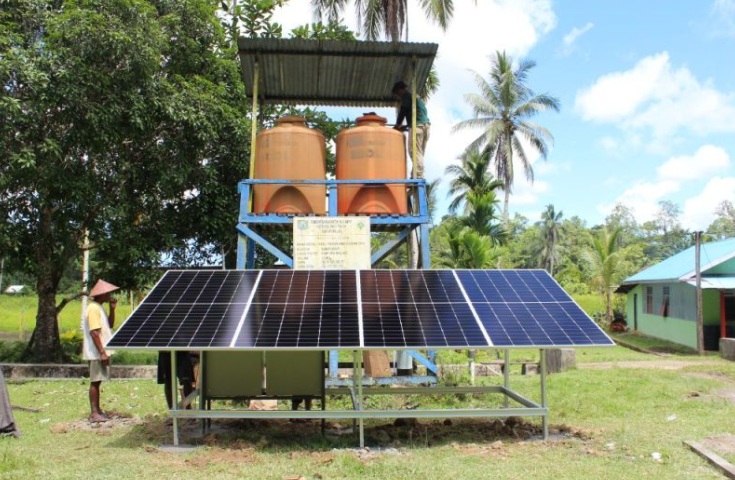
For communities living far from Indonesia’s main electricity networks, the arrival of a functioning light can mean more than simply ending darkness. In Papua, where geography often makes conventional infrastructure expensive and difficult to build, solar power is increasingly becoming a practical tool for improving daily life.
Recent developments in Papua Tengah and Papua Selatan illustrate that shift. In Mimika, Papua Tengah, the Jita District government has reported that 300 solar cell units have been installed to provide lighting across 10 villages. Meanwhile, Papua Selatan is preparing around 360 solar power points, with health facilities such as community health centers among the priorities.
The projects form part of a broader effort to bring basic infrastructure closer to communities in remote areas. Their significance extends beyond electricity itself. Reliable lighting can support evening activities, improve conditions around public facilities, and create better opportunities for children to study after sunset.
The initiatives also highlight a broader development challenge in Papua: how to expand essential services across a vast region where mountains, forests, rivers, and limited road connections can make conventional infrastructure difficult to deploy.
Bringing Light to Remote Villages
The story from Jita, in Mimika Regency, offers one of the clearest examples of how relatively small-scale renewable energy infrastructure can produce an immediate impact.
According to ANTARA, Jita received 300 solar cell units to support lighting in 10 villages. The assistance came through the Mimika Public Housing and Settlement Office following an assessment of communities considered eligible to receive the equipment.
The installation was carried out in stages. Initially, 100 lights were installed before another 200 units were added, bringing the total to 300. Jita District Head Yunus Edoway said residents had already begun benefiting from the installations and that roads had become brighter.
That detail is important because it puts the infrastructure project into a human context.
For residents of remote villages, street lighting can influence how people move after dark, how communities organize activities, and how safe public spaces feel. It can also make it easier for residents to reach public facilities during evening hours.
The project initially prioritizes five villages around the district capital: Jaitak, Noema, Wenin, Sempan Timur, and Sumapro. The district government said additional distribution would be directed toward other villages once priority areas had been covered.
The approach reflects a practical principle in infrastructure development: start where the need is greatest, evaluate the results, and then expand coverage.
Why Solar Power Makes Sense in Papua
Papua’s geography creates a different infrastructure equation from that of densely populated urban regions.
In many remote areas, extending conventional electricity grids requires substantial investment in transmission lines, poles, roads, and supporting infrastructure. The physical distance between settlements can make those investments particularly challenging.
Solar power offers a different model.
Rather than waiting for a large centralized grid to reach every community, solar installations can provide electricity locally. This makes them particularly relevant for isolated villages and public facilities where immediate access to conventional networks remains difficult.
That does not mean solar power should replace the development of larger electricity systems. Instead, the two approaches can complement one another.
Where a conventional grid is economically and technically feasible, grid expansion can provide greater capacity. Decentralized renewable energy can help bridge the gap where geography makes immediate grid extension difficult.
For Papua, that flexibility is especially valuable.
Papua Selatan Prepares 360 Solar Power Points
A similar initiative is emerging in Papua Selatan, where around 360 solar power points are being prepared for the province in 2026.
Reporting from Papua indicates that the program is intended to address electricity needs in villages and public service facilities, including community health centers.
The focus on health facilities gives the program an additional dimension.
A health center cannot operate effectively without dependable electricity. Medical equipment, lighting, communications equipment, and medicine storage can all depend on a stable power supply.
For communities in remote Papua, a health facility without adequate electricity can become far less useful, particularly after sunset.
The Papua Selatan program therefore demonstrates how renewable energy can become part of a broader public service strategy rather than being treated simply as an infrastructure project.
The provincial coordination agency responsible for regional development, BP3OKP Papua Selatan, has highlighted electricity shortages as one of the problems encountered during field visits. The agency reported that some community health centers had inadequate lighting and stressed the importance of stable electricity for facilities that operate around the clock.
That concern is especially relevant in remote areas where the nearest alternative health facility may be many hours away.
Electricity, Education, and Human Development
The value of electricity is not measured only by the number of lamps installed.
Lighting can change how families use their evenings. Children may gain additional time to read or complete homework. Small businesses can operate for longer hours. Community meetings can continue after sunset. Roads and public spaces can become easier to navigate.
In Jita, local officials specifically expressed hope that the solar lighting would support community activities and expand access to lighting in villages that still need it.
This is where energy infrastructure intersects with human development.
Papua’s development challenge is not simply about constructing roads, bridges, or buildings. It is also about creating the conditions under which people can make productive use of those facilities.
A school without electricity has limitations. A health center without reliable lighting faces operational difficulties. A small business without evening lighting may lose potential trading hours.
Solar energy can therefore serve as an enabling infrastructure.
The technology itself may appear modest compared with major road or bridge projects, but its effect can be significant when it reaches communities that previously had few alternatives.
A Development Strategy Built Around Remote Communities
The solar initiatives in Papua also fit into a wider pattern of infrastructure development across the region.
Recent development programs have increasingly emphasized access to remote settlements, including roads, bridges, telecommunications, housing, water, and electricity. This approach is particularly important in Papua because economic activity and public services are not evenly distributed across the territory.
The challenge for policymakers is to ensure that infrastructure reaches communities beyond major urban centers such as Jayapura, Timika, and Merauke.
Electricity is central to that objective.
The 300 solar units in Jita are being distributed across 10 villages rather than concentrated in a single urban location. Likewise, the proposed 360 solar points in Papua Selatan are intended to reach villages and public facilities where electricity access remains a concern.
Such projects can help narrow the infrastructure gap between more developed population centers and isolated communities.
Renewable Energy and Papua’s Geography
There is also an environmental argument for expanding renewable energy.
Papua is home to some of Indonesia’s most important tropical forests and ecosystems. Infrastructure development must therefore balance the need for improved living standards with environmental protection.
Solar energy can contribute to that balance by providing electricity without requiring the same type of fuel supply chain associated with diesel-based generation.
In isolated communities, transporting diesel fuel can itself be expensive and logistically complicated. Solar systems reduce dependence on regular fuel deliveries and can make local energy provision more resilient.
However, renewable energy projects still require proper planning.
Solar panels, batteries, and associated equipment need maintenance. Batteries eventually require replacement. Communities need technical capacity to keep systems functioning. Without long-term maintenance arrangements, even well-funded projects can deteriorate.
The next stage of Papua’s renewable energy strategy should therefore focus not only on installation numbers but also on sustainability.
From Installation to Long-Term Impact
The 300 solar units in Jita provide an encouraging example because local authorities have already reported that the installations are being used by residents.
However, the true measure of success will become evident over time.
Will the lights remain operational after several years? Will local technicians be trained to conduct basic repairs? Will communities have access to replacement components? Will additional villages receive installations?
These questions matter because infrastructure is most valuable when it remains functional long after the launch ceremony.
For Papua Selatan, the same principle will apply to the planned 360 solar points.
The focus on Puskesmas is particularly strategic. If electricity can improve health services in remote locations, the benefit may extend beyond lighting. Better power availability can support communications, refrigeration, and other basic medical requirements, although the precise capabilities of each installation will depend on its technical specification.
This is why energy planning should be closely integrated with education, healthcare, and local economic development.
The Economic Dimension
Electricity can also influence Papua’s local economy.
Small traders can keep shops open longer. Food vendors can operate after sunset. Community-based businesses can use basic electrical equipment. Local administrations can improve their ability to deliver services.
The impact may initially appear small at the household level, but cumulative improvements across hundreds of villages can contribute to broader economic participation.
For communities where transport costs are high and market access remains difficult, even modest improvements in local economic activity can matter.
Renewable energy also creates opportunities for local employment through installation, maintenance, and technical services. As the number of solar systems grows, demand for people who understand electrical systems, battery management, and basic repairs can increase.
This creates an opportunity to connect infrastructure programs with vocational training for young people in Papua.
Rather than treating communities solely as recipients of infrastructure, policymakers can develop local capacity to maintain and expand the systems.
Policymakers should also consider the expansion of solar energy in conjunction with other infrastructure projects in Papua, such as the Trans Papua Road project.
A More Inclusive Approach to Development
For the Indonesian government and regional administrations, expanding electricity access in remote Papua is also a test of whether development can reach communities outside major centers.
The Jita project demonstrates an approach based on local assessment. The district government identifies communities requiring support, while the relevant regional agency determines distribution and implementation.
Papua Selatan emphasizes coordination between regional institutions and the central government to facilitate the implementation of community proposals.
This coordination is essential because Papua’s infrastructure challenges are too geographically complex to be solved by one institution alone.
Local governments understand community needs. Provincial authorities can coordinate broader planning. Central government institutions can provide funding, technical standards, and national-level support.
When these layers work together, relatively simple technologies such as solar lighting can become part of a much larger strategy for improving quality of life.
Conclusion
The installation of 300 solar units in Jita and the preparation of around 360 solar power points in Papua Selatan represent more than efforts to brighten remote villages.
They reflect a broader development question facing Papua: how to bring essential services to communities separated by difficult geography and limited conventional infrastructure.
For families in Jita, the immediate result is straightforward. Roads and public spaces that were previously dark now have lighting, and residents are already experiencing the difference.
In Papua Selatan, the planned expansion carries another important promise, particularly for health centers and other public facilities that need reliable electricity.
The long-term success of these programs will depend on what happens after installation. Maintenance, local technical capacity, battery replacement, and continued expansion will determine whether today’s solar panels become lasting infrastructure or temporary improvements.
Yet the direction is significant. Renewable energy provides Papua with a flexible way to address some of the practical barriers created by its geography while supporting education, healthcare, community activity, and local economic development.
For Indonesia’s wider development agenda in Papua, that may be the most important lesson. Connectivity is not only about roads and bridges. Sometimes, development begins with something much simpler: making sure that when night falls, a village still has a light.

