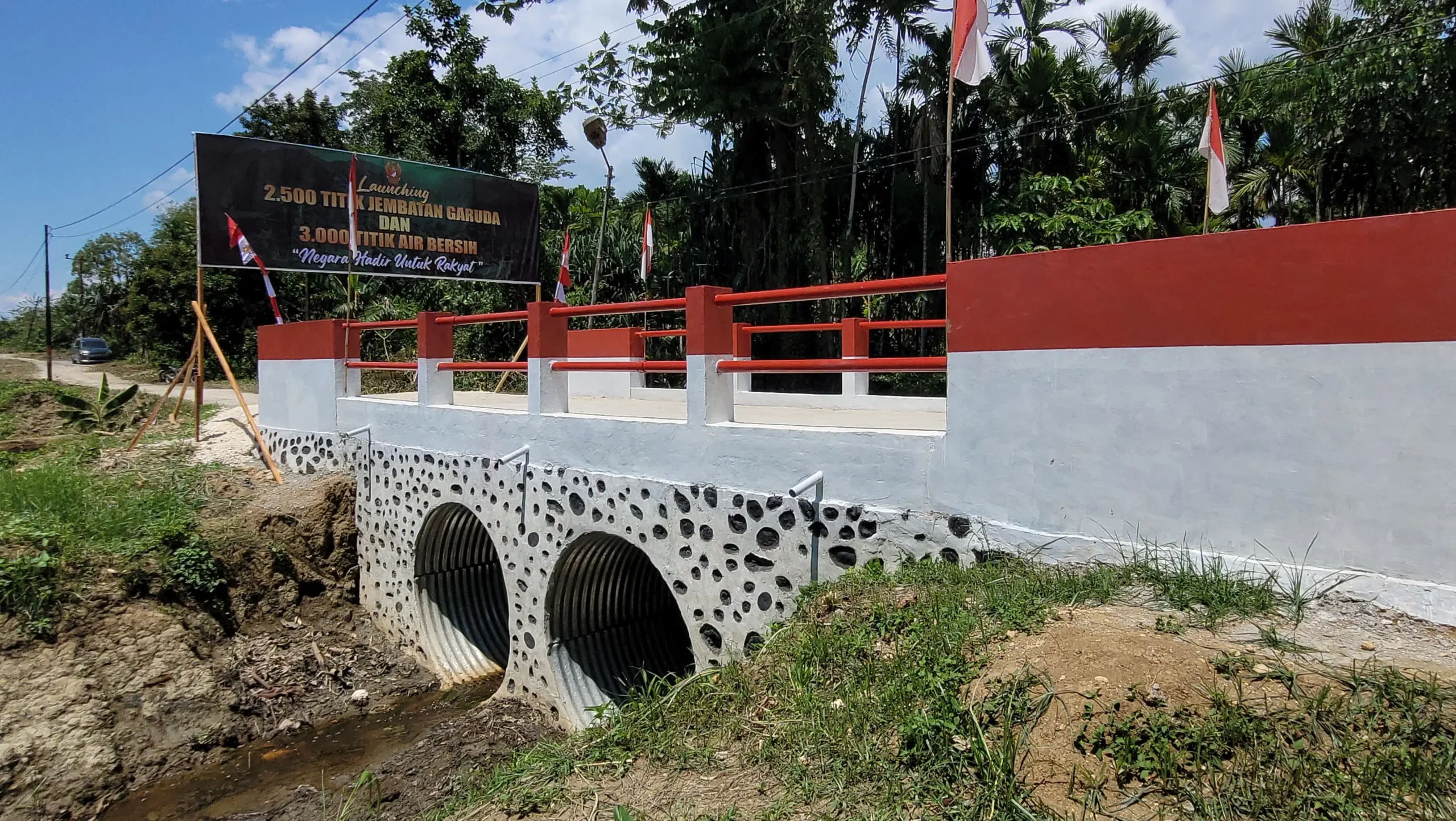
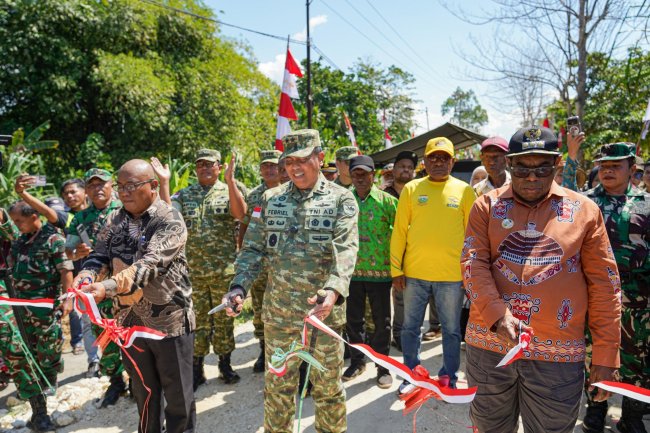
In a region where rivers, rugged terrain, and long distances can turn a short journey into a difficult trip, the opening of a new bridge can change daily life almost overnight. In Keerom Regency, Papua, that principle was at the center of the inauguration of the Garuda Bridge, formally launched through a virtual ceremony led by Indonesian President Prabowo Subianto on 13 August 2026.
The ceremony brought together the commander of the XVII/Cenderawasih Military Command, local government officials, and regional leaders in Keerom. The bridge, built through the initiative of the XVII/Cenderawasih Military Command, is designed to connect three villages and improve access for residents whose mobility has long depended on local infrastructure.
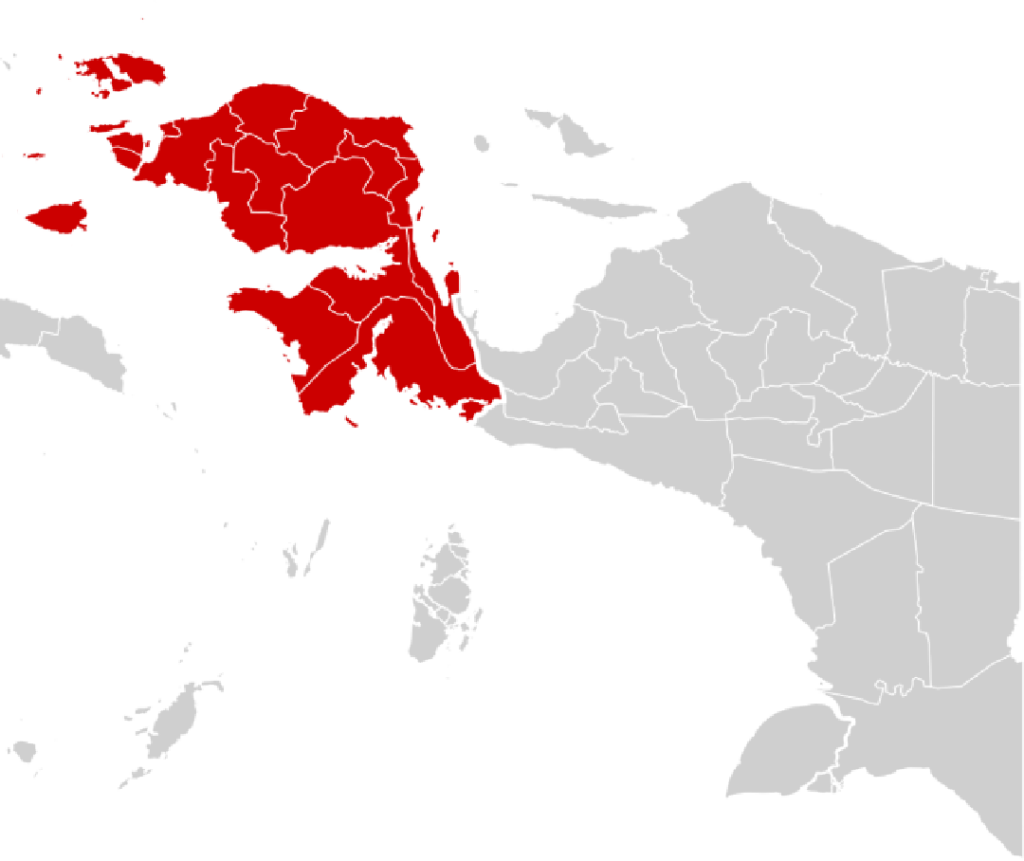
The Keerom project is part of a much larger infrastructure effort. According to the Commander of the XVII/Cenderawasih Military Command, Mayjen TNI Febriel Buyung Sikumbang, 76 Garuda Bridges have been constructed across three Papua provinces, connecting 142 villages and benefiting an estimated 32,828 households, or about 133,081 people. The bridges are located across Papua, Papua Tengah (Central Papua), and Papua Pegunungan (Papua Highlands).
The numbers offer a sense of scale, but the significance of the program is more easily understood at the village level. For residents, a bridge can mean a safer route to school, quicker access to healthcare, easier movement of agricultural products, and a more direct connection to nearby economic centers.
A Bridge Designed Around Everyday Needs
The Keerom inauguration reflects a broader approach to rural infrastructure in eastern Indonesia: focus on small and strategic connections that can have an immediate effect on communities.
The XVII/Cenderawasih Military Command has described the Garuda Bridge program as an effort to address difficulties faced by people in its area of responsibility. Rather than functioning only as transport infrastructure, the bridges are intended to open access to basic public services and economic activities.
That distinction is important in Papua.
Large infrastructure projects often attract attention because of their scale, but small bridges can have an equally direct impact on households. A community may already have a road, a school, or a health facility nearby, yet a river crossing can determine whether those facilities are realistically accessible.
A reliable bridge reduces that barrier.
For students, it can provide a safer route to school. For families, it can make travel to health facilities easier. For farmers and small traders, it can make it simpler to move agricultural products and household goods.
In remote communities, those improvements can translate into practical economic gains because less time and effort is spent navigating difficult crossings.
Three Villages, One New Connection
The Keerom bridge has particular local importance because it connects three villages, according to the reports surrounding the inauguration.
The ceremony was centered in Keerom, where the regional leadership joined the virtual launch with the president. The event demonstrated how a relatively local infrastructure project could be incorporated into a national development agenda.
The presence of the military command and local government officials also reflected the collaborative nature of the project.
For residents, however, the value of the bridge is likely to be measured less by the ceremony than by what happens afterward. The real test will be whether people can use the structure safely, regularly, and productively.
That includes maintaining the bridge, keeping connecting roads accessible and ensuring that local authorities and communities have arrangements in place to preserve the infrastructure.
Seventy-Six Bridges Across Three Papua Provinces
The Keerom bridge is only one part of a wider network.
Data released by ANTARA on August 14 showed that 76 Garuda Bridges had been built within the XVII/Cenderawasih Military Command’s area, covering three provinces. Together, they connect 142 villages and communities.
The construction portfolio includes different types of bridges. Of the 76 structures, 15 are Armco bridges, 55 are concrete bridges, and six are suspension bridges.
That mix reflects the varied physical conditions found across Papua.
The region’s geography is not uniform. Communities may be separated by rivers, steep terrain, forests, and areas where conventional road construction can be difficult or costly. Different bridge designs can therefore be adapted to local conditions.
The scale of the program also provides a broader picture of the connectivity challenge.
The 142 villages covered by the initiative represent more than isolated points on a map. They are communities where access to education, health services, markets, and government institutions depends partly on the quality of transportation links.
The reported estimate of 133,081 people benefiting from the 76 bridges underlines the potential social impact of relatively targeted infrastructure investments.
Connecting Infrastructure with Public Services
One of the clearest benefits expected from the Garuda Bridge network is improved access to basic services.
The XVII/Cenderawasih Military Command said the bridges are expected to facilitate access to education and healthcare as well as economic centers.
For international readers, this point provides important context.
Papua’s infrastructure challenge is not simply about distance. It is also about the physical barriers between communities and essential services.
A bridge can shorten a journey without necessarily changing the geographic distance. It creates a dependable crossing where residents may previously have had to rely on temporary structures, difficult paths, or longer alternative routes.
For a child traveling to school, reliability matters.
For a patient seeking healthcare, reliability can matter even more.
For a farmer carrying produce to market, the ability to transport goods consistently can affect whether the activity is economically worthwhile.
This is why connectivity has become an important component of Papua’s wider development agenda.
Infrastructure and Local Economic Activity
The economic effect of rural bridges can extend beyond transportation.
Improved connectivity can reduce the practical isolation of villages from nearby markets. Farmers may have more opportunities to sell agricultural products, while traders can reach communities more efficiently.
Small businesses can also benefit from improved movement of people and goods.
The effect is not automatic. A bridge alone cannot create a market where none exists. It needs to be accompanied by roads, telecommunications, access to finance, agricultural support, and functioning local economic institutions.
Nevertheless, connectivity provides a basic platform on which these activities can develop.
For Papua, where government policy increasingly emphasizes improving regional connectivity, the Garuda Bridge initiative therefore fits into a wider development picture.
The bridge is a physical structure, but its potential impact is economic and social.
The TNI’s Role Beyond Traditional Security
The Garuda Bridge program also highlights the Indonesian military’s role in supporting infrastructure development.
Pangdam XVII/Cenderawasih Maj. Gen. Febriel Buyung Sikumbang said the construction of Garuda Bridges formed part of the TNI’s territorial responsibilities and reflected the concept of kemanunggalan TNI dengan rakyat, or close cooperation between the military and the people.
He emphasized that the presence of soldiers in communities was not limited to defense and security responsibilities but also included efforts to help address difficulties faced by residents and support community welfare.
The role is particularly relevant in remote areas where access and logistics can make construction difficult.
Military territorial units have an established presence across many parts of Papua, allowing them to coordinate closely with village authorities and local residents.
That proximity can be useful for projects that require work in locations where conventional construction arrangements may face logistical challenges.
At the same time, infrastructure built through government and military-supported programs still requires appropriate technical standards, maintenance arrangements, and oversight to ensure long-term safety and durability.
For residents, the ultimate measure is simple: whether the bridge remains safe and useful long after the inauguration ceremony.
Part of a Wider National Infrastructure Target
The Garuda Bridge program in Papua is also connected to a broader national push to improve village connectivity.
President Prabowo Subianto highlighted village bridge construction in his 14 August address at the annual MPR session and the joint session of the DPR and DPD.
According to ANTARA, the president said the TNI had built 2,500 village bridges during 2026, while the Indonesian National Police had constructed 874 bridges. He set a national target of completing more than 5,000 bridges by the end of 2026.
Within that national framework, Papua presents a particularly important test.
The region’s geographical complexity means that improving connectivity requires solutions adapted to local conditions rather than relying on a single infrastructure model.
The 76 Garuda Bridges across the three Papua provinces demonstrate one approach: build smaller connections where they can unlock access for communities that might otherwise remain separated by natural barriers.
Development and Security in Papua
Infrastructure development in Papua also has a broader significance because development and security are closely connected.
Communities with better access to schools, healthcare facilities, markets, and government services can have more opportunities to participate in the formal economy and public institutions.
Improved mobility can also help government agencies deliver services more efficiently.
For Indonesian policymakers, this makes connectivity an important element of efforts to strengthen public welfare and regional integration.
The approach does not mean that infrastructure alone can resolve Papua’s complex political, social, and security challenges. Those issues require different forms of policy, dialogue, public services, and community engagement.
But reliable infrastructure can provide a practical foundation for addressing some of the everyday difficulties faced by communities.
That is why the Keerom bridge deserves attention beyond its physical dimensions.
What Comes Next for the Garuda Bridge Network?
The inauguration marks the beginning of the bridge’s operational life, not its conclusion.
Maintaining rural infrastructure in Papua can be challenging because of heavy rainfall, river dynamics, terrain, and limited access to maintenance equipment.
Local governments and communities will therefore have an important role in ensuring that bridges remain functional.
Regular inspections, timely repairs, and protection of connecting roads will determine whether the infrastructure continues to deliver its intended benefits.
There is also an opportunity to connect bridge construction with wider economic programs.
Agricultural development, local cooperatives, tourism, digital connectivity, and public transportation can all benefit when previously isolated communities gain better physical access.
The 76-bridge network could therefore become more valuable over time as complementary infrastructure and economic programs expand.
Conclusion
The inauguration of the Garuda Bridge in Keerom illustrates how a relatively small piece of infrastructure can carry significant importance for rural communities. Launched virtually by President Prabowo Subianto and developed through the XVII/Cenderawasih Military Command, the bridge connects three villages while contributing to a wider network of infrastructure across Papua.
With 76 Garuda Bridges now connecting 142 villages in Papua, Central Papua, and Highland Papua, the program has reached a scale that extends well beyond individual construction sites. The reported beneficiaries include approximately 32,828 households, or 133,081 people.
For those communities, the most important outcome is not the ceremony itself. It is the everyday journey that becomes easier afterward: reaching school, visiting a health facility, transporting agricultural products, or traveling to an economic center.
The next challenge is ensuring that these bridges are maintained and integrated with roads, public services, and local economic programs.
If that continuity is achieved, the Garuda Bridge initiative can become more than a collection of physical structures. It can serve as part of a longer-term effort to reduce isolation, strengthen connectivity, and expand practical opportunities for communities across Papua.