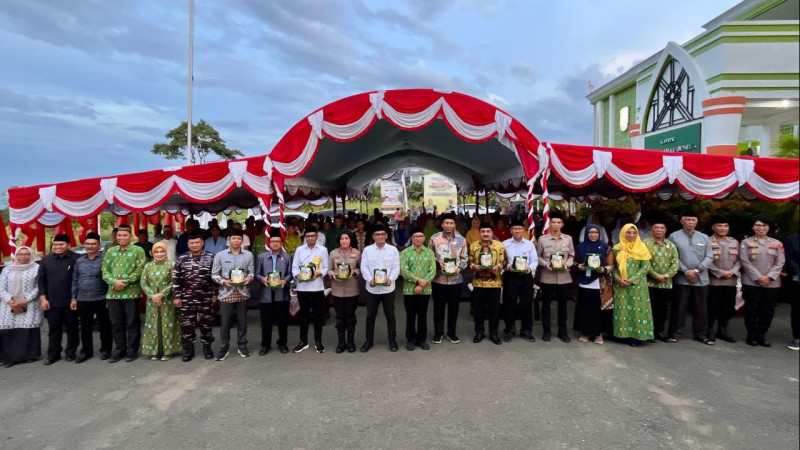
The 666 years of Islam in Papua are being commemorated at RTH Park, Izak Telusa Street, Fakfak Regency, Papua Barat (West Papua) Province, on 8 August 2026, in a celebration that places history alongside a message of tolerance and social harmony. Regent Samaun Dahlan and many local authorities, religious leaders, customary communities, and residents have presented the anniversary not simply as a religious milestone but as an opportunity to reflect on the traditions that have shaped life in one of Papua’s most diverse communities.
The historical tradition commemorated in Fakfak places the arrival of Islam on 8 August 1360, associated with Syekh Abdul Ghaffar, a Muslim scholar traditionally described as originating from Aceh. Local and regional historical discussions identify the Gar region, Kampung Rumbati in Fakfak, as an important site connected with this early Islamic presence. However, historical accounts concerning the precise origins and chronology of Islam in Papua contain different versions, and scholars and local institutions have continued efforts to document and reconcile these narratives.
That distinction is important. The anniversary is not only about assigning a date to the past. It is increasingly being used in Fakfak as a way to discuss how religious traditions became intertwined with local customs and social relationships.
The message from local leaders has been consistent: history should be preserved because it can help communities understand the values that have allowed different religious and cultural groups to live together.
Syekh Abdul Ghaffar and the Early Islamic Tradition
The story of Syekh Abdul Ghaffar occupies an important place in Fakfak’s historical memory.
According to accounts cited by Indonesian regional authorities, he is associated with the arrival of Islam in Papua on 8 August 1360, through Gar region, Kampung Rumbati in Fakfak. The account was also discussed during a national seminar on the history of Islam in Papua on 11 January 2025, where the then Acting Governor of Papua Barat, Ali Baham Temongmere, highlighted the importance of further documenting the historical record.
The same historical discussions point to maritime trade as an important channel through which Islam and wider cultural influences reached Papua. Connections between communities in the Maluku region and local leaders in Papua formed part of the broader network through which ideas, people, and goods moved across eastern Indonesia.
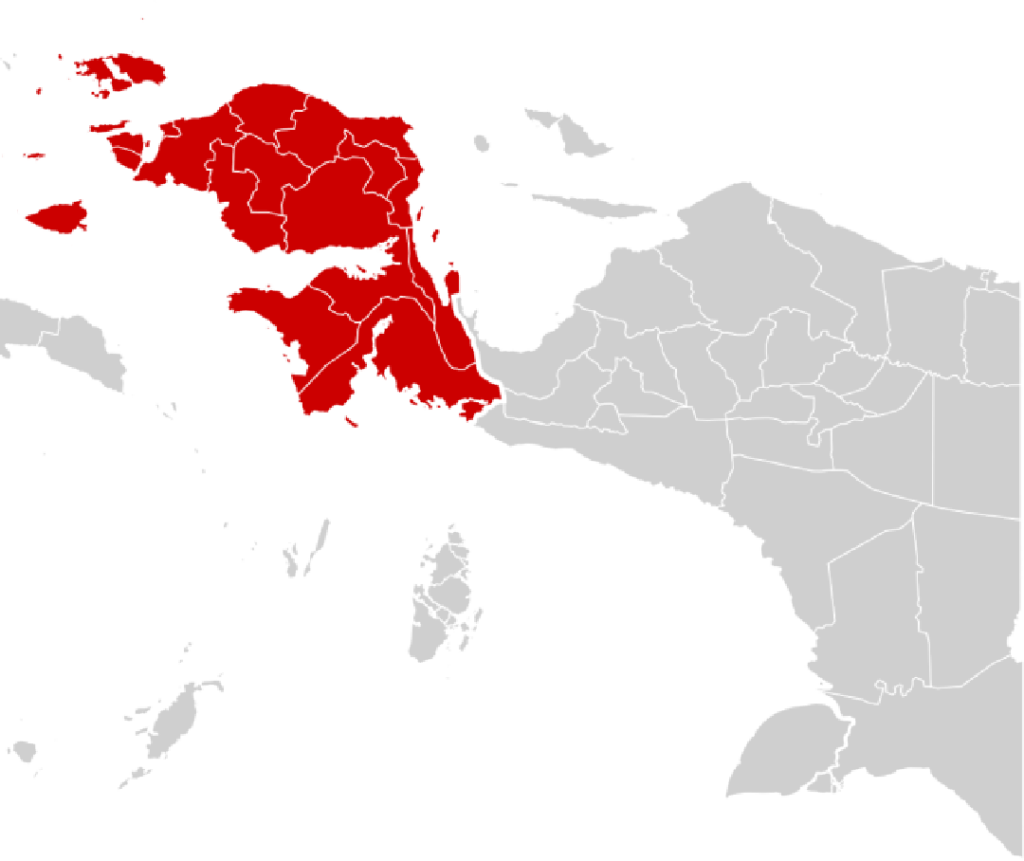
For Fakfak, this maritime dimension is particularly significant. The town’s position on the western coast of the Bird’s Head region placed it within historical networks connecting Papua with other parts of the Indonesian archipelago.
Yet the story of Islam in Papua cannot be reduced to a single journey or individual. The development of Islamic communities involved interaction between religious traditions, local customary structures, trade networks, and generations of Papuan communities.
This is why historical research remains important.
In 2006, field information was collected to expand knowledge about the history of Islam in Papua, followed by a seminar in Fakfak. A book concerning the history of Islam in Fakfak was subsequently compiled in 2007. In 2023, the Fakfak branch of the Indonesian Ulema Council, or MUI, organized a focus group discussion to bring together different historical accounts and sources.
The continuing research demonstrates that historical memory is a process. Oral traditions, customary narratives, written records, and academic research can complement one another while helping younger generations understand where their communities came from.
When Religious History Meets Local Tradition
Perhaps the most distinctive aspect of the Fakfak commemoration is the emphasis on the relationship between Islamic heritage and local traditions.
The philosophy of “Satu Tungku Tiga Batu (Idu-Idu Maninina, Jojor),” or “One Hearth, Three Stones,” has become a powerful symbol of this relationship.
The metaphor describes a social structure in which different elements stand together to support the same household hearth. In Fakfak, it is widely associated with harmony among religious and social communities.
Local leaders have repeatedly presented the philosophy as an example of how diversity can become a source of strength rather than division.
During preparations for the 2026 anniversary, Bupati Fakfak Samaun Dahlan described the commemoration as a historical moment that could reinforce unity, tolerance, and local wisdom. The district government has also framed the celebration as an opportunity to strengthen cultural and religious relationships among residents.
That approach gives the anniversary a wider social meaning.
The event is not being presented solely as a celebration for Muslims. Wahidin Puarada, chairman of the anniversary committee, said the commemoration should be shared by the wider Fakfak community because its central themes include fraternity, tolerance, and respect for ancestral history.
This emphasis is particularly relevant in Papua, where religious and customary identities often overlap within the same extended communities.
The experience of Fakfak illustrates how religious history can become part of a broader local identity without necessarily separating communities according to faith.
A Celebration Designed to Preserve, Not Simply Remember
The anniversary program has been developed around the idea that historical heritage needs to be actively maintained.
Ahead of the 8 August commemoration, Fakfak organized a series of religious and cultural activities. These included Islamic competitions, historical visits, cultural performances, and educational activities.
The district government also organized the Qasidah Bupati Cup, involving around 50 participants across children, youth, and adult categories. The event was designed not only as a competition but also as a way to preserve Islamic artistic traditions and strengthen community ties.
Earlier activities included Barzanji, Hadarah, and Sawat competitions, traditions that organizers described as part of Fakfak’s Islamic cultural heritage.
These activities give the anniversary a practical dimension.
Instead of treating history as something confined to textbooks, organizers are using music, religious arts, public events, and historical visits to connect younger residents with the traditions inherited from previous generations.
Muhammadiyah has also used the anniversary period to strengthen education and organizational development in Fakfak. According to Suara Muhammadiyah, the organization held a Baitul Arqam program in July 2026 and continues to manage seven educational institutions in Fakfak, ranging from early childhood education to secondary education.
Such activities demonstrate how historical commemoration can be connected with contemporary education and community development.
Tolerance as a Living Tradition
The most significant message emerging from the anniversary may be less about the number 666 than about what Fakfak chooses to do with its history.
Local leaders have repeatedly emphasized that the anniversary should reinforce peace, fraternity, and religious tolerance.
Wahidin Puarada said the historical legacy should be introduced to younger generations and to wider audiences as evidence of a longstanding tradition of coexistence in Fakfak.
Similarly, Mulyadi Djaya, chairman of the Papua Barat branch of the Indonesian Ulema Council and Muhammadiyah leadership, called for an approach to Islamic preaching that promotes knowledge, meaningful work, justice, and unity while maintaining tolerance.
That message gives the commemoration relevance beyond religious history.
In a region known internationally for its cultural and religious diversity, the Fakfak experience offers an example of how historical memory can support social cohesion when it is approached through dialogue and mutual respect.
The philosophy of Satu Tungku Tiga Batu provides a local expression of that principle.
It suggests that communities do not need to share every religious or cultural belief to share responsibility for the same social home.
From Historical Memory to a Shared Future
The significance of the 666 years of Islam in Papua extends beyond the preservation of religious history. In Fakfak, the anniversary is increasingly being framed as an opportunity to strengthen relationships among communities while passing local traditions to younger generations.
That approach matters in a province where religious identity and customary identity frequently exist side by side. The story remembered in Fakfak is therefore not simply about the arrival of a religion. It is also about how a religious tradition became part of a wider social landscape shaped by local customs, family relationships, and maritime connections.
The principle of Satu Tungku Tiga Batu provides a particularly strong framework for understanding this history. The metaphor of three stones supporting one hearth captures the idea that different elements of society can contribute to the stability of a shared community.
For Fakfak’s residents, this philosophy has contemporary relevance.
Religious tolerance is not simply an abstract principle discussed during ceremonies. It is reflected in everyday relationships, family networks, community activities, and cooperation between people of different faiths.
The 2026 commemoration consequently provides an opportunity to reinforce those relationships while ensuring that historical traditions remain meaningful in modern Papua.
Preserving History Through Education
One of the challenges facing historical commemorations is ensuring that younger generations understand their significance.
For this reason, the anniversary has been accompanied by educational and cultural activities designed to bring history closer to the public.
Historical discussions, religious arts, cultural performances, and visits to heritage locations provide different ways for young people to engage with the story of Islam in Fakfak.
This approach is particularly valuable because much of Papua’s historical knowledge has been transmitted through oral traditions.
Academic research can help document those traditions while local communities continue contributing knowledge about ancestral stories, customary practices, and important historical locations.
The combination of community knowledge and scholarly research can provide a more comprehensive understanding of Papua’s past.
It can also encourage young Papuans to see their local history as part of a much larger story involving the movement of people, ideas, and cultures across the Indonesian archipelago.
Fakfak’s location makes this especially relevant.
Long before modern transportation systems connected Papua with the rest of Indonesia, maritime networks linked communities across the eastern archipelago. Traders, religious scholars, and travelers carried goods, knowledge, and cultural practices between islands.
The history commemorated in Fakfak is therefore also part of the wider history of interaction across Southeast Asia.
Islam and Papua’s Cultural Diversity
The history of Islam in Papua developed within an environment already characterized by strong Indigenous traditions.
This is an important aspect of the Fakfak narrative because the arrival of Islam did not erase the region’s existing cultural identity.
Instead, religious practices became intertwined with local social structures and customs over generations.
That process can be seen in the continued importance of customary institutions alongside religious organizations.
It is also reflected in community celebrations, traditional arts, and social relationships that bring together residents from different religious backgrounds.
The principle of Satu Tungku Tiga Batu offers a local vocabulary for describing this coexistence.
Rather than presenting diversity as a problem to be managed, the philosophy emphasizes the importance of each element contributing to the stability of the wider community.
This principle has attracted attention beyond Fakfak because it provides an example of locally rooted approaches to managing religious and cultural diversity.
For international audiences, the story is significant precisely because it moves beyond generalized discussions about religious tolerance.
It shows how tolerance can emerge from specific historical experiences and become embedded in community institutions and cultural practices.
A Message of Tolerance for Modern Papua
The 666th anniversary comes at a time when Papua continues to experience rapid social and economic change.
Improved transportation, digital connectivity, education, and greater interaction with communities outside Papua are transforming how younger generations experience their identity.
These changes create opportunities, but they also make cultural preservation increasingly important.
Local traditions provide communities with a sense of continuity while allowing younger generations to understand the historical foundations of their society.
Fakfak’s approach is therefore relevant beyond the anniversary itself.
By combining religious commemoration with cultural activities, education and community participation, local authorities and religious organizations are seeking to ensure that historical memory remains connected to everyday social life.
The emphasis on tolerance also reinforces broader national efforts to maintain social cohesion within Indonesia’s highly diverse population.
For the Government of Fakfak, preserving the historical legacy of Islam is compatible with strengthening relations among communities of different faiths.
Bupati Fakfak Samaun Dahlan has emphasized that the anniversary should become a momentum for strengthening love, solidarity, and harmony among residents. The message reflects the district government’s effort to place cultural heritage within a broader framework of social cohesion.
Fakfak’s Heritage Has Wider Potential
The commemoration could also contribute to the development of cultural tourism in Fakfak.
Historical sites connected with the arrival and development of Islam, together with traditional villages, natural landscapes, and other cultural attractions, offer opportunities for visitors interested in Papua’s history.
Developing this potential responsibly would require careful cooperation between local authorities, customary communities, religious institutions, and tourism operators.
Cultural tourism works best when local communities remain active participants rather than simply becoming observers of commercial activity.
For Fakfak, this means ensuring that historical sites are properly documented and protected while tourism contributes directly to local livelihoods.
The anniversary can therefore serve as a starting point for broader efforts to map cultural heritage, improve interpretation facilities, and introduce historical sites to visitors.
Such initiatives could complement other economic development efforts while strengthening public awareness of the importance of heritage preservation.
Looking Ahead
The story of Islam’s arrival in Papua will continue to attract researchers, religious scholars, and cultural historians.
Further research is particularly important because historical accounts of the arrival of Islam contain different traditions and interpretations. Continued examination of oral histories, archival records, archaeological evidence, and local documentation can help build a stronger scholarly understanding of Papua’s religious history.
The 666th anniversary provides an opportunity to encourage that work.
Rather than treating the date as the conclusion of a historical discussion, Fakfak can use the commemoration as a platform for continued research and dialogue.
The same principle applies to religious tolerance.
The Satu Tungku Tiga Batu philosophy can remain relevant if it continues to be practiced through education, community cooperation, and respect among different religious groups.
In that sense, the most valuable legacy of the anniversary may not be the celebration itself but what communities choose to preserve after the festivities have ended.
Conclusion
The 666 years of Islam in Papua commemorated in Fakfak on 8 August 2026, provide an opportunity to look backward while considering the future.
The traditional account connecting Syekh Abdul Ghaffar with the arrival of Islam in Papua on 8 August 1360, remains an important part of Fakfak’s historical memory. At the same time, continued academic and community research is necessary to deepen understanding of the complex history surrounding the development of Islam in Papua.
What makes the commemoration particularly relevant today is its emphasis on coexistence.
Through the philosophy of Satu Tungku Tiga Batu, Fakfak presents a locally rooted vision of social harmony in which different religious and cultural communities contribute to the same shared society.
The anniversary therefore offers more than a reflection on religious history. It demonstrates how cultural memory can strengthen social cohesion, encourage education, support heritage preservation, and create opportunities for responsible cultural tourism.
For Papua and Indonesia more broadly, that is a message with enduring relevance: history is most valuable when it is preserved, studied, and transformed into a foundation for mutual respect and a more harmonious future.