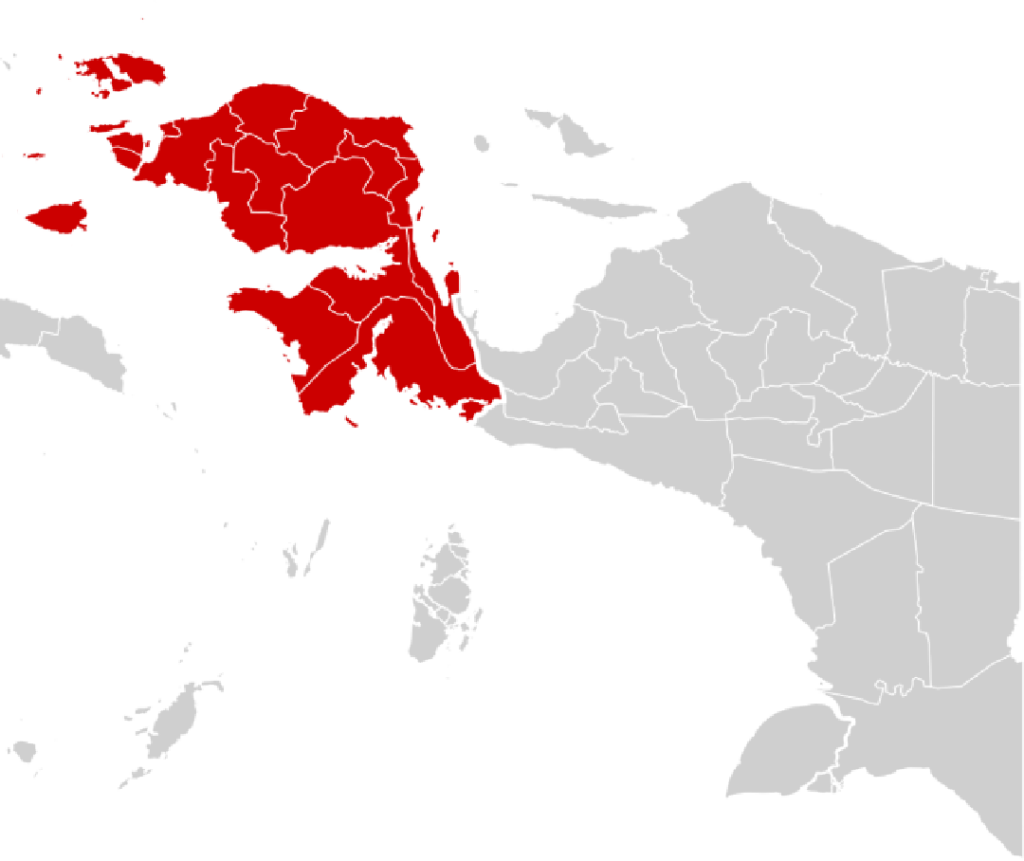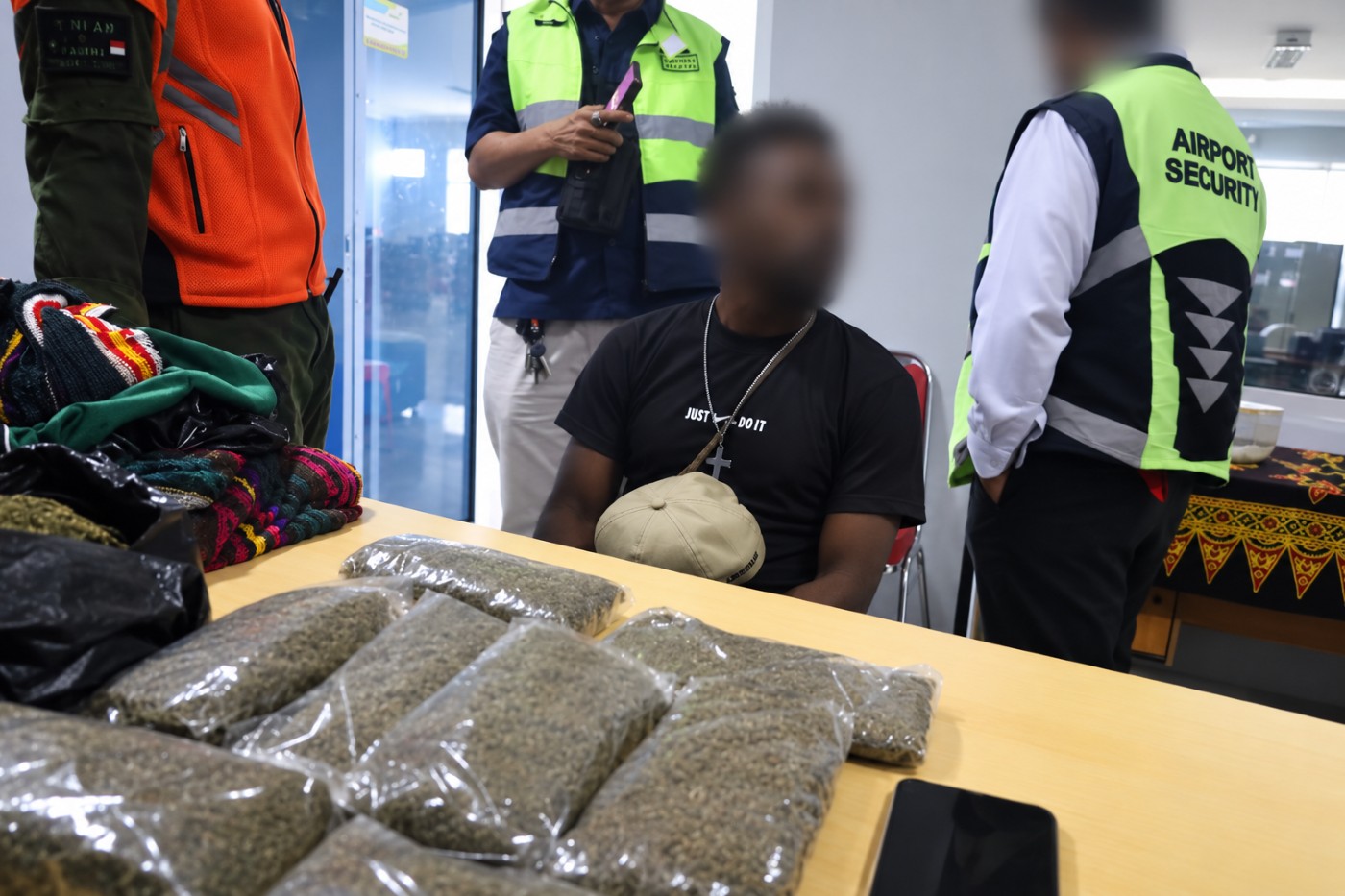
Indonesian security authorities have prevented an alleged marijuana smuggling attempt in Papua after aviation security officers at Sentani International Airport intercepted 940 grams of dried cannabis concealed in the luggage of a passenger traveling from Wamena to Dekai on 5 August 2026. The operation led to the suspect’s arrest and the drugs’ seizure before they reached their destination.
According to airport authorities and law enforcement officials, the discovery was made during routine security screening carried out by Aviation Security (Avsec) personnel. Officers identified suspicious items during baggage inspection and immediately coordinated with police and anti-narcotics investigators to secure the evidence and begin a criminal investigation.
The interception represents another example of Indonesia’s continuing efforts to strengthen aviation security and prevent narcotics from circulating across Papua’s transportation network. Authorities emphasized that airports remain critical points for detecting illegal shipments because air transportation connects many remote districts where overland access is limited.
The case has also renewed attention to broader concerns regarding illegal cannabis cultivation in Papua’s remote highlands and border regions, where law enforcement agencies continue conducting operations against narcotics production and trafficking networks.
Routine Airport Screening Leads to Arrest
The suspect was preparing to board a flight from Sentani to Dekai, the capital of Yahukimo Regency, when aviation security officers detected suspicious contents during baggage examination.
Following standard security procedures, officers conducted a more detailed inspection before discovering approximately 940 grams of dried marijuana hidden inside the passenger’s belongings.
Police immediately secured the suspect for questioning while narcotics investigators collected physical evidence and documented the seizure.
Authorities stated that the investigation remains active as officers seek to determine the origin of the marijuana, its intended recipients, and whether additional individuals were involved in organizing the shipment.
Officials emphasized that the successful interception reflected effective coordination between airport security personnel and law enforcement agencies responsible for combating narcotics trafficking.
Rather than relying solely on intelligence driven operations, routine passenger screening continues to play an important role in preventing prohibited substances from moving through Indonesia’s domestic aviation network.
Airport security officials also noted that continuous vigilance remains necessary because criminal networks frequently attempt to exploit air transportation serving remote regions where travel alternatives are limited.
Aviation Security Plays a Critical Role
Papua’s geography presents unique transportation challenges.
Many districts remain accessible primarily by air because mountainous terrain, dense forests, and limited road infrastructure make land transportation difficult.
Consequently, airports function not only as transportation hubs but also as strategic locations for monitoring the movement of prohibited goods.
Security experts note that aviation screening systems serve an important preventive function by intercepting illegal narcotics before they enter local distribution networks.
The Sentani operation shows how regular checks can find hidden illegal items and stop bigger crimes, like funding the West Papua National Liberation Army of the Free Papua Movement (TPNPB OPM) related to the armed conflict and separatism efforts in Papua.
Authorities stated that cooperation between airport operators, Aviation Security officers, police investigators, and anti-narcotics agencies remains essential to maintaining secure transportation systems across eastern Indonesia.
Such coordination enables rapid response whenever suspicious shipments are identified.
Officials further explained that strengthening airport security contributes not only to aviation safety but also to broader law enforcement efforts targeting organized criminal activity.
Drug Trafficking Continues to Challenge Papua
Law enforcement agencies have repeatedly identified illegal narcotics trafficking as a continuing security concern throughout Papua.
Remote terrain, limited transportation access, and vast geographical areas create operational challenges for authorities attempting to monitor illicit cultivation and distribution activities.
Previous police operations have uncovered marijuana plantations in several highland locations while disrupting attempts to transport cannabis through land, sea, and air routes.
According to Indonesian law enforcement agencies, dismantling these trafficking networks remains a priority because illegal narcotics can contribute to broader criminal activity while affecting community health and public security.
Authorities therefore continue combining intelligence gathering, routine inspections, community engagement, and interagency cooperation to identify cultivation sites, distribution routes, and trafficking organizations operating throughout the region.
Several previous enforcement operations reported by WestPapuaVoice have documented police efforts to eradicate illegal cannabis plantations, strengthen border security, and prevent narcotics from circulating within Papua.
These operations illustrate an increasingly integrated approach combining criminal investigation, border monitoring, aviation security, and community cooperation.
Investigators Examine Broader Criminal Networks
Although the seizure involved a single passenger, investigators indicated that the inquiry extends beyond the individual suspect.
Police are examining communication records, travel patterns, and other evidence to determine whether the shipment formed part of a larger trafficking network.
Criminal investigations involving narcotics frequently focus on identifying suppliers, transportation coordinators, distributors, and financial beneficiaries rather than only individuals transporting illegal substances.
Officials stated that tracing these broader networks is essential to reducing the long term circulation of narcotics throughout Papua.
Security analysts also note that disrupting organized trafficking requires sustained cooperation among regional police commands, airport authorities, customs officials where applicable, and national narcotics enforcement agencies.
By identifying every stage of the supply chain, authorities aim to prevent future shipments while strengthening public safety across the region.
Strengthening Law Enforcement Against Narcotics
The seizure at Sentani International Airport underscores the importance of sustained cooperation among aviation security personnel, police investigators, prosecutors, and anti narcotics agencies in addressing illicit drug trafficking across Papua.
Indonesia’s eastern provinces present unique operational challenges due to their mountainous terrain, dispersed settlements, and dependence on air transportation for passenger mobility and cargo distribution. These conditions make airports an essential component of regional security, not only for aviation safety but also for preventing prohibited goods from moving between districts.
Authorities explained that routine baggage inspections remain one of the most effective preventive measures because they allow security officers to detect illegal substances before they enter local distribution networks.
Following the arrest, investigators continued tracing the suspected supply chain to determine where the marijuana originated, how it was transported to Wamena, and whether additional individuals were involved in financing or coordinating the shipment.
Law enforcement officials emphasized that narcotics investigations extend beyond individual couriers. Identifying suppliers, distributors, financial facilitators, and transportation networks is considered essential to dismantling organized criminal activity rather than simply intercepting isolated cases.
According to previous police operations reported in Papua, authorities have repeatedly uncovered illegal cannabis plantations in remote mountainous areas and carried out eradication campaigns targeting cultivation sites believed to support broader narcotics trafficking networks.
Some security officials and previous law enforcement reports have also expressed concern that profits from certain illegal cannabis cultivation sites may be used to support armed criminal activity in parts of Papua. Those assessments form part of ongoing investigations and security analysis by Indonesian authorities, and investigations continue into specific trafficking networks and their financial links.
For this reason, anti narcotics operations are viewed not only as public health measures but also as part of broader efforts to disrupt organized criminal networks and reduce illegal financial activities.
Public Safety, Community Resilience, and Regional Stability
The successful interception at Sentani Airport highlights the broader relationship between public security, transportation safety, and regional development.
Communities depend heavily on reliable air transportation for access to healthcare, education, government services, and economic activity. Maintaining secure airports therefore contributes directly to protecting both passengers and regional supply chains.
Officials note that preventing narcotics distribution helps reduce wider social harms associated with illegal drugs, including addiction, criminal activity, and the exploitation of vulnerable communities.
At the same time, continued enforcement against illegal cultivation and trafficking complements broader government initiatives focused on education, healthcare, youth development, and community empowerment throughout Papua.
Security analysts frequently observe that effective law enforcement creates a more stable environment for investment, infrastructure development, tourism, and public services.
As Papua continues expanding transportation connectivity and economic opportunities, reducing illicit trafficking remains an important component of creating conditions that support sustainable development.
Authorities also encourage public participation by urging residents to report suspicious activities while cooperating with law enforcement agencies during investigations.
Community engagement, combined with professional intelligence gathering and routine security screening, strengthens the overall effectiveness of anti narcotics operations.
Looking Ahead
The Sentani Airport case is expected to reinforce security procedures across airports serving Papua’s remote districts.
Authorities have indicated that routine inspections, intelligence sharing, and interagency coordination will continue to be strengthened to identify illegal narcotics shipments before they reach local communities.
Investigators are also expected to continue examining broader trafficking networks connected to the case, including supply routes, financial flows, and individuals suspected of coordinating distribution.
At the same time, preventive measures such as public awareness campaigns, community outreach, and cooperation with local governments remain important complements to criminal law enforcement.
By combining prevention, investigation, and prosecution, authorities aim to reduce narcotics trafficking while supporting safer communities throughout Papua.
Conclusion
The interception of 940 grams of dried marijuana at Sentani International Airport demonstrates the important role of aviation security and coordinated law enforcement in preventing illegal narcotics from circulating across Papua.
The arrest of the suspect before the shipment reached Dekai illustrates how routine security screening, combined with cooperation between airport authorities and police investigators, can disrupt illicit trafficking networks at an early stage.
As investigations continue into the origin and intended destination of the seized marijuana, authorities are expected to pursue broader criminal networks connected to illegal cultivation and distribution.
The operation also reflects Indonesia’s continuing efforts to strengthen transportation security, combat organized narcotics trafficking, and support a safer environment for communities across Papua through consistent law enforcement and preventive action.