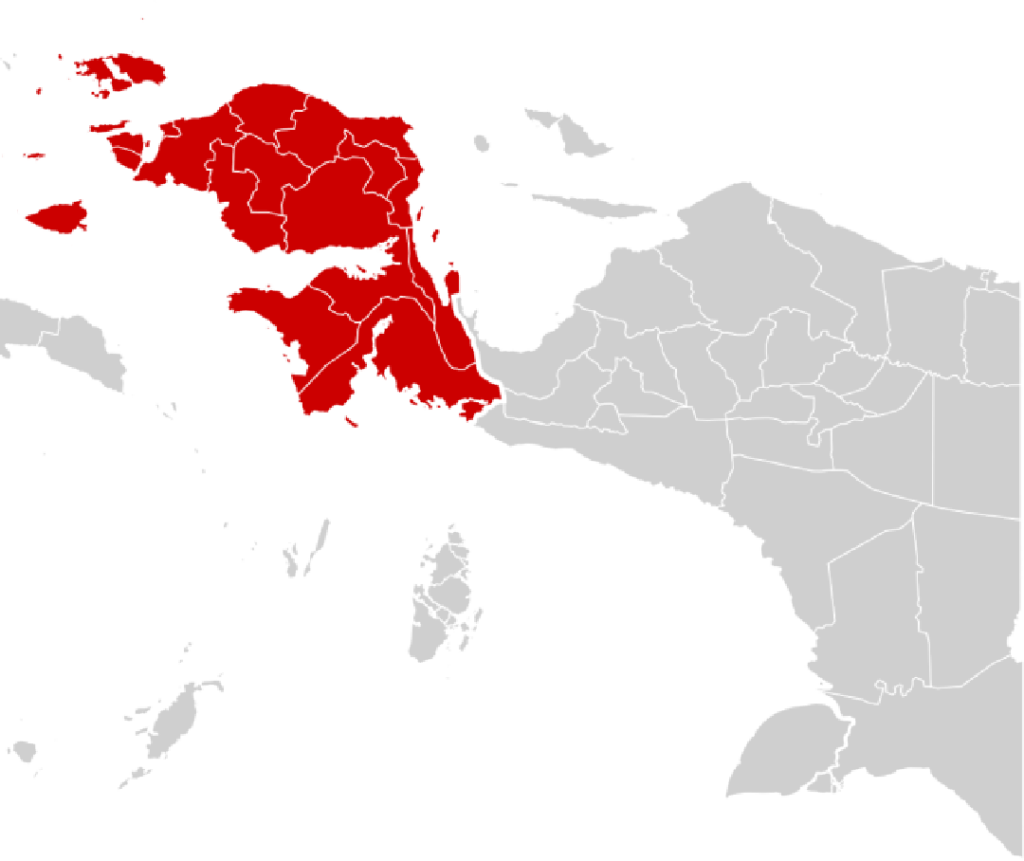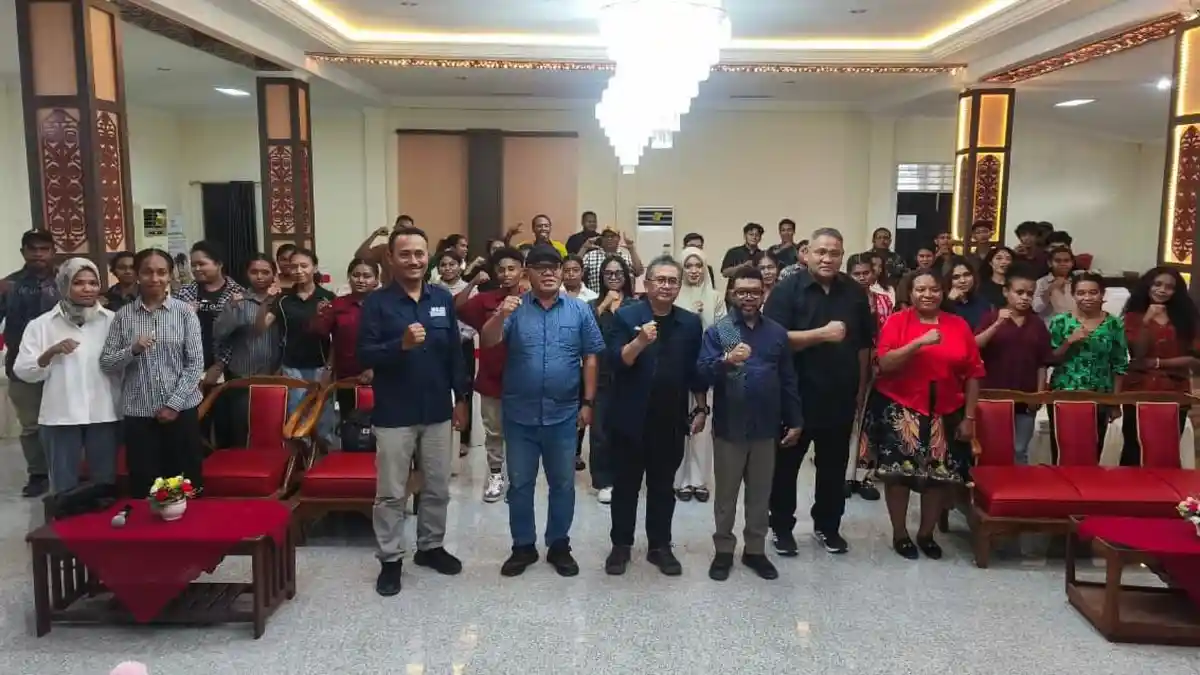
Understanding Papua Special Autonomy requires more than examining legal provisions or government policies. It also demands an appreciation of the broader geopolitical environment in which Papua continues to attract international attention. This was the central message delivered during a public lecture organized by the Papua Institute of Law and Development Technology (Institut Ilmu Hukum dan Teknologi Pembangunan Papua, IHTP), where academics and media leaders encouraged students to examine Papua’s development from both national and international perspectives.
The lecture, themed “Papua Special Autonomy from the Perspective of International Geopolitics,” featured IHTP Rector Filep Wamafma and Chairman of the Indonesian Cyber Media Network (JMSI), Teguh Santosa. The event emphasized that universities play an important role in preparing young Papuans to understand complex global developments while promoting critical thinking, responsible use of digital media, and constructive participation in national development.
Speakers also highlighted the importance of improving media literacy among university students, noting that inaccurate information and online disinformation have increasingly become challenges capable of influencing public perception. By strengthening geopolitical understanding and digital literacy, students are expected to become informed citizens who contribute positively to public discussion while helping maintain social cohesion.
Understanding Papua Special Autonomy Beyond Domestic Politics
Throughout the discussion, participants were encouraged to view Papua Special Autonomy not only as a domestic governance framework but also as a policy operating within an increasingly interconnected international environment.
According to Rector Filep Wamafma, discussions surrounding Papua frequently attract international attention because of the province’s strategic geographical position, abundant natural resources, cultural diversity, and broader regional dynamics in the Indo-Pacific.
For that reason, understanding Papua requires awareness of both local realities and external narratives that often circulate internationally.
The public lecture encouraged students to analyze information carefully rather than accepting narratives without verification. Speakers stressed that geopolitical issues are rarely simple, and public debate often involves competing interpretations shaped by political, economic, diplomatic, and media interests.
Developing the ability to evaluate information critically therefore becomes an essential academic skill.
The discussion also emphasized that Special Autonomy should continue to be understood as a framework designed to strengthen governance, improve public services, expand opportunities for Indigenous Papuans, and support sustainable regional development.
Participants noted that constructive dialogue regarding policy implementation remains important for ensuring that Special Autonomy continues delivering tangible benefits for local communities.
Rather than reducing the discussion to political slogans, the speakers encouraged students to examine Special Autonomy through evidence, policy evaluation, and measurable development outcomes.
Universities Prepare Students for an Increasingly Complex World
A central theme throughout the lecture was the growing responsibility of universities in preparing graduates capable of understanding rapidly changing global developments.
Rector Filep Wamafma emphasized that higher education institutions should not only produce graduates with professional expertise but also individuals capable of analyzing strategic issues affecting society.
This includes understanding geopolitics, public policy, media literacy, technological change, and international relations.
In today’s digital environment, information travels rapidly across borders.
Students therefore require the ability to distinguish verified facts from misinformation, understand how narratives are formed, and evaluate sources critically before sharing information through social media.
According to the speakers, universities occupy a unique position because they encourage evidence based discussion rather than emotional polarization.
Academic institutions can provide balanced spaces where differing perspectives are examined through research, legal analysis, historical context, and empirical evidence.
Such an approach is considered increasingly valuable as global information flows become more complex and public opinion is often shaped by digital platforms.
The lecture therefore positioned universities not merely as educational institutions but as contributors to informed public discourse.
By strengthening critical thinking, academic integrity, and digital literacy, universities help prepare future leaders capable of engaging responsibly with national and international issues.
Geopolitical Literacy Matters for Young Papuans
The discussion also highlighted why geopolitical literacy has become increasingly important for younger generations in Papua.
The Indo-Pacific region has emerged as one of the world’s most strategically significant areas, attracting growing attention from regional and global powers.
Although geopolitical competition primarily concerns relations among states, public narratives surrounding strategically important regions often circulate widely through international media and digital platforms.
Students were therefore encouraged to understand how international developments can influence public discussion about Papua.
Rather than responding emotionally to every narrative circulating online, speakers urged participants to prioritize verified information, legal analysis, and factual evidence.
This ability to evaluate competing narratives objectively strengthens not only academic quality but also public resilience against misinformation.
Participants were reminded that universities have long served as centers for critical inquiry, where ideas are debated openly while remaining grounded in credible evidence.
Such academic traditions become increasingly important in an era where misinformation can spread more rapidly than verified facts.
Academic Dialogue Encourages Constructive Public Participation
The public lecture also reflected a broader effort to encourage constructive civic participation among university students.
Rather than positioning young people as passive observers of national development, speakers encouraged students to become active contributors through research, innovation, public discussion, and community engagement.
Constructive participation begins with accurate understanding.
Students who possess strong analytical skills are better prepared to evaluate public policy, participate in democratic dialogue, and contribute ideas that strengthen society.
The speakers emphasized that universities should continue fostering environments where complex issues can be discussed respectfully through evidence based reasoning.
Such dialogue benefits both academic development and broader public understanding.
By encouraging students to approach sensitive issues thoughtfully rather than emotionally, educational institutions help build future leaders capable of supporting peaceful, informed, and constructive public discourse.
This objective aligns closely with Indonesia’s broader efforts to strengthen human capital development, promote digital literacy, and encourage responsible citizenship among younger generations.
Special Autonomy as a Bridge Between Papua and Jakarta
A major theme that emerged during the public lecture was the importance of viewing Papua Special Autonomy as a long term framework for strengthening the relationship between Papua and the central government while advancing inclusive development for Indigenous Papuans.
Speaking before students, academics, and media representatives, IHTP Rector Filep Wamafma emphasized that Special Autonomy should not be understood merely as a financial mechanism. Instead, he described it as a comprehensive policy instrument designed to protect the rights of Indigenous Papuans, improve governance, expand access to education and healthcare, and create greater economic opportunities across the region.
According to Wamafma, the effectiveness of Special Autonomy ultimately depends on consistent implementation and continuous evaluation. Public policies require cooperation among central and regional governments, educational institutions, civil society, and local communities to ensure that development programs produce measurable benefits for the people they are intended to serve.
He encouraged students to examine Special Autonomy through objective analysis rather than political polarization, stressing that universities should become centers for constructive dialogue supported by evidence and academic research.
Participants also discussed how Special Autonomy has evolved since its introduction, with continued adjustments intended to strengthen public administration, increase community participation, and improve development outcomes throughout Papua.
From this perspective, Special Autonomy functions not only as a legal framework but also as an institutional bridge that supports cooperation between Jakarta and Papua while recognizing the province’s unique social and cultural characteristics.
Digital Media Carries Both Opportunity and Responsibility
Another important topic addressed during the lecture concerned the rapidly changing digital information environment.
Teguh Santosa, Chairman of the Indonesian Cyber Media Network (JMSI), highlighted the growing influence of digital platforms in shaping public opinion, particularly among younger generations.
While digital technology provides unprecedented access to information, it also creates opportunities for misinformation and disinformation to spread quickly across social media networks.
Students were encouraged to become responsible digital citizens by verifying information before sharing it and by relying on credible sources when discussing public issues.
According to Santosa, universities have an important responsibility to cultivate media literacy because informed citizens are less vulnerable to manipulation through false or misleading narratives.
He noted that inaccurate information surrounding sensitive political and social issues can create misunderstanding, deepen polarization, and weaken public trust.
For that reason, strengthening digital literacy is increasingly viewed as an essential component of higher education.
Rather than responding emotionally to sensational online content, students were encouraged to develop habits of critical verification by comparing multiple credible sources, examining evidence carefully, and considering broader contexts before forming conclusions.
This approach supports healthier public discourse while helping maintain social harmony in an increasingly connected digital society.
Students Play a Strategic Role in Combating Hoaxes
Throughout the discussion, speakers consistently emphasized that university students represent one of Indonesia’s most important resources in promoting accurate information and strengthening social cohesion.
Young people today are among the most active users of digital platforms.
Their ability to identify misinformation, verify facts, and communicate responsibly therefore carries significant influence within their communities.
The lecture encouraged students to move beyond passive consumption of online information and instead become active contributors to a healthier information ecosystem.
This includes promoting evidence based discussion, respecting differences of opinion, and rejecting content that deliberately distorts facts or encourages division.
According to the speakers, combating hoaxes should not rely solely on government institutions or law enforcement agencies.
Educational institutions, journalists, civil society organizations, and ordinary citizens all have important roles in strengthening information resilience.
Students, in particular, possess the academic training necessary to evaluate sources critically while helping friends and communities distinguish verified information from misleading claims.
Developing these skills also supports broader democratic participation.
Citizens who understand how information is produced, distributed, and verified are generally better equipped to engage constructively in public debate while resisting attempts to manipulate public opinion.
Geopolitical Awareness Supports National Resilience
The lecture also explored the relationship between geopolitical literacy and national resilience.
Papua occupies a strategically important position within the Indo-Pacific region, an area that continues attracting international political, economic, and security interest.
Speakers explained that this geopolitical context makes accurate public understanding increasingly important.
International narratives concerning Papua often circulate through global media, academic publications, advocacy networks, and digital platforms.
Students were therefore encouraged to understand how geopolitical developments influence international discussions while remaining committed to evidence based analysis.
Rather than viewing geopolitics solely through the lens of competition among major powers, the lecture presented it as a framework for understanding how geography, diplomacy, economics, security, and information interact within today’s interconnected world.
For university students, developing geopolitical literacy helps improve their ability to interpret international events while appreciating Papua’s strategic importance within Indonesia’s national development agenda.
This broader perspective also encourages more balanced public discussion by placing local developments within wider regional and international contexts.
Looking Ahead
The public lecture organized by IHTP and JMSI illustrates the growing importance of combining legal education, geopolitical understanding, and digital literacy in preparing Indonesia’s next generation of leaders.
As information technology continues transforming how societies communicate, universities are expected to play an increasingly significant role in strengthening critical thinking and encouraging responsible public participation.
Future initiatives involving collaboration between higher education institutions, media organizations, and civil society can further enhance students’ understanding of national policy, international affairs, and responsible digital citizenship.
For Papua, where development issues often receive international attention, strengthening analytical capacity among young people will remain valuable for supporting informed dialogue and evidence based policymaking.
Conclusion
The public lecture on “Papua Special Autonomy from the Perspective of International Geopolitics” demonstrated how universities can contribute to a deeper understanding of Papua’s development within an increasingly interconnected world.
Through presentations by IHTP Rector Filep Wamafma and JMSI Chairman Teguh Santosa, students were encouraged to examine Special Autonomy through academic analysis, appreciate its role in strengthening relations between Papua and Jakarta, and recognize the importance of consistent policy implementation for improving community welfare.
Equally important, the discussion highlighted the growing responsibility of university students in combating misinformation and promoting responsible digital communication.
By strengthening media literacy, geopolitical awareness, and critical thinking, educational institutions can help prepare future leaders capable of contributing constructively to national development while supporting social cohesion and informed public dialogue.
As Papua continues advancing through investments in governance, education, infrastructure, and human capital, initiatives that connect academic scholarship with public engagement provide an important foundation for building a knowledgeable, resilient, and united society.