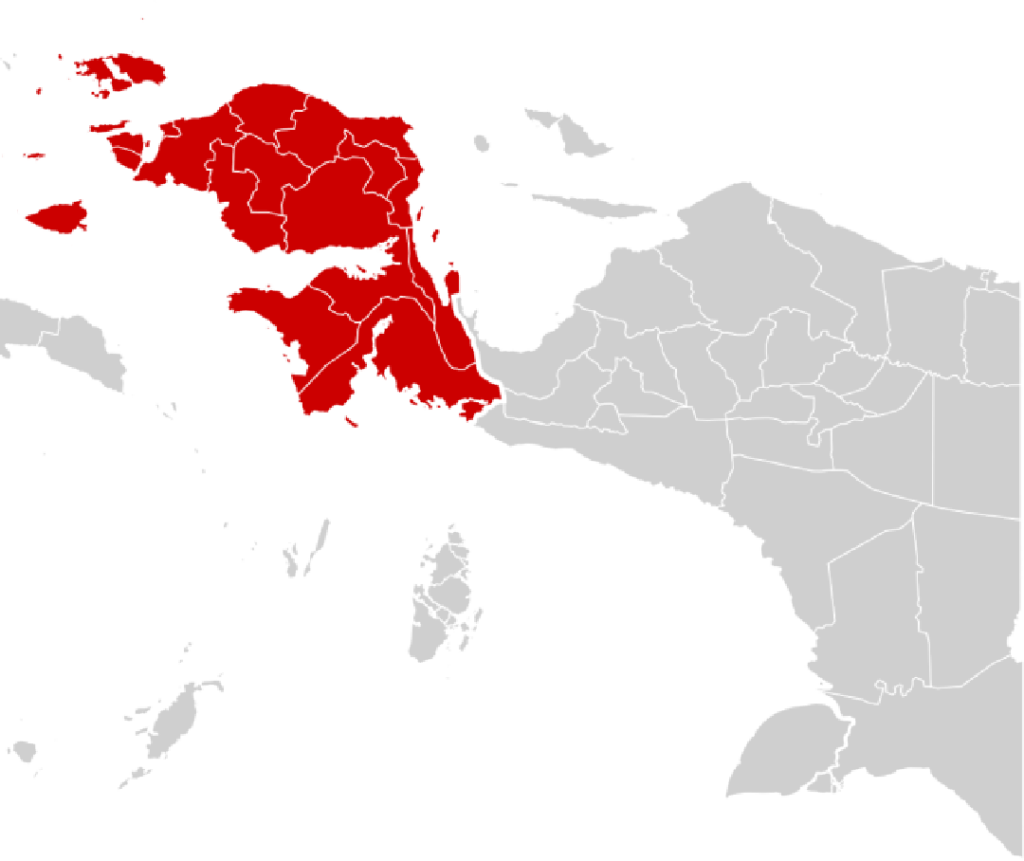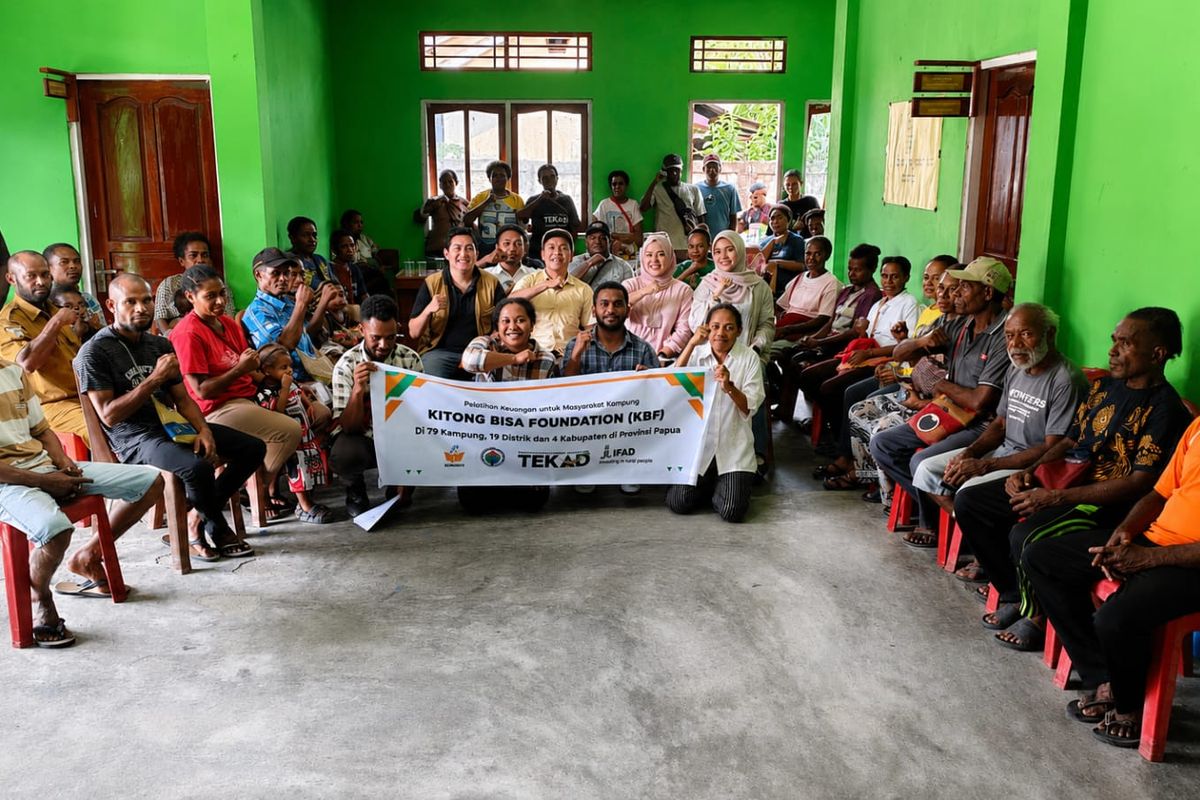
Efforts to strengthen Papua economic empowerment have entered a new phase as 1,700 households across 79 villages participate in financial literacy and entrepreneurship training designed to improve family incomes and encourage sustainable rural development. The initiative forms part of the Integrated Village Economic Transformation and Household Based Planning Program (TEKAD PBRT), a collaborative effort led by Indonesia’s Ministry of Villages and Development of Disadvantaged Regions (Kemendes PDT) in partnership with the International Fund for Agricultural Development (IFAD) and the Kitong Bisa Foundation.
The program represents one of the most comprehensive community based economic initiatives currently underway in Papua. Rather than focusing solely on infrastructure or short term financial assistance, TEKAD PBRT emphasizes strengthening household decision making, improving financial management, expanding entrepreneurial skills, and encouraging communities to identify their own economic opportunities.
The launch of the latest training activities was attended by Deputy Minister of Villages and Development of Disadvantaged Regions Billy Mambrasar, who underscored the importance of investing in human capacity alongside physical development. Officials described the initiative as part of Indonesia’s broader effort to create more inclusive economic growth in Papua by equipping families with practical skills that can generate long term prosperity.
For many rural communities, particularly in remote areas where employment opportunities remain limited, household economic resilience is increasingly viewed as a cornerstone of sustainable regional development.
TEKAD PBRT Expands Community Based Development
The TEKAD PBRT program has been developed around the principle that lasting economic progress begins at the household level.
Instead of relying exclusively on top down development strategies, the initiative encourages families to actively participate in planning their own economic future. Through structured mentoring, participants learn how to assess household resources, identify income generating opportunities, manage expenditures, and prepare long term financial plans.
Officials explain that this approach helps families make more informed economic decisions while encouraging greater independence.
Across the 79 participating villages, facilitators work directly with residents to develop practical solutions that reflect local economic conditions, available natural resources, and community priorities.
This localized planning process is intended to ensure that development initiatives remain relevant to each village’s unique circumstances rather than applying identical solutions across diverse regions.
Government representatives believe that empowering households to become active planners of their own economic future will produce stronger and more sustainable outcomes than short term assistance programs alone.
Financial Literacy Strengthens Household Resilience
Financial literacy forms one of the central pillars of the program.
Many rural families possess valuable agricultural, fisheries, forestry, or small business potential but often face challenges related to budgeting, savings, investment planning, and access to formal financial services.
The training therefore focuses on helping participants strengthen basic financial management skills while improving their understanding of responsible borrowing, savings strategies, household budgeting, and business planning.
Officials note that stronger financial literacy enables families to make better long term decisions regarding education, healthcare, farming investments, and business expansion.
Participants are encouraged to view household finances not simply as daily income and expenses but as part of a broader strategy for improving family welfare over time.
Development practitioners have consistently found that financial education contributes to stronger economic resilience by helping households better manage unexpected economic shocks.
For Papua, where many communities depend on seasonal agricultural production or small scale enterprises, improved financial planning may help families diversify income sources while reducing vulnerability to market fluctuations.
Entrepreneurship Creates Local Economic Opportunities
Alongside financial literacy, entrepreneurship training plays an equally important role within the TEKAD PBRT framework.
Rather than encouraging residents to seek employment exclusively outside their communities, the program promotes locally based entrepreneurship that builds upon existing village resources.
Participants receive guidance on identifying market opportunities, developing business ideas, improving product quality, managing production costs, and reaching potential customers.
Officials believe that strengthening entrepreneurial capacity can stimulate local economies while generating employment opportunities within villages themselves.
Papua possesses significant economic potential across agriculture, fisheries, ecotourism, traditional crafts, and community based industries.
Supporting local entrepreneurs allows these sectors to develop more sustainably while creating additional sources of household income.
Government representatives emphasize that entrepreneurship training is designed not only for experienced business owners but also for families interested in starting small enterprises for the first time.
This inclusive approach encourages wider community participation while promoting economic diversification throughout rural Papua.
Billy Mambrasar Emphasizes Human Capital Development
During the training activities, Deputy Minister Billy Mambrasar highlighted that community development extends beyond constructing infrastructure or expanding government programs.
He emphasized that strengthening human capacity remains equally important because sustainable development depends on people possessing the knowledge, confidence, and skills necessary to improve their own economic conditions.
According to officials, TEKAD PBRT seeks to place local communities at the center of development rather than positioning them solely as beneficiaries of government assistance.
By strengthening planning capacity, financial literacy, and entrepreneurship, families become active participants in shaping their own future.
Mambrasar also emphasized the importance of collaboration among government institutions, international development partners, civil society organizations, and local communities.
Such partnerships enable development programs to combine national policy objectives with local knowledge and international experience, producing solutions that are better adapted to Papua’s diverse social and economic conditions.
Government representatives believe that empowering Indigenous Papuan communities through education and economic skills contributes directly to inclusive development while strengthening long term regional resilience.
Household Planning Supports Inclusive Development
One of the distinctive characteristics of TEKAD PBRT is its emphasis on household based planning rather than isolated project implementation.
Facilitators encourage each participating family to develop realistic plans based on their own resources, priorities, and long term aspirations.
This planning process includes discussions regarding education, nutrition, income generation, financial management, agricultural productivity, and future investments.
Officials believe that when households establish clear development goals, they become better positioned to allocate resources efficiently while adapting to changing economic conditions.
The household planning model also promotes greater participation by women, youth, and other family members in economic decision making.
Development experts frequently identify inclusive family participation as an important factor supporting stronger community resilience and more sustainable economic growth.
For Papua, where many villages maintain strong communal traditions, integrating household planning with community development may further strengthen local ownership of development initiatives.
Partnership Between Government and International Development Partners
One of the defining features of the TEKAD PBRT initiative is its collaborative approach. Rather than relying solely on government institutions, the program brings together the Ministry of Villages and Development of Disadvantaged Regions (Kemendes PDT), the International Fund for Agricultural Development (IFAD), and the Kitong Bisa Foundation, combining public policy, international development expertise, and community level facilitation.
Officials involved in the program describe the partnership as an example of how inclusive development can be strengthened through cooperation between national institutions and global development organizations. Each partner contributes complementary expertise. Kemendes PDT provides policy direction and program coordination, IFAD contributes international experience in rural economic development, while the Kitong Bisa Foundation works closely with communities to ensure that training and mentoring remain relevant to local conditions.
This collaborative model also allows best practices from international rural development programs to be adapted to Papua’s unique social and geographical context. Rather than introducing standardized solutions, facilitators encourage communities to identify opportunities that reflect local resources, cultural traditions, and economic potential.
Government representatives believe that long term economic transformation requires continuous collaboration between multiple stakeholders, ensuring that development programs remain responsive, sustainable, and locally owned.
Strengthening Rural Economies Across Papua
The participation of 1,700 households from 79 villages illustrates the growing scale of efforts to strengthen village economies throughout Papua.
Many participating communities rely on agriculture, fisheries, livestock, forestry products, traditional handicrafts, and other small scale economic activities. Although these sectors possess considerable potential, limited financial literacy and business management experience have often constrained household income growth.
Through TEKAD PBRT, participants are encouraged to improve production planning, develop value added products, strengthen marketing strategies, and better manage household finances. Facilitators also help families understand how savings, responsible financial planning, and entrepreneurship can contribute to more stable livelihoods.
Officials explain that strengthening village economies produces broader social benefits beyond increased household income. Stronger local businesses create employment opportunities, encourage young people to participate in community development, and stimulate demand for locally produced goods and services.
For Papua, where many villages are geographically isolated, strengthening local economies can also reduce dependence on external markets while improving community resilience during periods of economic uncertainty.
Empowering Indigenous Communities Through Knowledge
The TEKAD PBRT initiative places significant emphasis on empowering Indigenous Papuan communities through practical knowledge rather than financial assistance alone.
Government officials have consistently emphasized that education, mentoring, and skills development provide long lasting benefits because communities gain the capacity to continue improving their economic conditions independently.
Financial literacy training helps families better understand budgeting, savings, investment, and responsible financial decision making.
Entrepreneurship mentoring encourages participants to identify opportunities within their own communities by building businesses that reflect local strengths and available resources.
Officials believe this combination of knowledge and practical experience creates stronger foundations for sustainable development.
Deputy Minister Billy Mambrasar highlighted that Papua’s future development depends not only on infrastructure investment but also on strengthening the capabilities of its people.
By expanding opportunities for learning and economic participation, the government seeks to ensure that development benefits are distributed more broadly across rural communities.
Household Planning Creates Sustainable Development
A distinguishing characteristic of the TEKAD PBRT approach is its focus on planning at the household level.
Rather than implementing development projects independently of local communities, facilitators encourage families to define their own priorities and establish realistic economic goals.
This process promotes greater participation from all family members, including women and young people, helping households make informed decisions regarding education, nutrition, business development, agriculture, and long term financial planning.
Development practitioners frequently note that sustainable economic progress begins with strong household management.
When families develop clearer financial plans and improve their ability to manage available resources, they become better prepared to invest in children’s education, healthcare, productive enterprises, and future economic opportunities.
Officials believe that this household centered approach complements broader village development strategies while strengthening community resilience over time.
Looking Ahead
Indonesia’s commitment to expanding inclusive economic development in Papua is expected to continue through greater investment in community capacity building, entrepreneurship, and household based planning. Programs such as TEKAD PBRT demonstrate an increasing emphasis on empowering communities through knowledge, financial literacy, and locally driven economic initiatives rather than relying solely on direct assistance. As cooperation between government institutions, international partners, and local organizations continues to grow, similar community based development models are likely to play an increasingly important role in supporting sustainable livelihoods across Papua’s rural areas.
Conclusion
The implementation of the TEKAD PBRT program marks an important step in strengthening Papua’s economic empowerment through community centered development. By providing financial literacy training and entrepreneurship mentoring to 1,700 households across 79 villages, Indonesia is investing not only in economic growth but also in the long term resilience of rural communities. The collaboration between Kemendes PDT, IFAD, and the Kitong Bisa Foundation, together with the participation of Deputy Minister Billy Mambrasar, reflects a shared commitment to creating more inclusive and sustainable development opportunities throughout Papua. By placing households at the center of planning and equipping communities with practical economic skills, the initiative contributes to stronger local economies while supporting Indonesia’s broader goal of reducing regional development disparities and expanding prosperity across eastern Indonesia.