
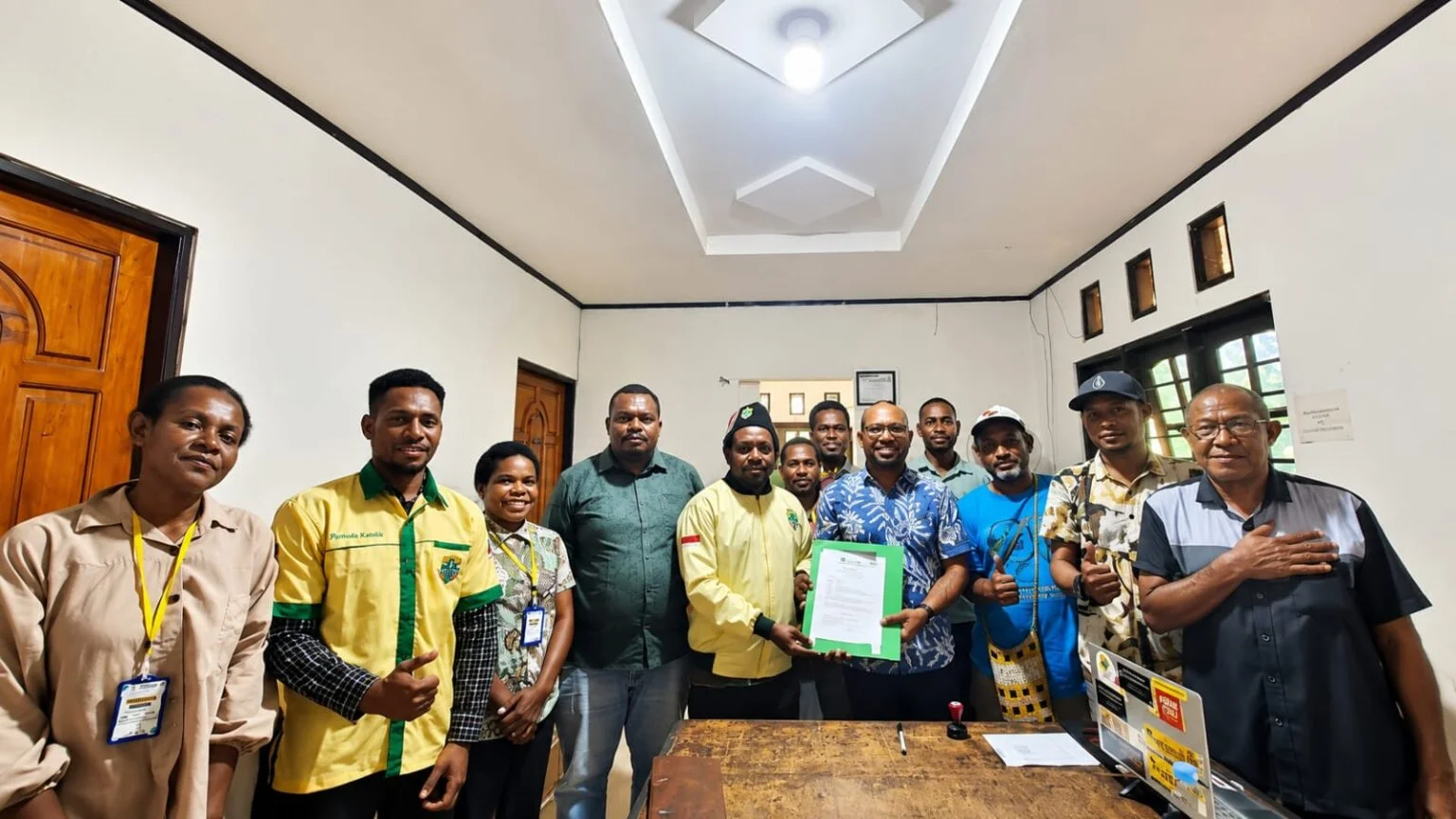
As the nature of information creation and dissemination is changing with digital technology, the need for well-trained, ethical, and professional journalists is increasing. In response to this challenge, the Papua Journalists Association (Asosiasi Wartawan Papua/AWP) and the Papua Regional Commissariat of Catholic Youth (Pemuda Katolik Komda Papua) have established a joint Papua Journalism School to enhance the capacity of young Papuans in journalism, media literacy, and responsible public communication.
The program reflects an increasing commitment to investment in human capital through practical education that prepares young people for an increasingly information-based society. The program aims not only to teach reporting skills but also to build critical thinking, ethical decision-making, and technological literacy, all competencies that have become indispensable in today’s fast-evolving media landscape.
Organizers say the journalism school is more than a technical training program. It aims to become a platform for young Papuans to learn how to produce accurate, balanced, and constructive reporting and to build up the confidence to actively participate in public discourse.
The strengthening of journalism education in Papua is considered an important contribution to both community development and democratic participation, as the storytelling needs to be sensitive and responsible to various communities, cultures, and local issues.
A Partnership Focused on Youth Capacity Building
AWP and Pemuda Katolik Komda Papua work together, combining the strengths of two organizations that complement each other.
The Papua Journalists Association offers professional experience in reporting, newsroom practices, journalistic ethics, and media production. Catholic Youth, meanwhile, has a large network of young people and experience in developing leadership, engaging the community, and running educational activities.
The organizers said that the partnership was created to give young Papuans practical exposure to how professional journalism functions and to foster the responsible use of digital media.
The training will include the fundamentals of journalism, such as news writing, interviewing, fact-checking, ethical reporting, multimedia storytelling, and communication skills.
The program also aims to educate participants about the larger social responsibility that comes with being a journalist who shares information in the public interest.
Organizers hope the school will teach not only technical skills but also the integrity, professionalism, and respect for standards of journalism that will serve participants well throughout their careers.
Journalism as a Tool for Human Capital Development
Educators are increasingly aware of the role of journalism as an important field in wider human resource development.
Effective communication skills and analytical thinking, research skills, and ethical judgment are important skills not only for journalists but also for people working in government, education, civil society, business, and creative industries.
Participants learn how to collect information in a systematic way, verify facts, interview sources, and present balanced reporting. Transferable skills are developed to support lifelong learning.
Organizers say the competencies will help young Papua New Guineans to better contribute to their communities and open career opportunities across several sectors.
The journalism school therefore complements broader education programs that are now being rolled out across Papua, including scholarship programs, vocational education, entrepreneurship training, sports academies, and cultural development programs.
These investments, taken together, indicate an increased focus on enhancing human capital in Papua via alternative educational pathways.
Media Literacy Becomes Increasingly Important
Digital platforms have grown rapidly to change the way people consume information.
Today, social media, messaging apps, online video, podcasts, and digital news platforms allow for the almost instantaneous circulation of information across communities.
While these technologies open new avenues of communication, they also heighten the possibility of misinformation, manipulated content, and unsubstantiated information, increasing the risk of disseminating such content to the public.
That’s why media literacy is becoming an increasingly important educational priority around the world.
The Papua Journalism School aims to help participants differentiate between verified information and unreliable sources and understand the importance of professional journalistic standards, the organizers said.
Students will be encouraged to think critically when evaluating information, check facts before publishing, and understand the ethical responsibilities of digital communication.
The modern information society increasingly considers these skills essential not only for journalists but also for its citizens.
Learning the Principles of Ethical Journalism
The bedrock of professional journalism is the trust of the public.
To maintain that trust, we must follow principles such as accuracy, fairness, independence, accountability, and respect for sources.
The Papua Journalism School aims to teach participants internationally recognized journalistic ethics alongside Indonesian professional standards.
Participants will learn that excellent journalism is about careful checking of facts, balanced coverage, protecting vulnerable sources, and avoiding scaremongering.
Participants believe that these principles are especially important when reporting on sensitive issues affecting communities, public institutions, or social harmony.
Ethical journalism demands reporters provide context, gather multiple perspectives, and refrain from amplifying unsubstantiated claims.
With the inclusion of these standards early in the program, it hopes to prepare participants for future careers that emphasize credibility and public confidence.
Preparing Young Papuans for the Digital Media Era
Today, reporting increasingly goes hand in hand with digital storytelling.
Today’s journalists must be able to write, shoot photos, produce videos, manage social media, do mobile reporting, make podcasts, and create multimedia content.
Amidst these developments, the Papua Journalism School aims to introduce participants to various digital communication tools used in the contemporary media industry.
These skills can open up careers in newspapers and broadcasting, as well as public relations, digital marketing, corporate communications, government information services, nonprofit organizations, the creative industries, and independent content production.
For the younger generation of Papua, the ability to communicate digitally offers an opportunity to be more involved in the developing creative economy in the region, as well as to provide accurate and useful information to society.
Journalism Strengthens Community Development
Aside from training prospective reporters, it is hoped that the Papua Journalism School will also help develop the community at large by motivating the young generation to be responsible communicators in their respective communities.
Local media in Papua is important in documenting cultural heritage, reporting development initiatives, highlighting educational achievements, and providing information that supports public participation. Well-trained journalists help ensure that local stories are accurately told and that Papua’s society is reflected in its diversity and complexity.
Organizers say that by beefing up journalism education, young people can become active participants in public dialogue rather than passive consumers of information.
Participants are invited to realize that journalism is more than just reporting events. It’s also about serving the public by providing accurate information, fostering informed discussion, and amplifying community experiences that might otherwise go unnoticed.
By building these capacities, young Papua New Guineans can contribute to enhancing public understanding of issues related to education, health care, environmental conservation, entrepreneurship, culture, sports, and local economic development.
This broader perspective is a reflection of journalism’s continuing role as a bridge connecting communities, public institutions, and society.
Digital Skills Expand Career Opportunities
The media environment continues to change rapidly.
Traditional newspapers, television, and radio increasingly work alongside digital news platforms, multimedia storytelling, podcasts, social media, mobile journalism, and data-driven reporting.
This has resulted in journalism education preparing students for careers far beyond traditional newsrooms.
Students at the Papua Journalism School are expected to gain practical skills that can be used to support careers in public relations, corporate communications, government information services, nonprofit organizations, digital marketing, creative industries, documentary production, and entrepreneurship.
As Indonesia’s digital economy continues to expand, these competencies are becoming increasingly valuable.
The learning of digital communication technologies is an opportunity for young Papuans to take their place more actively in national and international information networks while remaining rooted in local communities.
The hope of the organizers is that the participants may eventually become communicators who can tell Papua’s stories professionally, in a balanced way, and in accordance with the facts to audiences both in Indonesia and abroad.
These skills can also stimulate local innovation by enabling young entrepreneurs, community organizations, educational institutions, and cultural groups to communicate more effectively with wider audiences.
Investing in Young Communicators for Papua’s Future
The journalism school complements a growing number of initiatives designed to strengthen Papua’s human resources through education and vocational training.
Recently, Papuan youth have gained increasing access to scholarship programs, vocational education, sports academies, leadership development, digital skills training, and cultural initiatives.
The launch of the journalism school highlights the growing recognition of communication and media literacy as essential components of future workforce development.
Officials and educators increasingly agree that successful societies require not only engineers, teachers, doctors, and entrepreneurs but also professional communicators capable of delivering reliable information and encouraging constructive public dialogue.
By investing in journalism education today, Papua is preparing a generation that can contribute to transparent communication, responsible reporting, and stronger public engagement across multiple sectors.
For younger participants, the program also demonstrates that journalism represents a respected profession capable of creating meaningful social impact while offering diverse career opportunities.
International Perspectives on Media Literacy
Media literacy is an increasingly important educational priority around the world.
As societies become more digitally connected, organizations like UNESCO have always encouraged governments and educational institutions to strengthen media and information literacy.
Media literacy helps people think critically about information, tell the difference between reliable reporting and misinformation, understand ethical communication, and participate responsibly in public discourse.
Australia, Canada, Japan, South Korea, Germany, and the United Kingdom, among others, are increasingly training journalism students to combine traditional reporting skills with digital storytelling, multimedia production, verification techniques, and ethical decision-making.
Many of the principles are embodied in the Papua Journalism School, which emphasizes factual reporting, critical thinking, professional ethics, and digital competence.
For international audiences, the project demonstrates how local organizations in Papua are developing communication capacities that facilitate informed public participation and preparing youth for careers in an increasingly global information economy.
Looking Ahead
The first program of the Journalism School is being prepared, and organizers hope the initiative will become a sustainable platform for the development of future generations of professional communicators throughout Papua. The program is designed to improve educational opportunities and increase young people’s participation in community development by enhancing skills in reporting, ethical journalism, internet literacy, and media awareness. It is hoped that the continued collaboration of journalist organizations, educational institutions, youth groups, and civil society will further strengthen Papua’s growing ecosystem of responsible public communication.
Conclusion
The collaboration between the Papua Journalists Association (AWP) and the Papua Regional Commissariat of Catholic Youth is a valuable investment for the future of Papua’s young generation. Through the development of the Papua Journalism School, participants will receive hands-on training in reporting, interviewing, fact-checking, ethical journalism, multimedia storytelling, and digital communication. Beyond training future journalists, the program advances broader human capital development by building critical thinking, media literacy, and professional communications skills. Papua is creating more opportunity in education, vocational training, sports, and youth leadership. Journalism education is another important way to empower young people to contribute positively to their communities while sharing Papua’s diverse stories with professionalism, accuracy, and integrity.

