
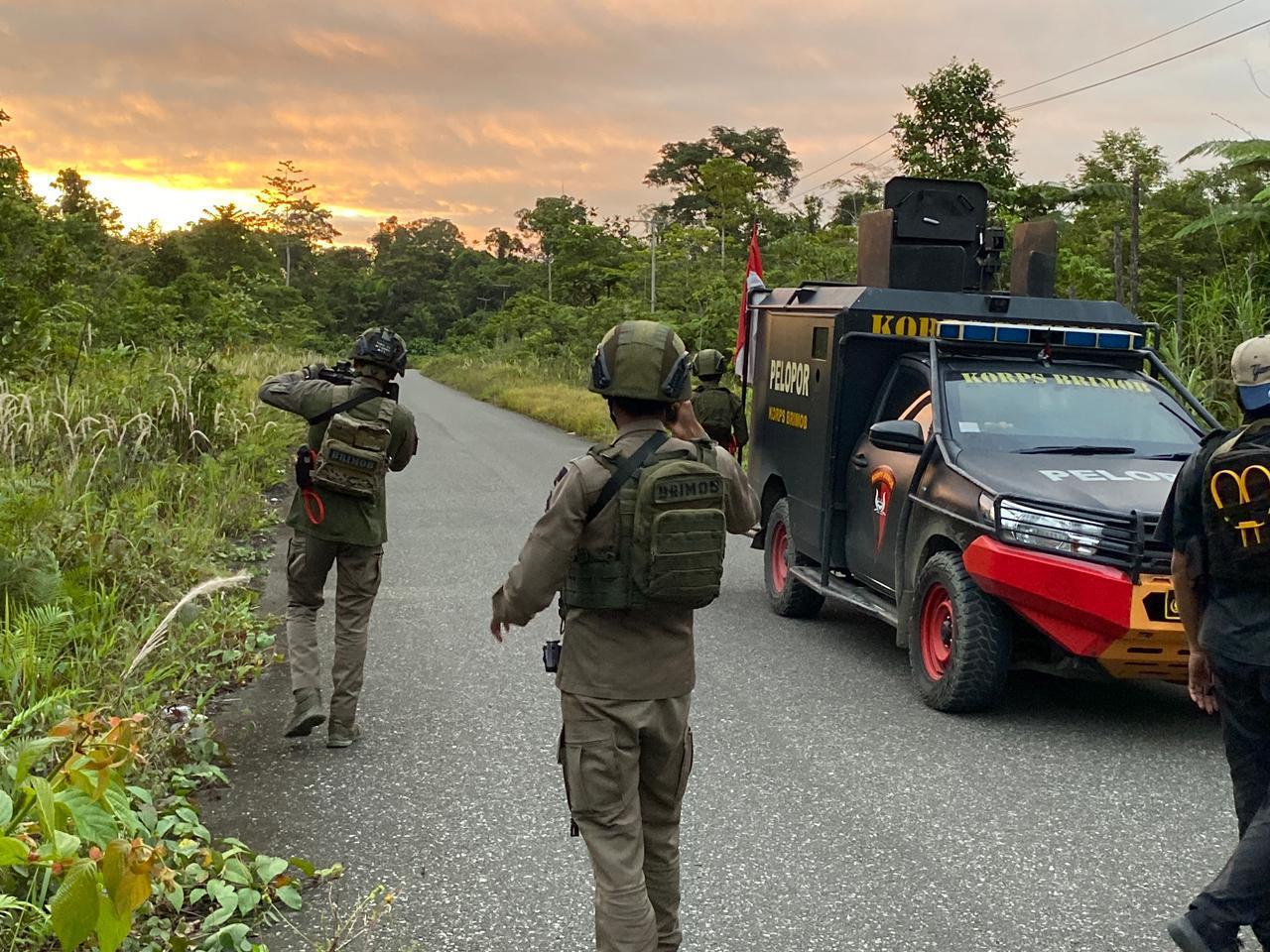
For almost two months, local communities in the mountains of Papua lived in fear after a series of violent attacks. Security forces have been hunting for a man they suspect is responsible.
The chase ended in the afternoon of June 17, 2026, when members of Indonesia’s Damai Cartenz Task Force came across a fugitive named Mayor Yason Suhun, a senior commander of the armed separatist group operating under the Muara Kali Heluk, Seng, Sulo, Baliem, and Indol Battalion (HSSBI) within the Kodap XVI Yahukimo network, one of the groups of the West Papua National Liberation Army (TPNPB), the Free Papua Movement (OPM).
Authorities reported that they located the suspect on Jalan Poros Logpon KM 7, Dekai District, Yahukimo Regency, before he escaped into a forested area.
Police statements said officers warned him and ordered him to surrender. The suspect tried to escape instead, investigators said, leading security personnel to take action.
The operation ended with the death of Mayor Yosan Suhun, bringing to an end one of the most closely followed security chases in Papua Pegunungan (Papua Highlands) this year.
For security officials, the incident was more than just the neutralization of a fugitive commander. It ended a manhunt linked to an attack that shocked residents and raised fears for the safety of civilians in the remote parts of Papua.
A Two-Month Pursuit
The hunt for Mayor Yosan Suhun started after a violent incident on April 28, 2026, in Yahukimo.
Two civilians, Alexander Angket and Naldy Magosa, were attacked in an assault allegedly carried out by members of an armed separatist group, authorities say.
The incident received widespread attention, as both victims were civilians and had no security operations role.
Police named Mayor Yosan Suhun as a key suspect in the attack and put him on their wanted list.
For almost two months, members of the Damai Cartenz Task Force had been gathering intelligence and carrying out field operations in various places in Yahukimo.
The operation was described as slow and methodical, with officials citing the difficult terrain and the movement of armed groups operating in the region.
Intelligence Leads Authorities to Dekai
According to the task force, data obtained through intelligence activities eventually pointed to the suspect being in the vicinity of Dekai.
Then security personnel conducted surveillance operations in the area.
On 17 June, officers reportedly spotted Mayor Yosan Suhun walking along Jalan Poros Logpon KM 7.
Authorities said personnel tried to arrest him alive, warning him before he fled into nearby woodland.
Police officials later said the suspect ignored repeated commands and tried to flee, leading to the confrontation that ended the manhunt.
Several security agencies and regional authorities later confirmed the operation.
Who Was Mayor Yosan Suhun?
Mayor Yosan Suhun was the reported operational commander of the HSSBI Battalion under Kodap XVI Yahukimo, which is one of a number of armed networks operating in the central part of Papua Pegunungan, investigators said.
Security officials said he was a major operational figure in the group.
Authorities said he was involved in organizing and directing activities that have contributed to instability in parts of Yahukimo.
Details of the group’s internal structure are difficult to verify independently, but Indonesian security agencies have consistently singled out Mayor Yosan Suhun as one of their priority targets in recent operations.

Link to Civilian Shooting
The most serious charge against Mayor Yosan Suhun was the shooting of Alexander Angket and Naldy Magosa.
Investigators believe that the April attack is part of a broader pattern of violence against civilians.
Human rights watchers and local officials have repeatedly raised concerns that ordinary people often pay the price of years of fighting in Papua.
The two civilian shootings rekindled those fears and added to the pressure on the security agencies to identify and apprehend whoever was responsible.
The case became a symbol for many Yahukimo residents of the dangers of communities caught between armed violence and security operations.
Civilian Security Remains a Priority
Indonesia’s authorities have increasingly emphasized protecting civilians as a central goal of security operations in Papua.
The violence, which targets local residents, traders, construction workers, health workers, and teachers, hampers efforts to improve living conditions in remote regions, officials say.
The April attack in Yahukimo only heightened those fears.
The shooting incident of Alexander Angket and Naldy Magosa underscored the vulnerability of ordinary citizens living far from major urban centers, security officials said.
Communities Seek Stability
Most of Papua Pegunungan still views stability and security as essential prerequisites for development.
Local governments have invested a lot in upgrading education, healthcare, transportation, and public services.
But when violence flares up, it often derails those efforts.
Community leaders in several districts have repeatedly called for peaceful conditions to allow children to attend school, farmers to reach markets, and health workers to access remote villages.
For these communities, security is not just a military issue.
It is strongly linked to daily life.
When it happens, the impact of violence often goes beyond the immediate casualties.
Violence slows down economic activity, complicates transport, and interrupts public services.
The Broader Security Context in Papua
The Yahukimo operation was part of ongoing efforts by Indonesian authorities to suppress armed violence in a number of areas of Papua.
In the past year, security agencies have reported numerous attacks on civilians, infrastructure, and government facilities.
Armed groups are increasingly targeting non-military locations such as schools, transport routes, and community facilities, authorities say.
The incidents have raised concerns among local residents and policymakers alike.
Balancing Security and Development
In Papua, Indonesia is more and more taking a twin-track approach that couples security with development.
Government programs in education, healthcare, transportation infrastructure, food security, and economic empowerment, among others, are growing throughout the region.
Officials say long-term stability depends on raising living standards and opening up opportunities.
To bridge the development gaps that have historically affected remote areas, various projects have been devised, ranging from road construction to scholarship programs.
Security officials have long stressed that public safety must be maintained so those initiatives can continue without interruption.
Damai Cartenz and Counterinsurgency Operations
The Damai Cartenz Task Force was set up as a specialized unit to address security threats in Papua and to collaborate closely with local authorities and communities.
Recently, the task force has carried out numerous operations targeting individuals suspected of being involved in armed attacks.
Officials say intelligence-led operations remain a key part of the strategy.
The push for Mayor Yosan Suhun demonstrated the level of importance placed on obtaining the information prior to taking enforcement action.
A Focus on Targeted Operations
Security analysts emphasize that targeted operations against specific individuals aim to mitigate broader risks to civilian populations.
Authorities want to minimize disruption to surrounding communities by focusing on suspects believed to be directly involved in violent acts.
The Yahukimo operation followed the same pattern.
Rather than sweeping across large areas, investigators focused on hunting down a specific fugitive connected to a particular criminal case.
Officials contend such tactics enable security agencies to keep up the heat on violent actors while minimizing the impact on ordinary residents.
What Comes Next for Yahukimo?
The death of Mayor Yosan Suhun does not automatically mean that security challenges in Yahukimo are over.
The authorities admit that armed groups remain active in several areas in Papua Pegunungan.
But officials say the operation removes a person they believe is responsible for serious acts of violence.
Local communities hope for a period of calm.
But residents still value access to education, healthcare, transportation, and economic opportunities.
Local authorities say development programs will continue despite security challenges.
The ultimate goal continues to be to help communities create the conditions needed to focus on improving livelihoods rather than dealing with repeated violence.
Conclusion
The operation by Indonesia’s Damai Cartenz Task Force on 17 June 2026 brought to a close a two-month manhunt for Mayor Yosan Suhun, a senior commander of the HSSBI armed group network in Yahukimo. The suspect was linked to the shooting of civilians Alexander Angket and Naldy Magosa on 28 April 2026, a case that drew wide concern across Papua Pegunungan, authorities said.
The operation is a significant law enforcement development, but it also underlines a bigger problem facing Papua: how to protect civilians from violence and also assist with long-term development. In Yahukimo, the measure of security is ultimately not in headlines or statistics, but in whether families can live, work, study, and travel safely. As authorities try to keep things stable, many residents hope that reduced violence will bring more attention to education, economic development, and quality of life in Papua Pegunungan regions.

