For years, residents in parts of Papua measured distance differently.
A village might sit only a few kilometers away, yet reaching it could take hours.
Not because the destination was far.
A river obstructed the path.
The crossings were even harder in the rainy season. Farmers waited for the water to go down before moving their crops. Occasionally the children took longer ways to school. Access to health services was determined by weather, river currents, and the availability of small boats.
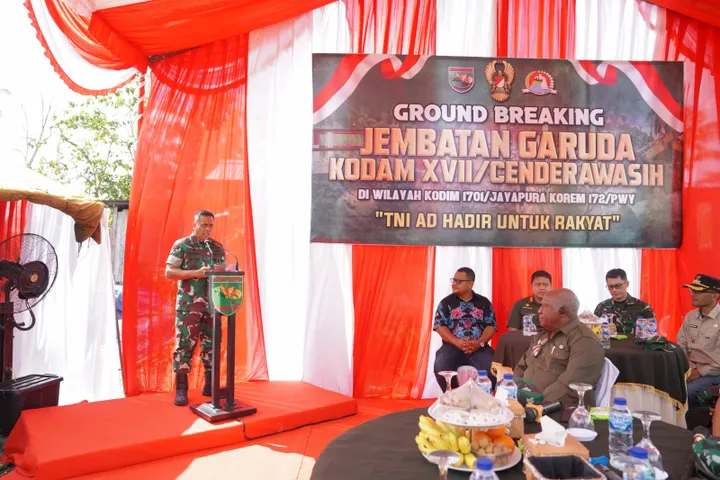
That everyday reality was the focus of talks on June 9, 2026, when Commander of the XVII/Cenderawasih Regional Military Command, Major General Febriel Buyung Sikumbang, attended the groundbreaking ceremony for Phase III of the Garuda Bridge Program in Jayapura.
Addressing regional officials, military, and community representatives, Major General Febriel said 15 Garuda Pioneer Bridges have been constructed in Papua to improve mobility and support communities living in difficult terrain.
He stated at the ceremony that the construction of the bridges aimed to enhance accessibility and strengthen connectivity between the regions.
His remarks reflected a challenge that has shaped development in Papua for decades.
Roads can be built.
Vehicles can be provided.
But when rivers cut through mountainous and forested landscapes, bridges often become the difference between isolation and opportunity.
More Than Construction Projects
The Garuda Bridge Program was launched to address one of Papua’s oldest development obstacles.
Geography.
Papua’s landscape is among the most challenging in Southeast Asia. Vast forests, steep mountains, and large river systems create natural barriers that make transportation expensive and time-consuming.
In some areas, residents can clearly see neighboring communities across a river but still need hours to reach them.
That is why bridge construction often attracts attention beyond engineering circles.
Local residents understand immediately what a new crossing can change.
A farmer thinks about market access.
A teacher thinks about attendance.
A health worker thinks about emergency response times.
The June 2026 Milestone
The June 9 groundbreaking ceremony marked the beginning of the third phase of the Garuda Bridge initiative.
According to Kodam XVII/Cenderawasih, the program has now delivered 15 bridges in different parts of Papua.
Military engineers presented plans for further infrastructure development during the event, which would enhance transportation links in remote areas.
Officials described the program as part of broader efforts to ensure that development reaches regions where geography has historically slowed economic activity.
The emphasis was not on large urban centers.
Instead, attention focused on districts where basic connectivity still presents daily challenges.
Communities Often Feel The Impact First
Infrastructure projects are frequently discussed using numbers.
Bridge length.
Construction costs.
Completion targets.
Yet residents usually evaluate projects differently.
They ask whether travel becomes easier.
Whether transportation costs fall.
Whether goods arrive faster.
Several local leaders attending previous Garuda Bridge activities have noted that the practical effects often become visible within months.
Small traders gain easier access to buyers.
Agricultural products reach markets more efficiently.
Public services become easier to access.
These changes rarely generate national headlines, but they are often the developments communities remember most.
Development and Security Working Together
The participation of Kodam XVII/Cenderawasih in infrastructure projects reflects a longstanding practice in remote regions where military engineering capabilities are frequently used to support national development programs.
In Papua, where construction logistics can be particularly demanding, such cooperation often helps accelerate projects that might otherwise face delays.
Military officials stressed during the June 9 event that infrastructure should ultimately serve communities and contribute to long-term welfare.
That message resonated with local development priorities, which increasingly focus on reducing disparities between urban and remote regions.
Looking Ahead
The number 15 does not solely define the significance of the Garuda Bridge Program.
What happens when the construction crews leave is important.
A bridge is only effective when people cross it.
When students come to school, it’s easier.
When crops reach the market more quickly, it becomes easier for people to access them.
When people in communities feel less alone than before.
For many Papuan people, that process has already begun.
And as Phase III launches come online, local officials are hoping the benefits can continue to spread to parts of the country where geography has long dictated the pace of daily life.
Conclusion
The announcement by Major General Febriel Buyung Sikumbang on June 9, 2026, that 15 Garuda Pioneer Bridges have been completed marks an important step in Papua’s continuing effort to overcome geographic barriers.
While the structures themselves are built from steel and concrete, their impact is measured differently.
In shorter journeys.
In stronger local economies.
And in the growing sense that remote communities are becoming more closely connected to the opportunities around them.