
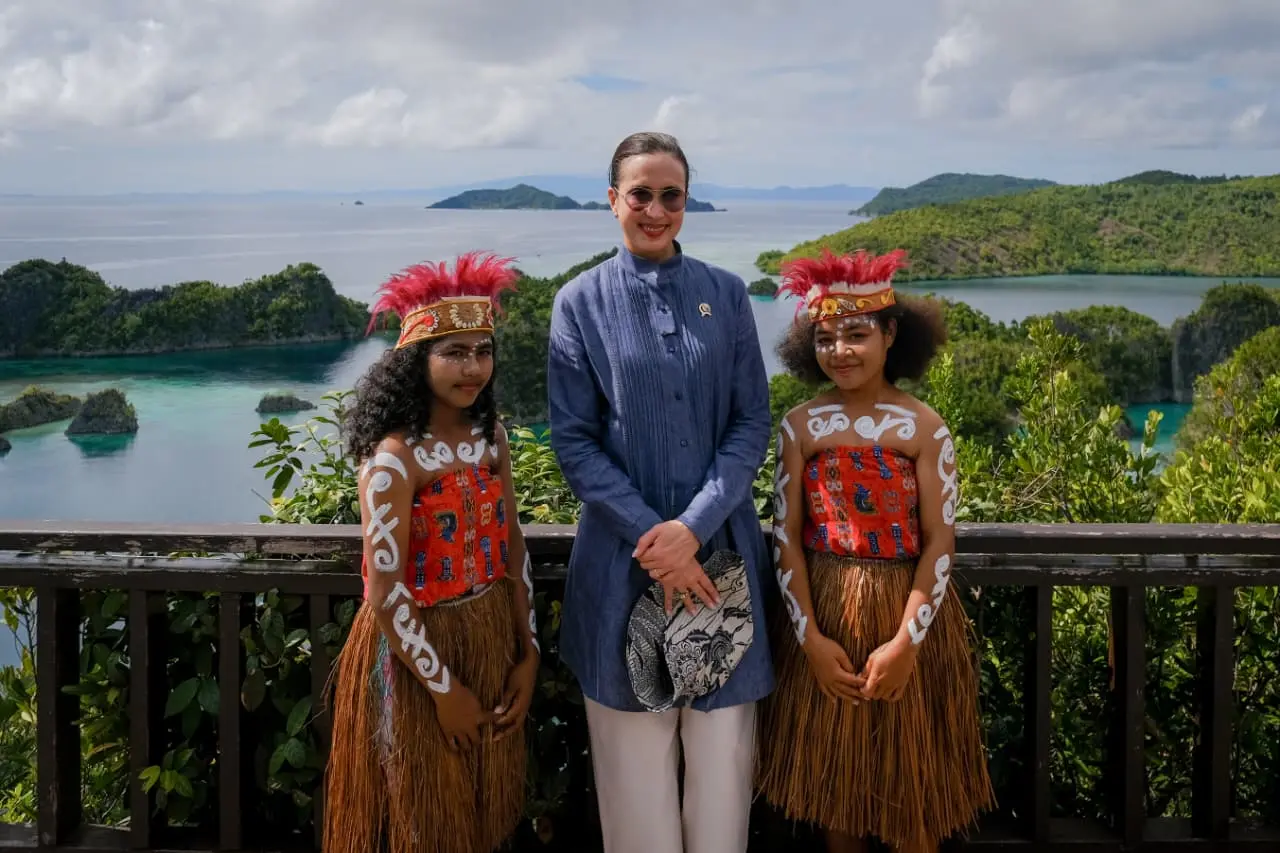
When Tourism Minister Widiyanti Putri Wardhana arrived in Raja Ampat on May 11-12, 2026, the visit was deliberately kept relatively low profile.
There were meetings with regional officials, inspections of tourism areas, and discussions about conservation and governance. But behind the schedule was a much larger issue now facing one of Indonesia’s most internationally recognized destinations.
Raja Ampat is preparing for UNESCO Global Geopark revalidation.
For Indonesia, the process is not only about maintaining international recognition. It is also about proving that tourism growth in Raja Ampat can continue without damaging the marine ecosystems and local communities that made the region globally famous in the first place.
During the visit, Widiyanti repeatedly emphasized that Raja Ampat should not fall into what she described as “exploitative tourism.”
“We must maintain Raja Ampat as a world-class destination while protecting sustainability and governance,” she said during discussions connected to the May 2026 visit.
UNESCO Revalidation Places Raja Ampat Under International Scrutiny
Raja Ampat currently holds status within UNESCO’s Global Geopark network, which recognizes regions with internationally important geological and environmental heritage.
The designation helped strengthen Raja Ampat’s global reputation over recent years, particularly among divers, conservation groups, and international tourism markets.
But UNESCO status is periodically reviewed through a revalidation process.
That evaluation examines environmental protection, tourism governance, conservation programs, educational efforts, and community participation.
Officials from Indonesia’s Ministry of Tourism and Creative Economy said preparations for the review have now become a major priority.
Tourism Ministry Focuses on Governance and Sustainability
Widiyanti Reviews Long-Term Tourism Plans
During her visit, Minister Widiyanti reviewed the implementation of the Raja Ampat Tourism Development Master Plan for 2024 to 2044.
The plan focuses heavily on sustainable tourism management rather than large-scale tourism expansion.
The ministry aims to ensure that Raja Ampat’s tourism growth aligns with conservation goals and community participation, as stated in the post-visit statements.
Officials also discussed coordination between regional governments, tourism operators, and environmental institutions ahead of UNESCO’s evaluation process.
The meetings focused not only on infrastructure readiness but also on governance systems and environmental management.
“Do Not Turn Raja Ampat Into Exploitative Tourism”
One of the minister’s strongest remarks during the trip came when she warned against tourism practices that prioritize short-term economic gain over long-term environmental protection.
According to reports published after the visit, Widiyanti said Raja Ampat should not become an example of exploitative tourism.
The comment reflected growing concerns about balancing tourism growth with ecological protection in one of the world’s richest marine biodiversity regions.
Local authorities acknowledged that Raja Ampat’s international reputation depends directly on environmental preservation.
Coral reefs, marine ecosystems, and relatively intact island landscapes remain the region’s primary attraction for foreign visitors.
Raja Ampat’s Global Reputation Continues to Grow
For years, Raja Ampat has become one of Indonesia’s most promoted tourism destinations internationally.
Its waters are widely known among divers because of extraordinary marine biodiversity, while aerial images of limestone islands have become familiar in global tourism campaigns.
Tourism activity has increased steadily over the past decade.
Guesthouses, diving operators, transportation services, and local tourism businesses have expanded alongside international attention toward the region.
But growth has also created pressure.
Environmental concerns involving waste management, coral reef protection, and tourism capacity have become part of ongoing discussions among officials and local communities.
Local Tourism Operators Raise Concerns
Some Residents Feel Excluded.
Although many local tourism actors welcomed the government’s attention, not everyone felt fully included during the minister’s visit.
A report published during the May 2026 discussions noted that several local tourism operators quietly expressed disappointment because they felt small community businesses were not sufficiently involved in strategic tourism conversations.
Some residents said international promotion often focuses on Raja Ampat’s beauty without always addressing practical economic challenges faced by local tourism operators.
Those concerns reflected broader debates about who benefits most from tourism growth in the region.
Community Participation Remains Key Issue
Government officials repeatedly stressed during the visit that sustainable tourism must involve local communities directly.
Several meetings discussed strengthening community-based tourism and ensuring Indigenous Papuan communities continue participating actively in tourism development.
Officials acknowledged that tourism expansion without strong local involvement could eventually create social tensions alongside environmental pressure.
That issue remains sensitive because many coastal communities in Raja Ampat depend directly on marine ecosystems connected to tourism activity.
Sustainability Becomes Central to Indonesia’s Tourism Strategy
Indonesia has increasingly promoted sustainable tourism as part of its national tourism policy, especially in environmentally sensitive regions such as Raja Ampat.
Rather than pursuing unrestricted visitor growth, officials now speak more frequently about conservation, carrying capacity, and governance quality.
Raja Ampat has become one of the clearest examples of that approach.
Officials involved in the UNESCO preparation process said the government wants tourism development to continue while preserving ecological balance.
That strategy is also important economically.
Environmental damage would directly threaten Raja Ampat’s tourism appeal itself.
UNESCO Status Carries Broader Importance
International Recognition Supports Tourism
Maintaining UNESCO Global Geopark status carries both symbolic and practical importance for Indonesia.
The recognition strengthens Raja Ampat’s international credibility as a conservation-based tourism destination and helps attract environmentally conscious travelers.
Officials said the status also reinforces Indonesia’s image internationally regarding environmental management and sustainable tourism.
Because of that, preparations for the revalidation process now involve multiple institutions at both national and regional levels.
Papua Becomes Part of Indonesia’s Tourism Diplomacy
Raja Ampat has increasingly become part of Indonesia’s broader tourism diplomacy strategy in the Asia Pacific region.
Government officials frequently describe Papua as an important tourism gateway with ecological significance recognized internationally.
That is one reason national-level attention toward Raja Ampat remains particularly strong ahead of UNESCO’s evaluation.
The government understands that Raja Ampat’s reputation extends beyond tourism alone.
It also shapes international perceptions of environmental management in eastern Indonesia.
Balancing Tourism and Conservation Remains Difficult
Despite repeated commitments to sustainability, managing tourism growth in Raja Ampat remains complicated.
Communities want economic opportunity.
Businesses want tourism demand to continue increasing.
At the same time, conservation groups continue warning that marine ecosystems remain vulnerable if tourism expands too aggressively.
Several environmental observers have raised concerns recently regarding waste management, reef protection, and infrastructure pressure in some tourism areas.
Those concerns formed part of the background discussions during the minister’s May 2026 visit.
Preparations Continue Ahead of UNESCO Evaluation
As the visit concluded, government agencies continued reviewing governance systems and tourism readiness connected to the UNESCO revalidation process.
Officials said strengthening coordination between national institutions, regional administrations, and local tourism actors remains one of the priorities moving forward.
Meanwhile, daily tourism activity across Raja Ampat continued normally.
Boats still carried divers through coral-rich waters.
Tourists climbed island viewpoints overlooking the sea.
And local residents continued balancing economic opportunity with growing pressure to protect one of the world’s most fragile marine tourism environments.
Conclusion
Indonesia’s preparations ahead of UNESCO Global Geopark revalidation have placed Raja Ampat under renewed international attention.
During her May 2026 visit, Tourism Minister Widiyanti Putri Wardhana emphasized that Raja Ampat’s future depends not only on attracting visitors but also on maintaining environmental sustainability and improving tourism governance.
The challenge now facing Raja Ampat is increasingly clear.
Tourism continues bringing global recognition and economic opportunity.
Ultimately, preserving the reefs, islands, and communities that built that reputation may determine whether Raja Ampat continues to receive international admiration for decades to come.

