
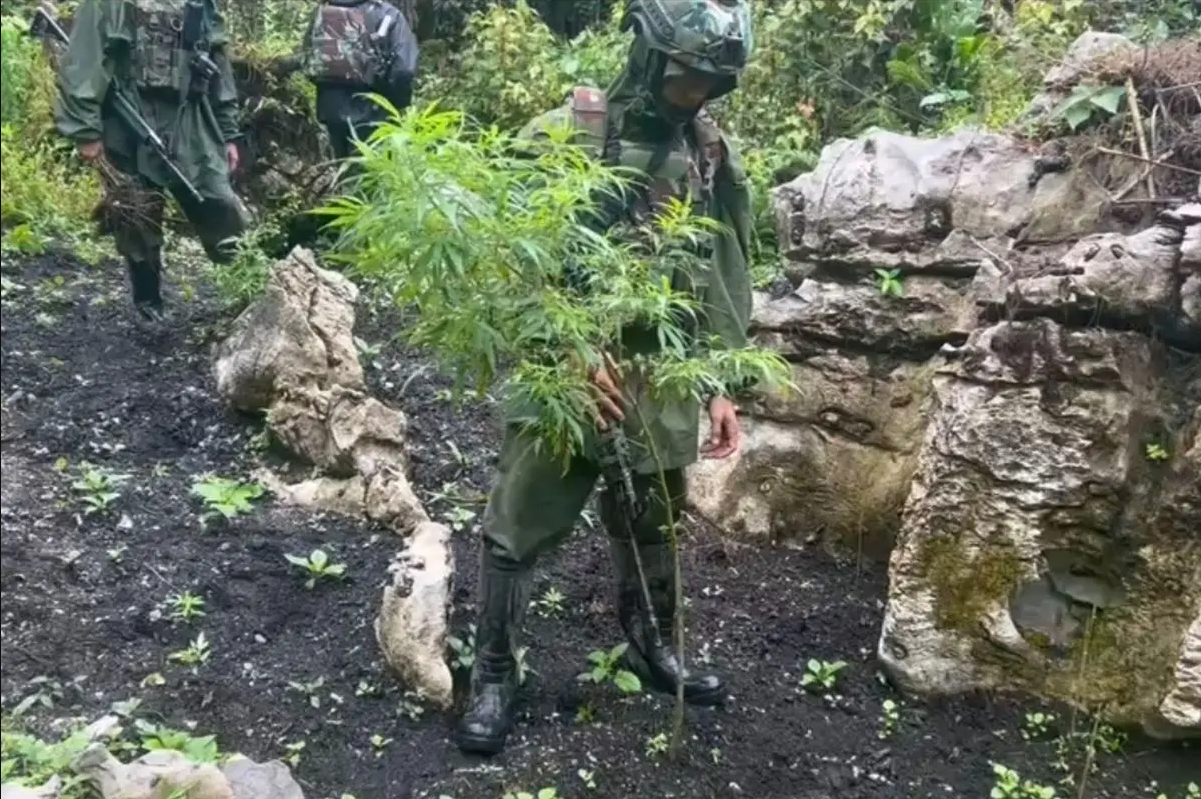
The soldiers moved quietly through thick forest in the mountains of Pegunungan Bintang on May 7, 2026, following intelligence reports about armed separatist activity in the area.
Rain had fallen earlier that morning, leaving the narrow paths muddy and slippery. Visibility inside the forest was limited. For hours, troops climbed through steep terrain before reaching a hidden clearing far from nearby settlements.
There, according to Indonesian military officials, they found something unexpected but deeply concerning.
Rows of cannabis plants.
By the time the operation ended, soldiers had discovered 216 marijuana trees nearing the harvest stage inside what authorities described as a concealed plantation allegedly connected to members of the West Papua National Liberation Army (TPNPB) Free Papua Movement (OPM), armed separatist network.
The operation, now widely discussed as the Papua cannabis field raid, has renewed concerns among Indonesian security officials about how narcotics cultivation and smuggling could be used to finance armed activities in Papua Pegunungan’s (Papua highlands) remote.
A Hidden Plantation in the Mountains
Military officers said the plantation was located in a difficult-to-reach section of forest in Pegunungan Bintang, an area known for steep mountains, dense vegetation, and limited transportation access.
Photos released after the operation showed armed soldiers standing among tall cannabis plants arranged in cultivation rows rather than growing naturally in the wild.
Authorities said the plants were already mature and appeared ready for harvest.
The site’s scale immediately raised suspicions about the operation’s organization rather than its intended personal consumption.
During the raid, troops also detained two men identified by their initials, LU and CU.
Military officials have not publicly disclosed their full identities, but investigators believe both individuals may have connections to separatist networks operating in the region.
Why Indonesian Authorities Are Concerned
Security Officials Suspect Funding Links
For Indonesian security agencies, the discovery was not viewed simply as a narcotics case.
Authorities suspect the cannabis plantation may have been part of a broader effort to generate funding for TPNPB OPM activities in Papua Pegunungan.
Officials have repeatedly warned recently that armed groups operating in isolated regions sometimes rely on illegal economic activity to sustain logistics, weapons procurement, and mobility.
Drug trafficking is considered especially dangerous because it combines criminal networks with security instability.
The latest discovery strengthened concerns that narcotics cultivation in Papua may be evolving into a structured funding source rather than isolated criminal activity.
Smuggling Routes Near the Border
Security officials are also probing possible smuggling routes linked to the plantation.
The mountainous border region between Indonesia and Papua New Guinea has been notoriously difficult to monitor due to dense forests and limited infrastructure.
Officials suspect that illegal trade routes may run through remote, poorly policed areas.
That vulnerability has made border districts ever more sensitive for both law enforcement and military operations.
Investigators are now trying to find out whether the cannabis harvested from the plantation was meant for distribution within Papua or for bigger trafficking networks outside Papua.
Operations in Papua Pegunungan Are Never Simple
Geography Shapes Security Challenges
For soldiers operating in Papua Pegunungan, terrain is often the first obstacle.
Road access remains extremely limited in many districts. Some locations can only be reached on foot after hours of travel through forests and mountain paths.
Weather conditions shift quickly.
Communication signals disappear in certain areas.
Military personnel involved in the May 7 operation reportedly carried supplies manually while moving through difficult routes before locating the plantation site.
That logistical reality partly explains why hidden cultivation areas can remain undetected for extended periods.
Villagers Often Live Closest to the Risk
They are frequently caught in the crossfire between security operations and armed group activity in Papua’s conflict-prone regions, particularly in local communities.
People in remote areas can sometimes face interruptions in transportation, economic uncertainty, and fear of armed confrontations.
Officials say illegal narcotics activity only adds another layer of vulnerability to already unstable areas.
Breaking up cultivation networks is therefore tied to not only law enforcement but also protecting communities from deeper criminal influence, say security authorities.
The Plantation Was Destroyed After the Raid
Military officials confirmed the destruction of the cannabis field following the operation.
Images circulating afterward showed soldiers uprooting and burning plants in the forest clearing.
Authorities also seized evidence from the site while continuing investigations into possible network connections.
The operation involved troops operating under regional military command structures responsible for Papua security missions.
Officials described the raid as part of broader efforts to prevent armed groups from strengthening logistical and financial capabilities through illegal activity.
Narcotics and Armed Conflict Often Overlap
Security analysts note that narcotics cultivation has historically appeared in conflict zones across several parts of the world.
Remote areas with weak infrastructure and limited state presence can become vulnerable to illegal cultivation because monitoring remains difficult.
Indonesian authorities appear increasingly concerned that similar patterns could develop inside isolated parts of Papua if trafficking networks are allowed to expand.
The concern is especially strong in border regions where geography complicates surveillance and law enforcement coordination.
Papua’s Development Push Faces Security Pressure
The Indonesian government continues to push for infrastructure, education, health, and economic programs across Papua as part of larger regional development policies.
Officials often say that long-term stability is not just about imposing security but also about reducing isolation and improving living conditions.
At the same time, authorities say armed violence and the networks for the financing of crime cannot be ignored, as they are important threats to the safety of local communities and to the effectiveness of development actions.
The government says security operations against armed groups are needed to prevent instability from disrupting development efforts in Papua.
Investigations Are Still Ongoing
Authorities Are Mapping Wider Connections
Following the arrests of LU and CU, investigators are now examining whether additional individuals were involved in maintaining or protecting the plantation.
Security agencies are reportedly tracing communication patterns and supply chains linked to the site.
Officials have not ruled out the possibility that similar cultivation areas may exist elsewhere in remote highland regions.
Focus on Preventing Expansion
Authorities say preventing narcotics networks from growing inside Papua remains a priority because of concerns about long-term security implications.
Military and police officials fear that illegal trafficking networks could exacerbate existing tensions if they intertwine with armed separatist movements.
That fear partly explains the strong response following the May 7 discovery.
Conclusion
The cannabis field raid in Papua’s Pegunungan Bintang revealed far more than a hidden plantation deep inside the forest.
For Indonesian authorities, the discovery of 216 cannabis plants and the detention of suspects identified as LU and CU reinforced concerns that narcotics cultivation may be linked to efforts to finance TPNPB OPM activities in Papua Pegunungan’s remote.
The case also highlighted how geography continues shaping security challenges across the region.
In Papua’s mountains, isolation can hide many things.
Villages.
Conflict.
On May 7, soldiers discovered entire cannabis fields growing quietly beneath the forest canopy.

