
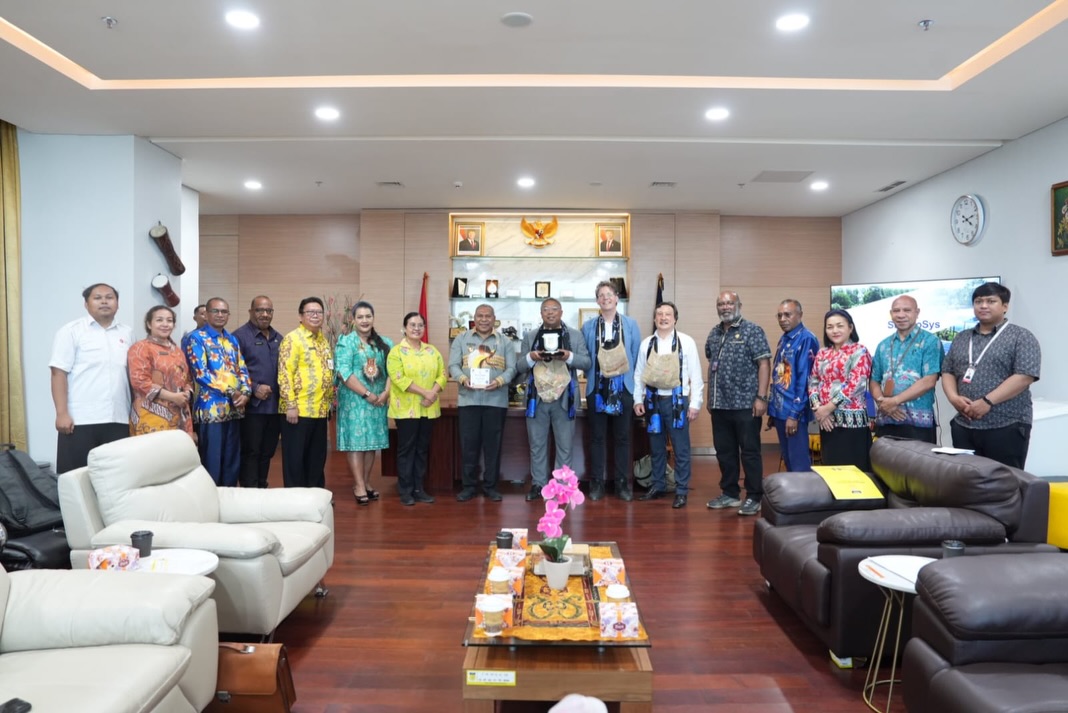
In Papua, development is often discussed in large terms. Infrastructure. Investment. Growth. But on the ground, the questions tend to be simpler.
Where will jobs come from?
How do young people find work?
And how can local resources be used more effectively?
Those questions were quietly present when provincial officials led by Deputy Governor Aryoko Rumaropen met with a delegation from the Netherlands led by Alfred Van Der Klis on April 16, 2026, at the Working Room of the Regional Secretary of Papua Province, Jayapura. The Papua-Netherlands cooperation talks focused on vocational education, employment, renewable energy, and economic opportunities. There were no sweeping announcements. No agreements signed.
Just a conversation that, for many, felt practical.
A Meeting Without Grand Promises
Officials described the discussions as exploratory.
That word matters.
It suggests something open, not yet fixed. A process of figuring out what could work, rather than announcing what already will.
The sectors mentioned were not surprising.
Training.
Jobs.
Energy.
These are areas where Papua continues to face challenges but also where the potential is often noted.
The idea is not to start from zero.
It is to connect what already exists with new support.
Why Vocational Training Came First
One of the recurring issues in Papua is the gap between education and employment.
Students graduate, but the transition into work is not always smooth. Employers, meanwhile, say they need specific skills that are not always available locally.
This is where vocational training becomes relevant.
Not as a replacement for formal education, but as a bridge.
The Netherlands is often cited for its vocational system, where training is closely tied to industry needs. That experience is part of what makes the partnership worth exploring.
Learning That Leads Somewhere
In discussions, the emphasis was not only on training programs themselves but also on where they lead.
Internships.
Partnerships with companies.
Pathways into employment.
Without those elements, training risks becoming disconnected from reality.
For Papua, the goal is to avoid that.
Energy as Both Need and Opportunity
Energy came up repeatedly in the talks.
Papua has significant potential in renewable sources. Rivers, sunlight, and natural resources offer possibilities that are still not fully used.
At the same time, access to reliable electricity remains uneven in some areas.
That contrast shapes the conversation.
Small Systems, Local Impact
Rather than large-scale projects alone, there is interest in smaller, more adaptable systems.
Solar installations.
Micro-hydropower.
Solutions that can be applied in remote areas without requiring extensive infrastructure.
The Netherlands brings experience in managing energy systems efficiently, though any application in Papua would need to be adapted to local conditions.
Economic Cooperation in Practical Terms
The talks also touched on broader economic cooperation.
Papua’s economy is often described in terms of potential.
Natural resources.
Agriculture.
Fisheries.
Tourism.
But turning potential into consistent activity requires more than interest.
It requires systems.
Transport.
Skills.
Market access.
Dutch investors have shown interest in exploring these sectors, particularly where sustainability is part of the approach.
Balancing Interest With Reality
There is, however, a sense of caution.
Officials are aware that not every discussion leads to implementation.
Papua presents challenges that are not always visible from outside.
Distance.
Logistics.
Local conditions that vary from one area to another.
Partnerships need to account for these factors.
Otherwise, they remain ideas.
A Broader Direction
The engagement with the Netherlands is part of a wider pattern.
Indonesia has been encouraging regions, including Papua, to build international connections that support development goals.
For Papua, this matters.
Geography has often limited access.
Partnerships can help bridge that gap, but only if they align with local needs.
Internal Link Perspective
Earlier coverage on this platform has looked at how infrastructure and human development intersect in Papua.
These discussions add another layer.
They show how external cooperation can support internal efforts, rather than replace them.
What Happens Next
For now, the next steps are likely to be technical.
Follow-up meetings.
More detailed assessments.
Possibly pilot programs in specific areas.
Nothing moves quickly in projects like this.
And that may not be a disadvantage.
Taking time allows for adjustment.
Conclusion: A Conversation That Feels Grounded
The Papua-Netherlands cooperation talks do not promise immediate change.
They are quieter than that.
But they reflect something important.
A shift toward practical collaboration.
Skills that lead to jobs.
Energy that reaches communities.
Economic activity that grows from local conditions.
In Papua, where development often unfolds gradually, these kinds of conversations can matter more than they first appear.
Not because of what is said.
But because of what may follow.

