
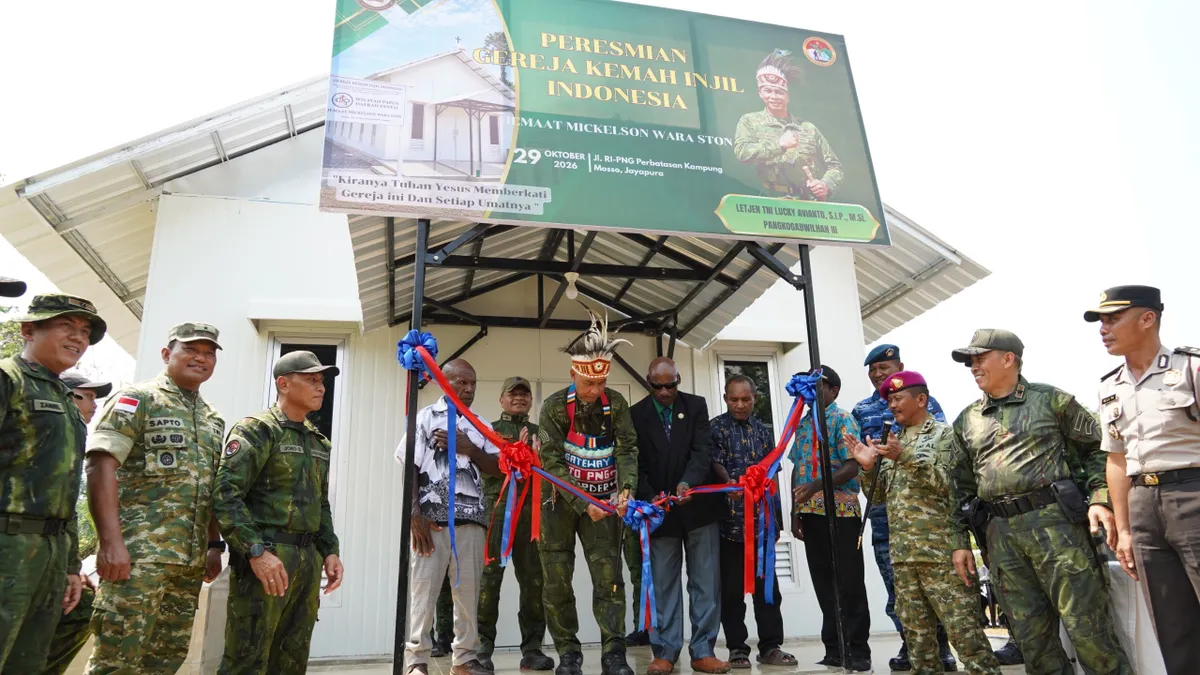
For residents of Kampung Mosso, a village in the Muara Tami District of Jayapura, the opening of a new church on October 29 marked the end of a long wait for a proper place of worship. After approximately eight years of holding religious services under limited conditions, the congregation of the Indonesian Gospel Tabernacle Church (Gereja Kemah Injil Indonesia, or GKII) in Mickelson, Wara, Ston, can now gather in a dedicated building made possible through cooperation involving the TNI, the BIN, and the local community.
The construction brought together the TNI’s Habema Teritorial Task Force Operation Command (Satgaster Koops TNI Habema), the BIN, and residents of the village. Support also came from other security institutions and local stakeholders. The project illustrates how cooperation between state institutions and communities can address practical needs beyond conventional security operations, particularly in a border area where access to public facilities remains an important part of local development.
The church was officially inaugurated by Lieutenant General TNI Lucky Avianto, Commander of the Joint Defence Area Command III (Pangkogabwilhan III), and Brigadier General TNI Riyanto, Commander of the TNI’s Satgaster Habema. The ceremony took place on October 29, 2026, and was attended by the TNI and the Indonesian Police (Polri) officials, regional government representatives, religious leaders, customary figures, and members of the local community.
An Eight-Year Wait Comes to an End
For the congregation of GKII Mickelson Wara Ston, the new building represents more than the completion of a construction project. It addresses a need that had remained unresolved for years. During the approximately eight-year waiting period, residents continued to hold worship services using modest facilities, exposed to difficult conditions, including heat and rain.
Despite these limitations, the congregation maintained its religious activities. The commitment of residents to continue worshipping reflected the importance of the church in the community’s daily life and the need for a more suitable facility.
The inauguration therefore carried particular emotional significance. According to reports from local media, the ceremony was marked by expressions of gratitude and happiness among residents who had waited for a permanent place of worship. Reverend Lani Wahyu, representing the church’s management, expressed appreciation to God and to all parties who had contributed to making the building possible.
Residents also conveyed their appreciation to President Prabowo Subianto and the TNI, particularly the Habema Territorial Task Force, for supporting the fulfillment of their long-standing need. Their response highlighted the importance of practical cooperation between government institutions and local communities in addressing issues that directly affect everyday life.
The church project was not presented merely as a military construction initiative. Rather, it involved a combination of institutional support and community participation. This cooperation helped bring together different stakeholders around a shared objective: providing the congregation with a suitable place to practice its faith.
TNI-BIN Cooperation and the Government’s Presence in Border Communities
The involvement of the TNI’s Satgaster Habema and the BIN was central to the project. According to ANTARA News Papua, the two institutions worked together to build the church for residents of Kampung Mosso, located in Muara Tami District, Jayapura City.
The project also received support from elements of Kodam XVII/Cenderawasih, the Papua Regional Police, and local residents. Metro TV reported that the construction was carried out through collective efforts, reflecting coordination among the TNI, police, BIN, and community members.
The involvement of multiple institutions is significant because development needs in border communities often require cooperation across administrative and operational boundaries. Local infrastructure, public services, religious facilities, and community welfare are interconnected. Addressing one need can also create opportunities for wider social engagement.
Lieutenant General Lucky Avianto described the church as an example of the state’s presence in Papua. He expressed hope that the building would serve not only as a place of worship but also as a center for social and economic activities within the community.
He also emphasized the wider role of religious institutions in Papua. Churches, he explained, can function as public spaces where residents discuss social concerns and family problems. Pastors and other religious leaders are widely respected figures whose involvement can help communities address difficulties and maintain social relationships.
In this context, the new building has the potential to become a meeting point for more than religious services. It can provide a shared space for community discussions, social activities, and cooperation among residents.
Lucky also expressed appreciation for the contributions of military personnel, government representatives, religious leaders, and members of the community who worked together to complete the project. His remarks underlined that the achievement was the result of collective participation rather than the work of a single institution.
A Church as a Center for Social Cohesion
The significance of the GKII Mickelson Wara Ston project extends beyond the physical structure. In many communities across Papua, religious institutions have an important place in social life. Churches can serve as centers for spiritual activities, community gatherings, education, and informal dialogue.
For Kampung Mosso, the availability of a more suitable worship facility is expected to strengthen the congregation’s ability to organize religious activities and maintain its community traditions. It may also provide a more accessible venue for discussions involving local leaders and residents.
Lucky’s remarks about the church’s social role reflect this broader understanding. By describing it as a potential center for addressing social and family issues, he pointed to the influence that religious leaders and institutions can have in supporting community stability.
The project also offers an example of how public institutions can engage with communities through initiatives that respond to locally identified needs. In areas where trust and communication are important to the relationship between residents and government institutions, cooperation on practical projects can create opportunities for sustained engagement.
Brigadier General Riyanto, Commander of the TNI’s Satgaster Habema, similarly highlighted the broader meaning of the initiative. He said the project was part of the government’s attention to the needs of people living in border areas, delivered through the work of the Habema Territorial Task Force.
“What we have built is not merely a church building but also a home for the faith, love, and hopes of the community. May brotherhood, peace, and a better future for Papua’s younger generation grow from this place,” Riyanto said.
His statement placed the construction within a wider social objective: strengthening relationships and creating a positive environment for future generations.
Health Services and Community Assistance Accompany the Inauguration
The inauguration was also accompanied by a series of social activities organized by the Joint Defence Area Command III. These included free medical services, the distribution of basic-needs packages, and a communal meal for children and residents.
According to Metro TV, the activities were organized alongside the church inauguration as part of a broader effort to strengthen relations between security personnel and the local population. The free medical services allowed residents to access basic health checks, while the distribution of essential goods provided additional assistance to participating households.
The communal meal, known as Makan Bersama Gembira, was also described by Lucky as the kick-off activity for the Free Nutritious Meals program, commonly known in Indonesia as Makan Bergizi Gratis (MBG), in the area.
The inclusion of these activities gave the inauguration a wider community dimension. Rather than limiting the event to a formal ceremony, the organizers used the occasion to bring together residents, public officials, and security personnel through practical services.
The health initiative was particularly relevant because access to medical services remains an important concern for communities in geographically challenging areas. Free health checks can help residents identify basic health concerns and encourage greater attention to preventive care. Meanwhile, community meals and assistance packages can strengthen social interaction and provide immediate support.
However, the long-term value of such activities will depend on continuity. One-off services can provide useful assistance, but sustained improvements require regular access to healthcare, adequate nutrition, and coordination with local service providers.
Importance for the Indonesia-Papua New Guinea Border Region
Kampung Mosso is situated in Muara Tami District, an area of Jayapura associated with Indonesia’s border with Papua New Guinea. Its geographical position gives the development of local facilities a significance that extends beyond the immediate needs of one congregation.
Border communities are an important part of national development. Their welfare depends not only on security arrangements but also on access to public services, infrastructure, education, healthcare, and opportunities for economic activity.
The church project demonstrates one way in which government institutions can contribute to this broader agenda. By helping provide a facility requested by residents, the participating institutions have supported a community need while creating an opportunity for stronger interaction with local stakeholders.
The presence of military, police, government, and religious representatives at the inauguration also reflected the involvement of different elements of society in supporting community welfare. Such cooperation can help strengthen local networks and encourage dialogue between institutions and residents.
At the same time, the project should be viewed as one contribution within a much larger development agenda. A new church cannot, by itself, resolve all the challenges facing border communities. Its wider impact will depend on how the facility is used, whether community activities continue to develop, and whether other essential services receive comparable attention.
Sustaining the Benefits Beyond the Inauguration
The completion of GKII Mickelson Wara Ston provides a practical example of cooperation between the state and local residents. The eight-year wait also serves as a reminder that community needs should be identified and addressed through consistent engagement, particularly in areas where geographical conditions and limited infrastructure can complicate development efforts.
For the TNI and BIN, the initiative demonstrates how institutional cooperation can extend into social programs that respond to community priorities. For local residents, the church provides a more suitable place of worship and a potential center for activities that strengthen relationships within the village.
The next step will be ensuring that the building becomes an active and sustainable community asset. Its contribution should be measured not only by the completion of construction but also by its role in supporting regular worship, youth activities, community discussions, and cooperation among local institutions.
The experience in Kampung Mosso also offers a broader lesson for development in Papua: initiatives are more likely to deliver lasting benefits when they respond to needs expressed by residents and involve local communities in their implementation.
Conclusion
The construction and inauguration of GKII Mickelson Wara Ston in Kampung Mosso mark an important achievement for a community that had waited approximately eight years for a proper place of worship. Through cooperation involving the TNI’s Satgaster Habema, the BIN, other government and security institutions, and local residents, a long-standing community need has finally been addressed. Beyond providing a place for religious services, the church is expected to serve as a center for social interaction, dialogue, and community solidarity. The accompanying health services, food assistance, and communal activities further demonstrated the potential of coordinated public engagement to support local welfare. Ultimately, the project’s lasting significance will depend on continued cooperation and the community’s ability to make the new facility a meaningful part of everyday life. For Papua’s border communities, such initiatives can contribute to a development approach that places people, social cohesion, and practical public services at its center.
Read Also
Maybrat Families Return Home After Years of Displacement
TNI Expands Community Service Across Papua Tengah

