
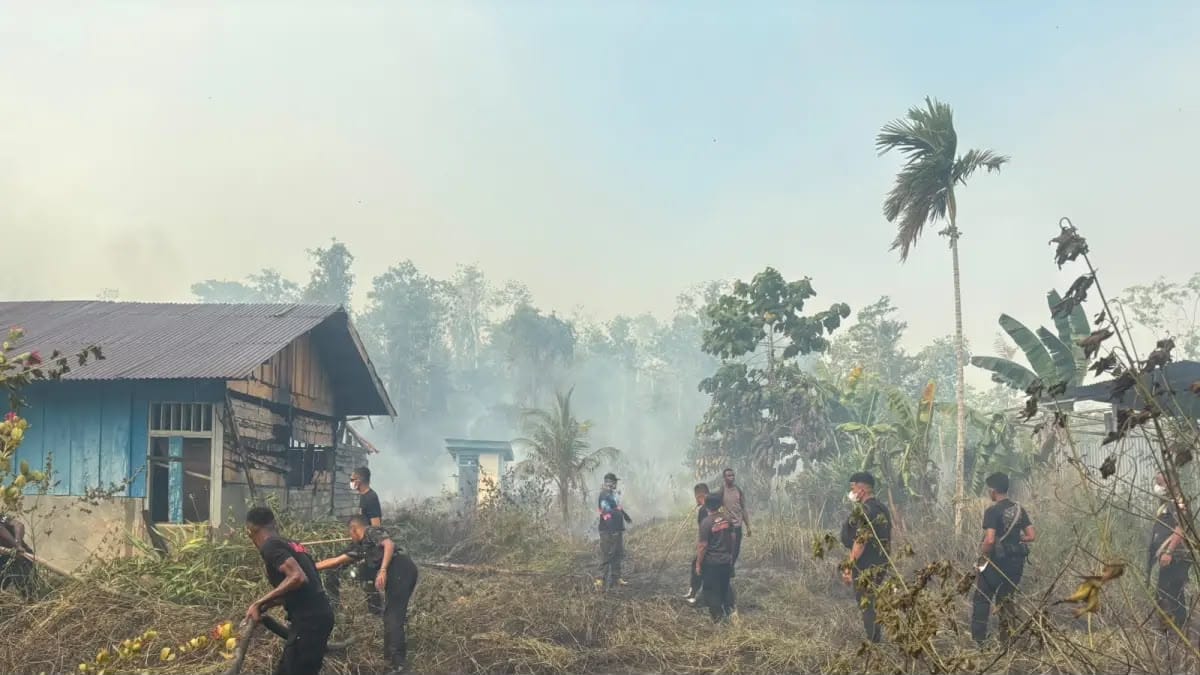
In Papua Tengah, the warning signs have become difficult to ignore. Papua Tengah (Central Papua) forest fires are spreading across several districts as the dry season intensifies, prompting the provincial government to activate a dedicated task force, mobilize firefighting resources, and prepare the health system for a possible rise in respiratory illness.
The scale of the latest hotspot monitoring gives a sense of the challenge. Data from Indonesia’s Meteorology, Climatology, and Geophysical Agency, or BMKG, showed 512 hotspots across Papua Tengah from August 20 to 21, 2026. Nabire accounted for 279 of them, or roughly 54.5 percent of the provincial total. Dogiyai followed with 72 hotspots, Paniai with 54, Puncak with 45, and Intan Jaya with 44. Deiyai recorded 11 and Puncak Jaya seven, while Mimika was the only district without a hotspot in the latest monitoring period.
For a province where forests and land remain closely connected to food, livelihoods, and community life, the fires are more than an environmental emergency. They are also a public health, transportation, and economic concern.
The provincial administration, led by Governor Meki Fritz Nawipa, has therefore focused its response on coordination rather than a single firefighting operation. A provincial task force has been established, local governments have been instructed to strengthen preparedness, and emergency resources have been mobilized in Nabire.
A Rapid Government Response
The provincial government’s latest response follows a sharp increase in reported hotspots. On August 21, authorities held an emergency meeting in Nabire involving the provincial government, Forestry Agency, Regional Disaster Management Agency, Health Agency, police, BMKG, BNPB, and RRI. The meeting was intended to assess conditions on the ground and establish a coordinated response.
The government has also activated an emergency response post at the Papua Tengah BPBD office. The provincial administration said the post would become the center of coordination, while an emergency contact number would be disseminated to make it easier for residents to report fires.
The approach reflects the geography of the province. Fires occurring simultaneously in different districts cannot easily be addressed through a centralized operation alone. Local governments, emergency agencies, police personnel, and communities all play a crucial role.
That principle is reflected in the structure of the provincial fire task force.
Governor Takes Direct Coordination Role
According to Salam Papua, Governor Meki Nawipa established the provincial Karhutla task force through Governor’s Decree No. 100.3.3.1/144 of 2026, issued on June 9. The governor chairs the task force, while the structure includes a deputy chair, coordination and assistance teams, a secretariat, and six operational fields.
At the district level, the regents of Papua Tengah’s eight districts serve as heads of their respective local task forces.
Nawipa is scheduled to lead a coordination meeting with the eight regents on August 23. The meeting is intended to align provincial and district responses and determine what resources are required in each affected area.
This is important because the latest hotspot data show that the problem is not concentrated in a single location. While Nabire is clearly the main area of concern, several highland districts have also recorded fires and hotspots.
The government’s message is consequently one of early intervention. Authorities are seeking to prevent individual fires from developing into a larger crisis rather than waiting until widespread smoke and damage have already occurred.
Nabire Emerges as the Main Hotspot
Nabire is currently at the center of the emergency.
BMKG monitoring for August 20 to 21 recorded 279 hotspots in the district. Across Papua Tengah, the total reached 512. The figures represented a significant increase compared with the previous monitoring period, when 246 hotspots had been recorded. The increase was particularly pronounced in Nabire, where the number rose from 113 to 279.
The BMKG classification also provides an important qualification. Of the 512 hotspots recorded across the province, 409 were categorized as having medium confidence, 94 as low confidence, and nine as high confidence. A satellite detected hotspot does not automatically mean that an active forest fire is occurring at every location, but the concentration and increase in hotspots can serve as an early warning of elevated fire risk.
BMKG has urged residents to avoid activities that could trigger fires, including uncontrolled land clearing, burning garden waste, and open burning. Residents are also encouraged to report smoke or visible fires quickly so that authorities can respond while the affected area remains manageable.
The warning is particularly relevant in Nabire, where smoke can affect residential areas and public infrastructure. BMKG has also warned that smoke moving toward settlements, public facilities, or Douw Aturure Airport could reduce visibility and disrupt aviation safety.
For a region where air transport is an important connection between communities, such disruption could quickly become an economic issue.
Firefighting Resources Remain a Challenge
The government’s response has also exposed a practical difficulty: the number of available firefighting vehicles remains limited.
The provincial emergency meeting identified equipment availability as one of the principal constraints. At present, six firefighting vehicles operated jointly by the provincial government and Nabire administration are available. Police have also provided two modified water cannon vehicles to assist firefighting operations.
Officials have acknowledged that the available resources may not be sufficient if fires emerge simultaneously in multiple locations.
Rather than waiting for additional equipment, the provincial government has opened cooperation with residents and private parties that own water tanker trucks. These vehicles can help transport water to firefighting units and extend the reach of operations.
The strategy is relatively simple but potentially significant. In emergency situations, the ability to move water can determine whether a small fire is contained or becomes considerably harder to control.
The provincial government has also planned a joint readiness assembly to consolidate personnel and establish more targeted operational strategies based on conditions at individual fire locations.
The police are contributing personnel as well. Papua Tengah Police said hundreds of joint personnel and Brimob officers had been deployed to Nabire to extinguish fires, monitor hotspots, and prevent new fires from spreading.
This multi-agency response places the issue within a broader disaster management framework rather than treating it solely as a forestry problem.
Health Risks Become the Next Concern
The environmental impact is only one part of the story.
As smoke has begun to affect parts of Nabire, health authorities have moved to prepare for an increase in respiratory complaints. The provincial health agency has reported an emerging increase in cases of acute respiratory infections, known locally as ISPA, although officials emphasize that the increase is not yet significant.
The response has been preventive.
The Health Agency has prepared approximately 60,000 three-layer masks, with plans to distribute around 1,000 masks each day at public locations and facilities. Officials have also confirmed the availability of cough medicine and vitamins through the provincial pharmaceutical supply system. Ambulances are being placed on standby for emergencies, including acute breathing difficulties.
The measures show how quickly an environmental event can become a public health issue.
For residents who work outdoors, sell goods in public areas or travel by motorcycle, prolonged exposure to smoke and dust can increase discomfort and respiratory risks. Authorities are therefore encouraging residents to wear masks outdoors, drink sufficient water, maintain household ventilation, and avoid unnecessary exposure to smoke.
Residents experiencing persistent cough or cold symptoms for more than three days, high fever, rapid breathing, or shortness of breath have been advised to seek medical attention at a community health center or other healthcare facility.
The government has also sought to balance health precautions with economic activity. Nabire’s Car Free Day was allowed to continue on August 22 because traders had already prepared their goods, and cancellation at short notice could affect their income. Health personnel attended the event to distribute masks and provide public education, while authorities said future events would be evaluated according to air quality and health conditions.
Dry Conditions Increase the Pressure
The current situation comes during the period that authorities identify as the peak dry season. Provincial officials have warned that August and September require heightened attention because dry conditions increase the potential for fires to spread.
BMKG officials have also linked the heightened fire risk to El Niño conditions and low rainfall, with a stronger El Niño signal expected from September to November. That outlook gives the current emergency a potentially longer horizon than a few days of firefighting.
This is why prevention remains as important as extinguishing existing fires.
The authorities have repeatedly asked residents not to clear land through burning and not to discard burning cigarette butts in open areas. Extinguish small fires when safe, and report uncontrolled ones to the emergency post.
The message also places some responsibility in the hands of communities themselves. Given the geographic scale of Papua Tengah and the difficulty of reaching some areas quickly, early reporting by residents can make a meaningful difference.
Protecting Forests Means Protecting Livelihoods
For Papua Tengah, the significance of the fires extends beyond the immediate environmental damage.
Forests and land are deeply connected to the daily lives of many communities. Governor Nawipa’s spokesman, Emanuel You, described forests and land as essential sources of livelihood and compared their destruction to damaging a fundamental part of people’s lives.
That perspective is particularly relevant in a province where communities rely on land for agriculture, food gathering, and other economic activities.
The fires can also affect transportation, public health, and local commerce. Smoke near an airport can affect visibility. Poor air quality can reduce outdoor activity. Agricultural land can be damaged. And prolonged disruption can place additional pressure on household incomes.
In this sense, the provincial response is not only about putting out fires. It is also about protecting the conditions that allow communities to continue their daily activities.
The government’s decision to bring together environmental agencies, disaster authorities, health officials, police, meteorologists, and local administrations reflects that wider understanding.
A Test of Coordination and Preparedness
The immediate priority is clear: prevent the current fires from spreading and reduce exposure to smoke.
But the coming weeks will also test whether the new task force can translate coordination into sustained action. The latest data show that the risk is distributed across much of Papua Tengah, while firefighting resources remain limited.
That makes early detection, accurate hotspot interpretation, rapid reporting, and community participation particularly important.
The provincial government has already taken several steps in that direction. It has established the task force, activated an emergency post, mobilized firefighting vehicles, involved police personnel, prepared medical supplies, and planned further coordination with district governments.
The next stage will be maintaining that momentum.
For international observers, the Papua Tengah experience also illustrates a broader challenge facing remote regions: disaster response is rarely only about the disaster itself. Environmental emergencies can quickly affect healthcare, food security, transportation, livelihoods, and local economic activity.
Looking Beyond the Current Fires
The immediate firefighting effort will determine how much damage occurs this season. Longer term, however, Papua Tengah may need to strengthen prevention systems as well.
That could include expanding firefighting equipment, improving local water supply for emergency response, strengthening community reporting networks, and improving coordination between hotspot monitoring and field verification.
Health preparedness is equally important. The decision to prepare masks, medicine, and ambulances before respiratory cases become severe provides an example of preventive public service delivery.
The experience could also strengthen public awareness about the risks of open burning. Fire prevention ultimately depends not only on government agencies but also on everyday decisions made by communities.
Conclusion
The latest Papua Tengah forest fires have presented the provincial government with a rapidly evolving challenge, but the response has moved quickly from monitoring to coordinated action. With 512 hotspots recorded across the province and 279 concentrated in Nabire, authorities have activated a dedicated task force, mobilized firefighting resources, and strengthened cooperation among government agencies, police, meteorological authorities, and local communities.
The health response is equally important. The preparation of 60,000 masks, strengthened medicine supplies, and standby ambulances shows that officials are treating the fires as a public health concern as well as an environmental emergency.
The real measure of success, however, will not simply be how many fires are extinguished. It will be whether the government can prevent new fires, protect communities from smoke, maintain transportation and economic activity, and strengthen preparedness before the next dry season arrives.
For Papua Tengah, the current emergency is a reminder that protecting forests is inseparable from protecting people. The coming weeks will show whether the province’s new coordination mechanism can turn that principle into lasting resilience.

