
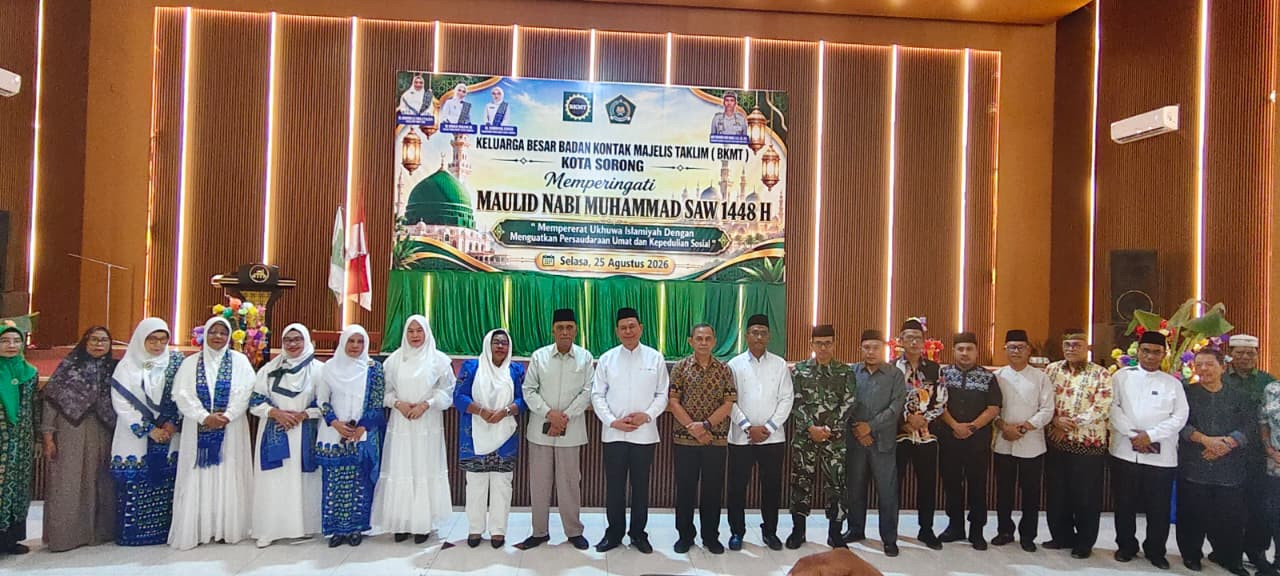
In Papua, Maulid Nabi this year has taken on a distinctly social character. Across Sorong, Nabire, Kaimana, and other communities, celebrations marking the birth of Prophet Muhammad have been used not only to remember his teachings but also to encourage tolerance, environmental responsibility, public service, and solidarity with people facing hardship elsewhere in Indonesia. The events, held as Indonesia marked the 1448 Hijriah Islamic year, offered a glimpse of how religious traditions can become part of everyday efforts to strengthen social cohesion in one of the country’s most culturally diverse regions.
In Sorong, the message was particularly clear. The city government called on residents to turn the Maulid celebration into an opportunity to strengthen brotherhood and harmony, while a local Muslim women’s organization used the occasion to raise funds for communities affected by an earthquake in Nusa Tenggara Timur (East Nusa Tenggara). In Nabire, meanwhile, the deputy regent connected the religious commemoration with environmental protection, arguing that the values associated with Prophet Muhammad should also inspire people to care for the natural world around them.
The combination of these messages matters beyond the religious calendar. Papua’s communities are shaped by different ethnic, cultural, and religious backgrounds, and the ability to maintain cooperation across those differences is closely connected to local stability and development. The 2026 Maulid observances showed how community organizations, religious figures, local governments, and security institutions can use a familiar cultural moment to promote a broader civic message.
From Religious Celebration to Social Cohesion
The Maulid Nabi celebration traditionally provides an opportunity for Muslims to remember the life and character of Prophet Muhammad. In Papua this year, however, several local leaders emphasized that remembering the Prophet should have practical consequences in community life.
At an event organized by the Family of the Contact Board of Islamic Study Groups, or BKMT, in Sorong, Deputy Mayor Anshar Karim urged residents to draw lessons from the Prophet’s example, including honesty, trustworthiness, compassion, justice, brotherhood, and concern for others. He said those principles remained relevant not only for individual religious life but also for government and public service.
Karim also stressed that regional development could not be carried out by government institutions alone. It requires participation and cooperation from people with different religious, ethnic, customary, and cultural backgrounds.
That point gives the celebration a significance that extends beyond the mosque. Development in Papua involves communities spread across large geographic areas, with considerable differences in local conditions and traditions. Social trust therefore becomes an important part of the development process.
The Sorong government presented religious tolerance and social cooperation not as abstract ideals but as practical requirements for creating a safe and harmonious city. The message was also consistent with the broader idea that economic and physical development must be accompanied by investment in character, integrity, and social responsibility.
Sorong Turns Celebration into Humanitarian Action
Perhaps the clearest example of this approach came from BKMT Kota Sorong, which used the Maulid gathering to launch a fundraising campaign for victims of an earthquake in East Nusa Tenggara.
The initiative was called “BKMT Kota Sorong Peduli NTT.” Organizers said the fundraising would not end with the religious ceremony. They planned to continue collecting donations in other public locations, including traffic intersections, before determining the mechanism for transferring the proceeds to affected communities.
The significance lies in the direction of solidarity. The fundraising was organized in Papua but aimed at helping people thousands of kilometers away in another Indonesian province.
Such actions illustrate how national solidarity can operate at the community level. Rather than being expressed only through government programs or formal institutions, national belonging can also emerge through ordinary citizens responding to the suffering of people they may never have met.
For Papua, where questions of identity, diversity, and national integration frequently receive international attention, these community initiatives provide another dimension to the story. They demonstrate that social relationships between Papua and other parts of Indonesia can also be built through humanitarian action and shared concern.
Nabire Connects Faith with Environmental Responsibility
The Maulid message also moved beyond social relations in Nabire, where Deputy Regent Burhanuddin Pawennari encouraged Muslim communities to use the occasion to strengthen environmental awareness.
Pawennari linked the teachings associated with Prophet Muhammad to the responsibility to protect the environment. He specifically referred to the impact of fires and haze, which can affect public health, economic activity, government operations, and education.
The argument is especially relevant in Papua, where forests, rivers, and coastal ecosystems are closely connected to the livelihoods and cultural practices of many communities.
The Nabire message thus framed environmental protection as a moral imperative. Caring for nature was presented not simply as a government responsibility or technical policy issue but as part of a broader obligation toward other people and future generations.
This approach could prove valuable as Papua faces the challenge of balancing infrastructure development and economic activity with environmental sustainability. Religious institutions and community leaders can play a useful role in translating environmental policies into everyday behavior.
Pawennari also called for stronger brotherhood, tolerance, and social concern amid Nabire’s diverse population. His message reinforced the idea that environmental protection and social harmony are interconnected. Communities that trust one another are more likely to cooperate when responding to fires, natural disasters, and other shared challenges.
Kaimana Puts Public Service Under the Spotlight
In Kaimana, the Maulid celebration took place within the local police institution, giving the event another dimension.
The Kaimana Police held a Maulid Nabi 1448 H gathering under the theme of emulating the character of Prophet Muhammad through the “Polri Presisi” approach to help build an Indonesia that is sovereign, just, and prosperous. The event brought together police personnel, the Bhayangkari organization, members of a local Islamic boarding school, and a women’s religious study group.
Kaimana Police Chief AKBP Satria Dwi Dharma emphasized the importance of treating the celebration as more than just an annual ceremony. Instead, he urged personnel to apply the Prophet’s values in their daily work and relationships with the public.
The values highlighted included honesty, patience, respect, brotherhood, and doing good for others. Police officials also emphasized maintaining positive relationships among officers and with the wider community.
This is particularly significant because public confidence in security institutions depends not only on enforcement capacity but also on how officers communicate and interact with citizens.
By connecting religious values with public service, the Kaimana event presented a model in which ethical conduct becomes part of institutional responsibility. The emphasis on communication, humanity, and responsibility also fits the broader objective of maintaining peaceful and stable communities.
Why the Message Matters for Papua
The common thread running through the different Maulid events is not a single political message. It is the practical value of social trust.
In Sorong, the focus was brotherhood, tolerance, and humanitarian assistance. In Nabire, it was environmental responsibility and community solidarity. In Kaimana, the emphasis was on integrity and responsible public service. While the settings were different, all three approaches sought to translate religious teachings into behavior that benefits society.
That is important in a region as diverse as Papua.
Papua is not a socially uniform territory. Its communities include numerous indigenous groups, migrants from other parts of Indonesia, and people from different religious traditions. In such an environment, public celebrations can become useful spaces for interaction and dialogue when they emphasize respect rather than division.
The Sorong government explicitly said that development requires participation from people regardless of religion, ethnicity, customary background, or culture. That formulation places tolerance within the context of development rather than treating it as a separate social issue.
The approach also reflects a broader understanding of development. Roads, electricity, health facilities, and economic opportunities are important, but they do not by themselves guarantee social stability. Communities also need trust, shared responsibility, and mechanisms for helping one another.
Youth, Character, and the Next Generation
The emphasis on character during the 1448 H celebrations also carries implications for young people.
Across Indonesia, religious leaders and government officials increasingly face the challenge of connecting traditional religious teachings with a younger generation living in a rapidly changing digital environment. The Maulid events in Papua offered a relatively direct answer: values such as honesty, patience, respect, and compassion remain relevant regardless of technological change.
For young Papuans, the message can be particularly meaningful when combined with opportunities in education, entrepreneurship, culture, and civic participation.
Therefore, it is worth noting that Sorong stresses the importance of character building alongside development. A region’s long-term development depends on both infrastructure and the quality of its users.
Religious celebrations can provide one avenue for this kind of character formation because they bring families, young people, community organizations, and public institutions together in a shared setting.
A Broader Picture of Papua’s Social Landscape
We should not view the Maulid celebrations in isolation. They form part of a wider pattern of community activities in Papua that use religious, cultural, and social events to strengthen cooperation.
In Sorong, for example, the decision to combine Maulid activities with humanitarian fundraising shows how religious institutions can become channels for social assistance. In Kaimana, the participation of police personnel and community groups creates an opportunity for interaction between public institutions and citizens. In Nabire, the integration of environmental concerns into religious reflection demonstrates how local leaders can connect faith with contemporary development challenges.
These examples offer international audiences a more nuanced picture of Papua. The region’s social dynamics cannot be understood only through security incidents or political debates. Everyday cooperation, religious activities, humanitarian initiatives, and cultural traditions also shape the relationship between communities and the state.
Conclusion
The 1448 H Maulid Nabi celebrations across Papua show how a religious commemoration can become a platform for broader social responsibility. In Sorong, the message centered on tolerance, brotherhood, and humanitarian solidarity. In Nabire, it extended to environmental protection. In Kaimana, the focus shifted to ethical public service and fostering stronger relationships between police and communities.
Perhaps the most important lesson lies not in the ceremonies themselves, but in the actions communities choose to take afterward. A fundraising campaign for earthquake victims, greater concern for the environment, respectful relations across social groups, and more responsible public service all turn religious reflection into concrete action.
For Papua, this kind of social capital can become an important complement to government development programs. Infrastructure and economic investment can create opportunities, but durable progress also depends on communities being able to cooperate across religious, ethnic, and cultural differences.
As Papua continues to undergo significant economic and social transformation, celebrations such as Maulid Nabi can provide a valuable space for reinforcing that cooperation. The events of 1448 H suggest that faith, when translated into compassion, tolerance, and public responsibility, can contribute not only to religious life but also to the wider project of building peaceful, inclusive, and resilient communities.
In that sense, the message from Papua this year is simple: remembrance becomes more meaningful when it is reflected in how people treat one another.

