For residents of Supiori, Papua, access to specialist medical care can mean more than finding a hospital. Geography, distance, and the availability of specialized services can determine whether a treatable condition is addressed early or allowed to interfere with everyday life.
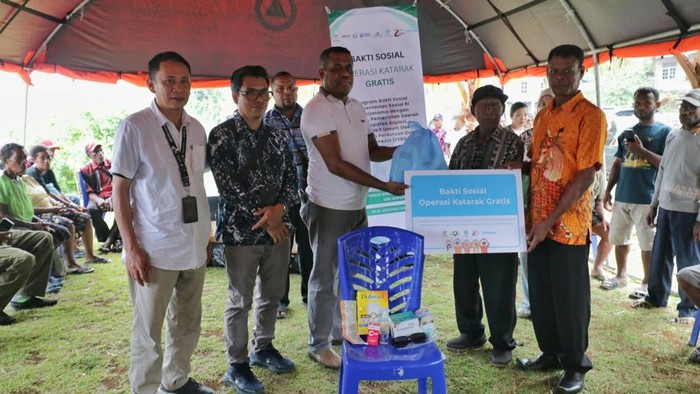
That reality was at the center of a social service initiative held in Supiori at the end of August, when the Indonesian Ministry of Social Affairs, the Supiori regency government, and medical partners organized free cataract surgery in Supiori.
The two-day program, held at Supiori Regional General Hospital, attracted 327 registrations. Of those applicants, 234 residents underwent medical screening to determine their eligibility for surgery. The program took place on August 29 and 30, 2026, and was reported as the first mass cataract surgery program conducted in Supiori.
The initiative is notable not only for the number of people reached but also for the way the service was organized. It brought together the Ministry of Social Affairs, the Supiori administration, the local hospital, the Indonesian Ophthalmologists Association, known as PERDAMI, and fundraising platform Kitabisa.
For Papua, where improving access to basic and specialized services remains an important part of regional development, the program offers a practical example of how central and local government cooperation can translate into direct assistance for communities.
Bringing Specialist Eye Care Closer to Supiori
Cataracts are a medical condition that can progressively impair vision and affect a person’s ability to work, study, travel, and participate fully in family and community life.
For residents in an urban center with multiple specialist hospitals, treatment can be relatively straightforward. In smaller and geographically dispersed regions, however, access to specialist care can be more complicated.
The Supiori program was designed to address part of that gap.
The operation was centered at Supiori Regional General Hospital, allowing residents to receive assessment and medical services locally rather than relying entirely on access to facilities outside the regency. According to the reports, the program was specifically aimed at people experiencing visual impairment caused by cataracts.
The 327 registrations also provide an indication of the level of public interest. While registration alone does not mean every applicant required surgery, the number shows substantial demand for the service.
Of the registrants, 234 proceeded to medical screening. That step is important because cataract surgery cannot simply be offered on the basis of registration. Medical professionals must first assess whether an individual is medically suitable for the procedure.
Screening Before Treatment
The screening process demonstrates that the program was not simply a distribution of social assistance. It incorporated a medical assessment intended to match treatment with individual health conditions.
RRI reported that the 234 residents underwent screening to establish their medical eligibility before surgery.
This approach is consistent with the Ministry of Social Affairs’ wider emphasis on assessment based on the needs of beneficiaries.
Syamsuddin, head of Sentra Wirajaya Makassar, said assistance from the ministry was provided following assessments so that the services delivered would correspond with the needs of recipients.
That principle is relevant for social programs in remote areas. A successful intervention is not measured only by how many people receive assistance, but also by whether the assistance reaches those who need it and whether the form of support is appropriate.
A Partnership Between Local and Central Government
The Supiori initiative began with a local government effort rather than being imposed from outside.
Melkias Edison Rumere, acting head of the Supiori Social Affairs Office, said the local administration sought to optimize its budget for social services. The regency government subsequently submitted a proposal to the Ministry of Social Affairs to secure support for the cataract treatment program.
That sequence is significant.
Local authorities are generally closer to the communities they serve and are therefore in a position to identify specific needs. At the same time, specialized medical programs may require resources, personnel, and institutional capacity that are difficult for a small local administration to provide independently.
The partnership provides a bridge between those two levels.
Supiori identifies a need and proposes an intervention. The central government provides institutional support through the Ministry of Social Affairs. Medical professionals and the local hospital provide the clinical component, while Kitabisa also participates in the collaboration.
The result is a model in which different institutions contribute various capabilities.
The Role of Medical Professionals
PERDAMI’s participation is particularly important because cataract treatment requires specialized ophthalmological expertise.
The involvement of a professional medical organization also helps ensure that the program is built around clinical assessment rather than simply administrative eligibility.
For communities, this distinction is important. A social assistance program involving medical treatment must maintain professional standards while remaining accessible to people who might otherwise have difficulty reaching specialist services.
The Supiori program therefore combines social policy with medical expertise.
More Than an Eye Surgery Program
The cataract initiative is only one part of a broader package of social programs being implemented in Supiori.
According to the Supiori Social Affairs Office, 12 other social assistance packages are also being realized. These include support equipment for people with disabilities, population administration services, and skills training for children.
This broader context changes how the cataract program can be understood.
Rather than treating the operation as an isolated medical event, the local government is positioning it within a wider effort to expand social protection and improve access to public services.
For people with disabilities, for example, assistive equipment can directly influence mobility and independence. Access to population administration services can help residents obtain the documents needed to access government programs. Skills training for children can contribute to longer-term social and economic participation.
The different programs address different needs, but they share a common objective: improving people’s ability to participate independently in community life.
Better Data Can Improve Social Services
One of the less visible elements of the Supiori initiative is the emphasis on identifying people who require assistance.
Rumere encouraged regency governments and village heads to improve the collection of data on residents who need social assistance and services.
This may sound administrative, but it is critical to the effectiveness of public programs.
A government can’t provide targeted services if it doesn’t know who needs them, where they live, or what kind of help they need.
In geographically dispersed communities, local-level data can be particularly important. Village officials and regency administrations can help identify residents who may not otherwise register for national or provincial programs.
Better information can therefore make social assistance more precise.
In the case of the Supiori cataract program, the initial registration and subsequent screening provide an example of how identification and medical assessment can work together.
The longer-term challenge will be ensuring that such data is regularly updated and used to identify other unmet needs.
Health Access as Part of Papua’s Development
Health services are sometimes discussed separately from economic development. In practice, the two are closely connected.
Poor eyesight can make it harder for an older person to work, travel independently, or contribute to household activities. For families, caring for a person with severe visual impairment can also require additional time and resources.
When a treatable condition is addressed, the benefits can extend beyond the individual patient.
This does not mean cataract surgery alone can transform a local economy. It does, however, illustrate why access to basic and specialized health care is an important component of human development.
A community with better access to health services is better positioned to participate in education, employment, local economic activity, and social life.
For Papua, this dimension of development is particularly relevant because improving physical infrastructure is only one part of reducing disparities in public services.
Health infrastructure, medical personnel, outreach services, and referral systems are equally important.
A Personal Story Behind the Numbers
The figures become more tangible through the experience of people who received treatment.
One of them was Felix Masoben, 68, who said his vision had previously been blurred. After undergoing the procedure, he expressed hope that his eyesight would return to normal.
His experience illustrates why the program matters at the individual level.
For policymakers, 234 screened residents is a statistic. For someone with vision problems, access to treatment can significantly impact daily activities that are often overlooked.
The value of a public health program ultimately rests on that human dimension.
Building a More Connected Social Service System
The Supiori experience also points to a broader question: how can social services become more systematic in Papua?
One approach is to strengthen cooperation between local governments and national ministries while expanding the role of local health facilities.
The cataract program demonstrates that a local government does not necessarily need to provide every resource. It can identify needs, prepare proposals, and coordinate with national institutions and professional organizations.
At the same time, central government support becomes more effective when local authorities provide accurate information about community needs.
That two-way relationship can help avoid a common problem in public policy: programs being available in theory but difficult to access in practice.
The presence of the operation at the superior hospital also provides a useful foundation for future health outreach. Once local institutions gain experience coordinating specialist services, similar models could potentially be used for other health conditions, subject to medical needs, resources, and government planning.
The Importance of Reaching Remote Communities
Supiori’s location gives the initiative an additional development dimension.
Papua is not a single uniform territory. Its communities differ in geography, infrastructure, population density, and access to public services. A program that works in a major city cannot automatically be transferred to a smaller island or remote region without adaptation.
The Supiori model is therefore relevant because it brings the service closer to the community.
This is consistent with the broader principle that development should not be measured only by infrastructure built in major urban centers. The availability of practical public services in smaller communities is equally important.
For the Indonesian government, strengthening those connections can contribute to more balanced development across Papua.
Looking Beyond One Weekend
The two-day cataract operation was an important intervention, but its longer-term value will depend on what follows.
Patients who undergo eye surgery require appropriate medical follow-up. Local health workers need sufficient capacity to monitor recovery and identify complications. Residents who were screened but did not undergo surgery may also require further assessment or referral, depending on their medical condition.
The reports provided for this article do not establish the number of people who ultimately received surgery after screening, so that figure should not be assumed from the 234 screening participants. What is clear is that 234 residents reached the medical screening stage out of 327 registered applicants.
That distinction is important when evaluating the program’s results.
It also highlights why future reporting on health initiatives should track the entire service chain, from registration and screening to treatment, follow-up, and longer-term outcomes.
Conclusion
The cooperation between the Ministry of Social Affairs and the Supiori Regency government in providing free cataract services offers a grounded example of public service delivery in Papua.
The program brought together local government, the central government, Supiori Regional General Hospital, PERDAMI, and Kitabisa. It attracted 327 registrations, with 234 residents undergoing medical screening. The initiative was also reported as the first mass cataract surgery program held in Supiori.
Its significance extends beyond the operating room.
The initiative demonstrates how local governments can identify community needs and use coordination with the national government to expand access to specialized services. It also shows the importance of accurate beneficiary data, medical assessment, and cooperation among public institutions and professional organizations.
For Papua’s development, such efforts matter because improving people’s quality of life requires more than roads, buildings, and economic investment. It also requires ensuring that residents can see, learn, work, and live with greater independence.
The Supiori program is one practical step in that direction. Its next test will be whether this collaborative approach can be sustained, expanded, and connected to broader health services so that access to specialist care becomes less dependent on where a person happens to live.