
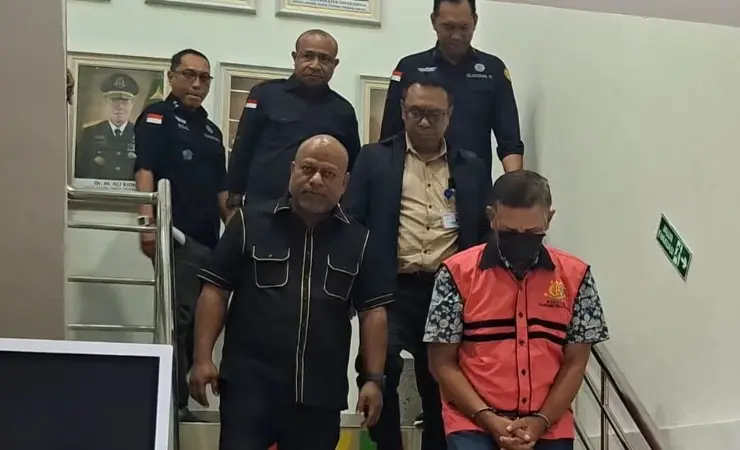
Papua Selatan (South Papua) has seen another test of public accountability after the Papua High Prosecutor’s Office named two suspects in the Boven Digoel road corruption case, involving two government-funded infrastructure projects with an estimated state loss of Rp10.64 billion, or roughly US$650,000.
The investigation concerns road construction projects in Boven Digoel Regency, Papua Selatan, that were financed through two different public funding streams in the 2023 fiscal year. One was supported by the General Allocation Fund, or DAU, while the other was financed through Indonesia’s Special Autonomy Fund, or Otsus.
The case came into sharper focus after prosecutors and construction experts inspected the projects and found that the physical progress was far below what would normally be expected from the funds already released. According to the Papua High Prosecutor’s Office, the two projects had a combined contract value of more than Rp12.1 billion.
The development is significant beyond the legal proceedings themselves. Roads in Papua are closely connected to access to public services, movement of goods, connectivity between communities and the broader economic development agenda. Ensuring that infrastructure budgets actually produce functioning infrastructure therefore remains a central issue in Papua’s development.
Two Road Projects at the Center of the Investigation
The investigation covers two separate packages administered by the Boven Digoel Public Works and Spatial Planning Agency.
The first concerns the Dema-Fefero road, financed through the 2023 General Allocation Fund. Its contract value was Rp5.866 billion.
The second involves the Kombay District, Wanggemalo Village, to Firiwage District, Firiwage Village road, financed through the 2023 Special Autonomy Fund. Its contract value was Rp6.273 billion. Prosecutors said the funding for this project had been disbursed in full.
Together, the two contracts amounted to Rp12.103 billion.
The distinction between the two funding sources is important. DAU is part of Indonesia’s intergovernmental fiscal transfer system, while Otsus is designed to support development in Papua through additional fiscal arrangements. In both cases, however, the underlying principle is the same: public money is expected to produce measurable benefits for communities.
That expectation is at the heart of the current investigation.
The Investigation Moves from Documents to the Field
The case did not rest solely on a review of administrative records.
According to prosecutors, investigators examined witnesses and later brought road construction experts to the project sites to assess the actual condition of the work.
A total of 42 witnesses were examined across the two cases. Twenty-two witnesses were questioned in relation to the Dema-Fefero project, while another 20 were examined in the Kombay-Firiwage case.
The field inspection took place on September 14, 2026.
That inspection became a key moment in the investigation. Construction experts found that the physical completion of the Kombay-Firiwage road was only 2.91 percent. The Dema-Fefero project had progressed further, but its physical completion was still only 10.36 percent.
The figures were particularly significant because prosecutors said the funds for the road projects had already been disbursed in full in the relevant project arrangements.
“The funds for the construction of the road sections had been disbursed 100 percent, but field inspections carried out together with the expert team found that the Kombay-Firiwage road had only reached 2.91 percent and the Dema-Fefero section only 10.36 percent,” Papua High Prosecutor’s Office Special Crimes Assistant Jusak Ayomi said, according to ANTARA.
The disparity between financial disbursement and physical realization subsequently became a central element of the prosecution’s case.
Two Suspects Named on October 2
After completing the initial stages of the investigation, prosecutors formally named two suspects on Friday, October 2, 2026.
They are identified by the initials RP, who served as the Commitment Making Officer, or PPK, at the Boven Digoel Public Works and Spatial Planning Agency in 2023, and S, identified as the contractor or person responsible for carrying out the work.
The Papua High Prosecutor’s Office said investigators had obtained at least two valid pieces of evidence for each case before making the designation. The decision was formalized through separate suspect designation orders dated October 2.
Jusak Ayomi, speaking through Head of Prosecution at the Special Crimes Division Alfisius Adrian Sombo, said the investigation had reached the suspect-designation stage only after a series of witness examinations and physical verification at the project sites.
RRI reported that Alfisius said the evidence collected was sufficient to establish the two suspects as allegedly responsible for the two road projects under investigation.
The identification of suspects does not, however, represent a final judicial determination of guilt. The case remains under investigation and will proceed through Indonesia’s criminal justice process.
State Loss Estimated at Rp10.64 Billion
The financial impact identified by prosecutors is substantial.
The Papua High Prosecutor’s Office calculated total alleged state financial losses at Rp10,640,767,814.66.
The estimated loss is divided between the two projects. The Dema-Fefero road accounts for Rp4,585,197,082, while the Kombay-Firiwage project accounts for Rp6,055,570,732.66.
The figure is notable because it represents a large share of the combined project allocation. PotretNews reported that the estimated loss almost approached the total budget allocated to the two road packages.
For a remote region such as Boven Digoel, the implications of ineffective infrastructure spending can extend beyond a balance sheet.
Road construction is often closely linked to the cost and reliability of transporting agricultural products, access to schools and health facilities, mobility for residents, and the ability of local governments to connect communities. When a project stalls after public funds have been released, the impact is therefore potentially felt by residents who were expecting the infrastructure to become operational.
RP Detained, S Remains at Large
Following the designation of the suspects, prosecutors took immediate legal steps against RP.
The Papua High Prosecutor’s Office said RP was detained at Abepura Class IIA Prison for 20 days. Prosecutors cited concerns related to the investigation, including the possibility of flight, interference with evidence, and repetition of criminal conduct.
S, meanwhile, has not been located.
Jusak Ayomi confirmed that S had been placed on the wanted list, known in Indonesia as a Daftar Pencarian Orang, or DPO.
The search for S adds another dimension to the investigation. Prosecutors must now pursue the outstanding suspect while continuing to establish the sequence of decisions, financial transactions, and project implementation that led to the alleged losses.
The investigation could also widen.
Prosecutors have repeatedly stated that the possibility of additional suspects remains open if investigators uncover sufficient evidence indicating that other individuals were involved.
Legal Charges and the Next Stage
The suspects are being investigated under Article 603 of Indonesia’s Law No. 1 of 2023 on the Criminal Code, in conjunction with provisions of Law No. 1 of 2026 concerning criminal adjustments and Indonesia’s anti-corruption legislation.
Prosecutors also cited Article 604 of the 2023 Criminal Code as a subsidiary charge, alongside related provisions of the anti-corruption law.
The legal framework reflects the transition of Indonesia’s criminal law system while maintaining the application of established anti-corruption provisions.
For the prosecutors, the immediate priority is not simply to establish that the road projects were incomplete. Investigators must ascertain the decision-making process, identify the individuals accountable for each project phase, and uncover the circumstances surrounding the alleged state losses.
That distinction matters because an incomplete infrastructure project by itself does not automatically establish criminal liability. The prosecution must demonstrate the elements of the alleged offense through evidence and ultimately in court.
A Test of Infrastructure Accountability in Papua
The Boven Digoel case arrives as Indonesia continues to place infrastructure and public services at the center of its development agenda in Papua.
Over the past several years, government investment across Papua has included roads, bridges, ports, airports, electricity networks, telecommunications, and health infrastructure. These projects aim to reduce geographic isolation and enhance economic opportunities in regions where transportation expenses and challenging terrain pose significant obstacles.
That makes effective budget management just as important as the construction itself.
The investigation by the Papua High Prosecutor’s Office demonstrates one part of that accountability chain. When prosecutors investigate suspected misuse of public funds, the objective is not only to establish criminal responsibility but also to protect the integrity of government spending.
For communities in Boven Digoel, the practical question is ultimately straightforward: whether the public funds allocated for roads result in roads that can actually be used.
In that sense, the case is not merely about Rp10.64 billion in alleged losses. It is also about whether infrastructure programs can deliver what was promised and whether public institutions can respond when implementation falls dramatically short of contractual expectations.
What Comes Next?
The investigation is still developing.
The Papua High Prosecutor’s Office has said that investigators will continue examining the two cases and will pursue other individuals if sufficient evidence emerges. The search for S is also expected to continue while RP remains in detention during the initial investigation period.
Jakus Ayomi said the institution would handle the case professionally, transparently, and accountably in accordance with the law. That commitment will be tested as the investigation moves toward the next legal stages.
The case serves as a reminder that strong oversight must accompany infrastructure spending for Indonesia’s broader Papua development agenda. Building roads in remote areas requires significant public resources, but delivering those roads requires more than releasing funds. It requires competent project management, close supervision, transparent procurement, and effective enforcement when serious irregularities are suspected.
The Boven Digoel investigation therefore carries significance beyond the two contracts under scrutiny. It illustrates the government’s continuing effort to ensure that development budgets are translated into tangible public assets while allowing law enforcement institutions to pursue suspected corruption through established legal procedures.
As the investigation proceeds, the final judicial process will determine individual responsibility. Until then, the allegations against RP and S will remain unproven, and the Rp10.64 billion figure will continue to represent the state loss calculated by investigators.
For Papua, the broader expectation is clear: public investment must reach the communities it is intended to serve.
Conclusion
The Boven Digoel road corruption investigation places public accountability at the center of a wider development challenge in Papua Selatan. Two road projects worth more than Rp12.1 billion were expected to improve connectivity, yet investigators found physical completion of only 2.91 percent on the Kombay-Firiwage section and 10.36 percent on Dema-Fefero.
The naming of RP and S as suspects, the detention of RP, and the search for S mark a significant step in the legal process. But the case is not yet finished. Prosecutors still have to establish the full chain of responsibility, determine whether others were involved, and bring the matter through the courts.
The case also underscores a crucial principle in Papua’s development for the Indonesian government: accountability must safeguard infrastructure investment. Roads, bridges, and public facilities can only transform communities when budgets are properly managed and projects are actually delivered.
The coming stages of the Boven Digoel investigation will show whether the authorities can fully trace the alleged losses and ensure that those found legally responsible are held accountable under Indonesian law.
Read Also
Papua Travel Budget Corruption Probe: Prosecutors Search DPR Office
KPK Probes Trillion Rupiah Papua Operational Funds
Guarding Billions, Protecting Trust: How Indonesia’s Attorney General Is Overseeing Strategic Projects in Papua to Fight Corruption

