
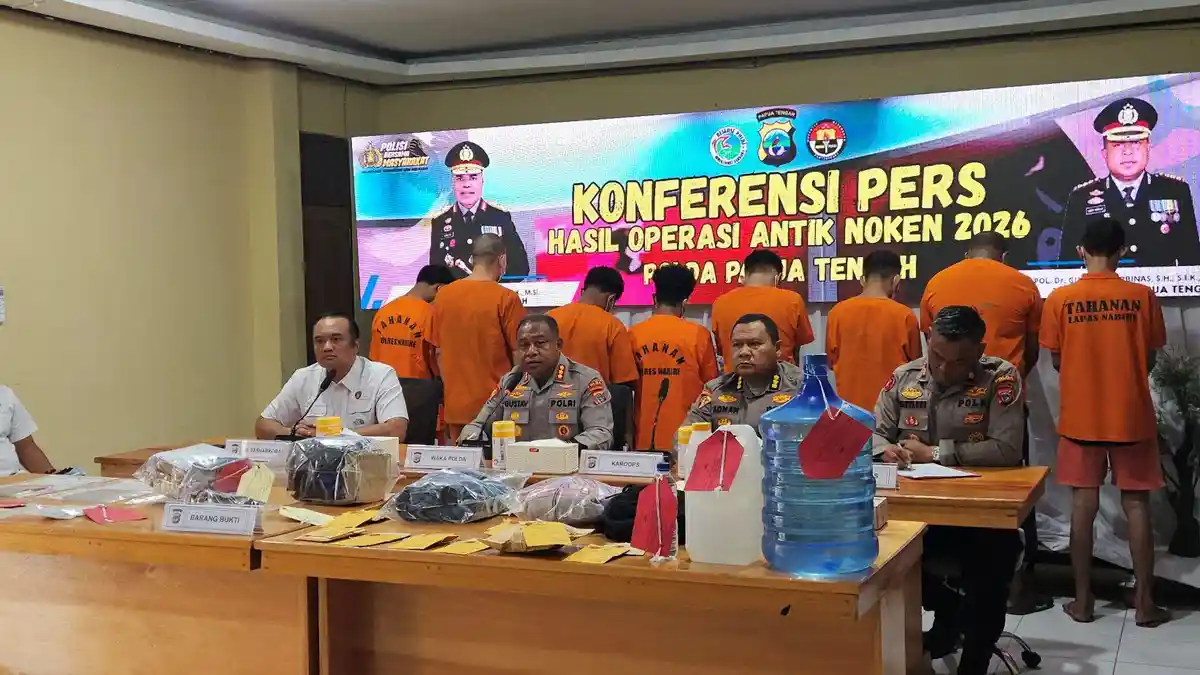
The Papua Tengah Antik Noken Operation 2026 has resulted in the disclosure of nine narcotics cases and the arrest of 13 suspects, a significant law enforcement initiative against illegal drug distribution in one of Indonesia’s easternmost provinces.
The operation ran from September 15 to October 4 and involved 120 personnel from the Papua Tengah (Central Papua) Regional Police, Nabire Police, and Mimika Police. Investigators seized 46.59 grams of crystal methamphetamine, along with cannabis and hundreds of liters of locally produced alcoholic beverages during the operation.
For Papua Tengah, the operation comes against a wider concern about the social consequences of narcotics and alcohol abuse. Police have increasingly linked prevention efforts to community education while maintaining targeted enforcement against people suspected of distributing illegal drugs.
The results were presented by Papua Tengah Deputy Police Chief Kombes Pol. Gustav R. Urbinas presented the results at a press conference in Nabire on Wednesday, October 7.
Twenty Days of Coordinated Enforcement
The operation began on September 15 after police prepared a coordinated enforcement strategy covering the jurisdiction of the Papua Tengah Regional Police.
Rather than relying on a single police unit, the operation brought together investigators at provincial and district levels. The 120 personnel included officers from the Papua Tengah Regional Police as well as the Nabire and Mimika police departments.
That structure allowed investigators to pursue suspected drug activity across two of the province’s key urban and economic centers.
Nabire, the provincial capital, is an important administrative and transportation hub. Mimika, meanwhile, is home to Timika and has a major economic role in Papua Tengah. Police operations in both areas therefore have implications beyond individual criminal cases, particularly because trafficking networks can exploit transportation and commercial connections.
By the end of the 20-day operation, investigators had recorded nine police reports involving narcotics offenses.
The provincial narcotics directorate handled three cases involving five suspects. Nabire Police handled two cases involving three suspects, while Mimika Police handled four cases involving five suspects.
The distribution shows that the operation was not concentrated in a single location. Instead, enforcement activity extended across the province’s two main operational areas.
What Police Found
The largest category of seized narcotics by weight was crystal methamphetamine, known locally as sabu.
Police reported a combined seizure of 46.59 grams of methamphetamine. The provincial narcotics directorate accounted for 4.7 grams, Nabire Police for 9.7 grams, and Mimika Police for 32 grams.
Cannabis was also recovered during the operation.
One particularly notable seizure occurred during the arrest of a fugitive who had been wanted by Nabire Prison authorities and was also listed in connection with a separate assault case handled by Nabire Police.
According to police, when the man was arrested on September 18, investigators found cannabis packaged in 43 small transparent plastic bags and one medium-sized bag.
The seizure illustrated how a narcotics investigation could intersect with other criminal cases. Authorities sought the individual not only for drug-related offenses but also because he had escaped from prison and was on a wanted list.
Police said the investigation into his activities remained part of the wider law enforcement process.
From a Prison Fugitive to a Drug Case
The arrest on September 18 became one of the most significant episodes during the operation.
Investigators from the Papua Tengah Regional Police had been conducting inquiries into several criminal activities in Nabire. The investigation eventually led officers to a location in the Harapan area near the former Nabire airfield.
After checking several people at the location, officers identified one of them as a prison fugitive.
The police had previously sought the man in connection with an assault case after he escaped from Nabire Class IIB Prison. Police subsequently found the cannabis packages in his possession.
The development was important because it demonstrated the value of combining intelligence gathering with conventional criminal investigations. A person initially sought for one offense can sometimes provide investigators with information about other criminal activity.
In this case, the discovery of cannabis gave investigators another basis for legal action.
Police have continued to examine the circumstances surrounding the suspect and any possible links to other cases.
Nabire and Mimika Become Key Enforcement Areas
The cases were recorded at several locations across Nabire and Mimika.
In Nabire, police identified areas including Jalan Jenderal Sudirman, Jalan Pipit, Girimulyo, Kalibobo, and Karang Mulia as locations connected to the cases. In Mimika, investigators conducted enforcement activity around Jalan Hasanuddin, Jalan Yos Sudarso, SP4, and Jalan Seriti.
The locations reflect the practical nature of narcotics enforcement.
Drug distribution does not necessarily take place in one identifiable center. Transactions can occur around residential areas, roads, commercial locations, and transportation routes.
For police, the situation means enforcement must combine information from different locations rather than relying only on visible street-level activity.
Gustav said the suspects were allegedly involved in distributing methamphetamine and cannabis in exchange for payment or financial gain.
The statement provides an important distinction: the police have identified an alleged distribution motive, but the ultimate determination of criminal responsibility remains subject to the legal process.
Local Alcohol Seizures Add a Social Dimension
Alongside the narcotics cases, police also seized significant quantities of locally produced alcoholic beverages.
The operation recorded 187.8 liters of Cap Tikus and 170 liters of Bopo, bringing the combined volume to approximately 357.8 liters.
The alcohol seizure requires some legal clarification.
According to the police, nine cases were classified as operational targets, while another case involving locally produced alcoholic beverages emerged as a non-target operation related to alleged violations of consumer protection and food regulations.
In other words, the hundreds of liters of alcohol should not be described as part of the nine narcotics cases themselves.
Nevertheless, police regard alcohol control as relevant to broader public order efforts. Local authorities and law enforcement agencies have repeatedly faced concerns about the social consequences of uncontrolled alcohol distribution, particularly when combined with other forms of substance abuse.
It is important, however, not to suggest that alcohol is the sole cause of crime.
Rather, uncontrolled alcohol consumption can be one contributing factor in certain social and public-order problems, while criminal behavior has multiple causes and must be assessed case by case.
Police See Prevention As Equally Important
The operation also reflects a broader change in the way police describe their approach to narcotics.
For Gustav, enforcement cannot depend exclusively on arrests and seizures.
“Polri also continues to prioritize preemptive and preventive measures through public education, counseling, mapping vulnerable areas, and cooperation with local governments, relevant agencies, educational institutions, and community leaders,” he said.
The approach is particularly important in a province where geography can make policing difficult.
Prevention can reach communities that may not be directly affected by an enforcement operation. Schools, families, religious institutions, community organizations, and local leaders can provide early warning and education before young people become involved in drug use or distribution.
This approach also places part of the responsibility outside the police institution.
Gustav stressed that narcotics prevention cannot be handled by the police alone. Community participation, he said, is necessary to prevent young people from becoming involved in drug abuse and trafficking.
The Legal Process Moves Forward
The suspects are being processed under different provisions depending on the alleged offense.
For methamphetamine cases, investigators are applying Article 114 paragraph (1) of Indonesia’s Narcotics Law and/or Article 609 paragraph (1) letter a of the 2023 Criminal Code.
For cannabis cases, prosecutors are using Article 114 paragraph (1) and/or Article 111 paragraph (1) of Law No. 35 of 2009 on Narcotics.
The case involving locally produced alcohol is being handled under provisions concerning consumer protection, food safety, and the Criminal Code, according to police.
The different legal provisions underline that the operation did not treat every seizure as the same type of offense.
Each case must be assessed according to the evidence, the nature of the alleged conduct, and the applicable legislation.
That distinction is particularly important in reporting criminal investigations. The 13 people identified by police are suspects, not convicted criminals. Their ultimate legal responsibility will be determined through the Indonesian justice system.
Why the Operation Matters for Papua Tengah
Papua Tengah is experiencing rapid administrative and economic development as one of Indonesia’s relatively new provinces.
Nabire has become the provincial administrative center, while Mimika remains an important economic area. Greater economic activity and population movement can bring opportunities, but they can also create new challenges for law enforcement.
Narcotics trafficking is one such challenge.
The government closely links maintaining a safe environment to the ability of communities to benefit from economic development. Schools, workplaces, businesses, and public institutions all depend on basic public security.
Drug enforcement therefore forms part of a wider effort to maintain social stability while Papua Tengah develops its infrastructure and economy.
The police operation is one element of that effort.
Its longer-term effectiveness, however, will depend on whether arrests are followed by successful prosecutions, whether supply networks are disrupted rather than simply replaced, and whether prevention programs reduce demand.
Beyond the 20-Day Operation
The end of Operation Antik Noken on October 4 does not mean the investigation ends.
Police have indicated that cases will continue to be developed and that information obtained during investigations can be used to identify wider networks.
A recent separate investigation illustrates this approach. On October 2, Papua Tengah police destroyed 4.7 grams of methamphetamine seized from a case that began with intelligence concerning a shipment from Jayapura to Nabire through an expedition service. Investigators subsequently identified an alleged connection to a prisoner at Nabire Prison and named two suspects, while another person was placed on the wanted list.
The case demonstrates why individual arrests are only one part of narcotics enforcement.
Trafficking networks can involve suppliers, couriers, intermediaries, and recipients. Investigators therefore need to follow the evidence beyond the first person arrested.
That process can take time.
A Community Challenge, Not Only a Police Challenge
Gustav’s appeal to residents reflects the broader reality of drug prevention in Papua Tengah.
Police can seize narcotics, arrest suspects, and dismantle individual distribution channels. But communities remain essential to preventing new networks from emerging.
Parents, teachers, community leaders, and local authorities can help identify early signs of substance abuse. Residents can also report suspicious activity to law enforcement agencies.
At the same time, prevention efforts need to address the social conditions that make young people vulnerable to drugs, including lack of information, peer pressure, and limited opportunities.
This is why the police emphasis on education and cooperation is significant.
We should not measure a successful anti-narcotics strategy solely by the number of arrests. It should also be judged by whether fewer young people become users, whether trafficking networks are disrupted, and whether communities become more willing to report illegal activity.
Conclusion
The Papua Tengah Antik Noken Operation 2026 has produced a substantial law enforcement result: nine narcotics cases were uncovered, 13 suspects were processed, 46.59 grams of methamphetamine were seized, and cannabis was recovered in several investigations.
Police also confiscated approximately 357.8 liters of locally produced alcoholic beverages, although the alcohol case was classified separately as a non-target operation involving alleged consumer protection and food-related offenses.
The operation ran for 20 days and brought together 120 personnel from the Papua Tengah Regional Police, Nabire Police, and Mimika Police. Its geographic reach across the province demonstrates the importance of coordinated enforcement as Papua Tengah continues to develop.
But the larger measure of success will come after the headlines fade.
If investigations can move upward from street-level arrests to the networks supplying illegal drugs, while prevention programs keep young people away from substance abuse, the impact will be more lasting. The same applies to community efforts to address uncontrolled alcohol distribution and other factors that can contribute to public-order problems.
Gustav’s message is therefore broader than a call for more arrests. He is asking residents to become part of the solution.
For Papua Tengah, that partnership between law enforcement, government, schools, families, and communities could prove as important as the seizures announced after 20 days of Operation Antik Noken.
The immediate results show that police enforcement is active. The next challenge is to ensure that those results translate into safer communities and a healthier environment for the province’s next generation.
Read Also
Papua Drug Cases Rise as Police Step Up Enforcement
1 Kg Cannabis Seized in Biak as Papua Drug Risk Grows

