
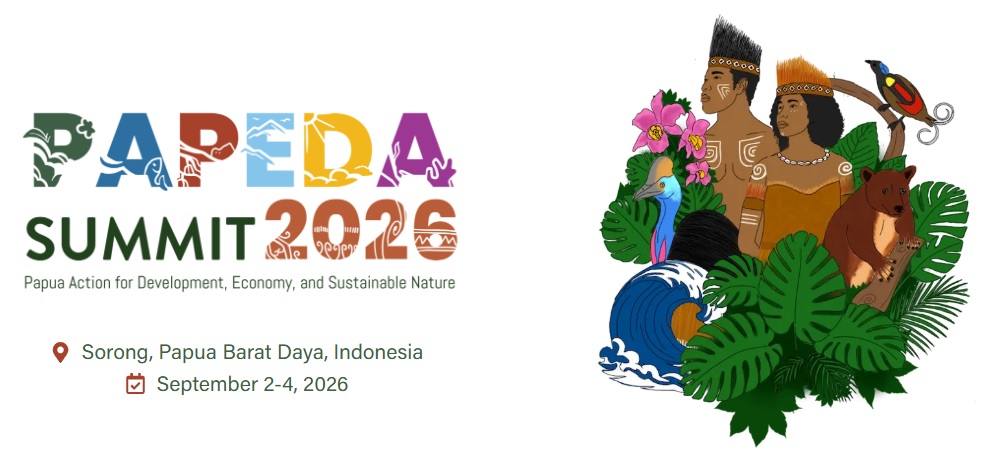
The PAPEDA Summit 2026 is moving into its final preparations in Sorong, Papua Barat Daya, with organizers expecting the three-day forum to become an important platform for discussing the future of sustainable development across Papua.
The Papua Sustainable Development Summit will take place in Sorong from September 2 to 4, 2026. Local organizers say approximately 130 speakers are expected to participate, while hundreds of delegates have already registered. The event is designed to bring government institutions, Indigenous representatives, academics, civil society organizations, development partners, and the private sector into the same conversation about Papua’s economic, environmental, and social future.
For Papua Barat Daya, the summit is more than a conference. It is an attempt to turn the growing discussion around forests, marine resources, Indigenous rights, climate action, and economic development into a shared policy agenda.
The timing is significant. Papua is entering a period in which economic expansion, infrastructure development, and natural resource management increasingly need to be considered alongside environmental protection and the interests of local communities.
Sorong Prepares for a Major Development Forum
The Papua Barat Daya provincial government held a final preparation meeting in Sorong on August 27, chaired by Governor Elisa Kambu. The governor called on the organizing committee to maintain coordination, transparency, and professionalism as the event approaches.
She also stressed that the summit should be viewed as a collective contribution to the future of Papua Barat Daya and Tanah Papua rather than as an event serving individual interests.
The practical preparations are extensive. Organizers have been reviewing accommodation, food services, coordination arrangements, and participant services ahead of the opening.
According to the provincial government, about 800 participants had registered by August 27. Attendance could rise to around 1,000 people on the opening day, followed by approximately 500 participants on the second and third days. The opening is planned at Gedung Rambar Jejma, while the main discussions will take place at several hotels, with much of the program centered at Hotel Vega.
Sorong therefore finds itself temporarily transformed into a meeting point for different perspectives on Papua’s development.
That diversity is central to the summit’s purpose.
A Forum Built Around Sustainable Development
From Economic Growth to a Broader Development Model
The official PAPEDA Summit website describes the event as “Papua Action for Development, Economy, and Sustainable Nature.” Its stated vision places people, nature, and sustainable development at the center of Papua’s future.
The official platform highlights five main priorities: better cooperation between the central and regional governments, safeguarding Indigenous rights, creating a new nature-based economy, ensuring food and energy independence, and incorporating science, innovation, and local knowledge into development plans.
These priorities indicate a shift in the discourse surrounding development in Papua.
For decades, the region’s economic potential has often been associated with mining, forestry, fisheries, and other natural resources. Those sectors remain important, but policymakers and development organizations are increasingly looking at how economic value can be generated without undermining the ecosystems and communities that support it.
The PAPEDA Summit seeks to place that question at the center of the policy conversation.
The agenda includes discussions on the green economy, blue economy, carbon management, sustainable value chains, environmental protection, and Indigenous community participation.
For international observers, the summit provides an opportunity to understand how Indonesia’s approach to sustainable development is being translated into regional policy in one of the country’s most environmentally important areas.
Indigenous Communities as Development Partners
One of the most important themes of the summit is the role of Indigenous communities.
The official summit platform says Papua is home to hundreds of Indigenous communities and more than 300 languages. It also presents Indigenous communities as important actors in managing land, forests, coastal areas, and marine resources.
This is particularly relevant because development projects in Papua frequently intersect with customary territories and traditional livelihoods.
The summit’s organizers say discussions will therefore include Indigenous participation, customary forests, and social forestry. The official program also highlights food and energy sovereignty based on local resources.
The objective is not simply to invite Indigenous representatives to a conference but to incorporate their knowledge and interests into the development discussion.
That approach could become increasingly important as Papua seeks to attract investment while maintaining environmental safeguards.
Green and Blue Economies Take Center Stage
Papua’s geography gives it a distinctive position in Indonesia’s sustainability agenda.
The official PAPEDA platform identifies extensive forests, mangroves, and marine ecosystems as important natural assets. It also highlights Papua’s position within the Coral Triangle, one of the world’s most biologically diverse marine regions.
This creates both an opportunity and a policy challenge.
Forests can support sustainable forestry, ecosystem services, and carbon initiatives. Coastal areas can support fisheries, tourism, and marine conservation. Communities can develop products based on local resources. Yet these opportunities depend on governance, infrastructure, financing, and the ability to ensure that economic benefits reach local populations.
The summit is expected to examine these questions through the concepts of the green and blue economy.
The blue economy is particularly relevant for coastal Papua, where fisheries, marine tourism, and ecosystem conservation have significant economic potential. Sorong itself is strategically positioned as a gateway to Raja Ampat and other destinations with international tourism potential.
At the same time, a sustainable economic strategy cannot depend solely on tourism. The summit’s agenda also includes agriculture, food security, energy, sustainable value chains, and human resource development.
That broader approach could help Papua avoid placing excessive pressure on a single economic sector.
130 Speakers and a Wide Range of Stakeholders
Government and Policymakers
The event is expected to attract senior government officials from Jakarta and the six provinces of Tanah Papua.
ANTARA reported that Coordinating Minister for Food Affairs Zulkifli Hasan is scheduled to attend and serve as a keynote speaker and officially open the summit. Several other ministries and government institutions have also been invited, including agencies responsible for national development planning, forestry, environment, and home affairs.
The official PAPEDA website lists several governors and senior government officials among the confirmed or proposed participants. These include Governor Elisa Kambu as host, Governor of Papua Barat Dominggus Mandacan, Governor of Papua Tengah Meki Fritz Nawipa, and Governor of Papua Pegunungan John Tabo, among others.
Their participation gives the summit a regional dimension.
Rather than addressing sustainability through a single provincial administration, the forum is intended to connect the development priorities of the different provinces that make up Tanah Papua.
Civil Society, Academia, and Business
The summit also involves a broad network outside government.
Its official website says the event was initiated by more than 50 civil society organizations and is being hosted by the Papua Barat Daya provincial government together with civil society groups and development partners in Papua.
Organizations working on forests, conservation, Indigenous rights, economic development, and community empowerment are among those involved.
Academics and researchers are also expected to contribute to discussions about agriculture, economics, environmental management, and regional development.
This combination matters because sustainable development cannot be implemented solely through government regulation. Businesses need viable investment models, communities need economic opportunities, researchers provide evidence, and governments provide policy and infrastructure.
The PAPEDA Summit is designed to bring those interests into the same room.
From Discussion to Policy Recommendations
Perhaps the most important test for the summit will come after the closing ceremony.
Organizers say the event is expected to produce policy recommendations for the central government and a Sorong Declaration on sustainable development.
That objective gives the event a practical dimension.
A conference can generate headlines, but its long-term value depends on whether its recommendations are translated into government programs, investment priorities, and measurable development outcomes.
According to ANTARA, the summit follows agreements reached during meetings of governors from Tanah Papua in Timika, Papua Tengah, and Manokwari, Papua Barat, in February 2026. Those meetings produced policy recommendations and the Sorong Declaration framework for sustainable development.
The September summit therefore represents part of a continuing policy process rather than an isolated event.
Measuring Success Beyond the Summit
For Papua, success could eventually be measured through practical indicators.
These may include stronger protection of customary forests, improved access to education and health services, growth in locally owned businesses, sustainable fisheries, better agricultural productivity, renewable energy development, and increased participation of Indigenous communities in economic activity.
The challenge will be connecting these ambitions with budgets, regulations, and implementation capacity.
That is particularly important in remote areas, where infrastructure gaps can make otherwise promising development programs difficult to implement.
The forum’s focus on finance is therefore significant. The official program includes climate finance, green and blue financing, and sustainable economic models.
If the summit can connect Papua’s environmental assets with credible financing mechanisms and local economic opportunities, it could help move sustainability from an environmental concept into an economic strategy.
Why the Summit Matters for Papua’s Future
Papua’s development debate increasingly sits at the intersection of three pressures: the need for economic growth, the protection of natural resources, and the participation of local communities.
Government has a responsibility to provide infrastructure, public services, and economic opportunities. At the same time, development in environmentally sensitive areas requires careful planning.
The PAPEDA Summit offers a forum in which those competing priorities can be discussed openly.
For Indonesia, the event also provides an opportunity to demonstrate that sustainable development in Papua can be pursued through cooperation between national and regional governments, Indigenous communities, private investors, academics, and civil society.
For international audiences, the summit offers another perspective on Papua beyond discussions dominated by security and political issues. Economic development, environmental conservation, culture, and human resource development are equally important parts of the region’s future.
The event’s official platform explicitly presents the summit as an effort to strengthen Indonesia’s leadership in sustainable development, with Tanah Papua playing a central role.
That positioning could become particularly relevant as international interest in climate finance, biodiversity protection, and sustainable commodities continues to grow.
A New Chapter for Sustainable Papua?
The September meeting in Sorong will not resolve every development challenge facing Papua. Nor should a three-day summit be expected to do so.
Its significance lies elsewhere.
The PAPEDA Summit creates a structured space for different actors to establish a common understanding of what sustainable development should mean for Tanah Papua. Its proposed focus on Indigenous participation, environmental protection, green and blue economies, food and energy security, science, and local knowledge provides a broad foundation for that discussion.
The scale of participation is also notable. Local reporting indicates around 130 speakers are scheduled to contribute to the forum, while organizers expect hundreds of participants throughout the three days.
The official website currently describes six plenary sessions and 15 parallel sessions involving approximately 100 speakers and moderators, suggesting that the final speaker and session composition may continue to evolve as preparations conclude.
Ultimately, the credibility of PAPEDA Summit 2026 will depend on what happens after Sorong.
If the recommendations become concrete policies, stronger partnerships, and measurable programs, the summit could mark an important step toward a development model that combines economic opportunity with environmental stewardship and meaningful community participation.
For Papua, that is the larger opportunity: not simply to host another international-style forum, but to use Sorong as a starting point for turning sustainable development into a practical, long-term regional agenda.
Conclusion
The PAPEDA Summit 2026 is taking place at a pivotal time for Tanah Papua. With government leaders, Indigenous representatives, academics, civil society organizations, and businesses preparing to meet in Sorong, the forum has the potential to connect environmental protection with economic development and local participation.
Its proposed Sorong Declaration and policy recommendations will be the clearest measure of its success. If those commitments are followed by implementation, financing, and transparent evaluation, the summit could strengthen Papua’s position as an important part of Indonesia’s sustainable development strategy.
The real test will begin when the delegates leave Sorong. The value of the summit will ultimately be judged not by the number of speakers on its program but by whether its ideas improve livelihoods, protect Papua’s natural wealth, and create opportunities for future generations.

